
Ancient Art, Antiquities, Books, Natural History, Stamps & Coins

-
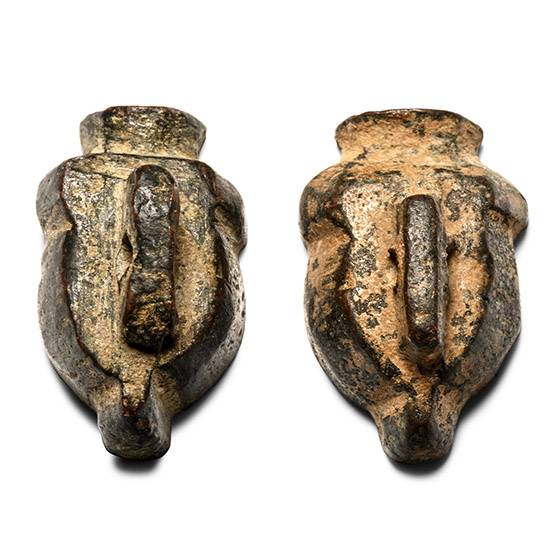
Post Medieval Bronze Musket Shot Mould Pair
Circa 17th-19th century A.D.Estimate: £50 - 70 (+bp*)
Opening Bid: £5
Pair of moulds with locating lugs and sockets to the inner face, loops to the outer faces. 32 grams total, 27 mm each
London gentleman's collection, 1970-1990s, by descent. -
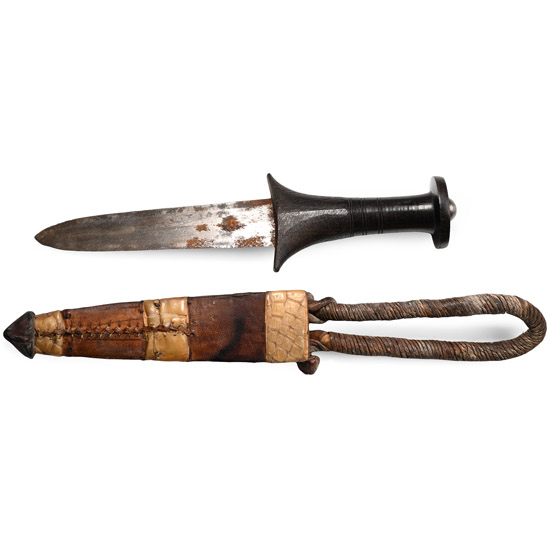
Mahdi Arm Dagger with Sheath
Sudan, late 19th-early 20th century A.D.Estimate: £70 - 90 (+bp*)
Opening Bid: £5
Comprising a tongue-shaped two-edged blade and carved wooden hilt with bands of horizontal ribbing, integral crossguard and disc pommel with a domed button; leather sheath with crocodile-skin panels and twisted leather thong forming a thick suspension loop; leather-covered knop forming a chape. 172 grams, 27.5 cm
From the private collection of Peter Clayton, FCILIP, Dip, Arch, FSA, FRNS, Hemel Hempstead, Hertfordshire, UK; formed since the late 1950s. -
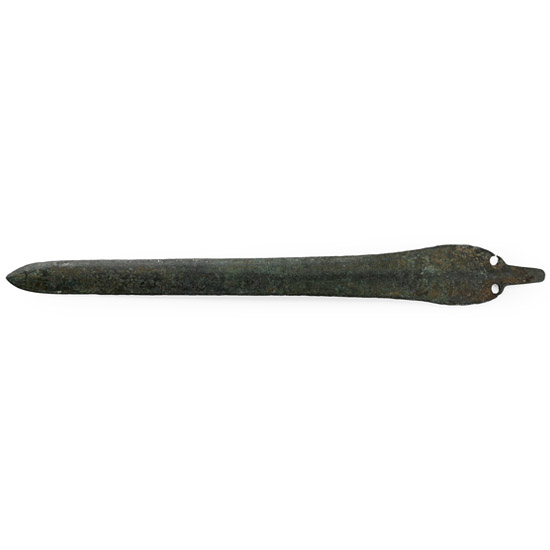
Western Asiatic Bronze Dagger Blade
2nd-1st millennium B.C.Estimate: £100 - 140 (+bp*)
Opening Bid: £5
Slender blade with rounded, pierced shoulders and a short tang. 170 grams, 34.9 cm
Acquired on the UK art market since the 1960s. From the private collection of Mr J.P.H., a Woolwich, UK, collector, his collection formed since the 1960s. -
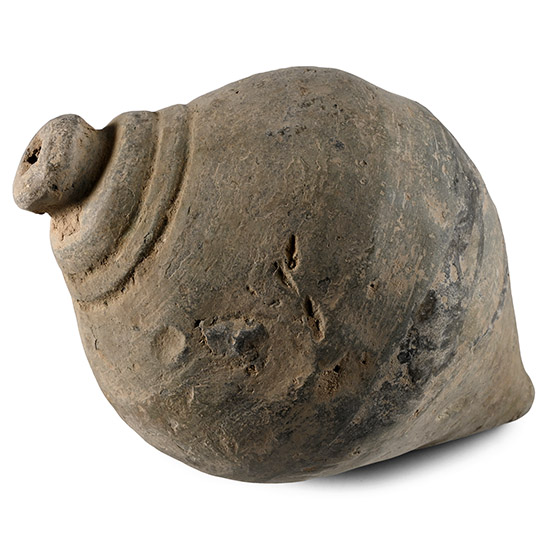
Byzantine 'Greek Fire' Ceramic Fire Bomb or Hand Grenade
9th-11th century A.D.Estimate: £70 - 90 (+bp*)
Opening Bid: £5
Biconical body with pointed base and a domed filler hole; intended to be filled with explosive liquid and a wick, and used as a hand grenade. 540 grams, 13.3 cm
Ex important collection of weaponry, London, UK, 1980-1990s. Accompanied by an academic paper by military specialist Dr Raffaele D'Amato, dated 15 July 2019 and titled 'Eastern Roman Empire - Greek Fire Bomb or Hand Grenade (μεσαίον kακάβιον) 9th-11th century AD'.
Apart from the use of siphons or manual flame-throwers called cheirosiphona, special corps of Roman soldiers employed terracotta grenades, in the form of small jars, abundantly evidenced in archaeological excavations. They were called μεσαία kακαβιά or κυτροκακάβια, where the former had a bulbous shape and the latter a more cylindrical form. -
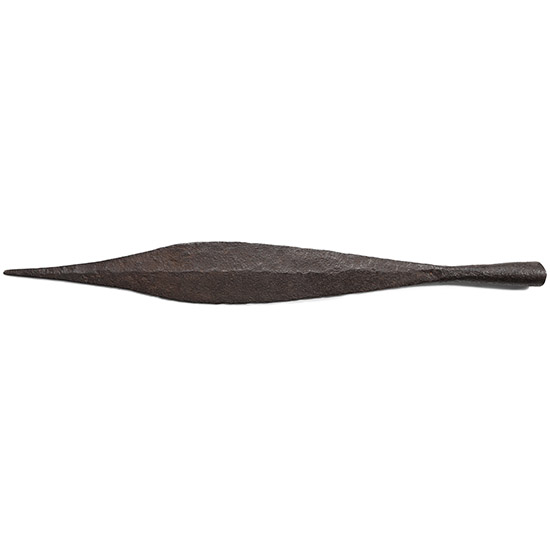
Large Sudanese Socketted Spearhead
Late 19th-early 20th century A.D.Estimate: £60 - 80 (+bp*)
Opening Bid: £5
Large leaf-shaped blade with extended and rounded tip, thick neck, hand-forged split socket with rounded lip. 935 grams, 60 cm
From the private collection of Peter Clayton, FCILIP, Dip, Arch, FSA, FRNS, Hemel Hempstead, Hertfordshire, UK; formed since the late 1950s. -
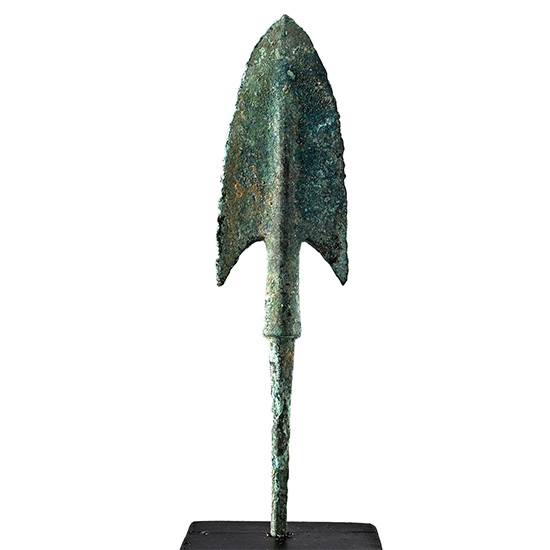
Western Asiatic Bronze Arrowhead
2nd-1st millennium B.C.Estimate: £100 - 140 (+bp*)
Opening Bid: £55
With spade-shaped blade, midrib, lateral barbs, round-section tang; mouned on a custom-made stand. 75 grams total, 16 cm high including stand
Ex Abelita collection, 1980s-2010. -
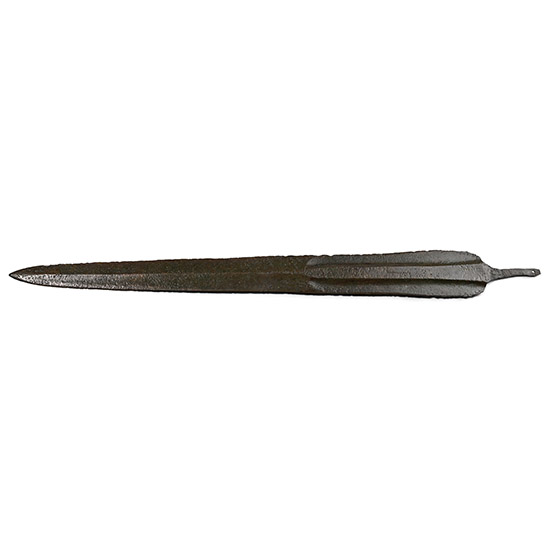
Luristan Bronze Sword Blade
Circa 6th-4th century B.C.Estimate: £300 - 400 (+bp*)
Opening Bid: £150
Tapering leaf-shaped type with raised flat-section midrib in the upper third, rounded shoulders with short rectangular-section tang pierced at the upper end; lower blade lozenge-section with light bulb at the point. 358 grams, 46.8 cm
Ex Abelita collection, 1980s-2010. -
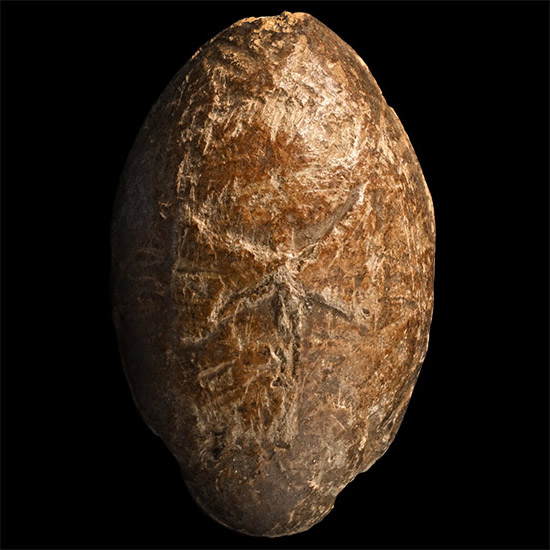
Greek Lead Slingshot with Double Axe
3rd-2nd century B.C.Estimate: £100 - 140 (+bp*)
Opening Bid: £50
Biconical in profile with a brownish patina, one side decorated with a double-axe labrys. 30.5 grams, 27 mm
Previously property of an Austrian collector, Vienna, Austria. From a German private collection, formed since the 1980s.
Since Minoan times, the labrys was an important symbol in the Greek world, illustrating power. This glans can be linked to lead bullets showing the same labrys symbol on one side and the name 'ΤΕΙΣΕΑ' on the other side. The name 'Τεισέας' might come from Caria or Lycia. -
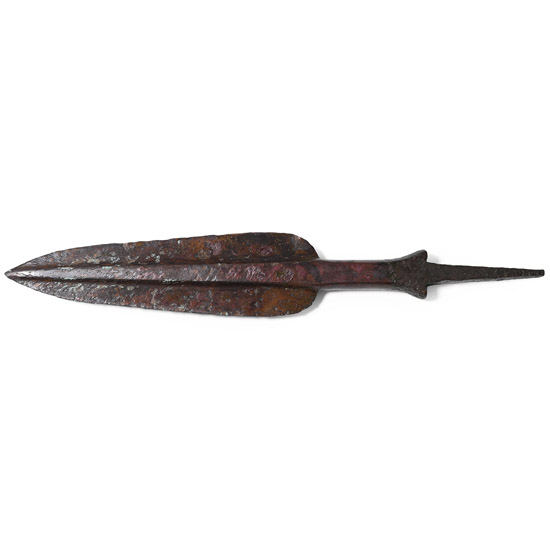
Western Asiatic Bronze Spear Blade
2nd-1st millennium B.C.Estimate: £150 - 200 (+bp*)
Opening Bid: £80
With an ovate blade, prominent central rib and rounded shoulders, square-section shaft with flared lateral spurs forming a collar, rectangular tang with narrow tip. 347 grams, 29.6 cm
Ex Abelita family collection, 1980s-2000s. -
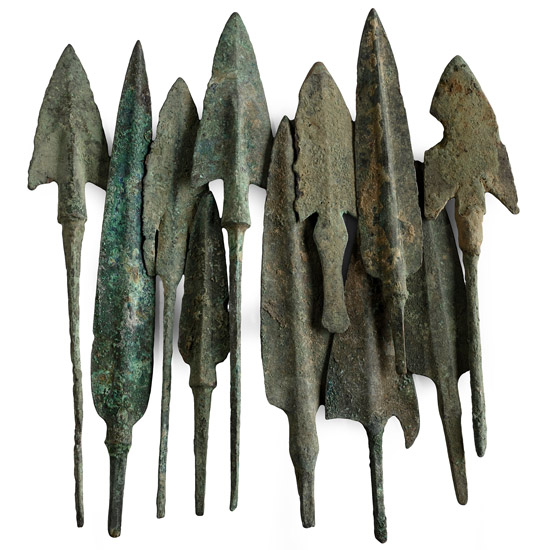
Western Asiatic Bronze Arrowhead Collection
2nd-1st millennium B.C.Estimate: £100 - 140 (+bp*)
Opening Bid: £55
Including leaf-shaped, heater-shaped, barbed and other types. 291 grams total, 9.2-16.6 cm
Ex Abelita collection, 1980s-2010. -
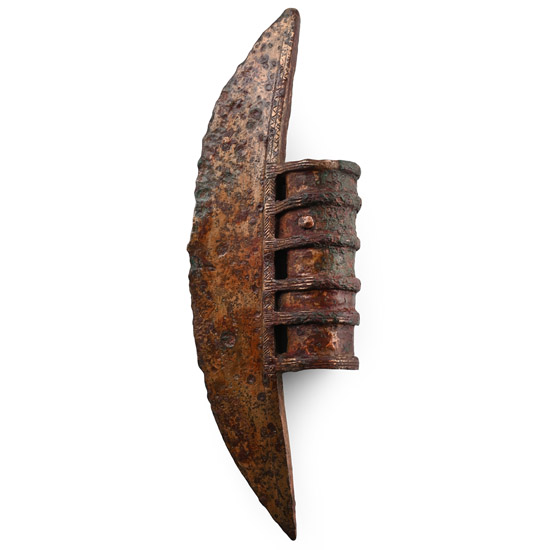
Luristan Socketted Bronze Halberd
CIrca 9th-6th century B.C.Estimate: £150 - 200 (+bp*)
Opening Bid: £5
Comprising: crescentic triangular-section blade with herringbone pattern to the rear edge, six integral attachment struts, tubular socket with transverse fixing pin. 478 grams, 22.9 cm
Acquired on the UK art market. From a gentleman's collection from East Sussex, UK. -
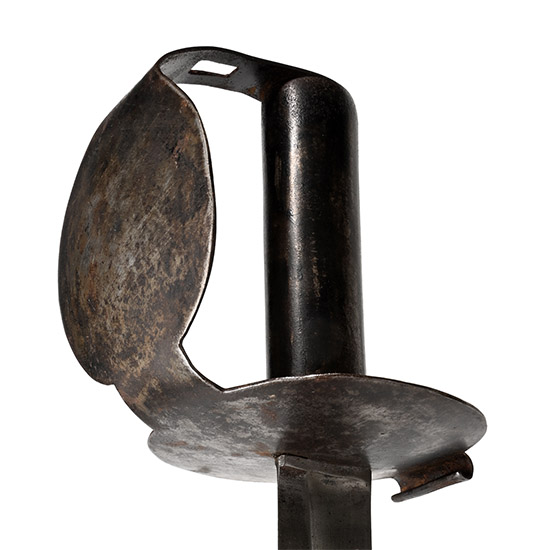
British Napoleonic 'Battle of Trafalgar Period' Naval Boarding Cutlass
1801-1840 A.D.Estimate: £500 - 700 (+bp*)
Opening Bid: £5
Broad slightly curved blade with thick back and shallow fuller, narrow pointed tip; hollow iron grip with 'figure-of-eight' guard protecting the gripping hand and the knuckles; 1801-4 patent type; with old collector's tag 'British Figure of Eight Naval boarding cutlass - smooth grip pattern 1801-4 (then corrugated grip 1840)' 883 grams, 83 cm
From the private collection of Peter Clayton, FCILIP, Dip, Arch, FSA, FRNS, Hemel Hempstead, Hertfordshire, UK; formed since the late 1950s.
The hilt pattern was replaced in 1840 by a type with similar guard but with a ribbed grip.
