
Ancient Art, Antiquities, Books, Natural History, Stamps & Coins

-
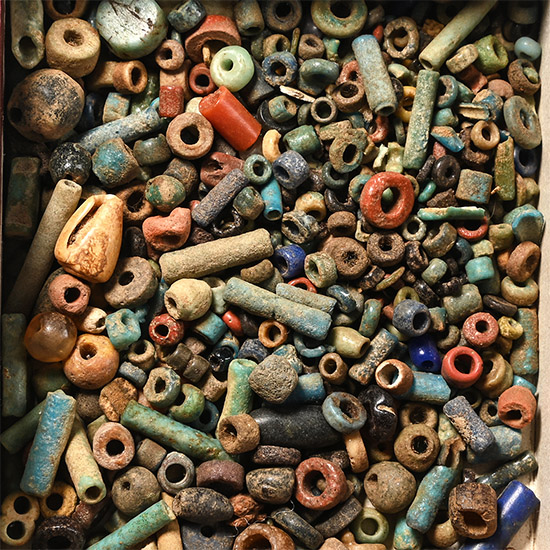
Egyptian Assorted Faience and Other Beads in Ronson Lighter Box
Late Period-Ptolemaic Period, circa 664-30 B.C.Estimate: £50 - 70 (+bp*)
Opening Bid: £5
Comprising tubular, discoid, shell, and other beads, in a vintage 'Ronson' lighter box. 23 grams total, 1-17 mm
Excavated from Egypt in 1914. From the private collection of Mr David Sams and his wife Elizabeth Kate Sams, gentry and amateur archaeologists who travelled to Egypt in 1914 with their daughter Ethel. Mr Sams and his wife led digging expeditions from which these items come from the family estate of Mr and Mrs Sams, by direct descent to their granddaughter. -
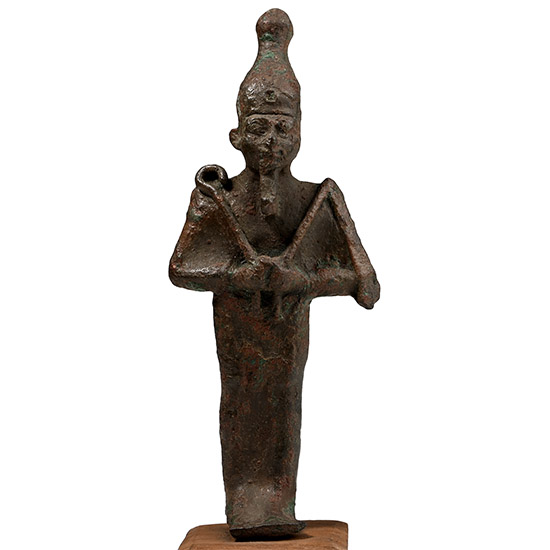
Egyptian Bronze Figure of Osiris
Late Period, 664-332 B.C.Estimate: £80 - 100 (+bp*)
Bids: 4 | Current Bid: £27
Modelled in the round, wearing the white crown and a divine beard, with arms bent and hands clasped knuckle-to-knuckle, holding Osiris's royal regalia - the crook and flail; accompanied by a typed inventory; mounted on a custom-made stand with an old handwritten label on the underside 'Osiris (Judge of the Dead) Solid Bronze B.C. 1600. Lord Grenfell's Collection'. 295 grams total, 15.7 cm high including stand
Ex Lord Grenfell's (1896-1926) collection, UK. From the estate of a deceased Sussex private collector. Accompanied by an original typed 'List of Egyptian Relics' in which this object is listed as no.1. -
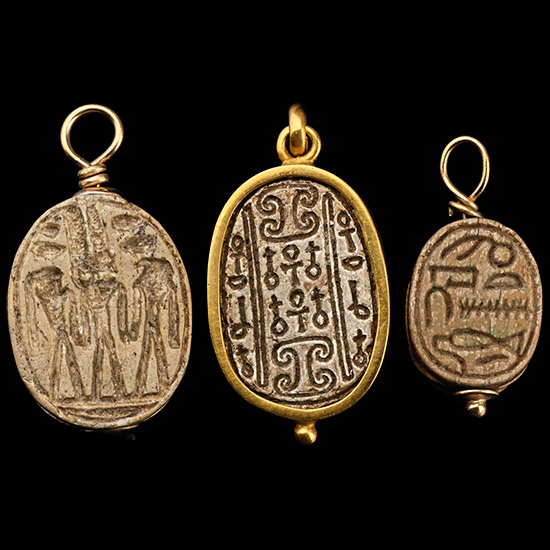
Collection of Egyptian Faience and Steatite Scarabs with Gold Mounts
Second Intermediate Period-Late Period, 1782-332 B.C.Estimate: £400 - 600 (‡+bp*)
Opening Bid: £200
Comprising: grey scarab with gold mounting pin, frame and loop, three panels on the underside with ankh and other motifs; grey scarab with traces of turquoise surface, gold mounting pin and loop, hieroglyphs on the underside; cream scarab with gold mounting pin and loop, frieze of three figures on the underside, the middle figure wearing an atef crown. 9.85 grams total, 24-32 mm
Private collection of Kal Noselson, New York, acquired between 1976 and the late 1990s; thence by descent. Accompanied by the collector's original inked images. -
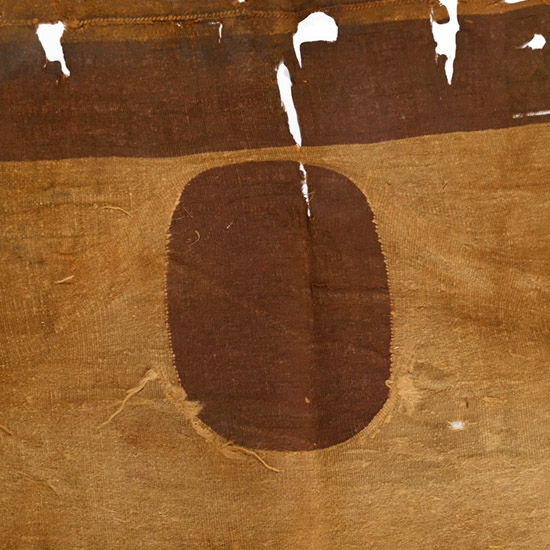
Large Egyptian Coptic Textile Shoulder Fragment of a Man's Military Tunic with Clavus and Orbiculus
Circa 5th-6th century A.D.Estimate: £200 - 300 (+bp*)
Opening Bid: £5
Large section of a shoulder from a man's tunic in wool on linen, decorated with a long purple clavus featuring geometric squares and a purple orbiculus on the shoulder; tapestry, weave braids with right-angled borders. 233 grams total including paper folder, 82 cm
Acquired 1970s-1996. Property of a North American collector. London collection, 2016.
The tunic was decorated in purple with opus phrygium embroidery. This corresponds to the iconography of military tunics for 5th-7th century Roman soldiers. The archaeological evidence from the desert cemeteries of Egypt offers striking confirmation of pictorial sources on late Roman clothing around the empire. -
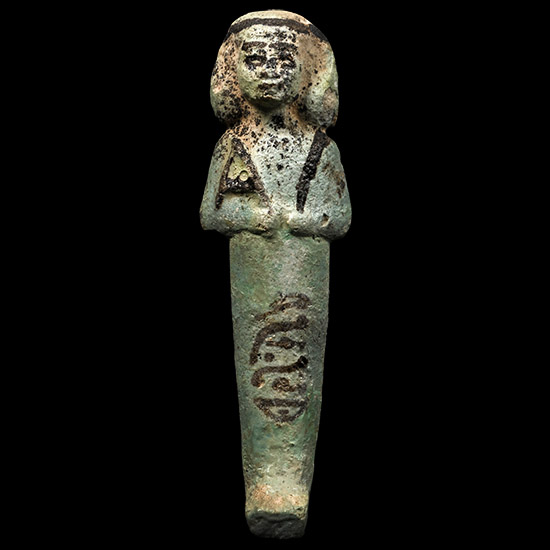
Egyptian Pale Blue Glazed Hieroglyphic Shabti
Third Intermediate Period, 22nd Dynasty, circa 945-715 B.C.Estimate: £200 - 300 (+bp*)
Bids: 1 | Current Bid: £5
Mummiform figure with a high-relief bag wig, a top sash band, facial details, tools, a seed bag, and hieroglyphs on the lower body in black. 42 grams, 11.6 cm
with a privately curated collection, 1980s-early 2000s. From the private collection and estate of Christine Simons (1943-2025), West Midlands, UK. -
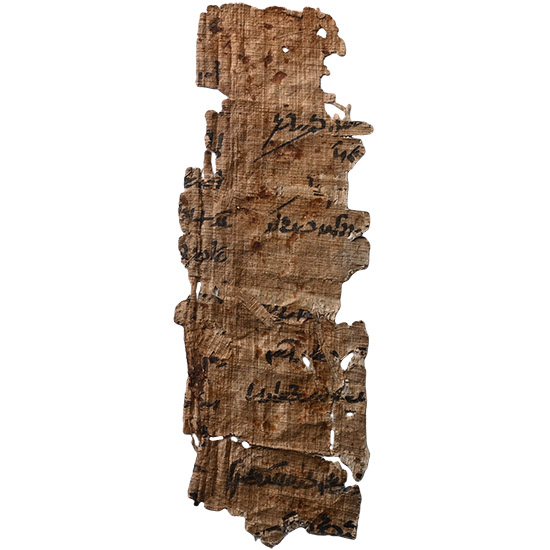
Egyptian Papyrus Fragment with Text
Graeco-Roman Period, circa 3rd century B.C.-2nd century A.D.Estimate: £80 - 100 (+bp*)
Bids: 1 | Current Bid: £5
Rectangular fragment of papyrus with inked Demotic script text in two columns; mounted on a board. 195 grams total, 15.5 cm (25 x 20 cm including frame)
Ex retired East Anglian school teacher, Isle of Wight, Hampshire, UK, 1960s-1980s. -
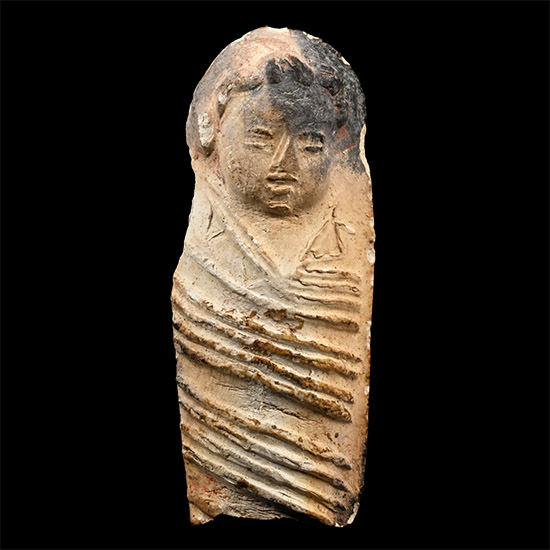
Romano-Egyptian Plaster Mummy
Circa 2nd century A.D.Estimate: £40 - 60 (+bp*)
Bids: 1 | Current Bid: £5
D-shaped in section with mummy wrapping to the body, exposed face with curls of hair. 6.14 grams, 44 mm
From the private collection of a European gentleman (1942-2024), formed since the 1970s. -
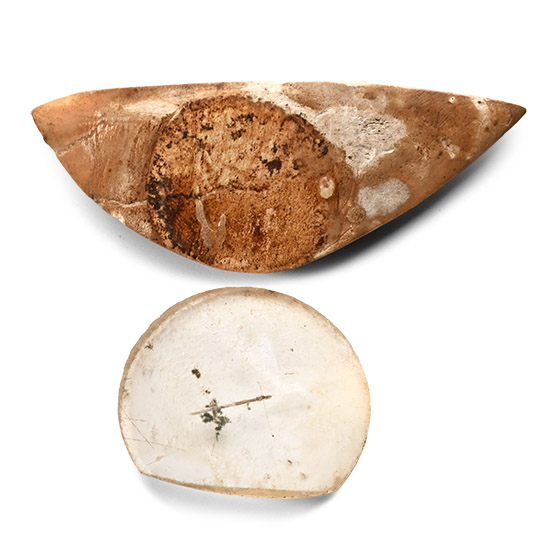
Egyptian Inlaid Mummy Eye
Late Period, 664-332 B.C.Estimate: £500 - 700 (‡+bp*)
Opening Bid: £250
Almond-shaped insert in pale stone with disc-shaped, convex iris, possibly not belonging. 4.51 grams total, 18-37 mm
Ex Milfred (Miriam) Devor Collection. with Archaeological center, Tel-Aviv, 27 March 2013, no.356. -
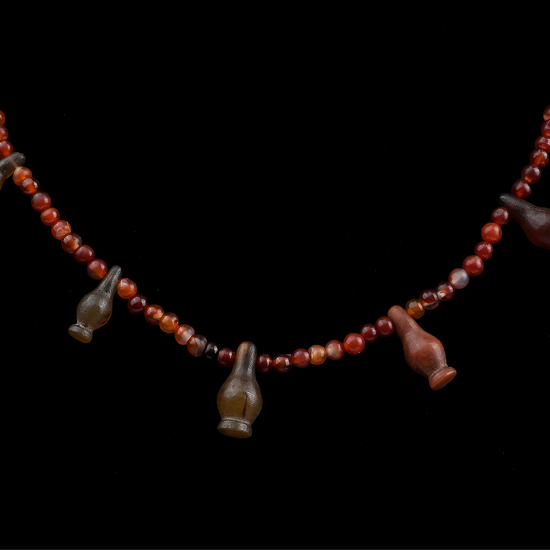
Egyptian Carnelian Bead and Poppy Amulet Necklace
Late Period, 664-332 B.C. and laterEstimate: £200 - 300 (+bp*)
Opening Bid: £100
Poppy-head amulet necklace restrung with later spherical beads. 21.9 grams, 45 cm long
From the collection of a gentleman, acquired on the London art market in the 1990s. -
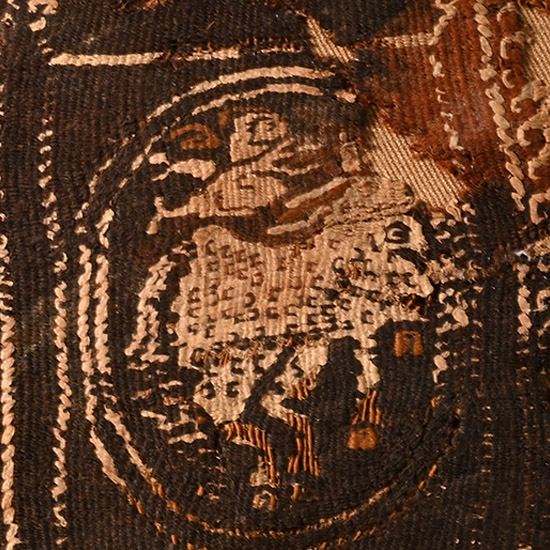
Egyptian Mounted Coptic Tunic Textile Fragment of a Tablion with Animals
Circa 4th-7th century A.D.Estimate: £60 - 80 (+bp*)
Opening Bid: £5
In purple wool and coarse linen, S-torsion, embroidered with an image of a horse and a flying putto, the borders decorated with meanders; mounted on linen backing. 54 grams total, 14 cm
Acquired 1970s-1996. Property of a North American collector. London collection, 2016.
The tabula, or tablion, was a square embroidery decorating tunics and mantles. These fabrics were of great decorative finesse, displaying an unusual and extremely well-preserved colour palette. The animal design recalls Iranian motifs, while the flying putto combines Dionysiac and Christian figurative elements. -
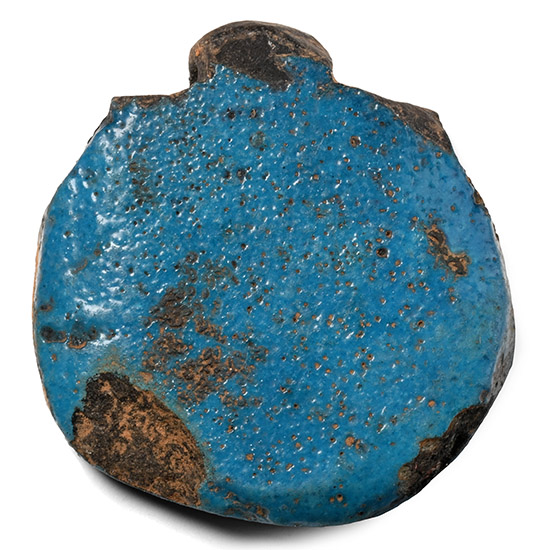
Large Egyptian Bright Blue Faience Sun Disc Amulet
Late Period, 664-332 B.C.Estimate: £40 - 60 (+bp*)
Opening Bid: £5
Large discoid with deep blue glaze, representing the sun disc on the horizon, pierced at the top. 7.5 grams, 32 mm
Excavated from Egypt in 1914. From the private collection of Mr David Sams and his wife, Elizabeth Kate Sams, gentry and amateur archaeologists who travelled to Egypt in 1914 with their daughter, Ethel. Mr Sams and his wife led digging expeditions from which these items come, from the family estate of Mr and Mrs Sams, by direct descent to their granddaughter.
The sun disc and sun-disc-on-the-horizon (akhty) amulets are linked to the deceased's rebirth. -
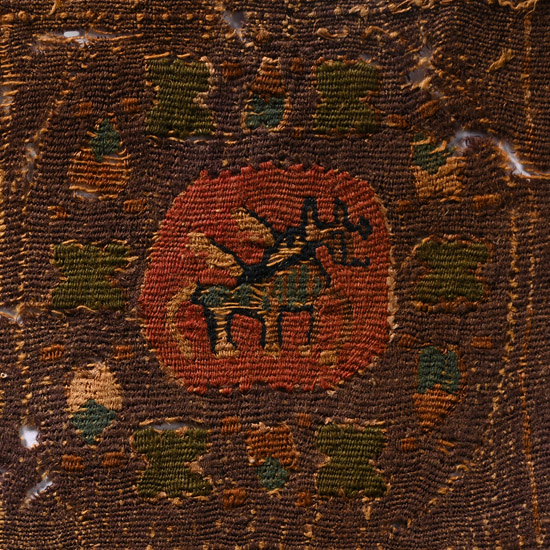
Egyptian Coptic Textile Fragment of a Tunic Tablion with Pegasus
Circa 7th century A.D.Estimate: £40 - 60 (+bp*)
Opening Bid: £5
In natural wool in shades of light brown, yellow, green, blue, and red with S-twist yarn, depicting the figure of Pegasus within a central medallion, surrounded by geometric and vegetal motifs; borders ornamented with meanders. 1.3 grams, 10.5 cm
Acquired 1970s-1996. Property of a North American collector. London collection, 2016.
The tabula, or tablion, was a square embroidery used to decorate tunics or mantles. The central figure is a rare representation of the winged horse Pegasus, a motif derived from Greek mythology, showing that classical iconography was still alive among the Christian Graeco-Roman people.
