
Ancient Art, Antiquities, Books, Natural History, Stamps & Coins

-
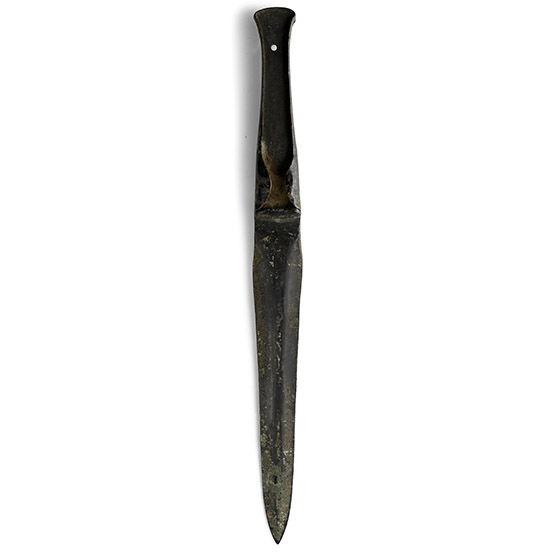
Luristan Bronze Dagger
13th century B.C.Estimate: £180 - 240 (+bp*)
Opening Bid: £90
With a lentoid-section blade, tongue-shaped in plan, with an integral tapering hilt with flared finial, lateral flanges to accept a panel of bone to each face forming the grip. 185 grams, 32.5 cm
Ex Abelita family collection, 1980s-2000s.
The art of Luristan can be described as the art of nomadic herdsmen and horsemen with an emphasis on the crafting of small, easily portable objects, among these a great number of bronze weapons. The rich and noble aristocrats of the Luristan, Elamites, Hurrians, Lullubians, Kutians, and Kassites went to battle splendidly equipped and wore magnificent bronze armour, using maces, spears and daggers as offensive weapons, alongside spears, bows and arrows. -
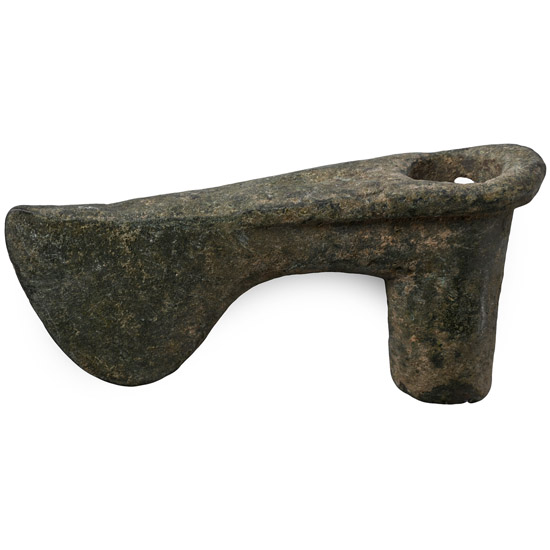
Luristan Bronze Axehead
2nd-1st millennium B.C.Estimate: £100 - 140 (+bp*)
Opening Bid: £50
With a short socketted shaft and flange to the mouth, a broadening blade towards the cutting edge. 374 grams, 12.3 cm
Ex Abelita collection, 1990s. -
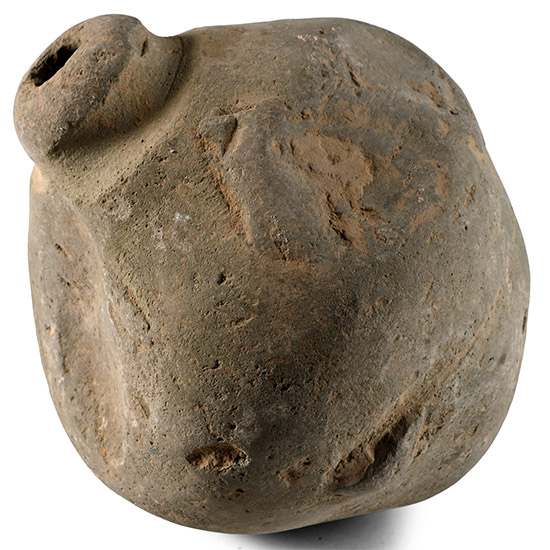
Byzantine 'Greek Fire' Ceramic Fire Bomb or Hand Grenade
9th-11th century A.D.Estimate: £70 - 90 (+bp*)
Opening Bid: £5
Bulbous body with rounded base and domed filler hole; intended to be filled with explosive liquid and a wick, and used as a hand grenade. 590 grams, 10.3 cm
Ex important collection of weaponry, London, UK, 1980-1990s. Accompanied by an academic paper by military specialist Dr Raffaele D'Amato, dated 15 July 2019 and titled 'Eastern Roman Empire - Greek Fire Bomb or Hand Grenade (μεσαίον kακάβιον) 9th-11th century AD'.
Apart from the use of siphons or manual flame-throwers called cheirosiphona, special corps of Roman soldiers employed terracotta grenades, in the form of small jars, abundantly evidenced in archaeological excavations. They were called μεσαία kακαβιά or κυτροκακάβια, where the former had a bulbous shape and the latter a more cylindrical form. -
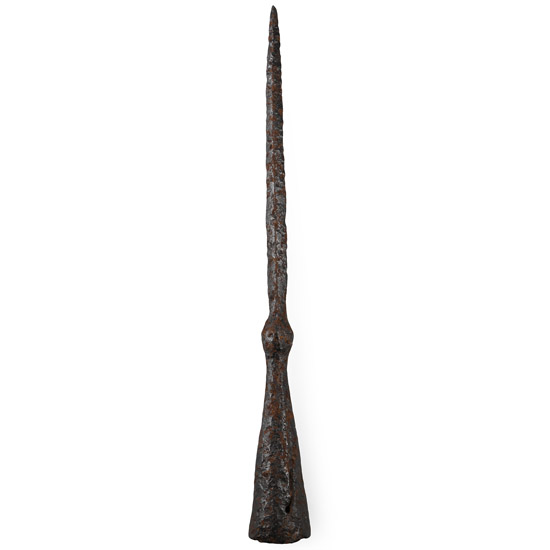
Eastern Balkans Period Socketted Spear
Circa 14th century A.D.Estimate: £80 - 100 (+bp*)
Opening Bid: £5
Socketed spearhead with a spheroconic transition; the long, square-sectioned point separated from the socket by a small sphere. 245 grams, 31 cm
Acquired on the UK art market since the 1960s. From the private collection of Mr J.P.H., a Woolwich, UK, collector, his collection formed since the 1960s. -
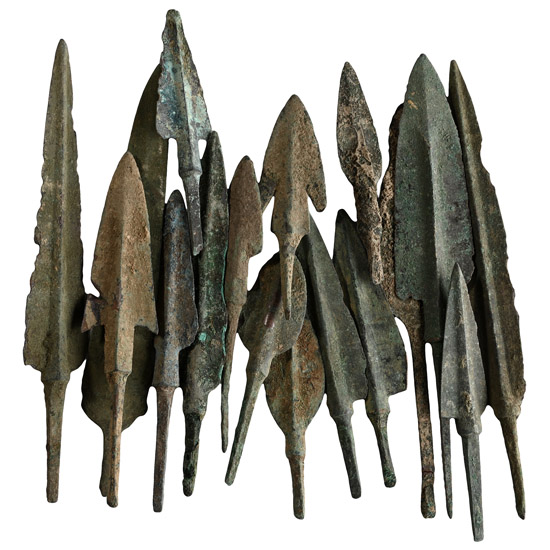
Western Asiatic Bronze Arrowhead Collection
2nd-1st millennium B.C.Estimate: £100 - 140 (+bp*)
Opening Bid: £50
Comprising barbed-and -tanged, triangular, leaf-shaped and other typs. 331 grams total, 8-16.5 cm
Ex Abelita collection, 1980-2010. -
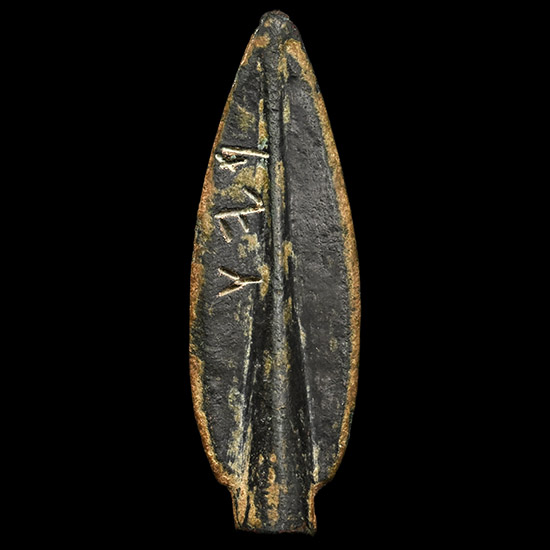
Phoenician Bronze Arrowhead with Inscription
5th century B.C.Estimate: £500 - 700 (+bp*)
Opening Bid: £250
Leaf-shaped arrowhead with a raised midrib extending to a tubular, short socket, Phoenician letters on both sides. 5.34 grams, 41 mm
London gentleman's collection, 1970-1990s, by descent.
The style of the socketed arrowhead is related to the period of the Achaemenid Empire. Although the Phoenician arrowheads with inscriptions are mostly prevalent at the end of the Bronze Age, the arrowhead can prove that ownership inscriptions on this kind of weapon persisted over time. -
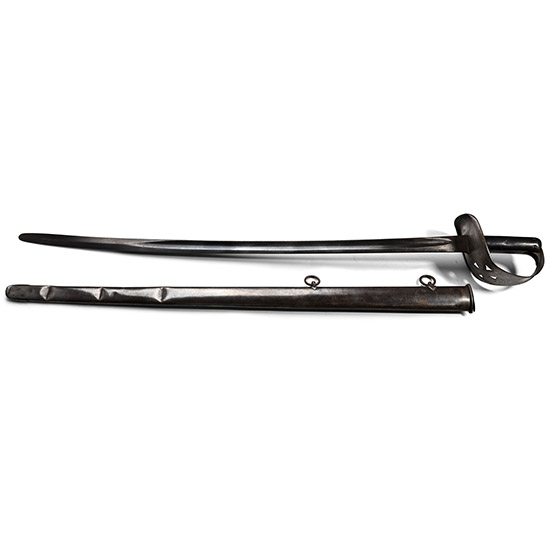
British Heavy Cavalry Trooper's Sword with Scabbard
19th century A.D.Estimate: £300 - 400 (+bp*)
Bids: 1 | Current Bid: £5
British 1796 Pattern Backsword with lozenge-section tip and fuller to each face of the blade; swept guard with openwork saltire design; stamped to ricasso '[arrow] FFD / [crown] 30 / E / X'; reverse with numerous feint numerical stamps; brass scabbard with two suspension rings, worn. 1.6 kg, 98.5 cm
From the private collection of Peter Clayton, FCILIP, Dip, Arch, FSA, FRNS, Hemel Hempstead, Hertfordshire, UK; formed since the late 1950s. -
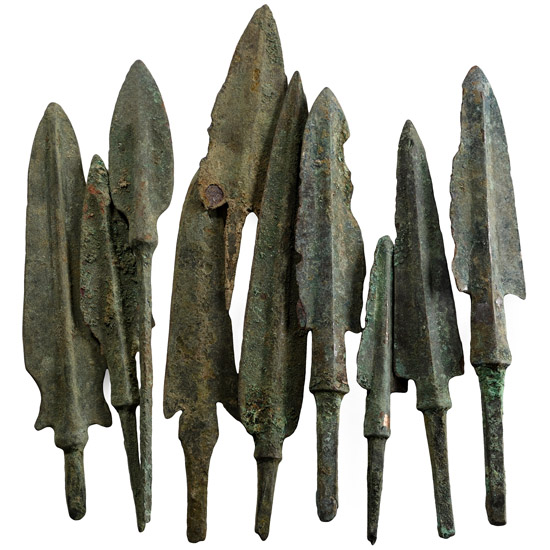
Western Asiatic Mounted Bronze Arrowhead Group
2nd-1st millennium B.C.Estimate: £50 - 70 (+bp*)
Opening Bid: £5
Including flat leaf-shaped, triangular, barbed and other types. 237 grams total, 8.5-13.2 cm
Ex Abelita collection, 1980s-2010. -
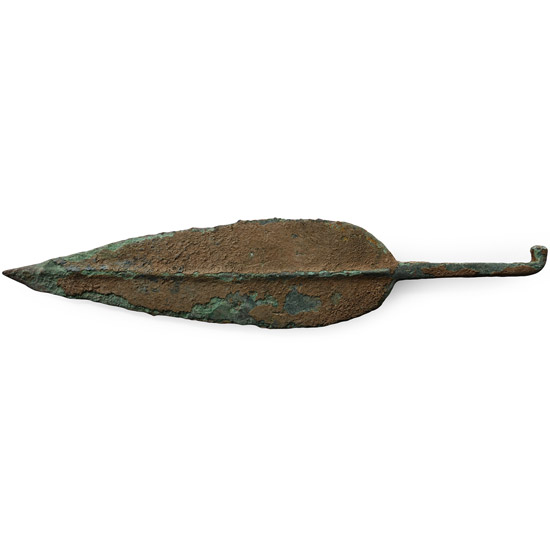
Luristan Bronze Tanged Spearhead
14th-10th century B.C.Estimate: £100 - 140 (+bp*)
Opening Bid: £50
Large leaf-shaped blade with a narrow midrib and a rectangular-section tang with bent finial. 275 grams, 30.4 cm
Ex Abelita collection, 1990s. -
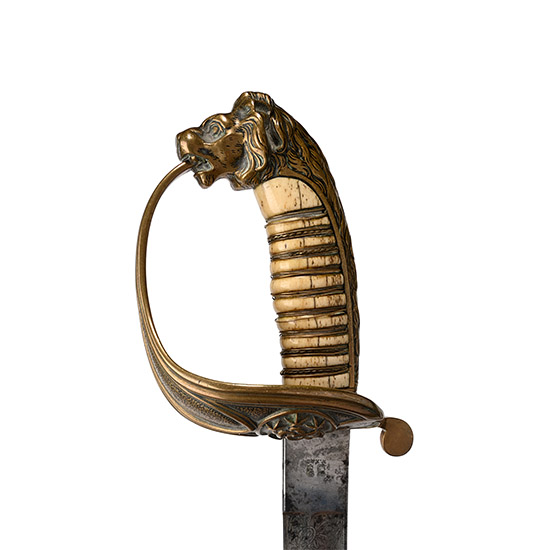
Turkish Naval Officer's Dress Sword with Scabbard
Circa 1900 A.D.Estimate: £300 - 400 (+bp*)
Bids: 1 | Current Bid: £1
Single-edged blade, almost straight with thick back and narrow tip, shallow fuller to each face; brass lion-head sleeve to the bone grip with wire binding; solid swept lion-head knuckle-guard with lug and hinged rear plate pierced to accept a sword-knot, low-relief escutcheon with anchor and three stars; ricasso with stamped 'W.K. &C' beneath a crowned bust and helmet; back stamped '[Wey]ersberg Kirschbaum & Cie. Solingen'; wooden-framed scabbard with black leather covering, brass chape, plaque and frog with two suspension rings, fixed with screws; edge of blade nicked and scored at tip, scabbard split along centreline; old collector's label 'Turkish (Ottoman) Naval Sword c.1900'. 1.32 kg, 96.3 cm
From the private collection of Peter Clayton, FCILIP, Dip, Arch, FSA, FRNS, Hemel Hempstead, Hertfordshire, UK; formed since the late 1950s.
The blade-maker Weyersberg Kirschbaum & Cie. was formed in 1883 from the merger of two earlier factories. -
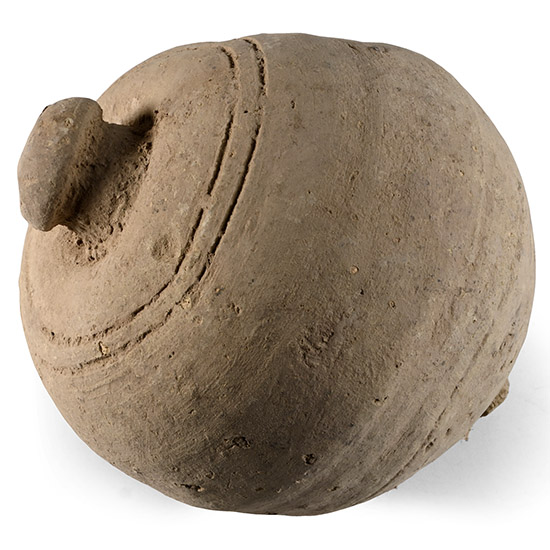
Byzantine 'Greek Fire' Ceramic Fire Bomb or Hand Grenade
9th-11th century A.D.Estimate: £70 - 90 (+bp*)
Opening Bid: £5
Bulbous body with rounded base and domed filler hole, two circumferential bands above the shoulder; intended to be filled with explosive liquid and a wick, and used as a hand grenade. 772 grams, 12.2 cm
Ex important collection of weaponry, London, UK, 1980-1990s. Accompanied by an academic paper by military specialist Dr Raffaele D'Amato, dated 15 July 2019 and titled 'Eastern Roman Empire - Greek Fire Bomb or Hand Grenade (μεσαίον kακάβιον) 9th-11th century AD'.
Apart from the use of siphons or manual flame-throwers called cheirosiphona, special corps of Roman soldiers employed terracotta grenades, in the form of small jars, abundantly evidenced in archaeological excavations. They were called μεσαία kακαβιά or κυτροκακάβια, where the former had a bulbous shape and the latter a more cylindrical form. -
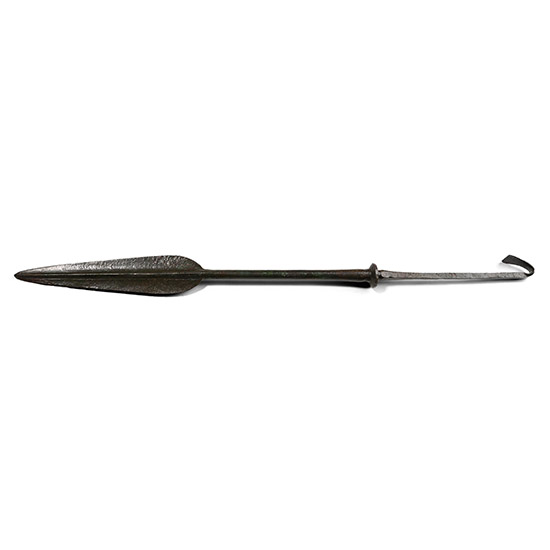
Luristan Bronze Javelin Head
2nd-1st millennium B.C.Estimate: £200 - 300 (+bp*)
Opening Bid: £100
Comprising a slender leaf-shaped two-edged blade with midrib extending to a columnar neck with median bulb and dished collar; square-section tang with bent fish-tail finial. 215 grams, 45.5 cm
Ex Abelita collection, 1980s-2010.
