
Ancient Art, Antiquities, Books, Natural History, Stamps & Coins

-
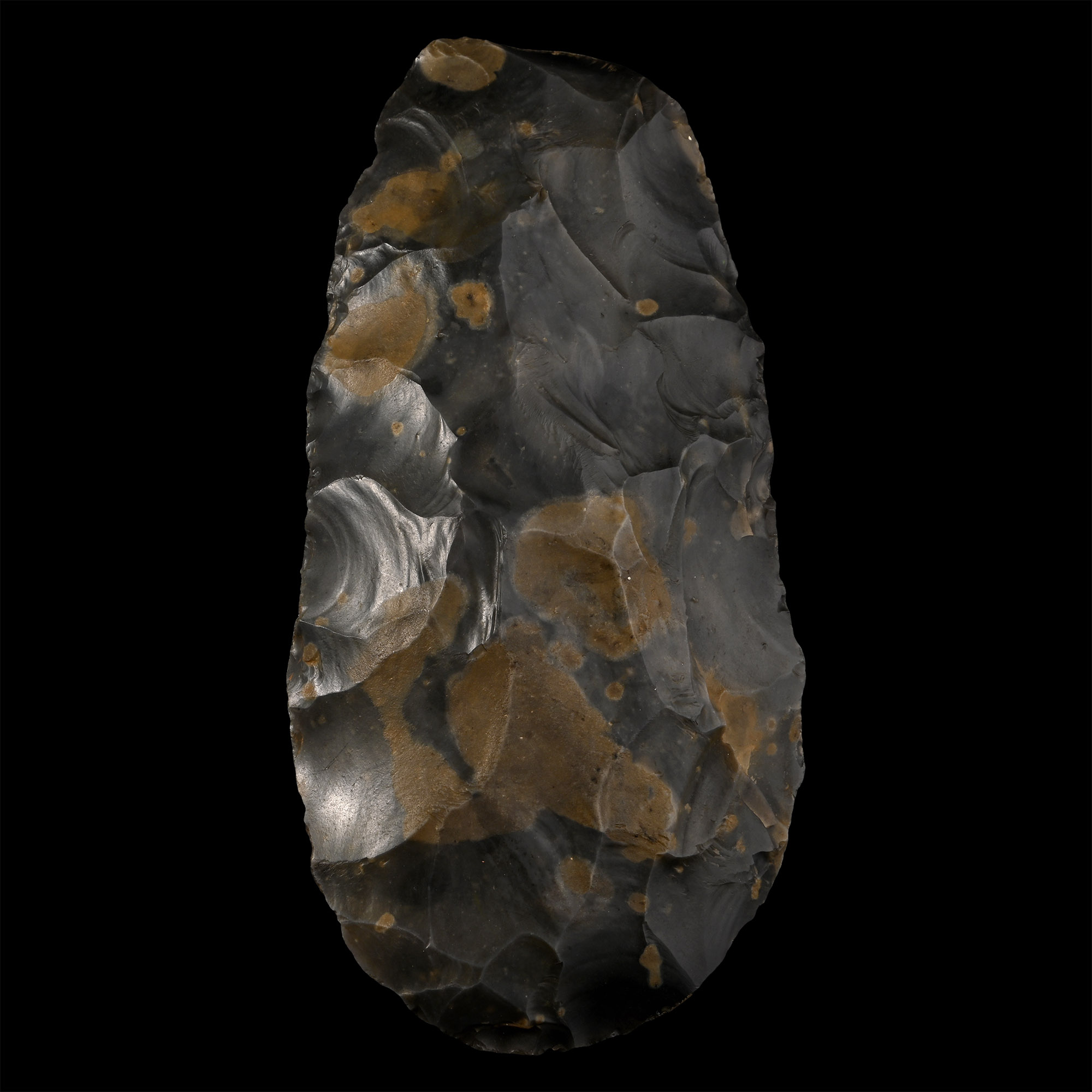
Large Yorkshire Stone Age Kapped Flint Classic Handaxe
Neolithic Period, circa 5000-3500 B.P.Estimate: £800 - 1,000 (+bp*)
Bids: 3 | Current Bid: £40
Biconvex in section and tongue-shaped in plan with patch of cortex and inked legend 'Found near Selby Yorkshire 1928'. 684 grams, 16.9 cm
Found near Selby, West Yorkshire, UK, 1928. Ex Martin Doyle collection, Leverstock, UK, 1980s-2000s. -

Stone Age Knapped Flint Axehead
Neolithic Period, circa 6000 B.P.Estimate: £600 - 800 (+bp*)
Opening Bid: £290
Regularly formed with parallel long sides and rounded corners; inked findspot 'Clery' and number '67' to reverse. 389 grams, 13.5 cm
Acquired in the 1970s-1990s. From the collection of the famous UK musician and amateur archaeologist, Victor Brox (1941-2023). Acquired on the UK art market at auction after being sold by Mr Brox’s family. From the private collection of an East Anglian, UK, specialist collector. -
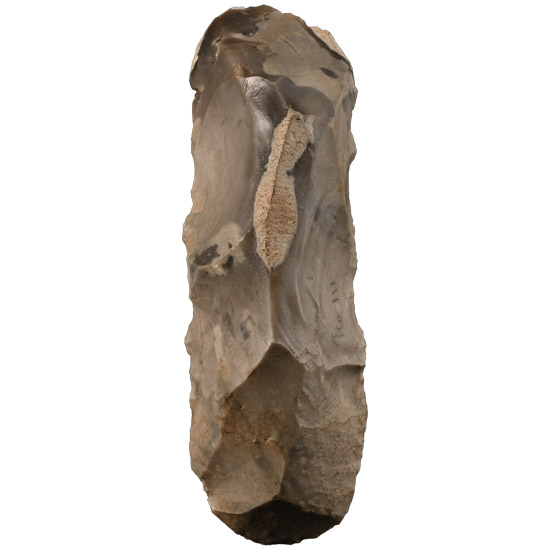
Large Farnham St Martha Stone Age Knapped Flint Adze
Neolithic Period, circa 6,000 B.P.Estimate: £120 - 170 (+bp*)
Bids: 1 | Current Bid: £5
Tongue-shaped in plan and plano-convex in section with a rounded butt, small patches of cortex, inked findspot 'St. Marth (Tyting) (1930)' and pencilled notations. 235 grams, 13.1 cm
Found St Martha, Tyting Lane, near Farnham, Surrey, UK. Found during the original official excavations in the Farnham area, Surrey, UK, which were conducted by Harold Falkner (1875-1963) and William Francis Rankine (c.1877-1962), who were instrumental in the excavation works and pit dwellings at sites including Six Bells, Frensham, Tilford, Thursley and Bagshot, and Waverley, amongst others, at and near Farnham in the 1930s and 1940s. Much of the material is now in the prestigious Farnham museum. The present part of the collection having been gifted to their good friend and Haselmere Parish Priest, Charles Borelli (c.1914-2000) of Farnham, who was part of the Borelli family from Italy who emigrated from Lake Como in 1828 to set up the Borelli family watch and jewellery business; thence by family descent to his nephew.
Farnham district is one of the most interesting prehistoric regions in England, and has been visited by a succession of prehistoric peoples from Palaeolithic times onwards. Along the southern slope of the Farnham valley are three gravel terraces, which are famous prehistorically and have yielded large quantities of flint implements and bones of prehistoric animals, notably the mammoth. In prehistoric times, the chalk deposits played an important role in attracting settlers, as they contained rich layers of flint nodules used to make implements. The Farnham Gravels have been an abundant source of Palaeolithic finds, most prominent being hand axes. The axes differ in type, and each type is associated with a cultural phase of the Palaeolithic period. Types similar to these are found in similar deposits in the Somme valley and in many English valley gravels. Flint mining was also carried out by the Neolithic folk. Polished axes and leaf forms, arrowheads and knives, or possibly lance heads, are characteristic of the Neolithic flint work. -
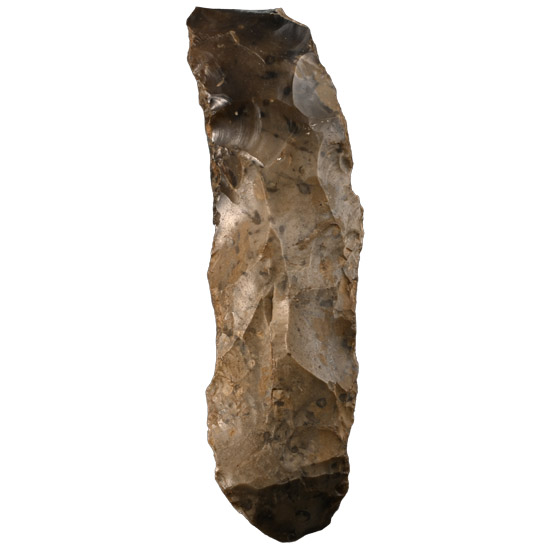
Very Large Farnham Stone Age Knapped Flint Pick
Neolithic Period, circa 6000 B.P.Estimate: £120 - 170 (+bp*)
Opening Bid: £5
Triangular in section with rounded edge, cortex to shank, inked 'Tilford' findspot and various pencilled notations. 605 grams, 20 cm
Found during the original official excavations in the Farnham area, Surrey, UK, which were conducted by Harold Falkner (1875-1963) and William Francis Rankine (c.1877-1962), who were instrumental in the excavation works and pit dwellings at sites including Six Bells, Frensham, Tilford, Thursley and Bagshot, and Waverley, amongst others, at and near Farnham in the 1930s and 1940s. Much of the material is now in the prestigious Farnham museum. The present part of the collection having been gifted to their good friend and Haselmere Parish Priest, Charles Borelli (c.1914-2000) of Farnham, who was part of the Borelli family from Italy who emigrated from Lake Como in 1828 to set up the Borelli family watch and jewellery business; thence by family descent to his nephew.
Farnham district is one of the most interesting prehistoric regions in England, and has been visited by a succession of prehistoric peoples from Palaeolithic times onwards. Along the southern slope of the Farnham valley are three gravel terraces, which are famous prehistorically and have yielded large quantities of flint implements and bones of prehistoric animals, notably the mammoth. In prehistoric times, the chalk deposits played an important role in attracting settlers, as they contained rich layers of flint nodules used to make implements. The Farnham Gravels have been an abundant source of Palaeolithic finds, most prominent being hand axes. The axes differ in type, and each type is associated with a cultural phase of the Palaeolithic period. Types similar to these are found in similar deposits in the Somme valley and in many English valley gravels. Flint mining was also carried out by the Neolithic folk. Polished axes and leaf forms, arrowheads and knives, or possibly lance heads, are characteristic of the Neolithic flint work. -
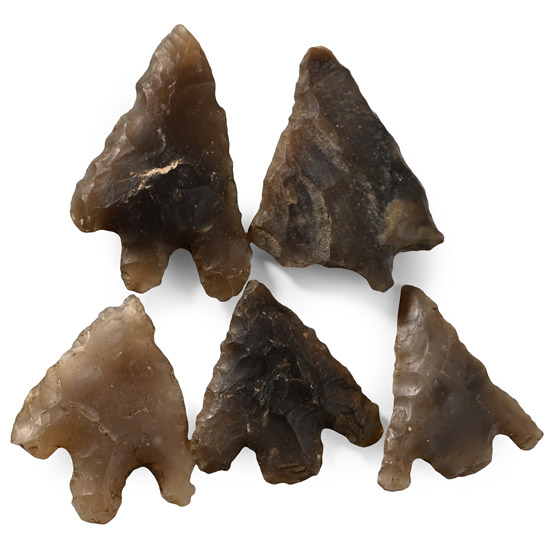
Farnham Stone Age Knapped Flint Arrowhead Collection
Neolithic Period, circa 6,000 B.P.Estimate: £300 - 400 (+bp*)
Bids: 1 | Current Bid: £5
Group of tanged or barbed and tanged arrowheads with triangular point. 9.99 grams total, 23-31 mm
Found during the original official excavations in the Farnham area, Surrey, UK, which were conducted by Harold Falkner (1875-1963) and William Francis Rankine (c.1877-1962), who were instrumental in the excavation works and pit dwellings at sites including Six Bells, Frensham, Tilford, Thursley and Bagshot, and Waverley, amongst others, at and near Farnham in the 1930s and 1940s. Much of the material is now in the prestigious Farnham museum. The present part of the collection having been gifted to their good friend and Haselmere Parish Priest, Charles Borelli (c.1914-2000) of Farnham, who was part of the Borelli family from Italy who emigrated from Lake Como in 1828 to set up the Borelli family watch and jewellery business; thence by family descent to his nephew.
Farnham district is one of the most interesting prehistoric regions in England, and has been visited by a succession of prehistoric peoples from Palaeolithic times onwards. Along the southern slope of the Farnham valley are three gravel terraces, which are famous prehistorically and have yielded large quantities of flint implements and bones of prehistoric animals, notably the mammoth. In prehistoric times, the chalk deposits played an important role in attracting settlers, as they contained rich layers of flint nodules used to make implements. The Farnham Gravels have been an abundant source of Palaeolithic finds, most prominent being hand axes. The axes differ in type, and each type is associated with a cultural phase of the Palaeolithic period. Types similar to these are found in similar deposits in the Somme valley and in many English valley gravels. Flint mining was also carried out by the Neolithic folk. Polished axes and leaf forms, arrowheads and knives, or possibly lance heads, are characteristic of the Neolithic flint work. -
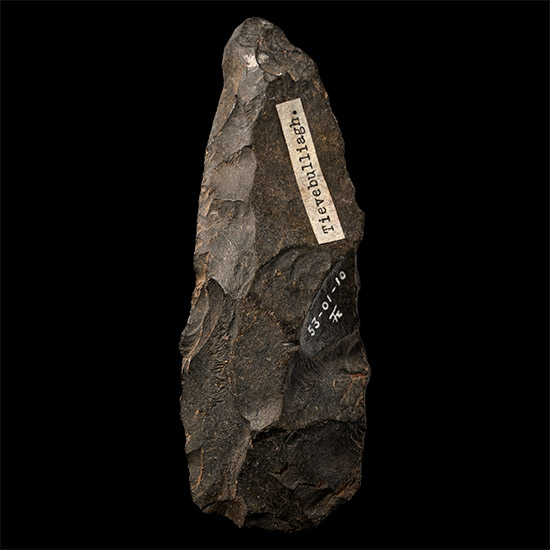
Northern Ireland Stone Age Knapped Black Stone Axe
Neolithic Period, circa 6000 B.P.Estimate: £200 - 300 (+bp*)
Opening Bid: £5
Tongue-shaped in plan and lentoid in section with broad butt; inked legend '53-01-10' and pasted label 'Tievebulliagh'. 290 grams, 14 cm
Found Tievebulliagh, Northern Ireland, 1st October 1953. From the collection of Haselmere Parish Priest, Charles Borelli (c.1914-2000) of Farnham; who was part of the Borelli family from Italy who emigrated from Lake Como in 1828 to set up the Borelli family watch and jewellery business; thence by family descent to his nephew. -
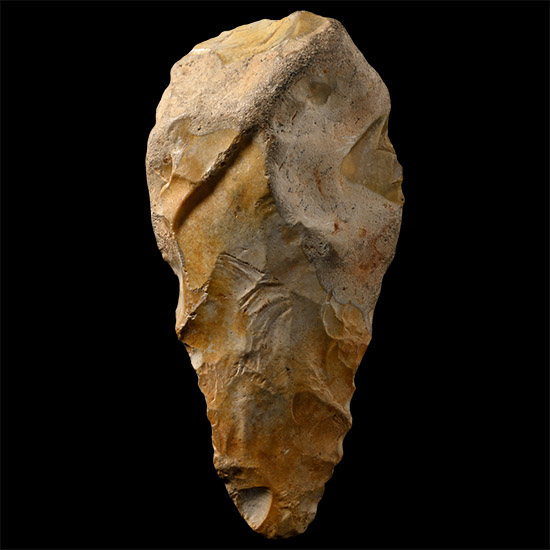
Hampshire Stone Age Kapped Flint Ficron Handaxe
Middle Palaeolithic Period, circa 150,000-60,000 B.P.Estimate: £300 - 400 (+bp*)
Bids: 2 | Current Bid: £11
Piriform in plan and biconvex in section with irregular butt; old inked legend 'N.Romsey Hants'. 350 grams, 14.8 cm
Found North Romsey, Hampshire, UK. Ex Martin Doyle collection, Leverstock, UK, 1980s-2000s. -
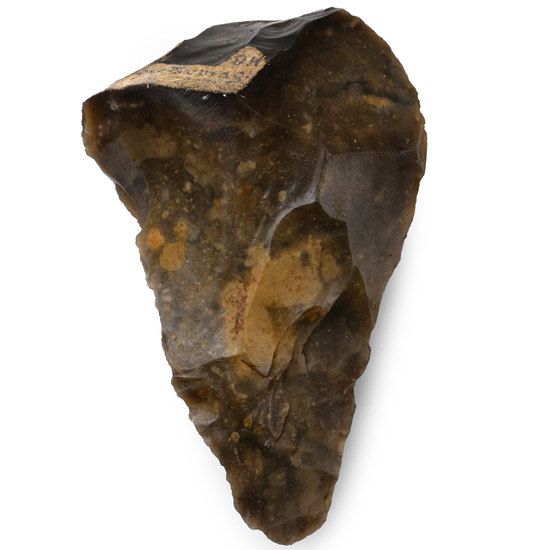
Swanscombe British Stone Age Knapped Ficron Handaxe
Lower Palaeolithic Period, circa 420,000-380,000 B.P.Estimate: £120 - 170 (+bp*)
Opening Bid: £5
Scaphoid in section with irregular broad point, cortex to the butt with old pencilled legend 'SW[...]E'. 95 grams, 85.6 mm
Found Swanscombe, Kent, UK. From the original collection of Henry Dewey. From the collection of a London, UK, gentleman.
Attributed to Homo heidelbergensis -
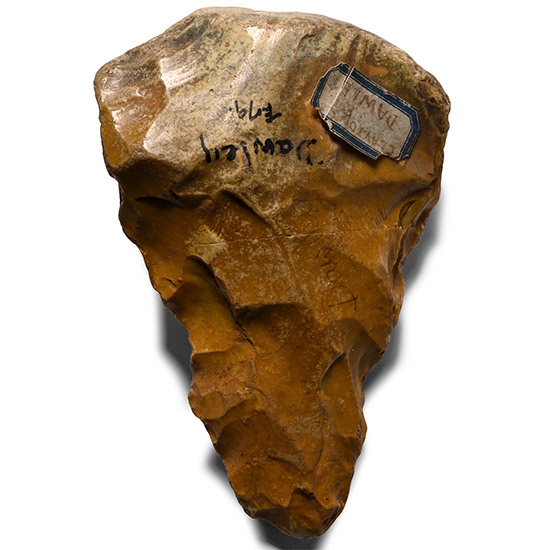
Dawley British Stone Age Knapped Ficron Handaxe
Lower Palaeolithic Period, circa 600,000-2500,000 B.P.Estimate: £120 - 170 (+bp*)
Bids: 2 | Current Bid: £10
Leaf-shaped in plan with broad rounded butt; an old label reading 'Clayton's, Dawley', inked legend 'Dawley E79'; repaired. 180 grams, 93 mm
Found at Clayton’s Pit, Dawley, Middlesex, UK. From the collection of a London, UK, gentleman.
Clayton’s Pit sat on the Lynch Hill Terrace and was used for commercial brick earth and gravel digging in the 19th and 20th centuries. Many of the stone tools recovered are held in the British Museum and the Museum of London. -
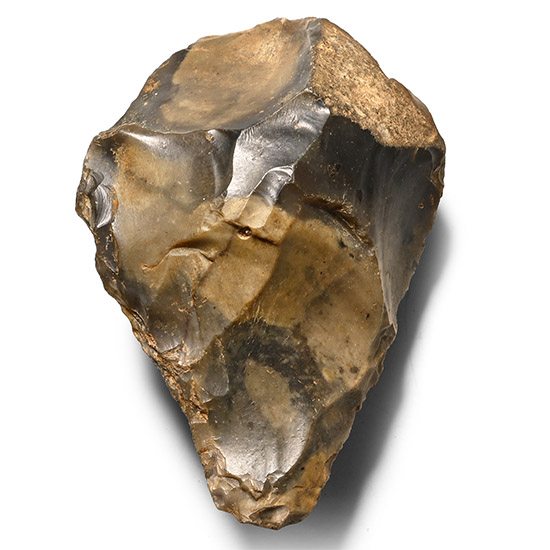
Swanscombe Stone Age Knapped Hand Axe
Middle Palaeolithic Period, circa 150,000-60,000 B.P.Estimate: £120 - 170 (+bp*)
Bids: 1 | Current Bid: £5
Piriform in plan with thick bulb at the base; old findspot label 'Kent / Swanscombe'. 122 grams, 80 mm
Found Swanscombe, Kent, UK. From the private collection of Peter Clayton, FCILIP, Dip, Arch, FSA, FRNS, Hemel Hempstead, Hertfordshire, UK; formed since the late 1950s.
The name of the site is associated with 'Swanscombe Man', the remains of a late Homo erectus or an early Homo sapiens individual. Recent investigation suggests that the remains are those of a 400,000-year-old early Neanderthal woman. -
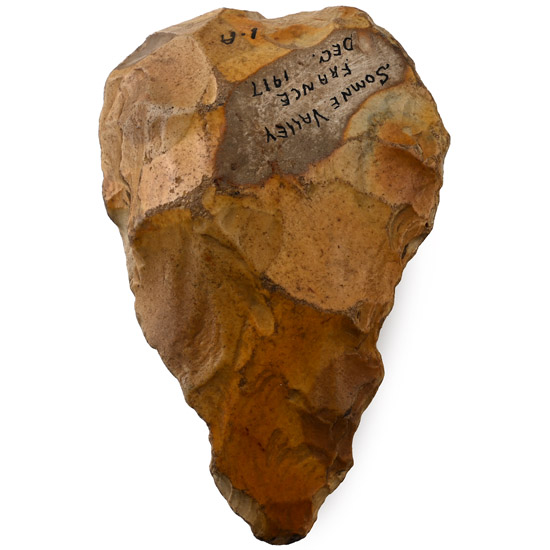
Somme Valley French Stone Age Handaxe
Lower Palaeolithic Period, Acheulean, circa 650,000-350,000 B.P.Estimate: £150 - 200 (+bp*)
Bids: 1 | Current Bid: £5
Piriform in plan and biconvex in section with broad butt. 184 grams, 10.2 cm
Found in the Somme Valley, France, December 1917. From the collection of an Australian collector before being brought back to the UK. Acquired on the UK art market in the 2020s. From a private collection.
Attributed to Homo Heidelbergesis. After the Battle of the Somme during WW1, the area around the Somme became a quieter location where soldiers recuperated. There are reports that many Stone Age artefacts were found during this time while soldiers were not on the front line. With the landscape being turned over considerably and trenches being hand-dug, this is not surprising. -
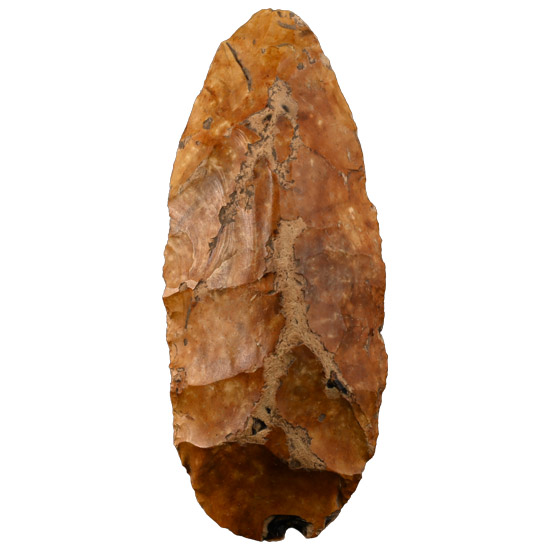
British Stone Age Flint Handaxe
Mesolithic Period, 7,000-5,000 B.P.Estimate: £300 - 400 (+bp*)
Opening Bid: £100
Leaf-shaped in plan and lentoid in section with light tan colouration shading to a deep amber at the edges. 276 grams, 13.9 cm
Found Bottisham, Cambridgeshire, UK, 2022. With old Noonans auction lot ticket.
