
Ancient Art, Antiquities, Books, Natural History, Stamps & Coins
Days 1-5
Open For Bidding
Open For Bidding

-
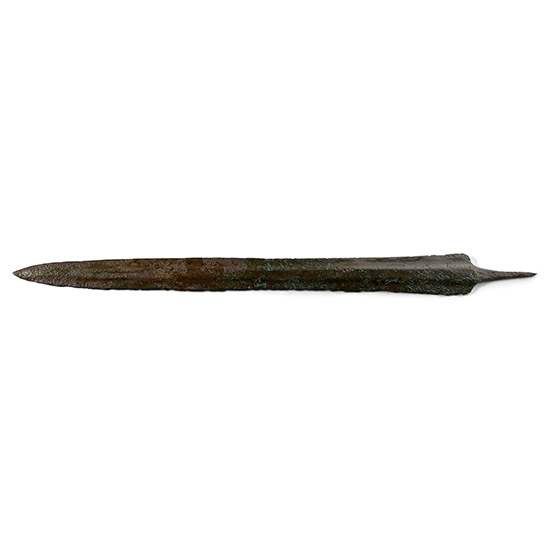
Large North-West Persian Bronze Dirk
Early 1st millennium B.C.Estimate: £150 - 200 (+bp*)
Opening Bid: £75
Slender blade with raised midrib and a short tang. 217 grams, 39.7 cm
Ex Abelita family collection, 1990s. -
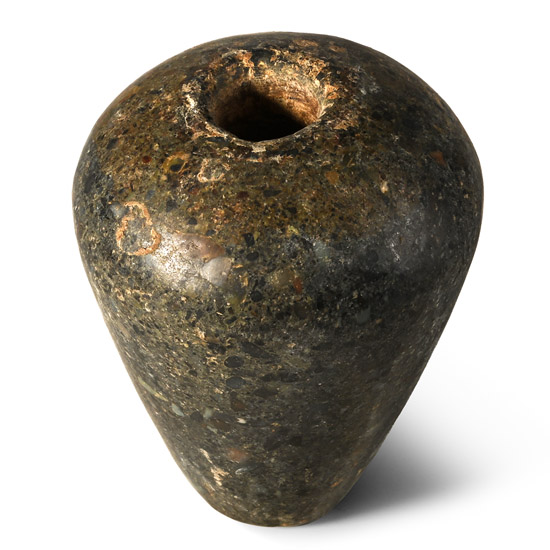
Western Asiatic Polished Stone Macehead
3rd-2nd millennium B.C.Estimate: £80 - 100 (+bp*)
Opening Bid: £44
Ovoid body with circular socket. 435 grams, 86 mm
From the collection of a London, UK, gentleman, 1990s. -
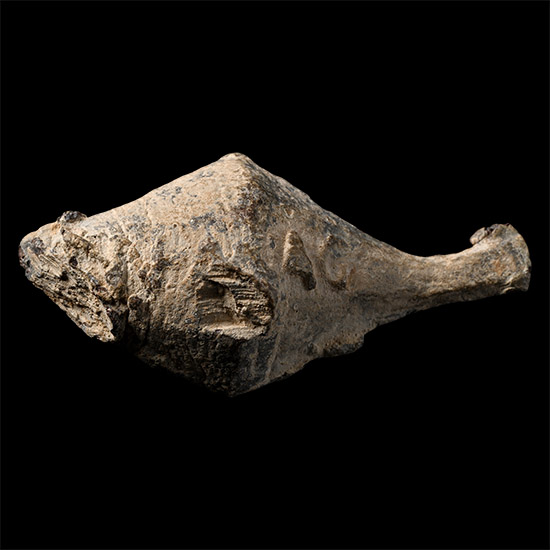
Roman Lead Cnaeus Pompey Battle of Munda Slingshot
Circa 46 B.C.Estimate: £150 - 200 (+bp*)
Opening Bid: £5
Facetted lentoid-section sling shot (glans) with inscription in Latin letters 'CN' (Cneius) 'MAG' (Magnus) on one side, and 'IMP' for 'IMPERATOR' (victorious general) to the other side, i.e., Gnaeus Pompeius Magnus Imperator (Pompey the Great the victorious general). 71.2 grams, 51 mm
Previously from a private Spanish collection. Ex London, UK, gentleman. Accompanied by a copy of a Spanish export licence.
The shot (Völling type 1C) is marked with the abbreviated name of Gnaeus Pompey; it was used in quantity at the Battle of Monda (or Munda) against Julius Caesar, 17th March 45 BC. The projectiles could be of different material: in lead (glandes) or in pottery or stone (lapides missiles). Sometimes they were signed with the name of the general, as is our specimen. -
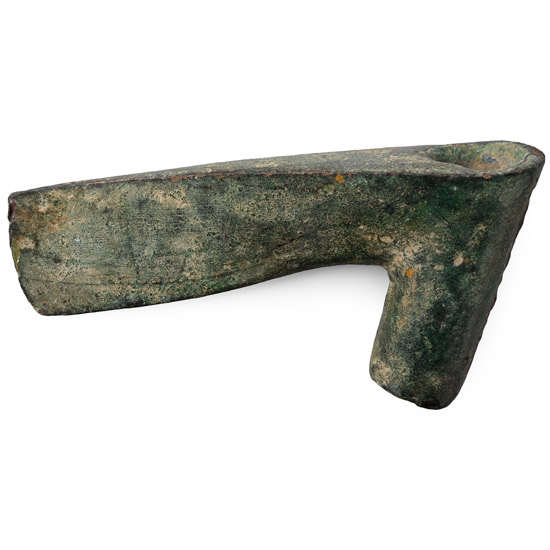
Luristan Bronze Axehead
2nd-1st millennium B.C.Estimate: £100 - 140 (+bp*)
Opening Bid: £50
With a narrow, slightly angled blade and a tubular socket. 374 grams, 13.1 cm
Ex Abelita collection, 1990s. -
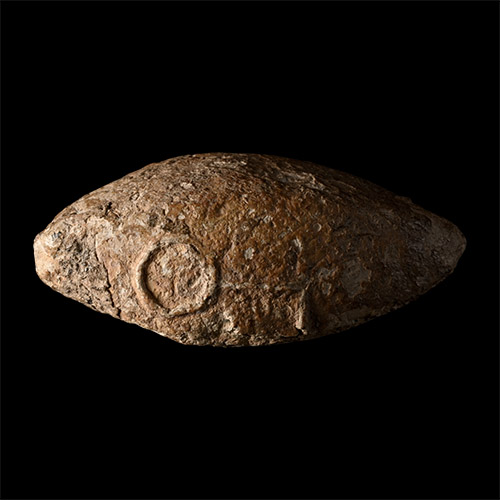
Greek Lead Slingshot with Monogram
3rd-1st century B.C.Estimate: £60 - 80 (+bp*)
Bids: 1 | Current Bid: £5
Lenticular type with casting seam to the rim, raised monogram (caduceus?) on one side. 30.6 grams, 33 mm
Ex German art market, 2000s. Acquired from an EU collector living in London. From the collection of a Surrey, UK, gentleman. -
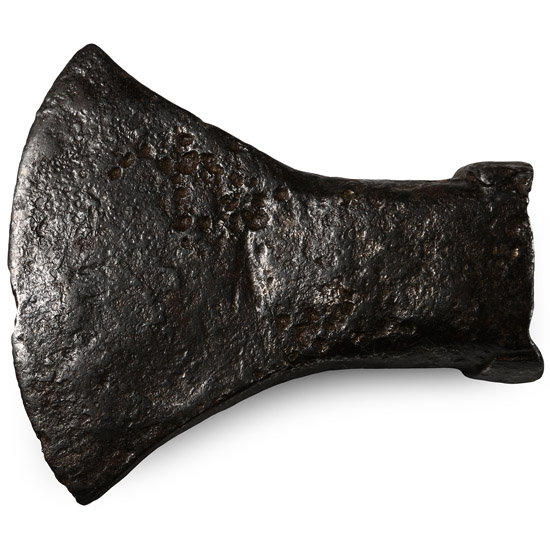
Celtic Iron Open Socketted Splayed Axehead
Late Hallstatt-Early La Tene Period, circa 450 B.C.Estimate: £50 - 70 (+bp*)
Opening Bid: £5
Curving blade and a rectnagular-section socket with thickened rim. 332 grams, 10.7 cm
Ex M. Spiegelberg collection, since 1989-1992; thence by descent. Accompanied by a copy of a previous yellow cataloguing slip. -
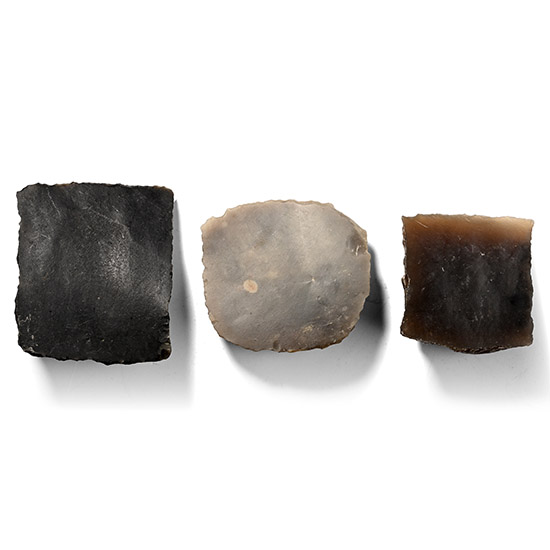
Knapped Musket Gun Flint Group
Circa 18th century A.D.Estimate: £10 - 20 (+bp*)
Opening Bid: £5
Comprising three gun flints, one tongue-shaped and the other two rectangular. 33.1 grams total, 29-36 mm
From the private collection of the late Mr M., a collector from Waterlooville, Hampshire, UK; late 1980s-early 1990s. -
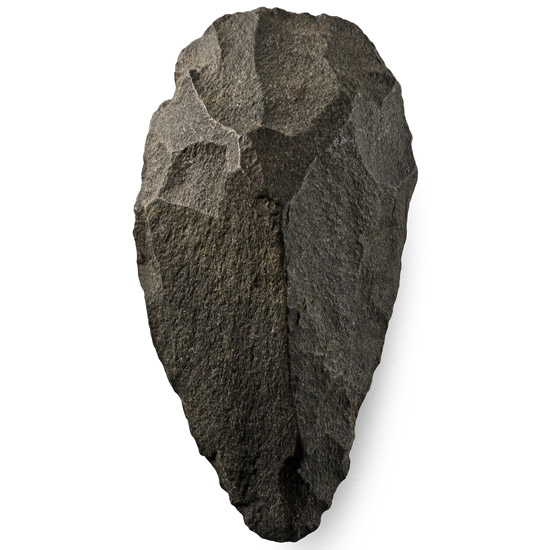
African Stone Age Homo Erectus Knapped Handaxe
Lower Palaeolithic Period, circa 1,000,000-500,000 B.P.Estimate: £60 - 80 (+bp*)
Opening Bid: £5
Ovate handaxe with thick butt. 233 grams, 11.1 cm
From Central Sahara, Africa. Ex old German collection formed in the 1970s by Dr J Fehkhaber. Acquired on the European art market. -
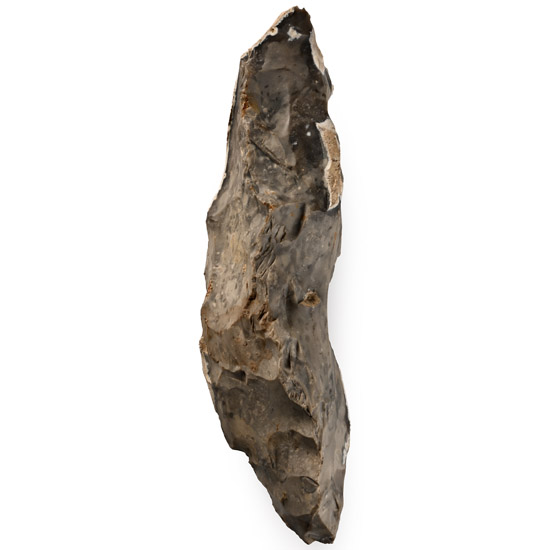
Farnham Very Large Stone Age Knapped Flint Pick
Neolithic Period, circa 6,000 B.P.Estimate: £100 - 140 (+bp*)
Opening Bid: £5
Roughly triangular in section with broad point; much cortex remaining. 713 grams, 21 cm
Found during the original official excavations in the Farnham area, Surrey, UK, which were conducted by Harold Faulker (1875-1963), and William Francis Rankine (c.1877-1962), who were instrumental with the excavation works and pit dwellings at sites including Six Bells, Frensham, Tilford, Thursley and Bagshot, and Waverley, amongst others at and near Farnham in the 1930s and 1940s. Much of the material is now in the prestigious Farnham museum. The present part of the collection having been gifted to their good friend and Haselmere Parish Priest, Charles Borelli (c.1914-2000) of Farnham; who was part of the Borelli family from Italy who emigrated from Lake Como in 1828 to set up the Borelli family watch and jewellery business; thence by family descent to his nephew.
Farnham district is one of the most interesting prehistoric regions in England, and has been visited by a succession of prehistoric peoples from Palaeolithic times onwards. Along the southern slope of the Farnham valley are three gravel terraces, which are famous prehistorically and have yielded large quantities of flint implements and bones of prehistoric animals, notably the mammoth. In prehistoric times, the chalk deposits played an important role in attracting settlers, as they contained rich layers of flint nodules used to make implements. The Farnham Gravels have been an abundant source of Palaeolithic finds, most prominent being hand axes. The axes differ in type, and each type is associated with a cultural phase of the Palaeolithic period. Types similar to these are found in similar deposits in the Somme valley and in many English valley gravels. Flint mining was also carried out by the Neolithic folk. Polished axes and leaf forms, arrowheads and knives, or possibly lance heads, are characteristic of the Neolithic flint work. -
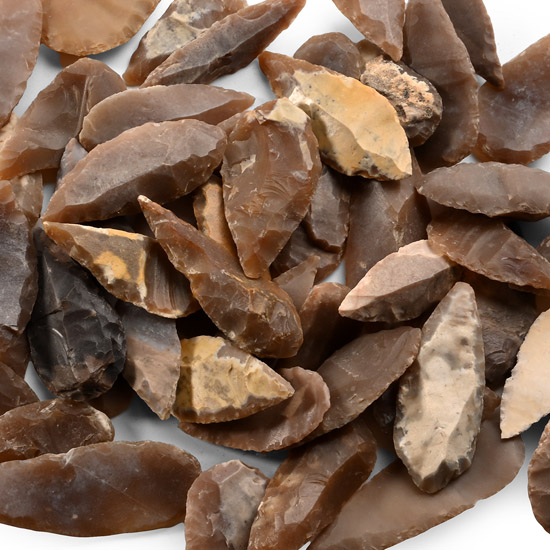
Stone Age Leaf-Shaped Arrowhead Collection
Neolithic Period, 8th-6th millennium B.P.Estimate: £50 - 70 (+bp*)
Opening Bid: £5
Comprising mostly bifacial and uniface leaf-shaped and piriform flint and chert arrowheads; probably from the Sahara region of North Africa. 105 grams total, 22-44 mm
UK gallery, early 2000s.
Similar specimens of arrowheads have been found in the Eastern Sahara Region of Abu Tartur Plateau. Most of the arrowheads came from the El Jarar Neolithic, c. 7700-7300 B.P. (c.6500-6100 B.C.). Other parallels occur in the region of Kharga Oasis. -
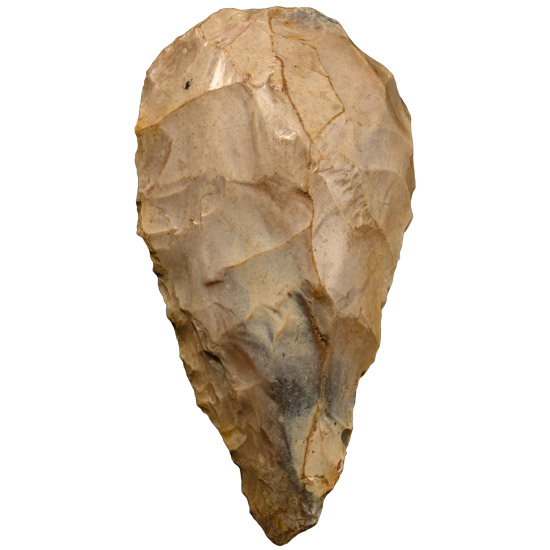
British Stone Age Knapped Flint Axe
Middle Palaeolithic Period, circa 150,000-60,000 B.P.Estimate: £150 - 200 (+bp*)
Bids: 1 | Current Bid: £5
Piriform body with pointed tip, an old handwritten label on one side. 262 grams, 12.3 cm
Found Test Road, Huzbourough Copse, Hampshire, UK, June 1965. From the collection of Martin Doyle, Leverstock, UK, 1980s-2000s. -
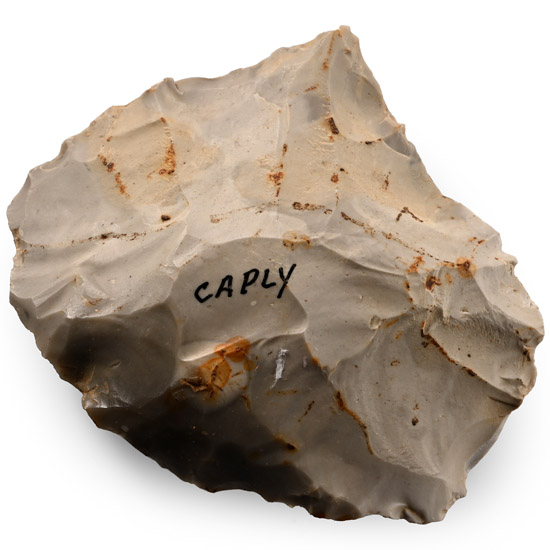
French Stone Age Knapped Flint Bifacial Adze
Neolithic Period, circa 6000 B.P.Estimate: £70 - 90 (+bp*)
Opening Bid: £5
Cordiform in plan and lentoid in section with acute point; inked legend 'Caply' to one face. 190 grams, 93 mm
From Caply, Northern France. From the UK art market.
