
Ancient Art, Antiquities, Books, Natural History, Stamps & Coins
Days 1-5
Open For Bidding
Open For Bidding

-
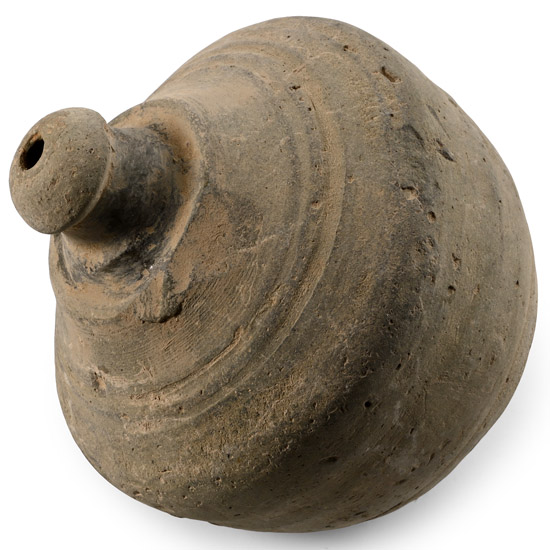
Byzantine 'Greek Fire' Ceramic Fire Bomb or Hand Grenade
9th-11th century A.D.Estimate: £80 - 100 (+bp*)
Opening Bid: £5
Large bulbous body with a domed filler-hole and two circumferential bands above the shoulder; intended to be filled with explosive liquid and a wick, and used as a hand grenade. 715 grams, 12.3 cm
From an important specialist collection, London, UK, 1990s. Accompanied by an academic paper by military specialist Dr Raffaele D'Amato, dated 15 July 2019 and titled 'Eastern Roman Empire - Greek Fire Bomb or Hand Grenade (μεσαίον kακάβιον) 9th-11th century AD'.
Apart from the use of siphons or manual flame-throwers called cheirosiphona, special corps of Roman soldiers employed terracotta grenades, in the form of small jars, abundantly evidenced in archaeological excavations. They were called μεσαία kακαβιά or κυτροκακάβια, where the former had a bulbous shape and the latter a more cylindrical form. -
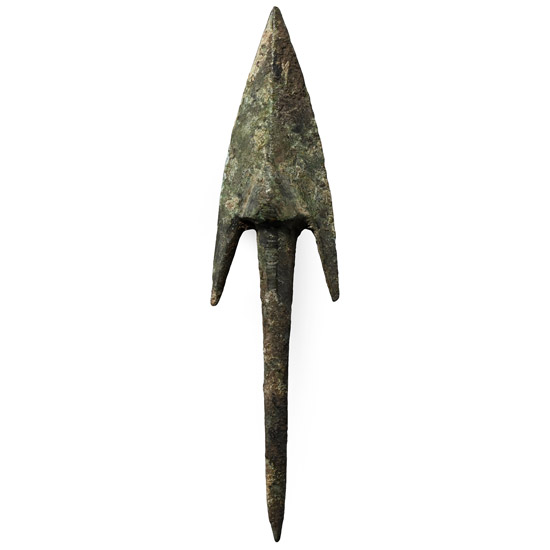
Large Phoenician Bronze Arrowhead
Levant, circa 1200-1100 B.C.Estimate: £40 - 60 (+bp*)
Opening Bid: £5
Broad and lentoid in section with spiked tang, elongated barbs, bulb to each face at junction with the head. 16.5 grams, 75 mm
From the private collection of Mr Brian Edwards, New Malden, Surrey, UK, formed from the late 1970s-early 1980s; thence by descent. Accompanied by the original collector's data sheet(s) with reference no.A10. -
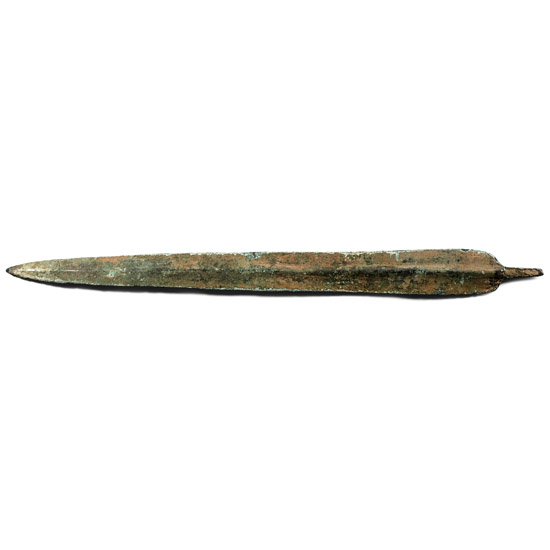
Western Asiatic Bronze Sword Blade
1st millennium B.C.Estimate: £100 - 140 (+bp*)
Opening Bid: £5
Slender double-edged blade with raised midrib and short tang. 224 grams, 42.2 cm
From a UK collection formed in the 1980s. Property of an Essex, UK, gentleman. -
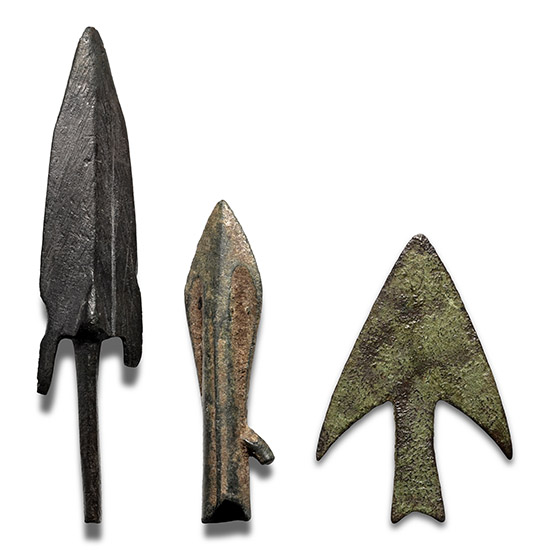
Greek and Other Bronze Arrowhead Group
4th century B.C. and laterEstimate: £60 - 80 (+bp*)
Opening Bid: £5
Comprising three arrowheads, one socketted with a lateral spur, one barbed and tanged, and the third a flat-section barbed and tanged type. 20 grams total, 39-67 mm
Ex German art market, 2000s. Acquired from an EU collector living in London. From the collection of a Surrey, UK, gentleman. -
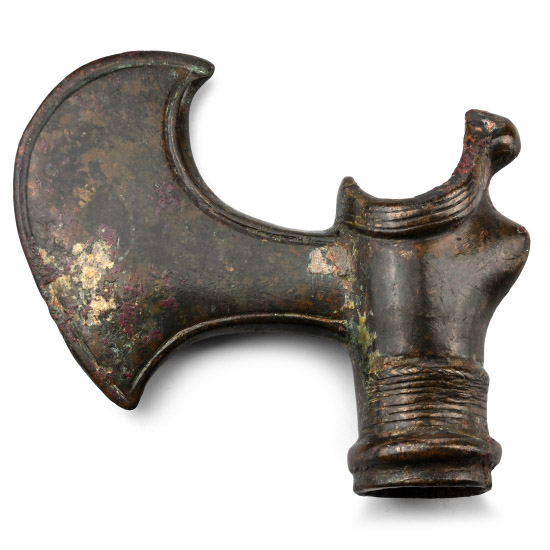
Luristan Bronze Socketted Axehead
Circa 2200-1600 B.C.Estimate: £150 - 200 (+bp*)
Bids: 1 | Current Bid: £5
Curving blade and a tubular socket with decorative collars. 246 grams, 10 cm
From the collection of Martin Doyle, Leverstock, UK, 1980s-2000s. -
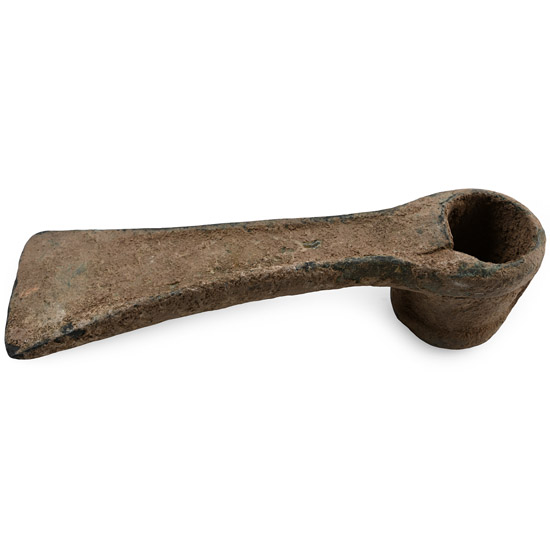
Large Luristan Bronze Adze
Bronze Age, 2nd-1st millennium B.C.Estimate: £100 - 140 (+bp*)
Opening Bid: £50
Short tubular socket with raised ribs, perpendicular rectangular-section blade with convex cutting edge. 462 grams, 16.5 cm
From a UK collection formed in the 1980s. Property of an Essex, UK, gentleman.
Unadorned weapons, especially axes, adzes, and picks, were made by Luristan craftsmen using simple clay or stone bivalve moulds, into which a core was inserted to form the socket for the shaft. Typically, the metallic composition consisted of a combination of arsenical bronze and copper, together with a small percentage of lead. -
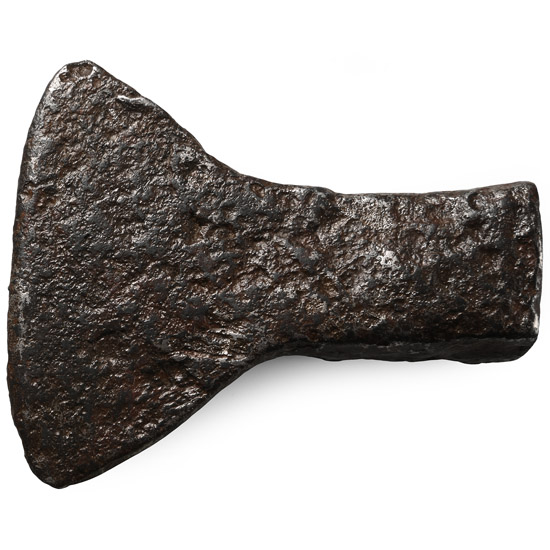
Celtic Iron Open Socketted Splayed Axehead
Late Hallstatt-Early La Tene Period, circa 450 B.C.Estimate: £50 - 70 (+bp*)
Opening Bid: £5
Flaring blade with a rectangular-section folded socket. 155 grams, 84 mm
Ex M. Spiegelberg collection, since 1989-1992; thence by descent. Accompanied by a copy of a previous yellow cataloguing slip. -
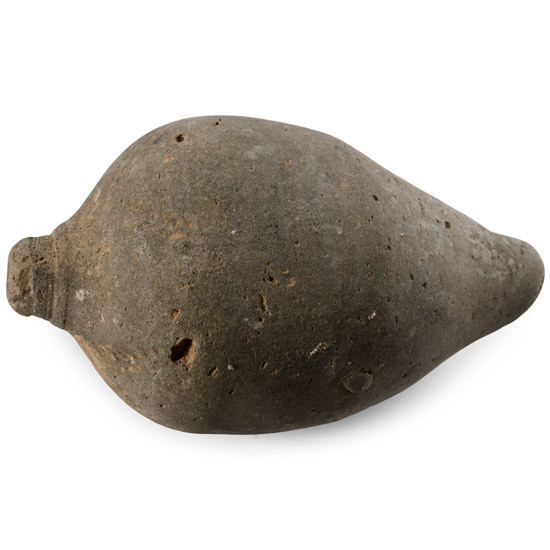
Byzantine 'Greek Fire' Ceramic Fire Bomb or Hand Grenade
9th-11th century A.D.Estimate: £80 - 100 (+bp*)
Opening Bid: £5
Piriform body with domed filler-hole; intended to be filled with explosive liquid and a wick, and used as a hand grenade. 455 grams, 14.6 cm
From an important specialist collection, London, UK, 1990s. Accompanied by an academic paper by military specialist Dr Raffaele D'Amato, dated 15 July 2019 and titled 'Eastern Roman Empire - Greek Fire Bomb or Hand Grenade (μεσαίον kακάβιον) 9th-11th century AD'.
Apart from the use of siphons or manual flame-throwers called cheirosiphona, special corps of Roman soldiers employed terracotta grenades, in the form of small jars, abundantly evidenced in archaeological excavations. They were called μεσαία kακαβιά or κυτροκακάβια, where the former had a bulbous shape and the latter a more cylindrical form. -
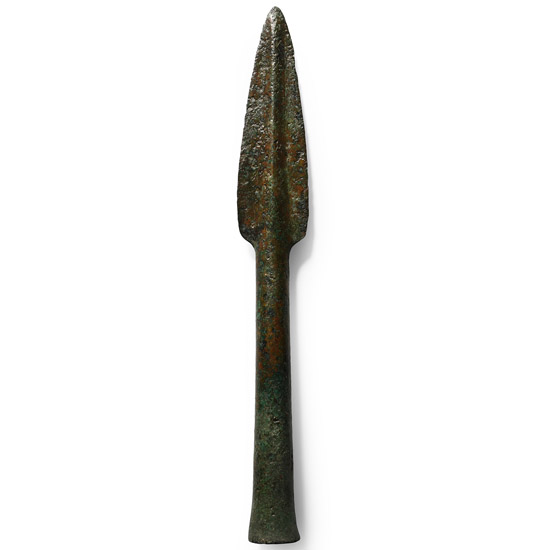
Western Asiatic Bronze Socketted Spearhead
2nd-1st millennium B.C.Estimate: £180 - 240 (+bp*)
Opening Bid: £90
Comprising a leaf-shaped blade with a midrib, a long tapering socket with a flared mouth. 154 grams, 25.5 cm
Ex Abelita family collection, 1980s-2000s. -
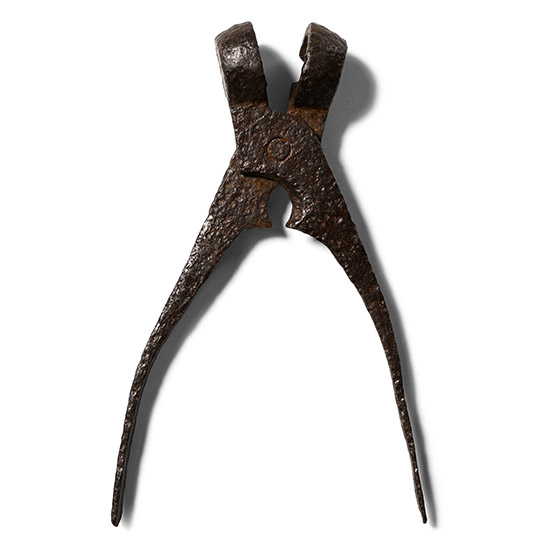
Civil War Period Iron Musket Ball Scissor Mould
Circa 17th century A.D.Estimate: £40 - 60 (+bp*)
Opening Bid: £5
Two-part mould with pivoting handles, pouring hole to upper face. 55.8 grams, 12.5 cm
From the private collection of Mr Brian Edwards, New Malden, Surrey, UK, formed from the late 1970s-early 1980s; thence by descent. -
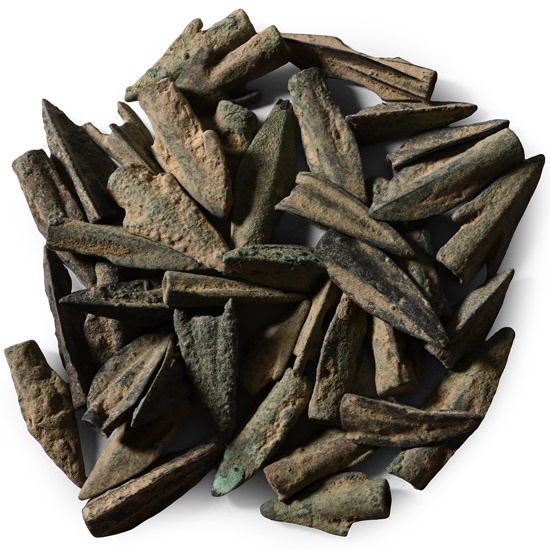
Greek and Scythian Bronze Arrowhead Collection
Circa 5th-3rd century B.C.Estimate: £100 - 140 (+bp*)
Opening Bid: £50
A mixed group of socketted arrowheads, including some triangular types. 137 grams total, 20-34 mm
Ex London, UK, collection, 1990s.
In ancient Greek warfare, archers were mainly employed by Scythians and Cretans. Both used composite bows made of wood, horn, bone and sinew. This explains the great range of Scythian arrowheads found on the Greek sites. -
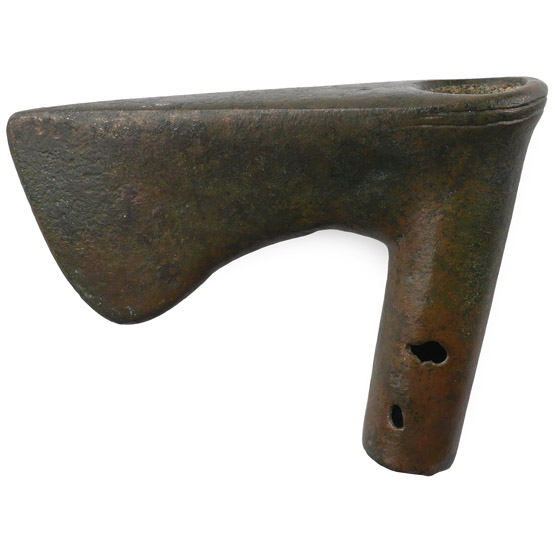
Western Asiatic Bronze Axehead
Late 3rd-early 2nd millennium B.C.Estimate: £180 - 240 (+bp*)
Opening Bid: £100
With a short socketted shaft, the plain rectangular blade broadening towards the cutting edge; side holes on the shaft. 446 grams, 11.4 cm
Ex Abelita family collection, 1980s-2000s.
Unadorned weapons, especially axes, adzes, and picks, were made by Luristan craftsmen using simple clay or stone bivalve moulds, into which a core was inserted to form the socket for the shaft. Typically, the metallic composition consisted of a combination of arsenical bronze and copper, together with a small percentage of lead.
