
Ancient Art, Antiquities, Books, Natural History, Stamps & Coins
Days 1-5
Open For Bidding
Open For Bidding

-
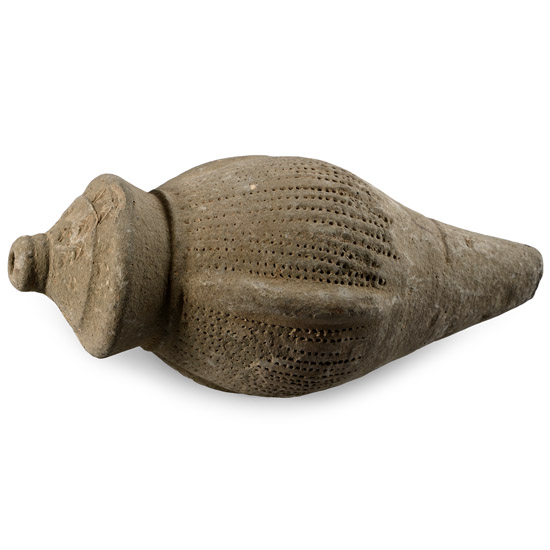
Turco-Mongol 'Greek Fire' Ceramic Fire Bomb or Hand Grenade
13th-15th century A.D.Estimate: £80 - 100 (+bp*)
Opening Bid: £5
Piriform in profile with a stepped neck, incised decoration and three raised lugs; intended to be filled with explosive liquid and a wick, and used as a hand grenade. 424 grams, 17 cm
From an important specialist collection, London, UK, 1990s. Accompanied by an academic paper by military specialist Dr Raffaele D'Amato, dated 15 July 2019 and titled 'Eastern Roman Empire - Greek Fire Bomb or Hand Grenade (μεσαίον kακάβιον) 9th-11th century AD'.
Apart from the use of siphons or manual flame-throwers called cheirosiphona, special corps of Roman soldiers employed terracotta grenades, in the form of small jars, abundantly evidenced in archaeological excavations. They were called μεσαία kακαβιά or κυτροκακάβια, where the former had a bulbous shape and the latter a more cylindrical form. -
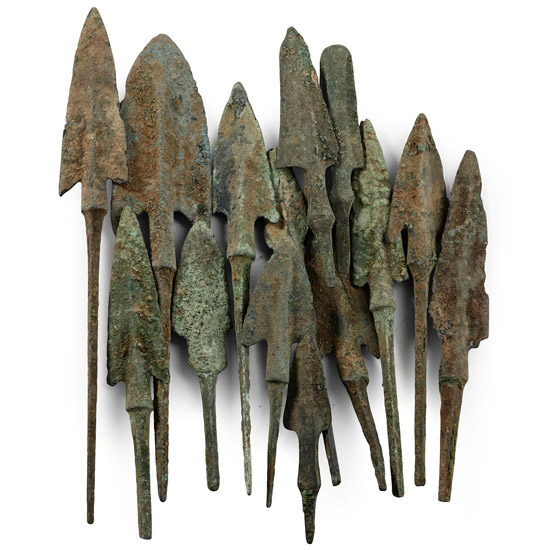
Western Asiatic Bronze Arrowhead Collection
2nd-1st millennium B.C.Estimate: £100 - 140 (+bp*)
Opening Bid: £50
Comprising fourteen tanged arraoheads, mostly barbed types. 232 grams total, 6.1-16 cm
Ex London, UK, collection, 1990s. -
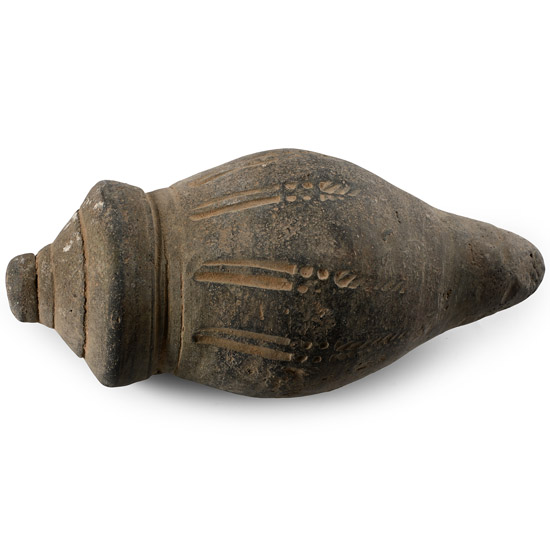
Turco-Mongol 'Greek Fire' Ceramic Fire Bomb or Hand Grenade
14th-15th century A.D.Estimate: £80 - 100 (+bp*)
Opening Bid: £5
Piriform in profile with a stepped neck, incised decoration; intended to be filled with explosive liquid and a wick, and used as a hand grenade. 385 grams, 16 cm
From an important specialist collection, London, UK, 1990s. Accompanied by an academic paper by military specialist Dr Raffaele D'Amato, dated 15 July 2019 and titled 'Eastern Roman Empire - Greek Fire Bomb or Hand Grenade (μεσαίον kακάβιον) 9th-11th century AD'.
Apart from the use of siphons or manual flame-throwers called cheirosiphona, special corps of Roman soldiers employed terracotta grenades, in the form of small jars, abundantly evidenced in archaeological excavations. They were called μεσαία kακαβιά or κυτροκακάβια, where the former had a bulbous shape and the latter a more cylindrical form. -
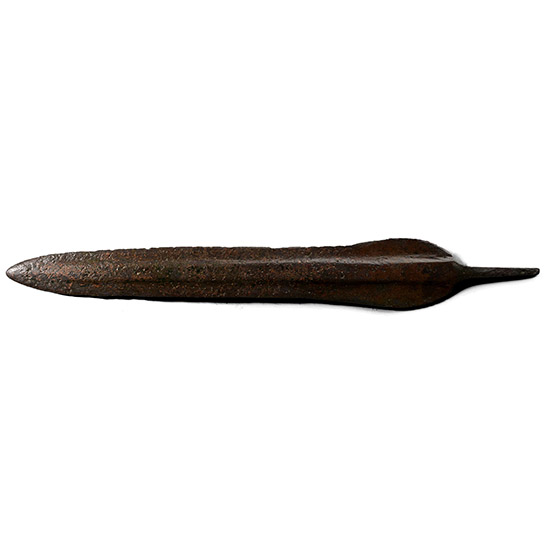
Large Western Asiatic Bronze Dagger
1st millennium B.C.Estimate: £200 - 300 (+bp*)
Opening Bid: £100
Slender blade with a wide midrib and a short rectangular-section tang. 267 grams, 34.7 cm
Ex Abelita family collection, 1990s. -
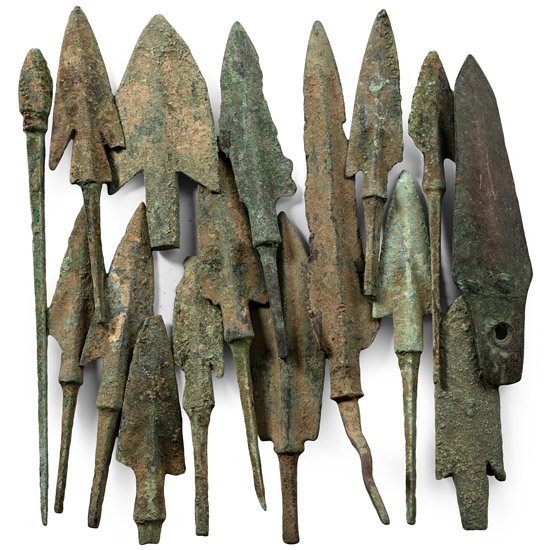
Western Asiatic Bronze Arrowhead Collection
2nd-1st millennium B.C.Estimate: £100 - 140 (+bp*)
Opening Bid: £50
Comprising sixteen tanged arrowheads, mostly barbed types. 313 grams total, 6.5-14.7 cm
Ex London, UK, collection, 1990s. -
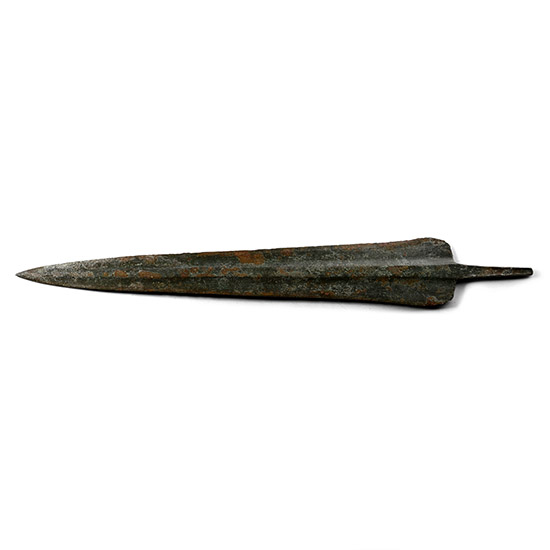
Western Asiatic Bronze Dagger
14th-10th century B.C.Estimate: £200 - 300 (+bp*)
Opening Bid: £100
Triangular blade with raised midrib and a rectangular-section tang. 130 grams, 31 cm
Ex Abelita family collection, 1990s. -
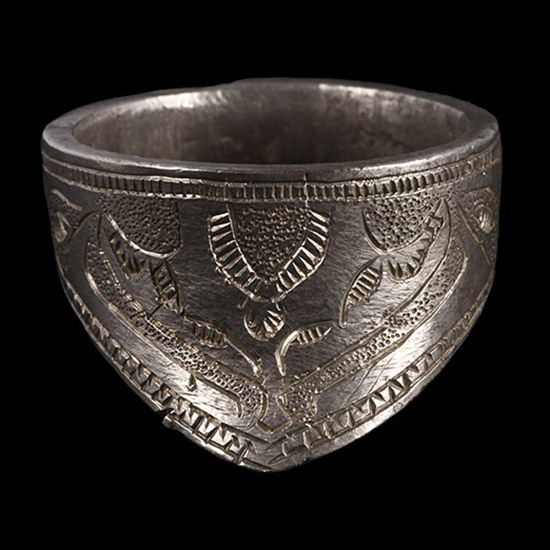
Large Byzantine Silver Archer's Ring
14th-15th century A.D.Estimate: £400 - 600 (+bp*)
Opening Bid: £200
Comprising a hoop with reserved triangular ornament on the edges and triangular plaque with foliage motifs, raised central panel with frond motif. 22.61 grams, 34.77 mm overall, 25.16 mm internal diameter
Acquired in the 1990s. Ex Cambridgeshire, UK, collection.
Archer rings in Late Byzantium and the medieval Balkans were connected with the employment of the powerful composite bow, but very often, in the 14th century they served as insignia of rank for aristocratic noblemen. Archaeological findings of archers’ rings originate mainly from fortified towns, including mining centres. Many were made in bone, simple in design and undecorated. In contrast, the ones made in bronze and silver were usually decorated in rather uniform style, consisting of floral motifs on the head, mostly tulip and foliage, and linear motifs around the edges. This decoration combined Turkish, Central European and Eastern Roman traditional patterns. -
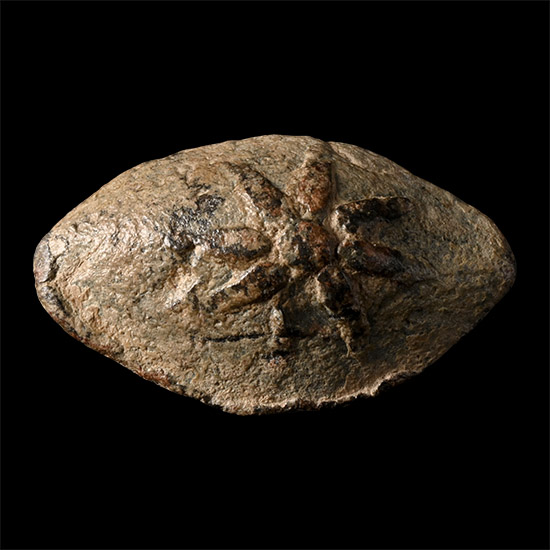
Greek Lead Slingshot with Macedonian Star
3rd-1st century B.C.Estimate: £60 - 80 (+bp*)
Bids: 1 | Current Bid: £5
Biconical in profile with a casting seam and a rayed solar symbol, the so-called Argead Star, on one side. 27.2 grams, 30 mm
Ex German art market, 2000s. Acquired from an EU collector living in London. From the collection of a Surrey, UK, gentleman.
The rayed solar symbol (Argead Star, Vergina Star) is interpreted as the historical royal symbol of the ancient Macedonian Dynasty of the Argeads, with its most famous member being Alexander the Great. -
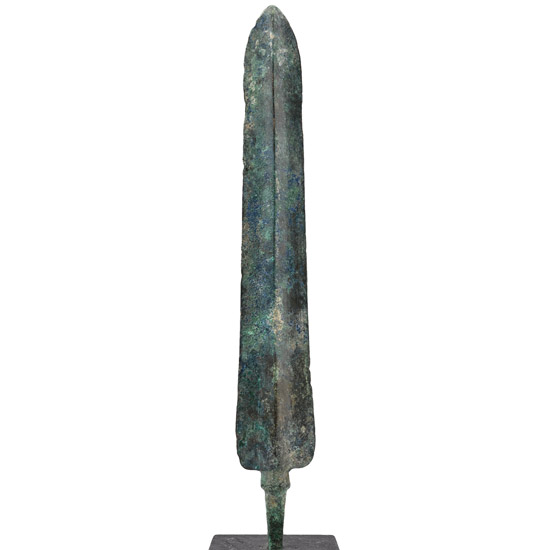
Luristan Bronze Spearhead
1000–650 B.C.Estimate: £100 - 140 (+bp*)
Opening Bid: £5
Slender blade with raised midrib, a collar beneath the shoulders and a rectangular-section tang; set in a custom-made stand. 96 grams total, 20.5 cm including stand
Acquired on the UK art market. Private collection, Suffolk. -
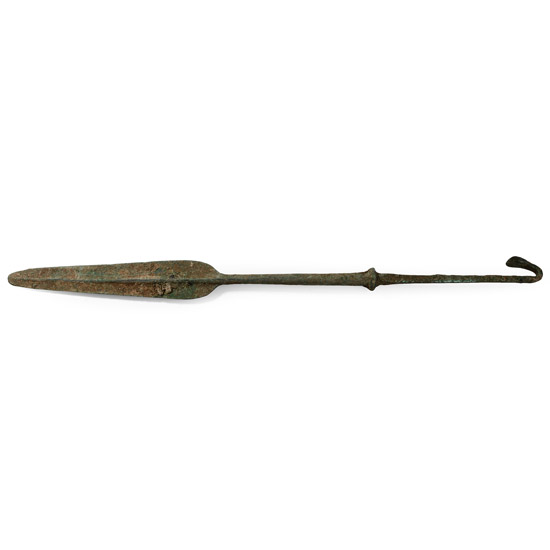
Luristan Bronze Tanged Spearhead
2nd-1st millennium B.C.Estimate: £100 - 140 (+bp*)
Opening Bid: £50
Featuring a slender leaf-shaped blade with a long tapering shaft and a rectnagular-section tang with a bent finial. 197 grams, 43.1 cm
Ex Abelita collection, 1990s. -
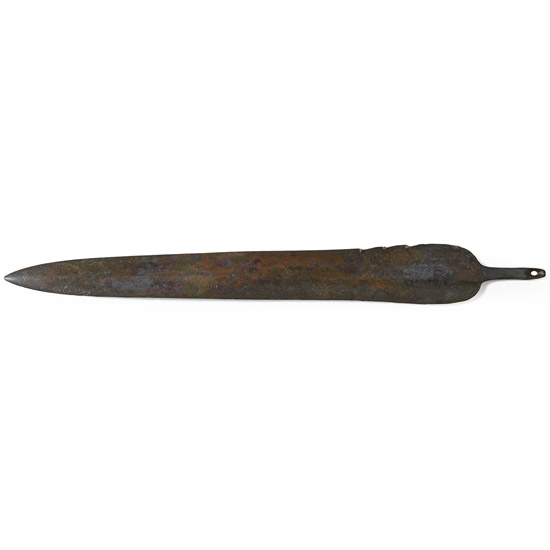
Western Asiatic Bronze Spear Blade
2nd-1st millennium B.C.Estimate: £180 - 240 (+bp*)
Opening Bid: £90
Comprising a tapering leaf-shaped blade with a raised midrib and a short tapering tang. 245 grams, 35 cm
Ex Abelita family collection, 1980s-2000s. -
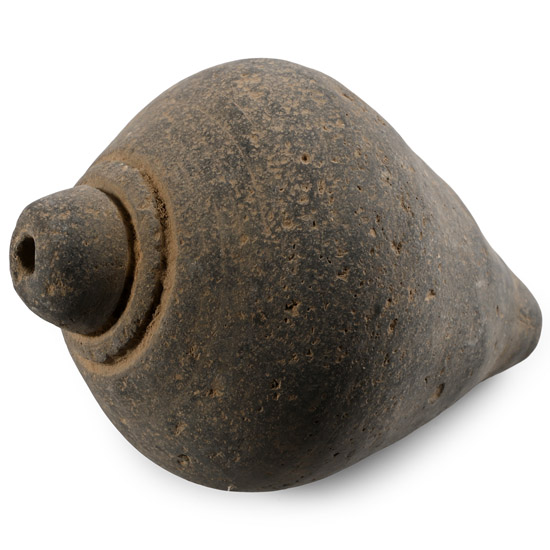
Byzantine 'Greek Fire' Ceramic Fire Bomb or Hand Grenade
9th-11th century A.D.Estimate: £80 - 100 (+bp*)
Opening Bid: £5
Piriform body with dome filler-hole; intended to be filled with explosive liquid and a wick, and used as a hand grenade. 536 grams, 12.7 cm
From an important specialist collection, London, UK, 1990s. Accompanied by an academic paper by military specialist Dr Raffaele D'Amato, dated 15 July 2019 and titled 'Eastern Roman Empire - Greek Fire Bomb or Hand Grenade (μεσαίον kακάβιον) 9th-11th century AD'.
Apart from the use of siphons or manual flame-throwers called cheirosiphona, special corps of Roman soldiers employed terracotta grenades, in the form of small jars, abundantly evidenced in archaeological excavations. They were called μεσαία kακαβιά or κυτροκακάβια, where the former had a bulbous shape and the latter a more cylindrical form.
