
Ancient Art, Antiquities, Books, Natural History, Stamps & Coins
Days 1-5
Open For Bidding
Open For Bidding

-
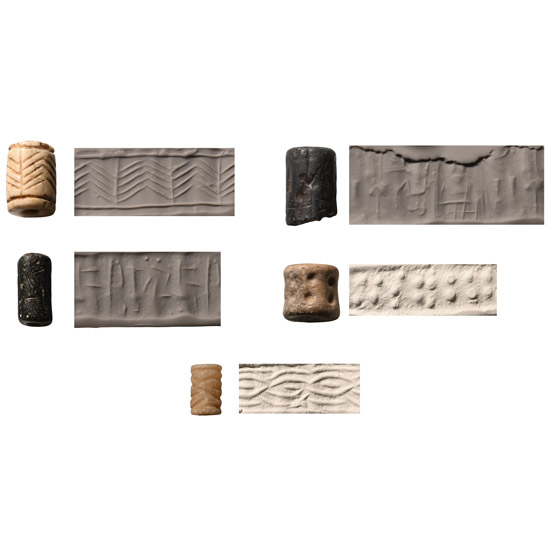
Western Asiatic Stone Cylinder Seal Group
3rd-2nd millennium B.C.Estimate: £80 - 100 (+bp*)
Opening Bid: £5
Comprising: a brown steatite seal with drilled motifs; a cream quartz seal with a geometric pattern; an intentionally broken hematite seal with a nude frontal woman, two small figures with antlers beneath, a male with curly hair and another figure with a long neck, a practise piece; a cram limestone seal with three tree motifs; a steatite seal with linear and pellet motifs; supplied with museum-quality impressions. 25.1 grams total, 13-21 mm
From the private collection of a European gentleman (1942-2024), formed since the 1970s. Accompanied by previous typed catalogue slips with collection nos.11, 12, 54, 62, 71. -
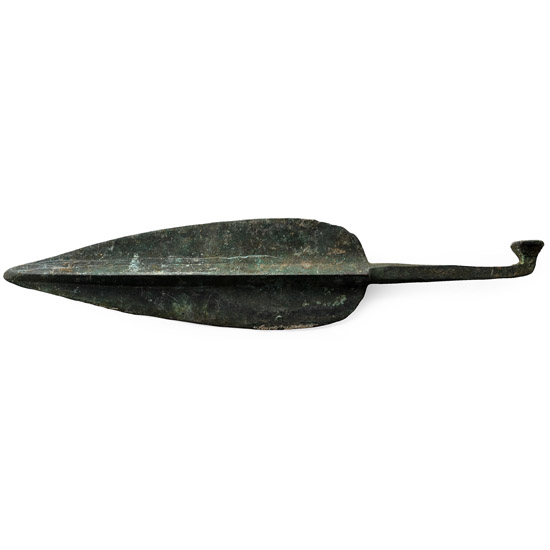
Western Asiatic Bronze Tanged Spearhead
14th-10th century B.C.Estimate: £100 - 140 (+bp*)
Opening Bid: £50
Leaf-shaped blade with raised midrib extending to the rectangular-section tang with a bent finial. 171 grams, 25.5 cm
Ex Abelita collection, 1990s. -
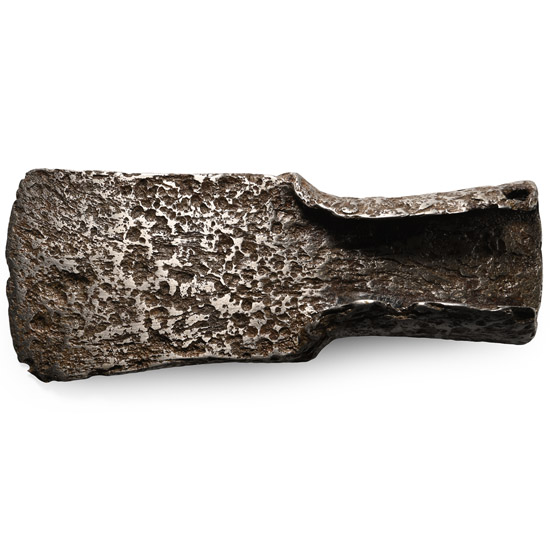
Celtic Iron Winged Axehead
Late Hallstatt-Early La Tene Period, circa 800-450 B.C.Estimate: £60 - 80 (+bp*)
Opening Bid: £5
Gently curving cutting edge and a long extension to the rear with lateral wings; very rare. 390 grams, 14.8 cm
Ex M. Spiegelberg collection, since 1991; thence by descent. Accompanied by a previous yellow cataloguing slip. -
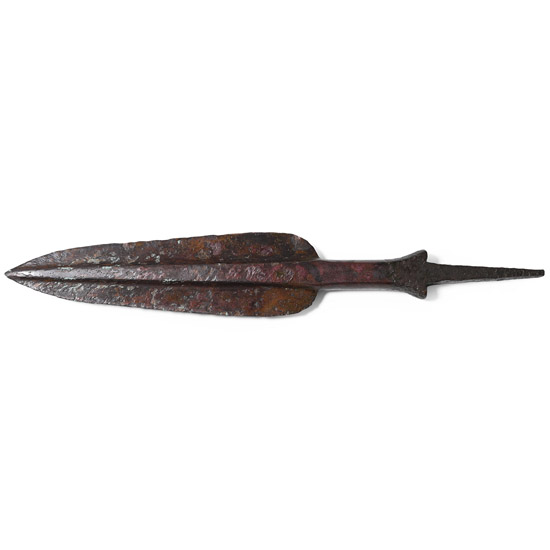
Western Asiatic Bronze Spear Blade
2nd-1st millennium B.C.Estimate: £180 - 240 (+bp*)
Opening Bid: £90
With an ovate blade, prominent central rib and rounded shoulders, square-section shaft with flared lateral spurs forming a collar, rectangular tang with narrow tip. 347 grams, 29.6 cm
Ex Abelita family collection, 1980s-2000s. -
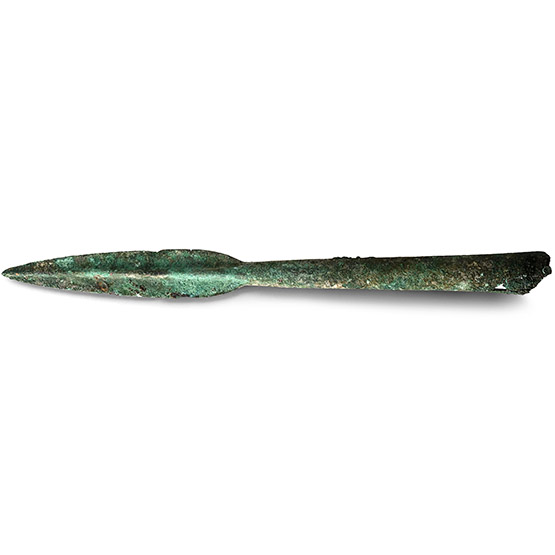
Western Asiatic Bronze Spearhead
9th-7th century B.C.Estimate: £100 - 140 (+bp*)
Opening Bid: £56
Comprising a leaf-shaped blade with a midrib and a long tapering socket; accompanied by a display stand, repaired. 365 grams total, spearhead: 36.5 cm (38.2 cm including stand)
Ex Abelita family collection, 1980s-2000s.
The spear, belonging to type 3 of the Khorasani classification, was used by chariot fighters to strike each other or the enemy infantry from above. Similar specimens with longer sockets were excavated by Negahban in the Amlash area. According to Moorey, sockets as long, if not longer than the blade, are a characteristic of Iranian spearheads in the late 2nd and early 1st millennium B.C. A similar spearhead from the Tappeh Sialk has been dated to the 9th-7th century B.C. -
.jpg)
Indo-Persian Inlaid Iron Talwar with Scabbard
Early-mid 20th century A.D.Estimate: £400 - 600 (+bp*)
Opening Bid: £200
Comprising a curved damascened steel blade, hilt with horse-head pommel, knuckle-guard and stub quilolons; scabbard with two suspension points, inlaid white-metal detailing. 823 grams, 64 cm
Private collection, UK.
This is an example of a saber mass-produced for tourists at the turn of the 19th and 20th centuries. This is evidenced by the carelessly executed decoration of the engraved ornament covering the main part of the scabbard, as well as the inferior technique of decorating the hilt. However, it is a solid replica of the swords used in real combat. -
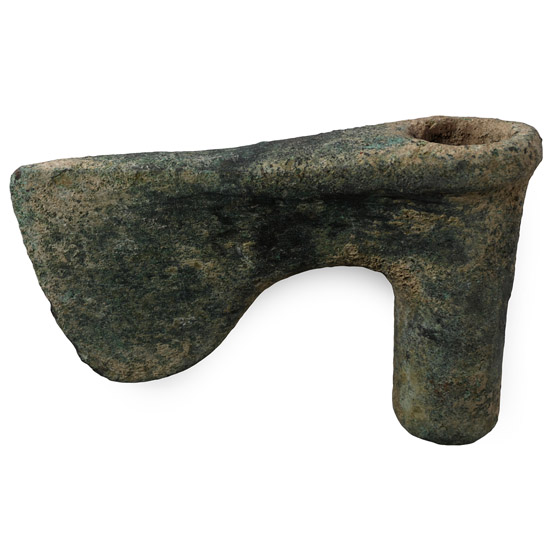
Luristan Bronze Axehead
2nd-1st millennium B.C.Estimate: £100 - 140 (+bp*)
Opening Bid: £50
With a short socketted shaft and flange to the mouth, broadening blade towards the cutting edge. 291 grams, 10.1 cm
Ex Abelita collection, 1990s. -
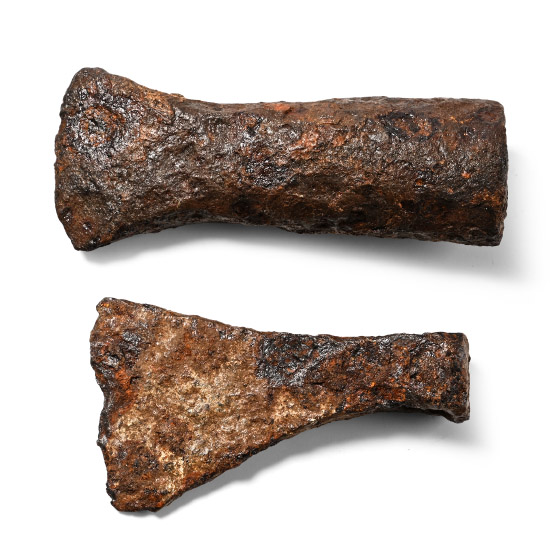
Medieval and Later Iron Axehead and Adze Group
15th-19th century A.D.Estimate: £30 - 40 (+bp*)
Opening Bid: £5
Comprising: small blade with offset triangular socket, flared edge; adze with split socket and small flared blade. 157 grams total, 69-82 mm
From the private collection of Mr Brian Edwards, New Malden, Surrey, UK, formed from the late 1970s-early 1980s; thence by descent. Accompanied by the original collector's data sheet(s) with reference nos.A72 & A73. -
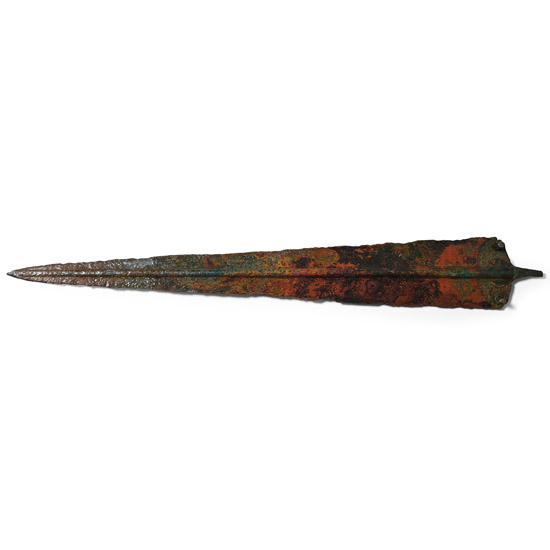
Luristan Bronze Tanged and Rivetted Spearhead
1st millennium B.C.Estimate: £180 - 240 (+bp*)
Opening Bid: £90
Comprising a triangular blade with a narrow midrib, a short tang with two attachment studs in situ. 184 grams, 32 cm
Ex Abelita family collection, 1980s-2000s. -
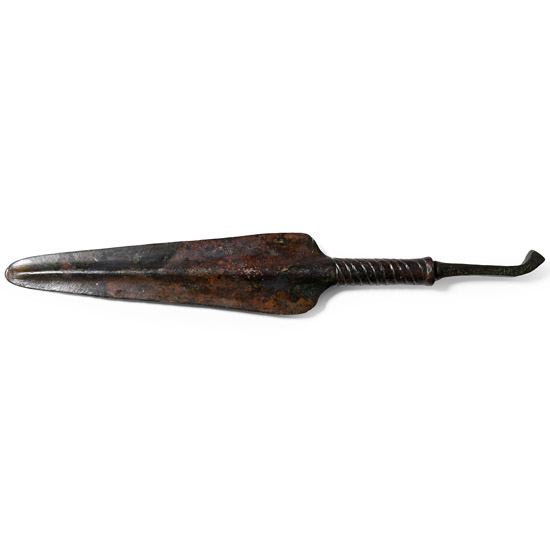
Western Asiatic Bronze Spear Blade
2nd-1st millennium B.C.Estimate: £180 - 240 (+bp*)
Opening Bid: £90
Comprising a triangular blade with a rounded tip, a flaring neck with incised barleytwist detailing, and a square-section tang with bent tip. 355 grams, 32.2 cm
Ex Abelita family collection, 1980s-2000s. -
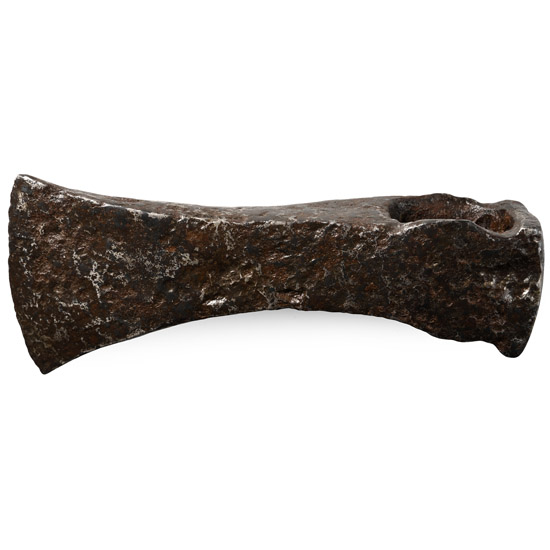
Late Roman Period Iron Narrow Axehead
Germany, 3rd-5th century A.D.Estimate: £40 - 60 (+bp*)
Opening Bid: £5
Narrow axe with curved blade and oval socket with a flat extension to the rear. 616 grams, 15.5 cm
Ex M. Spiegelberg collection, since 1991; thence by descent. Accompanied by a previous yellow cataloguing slip. -
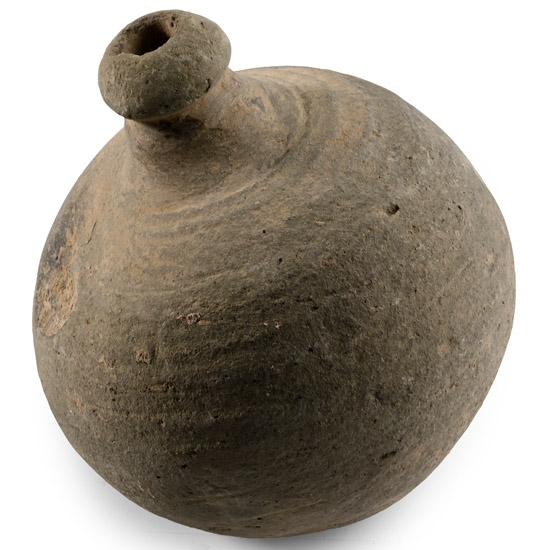
Byzantine 'Greek Fire' Ceramic Fire Bomb or Hand Grenade
9th-11th century A.D.Estimate: £80 - 100 (+bp*)
Opening Bid: £5
Bulbous body with rounded base and domed filler-hole; intended to be filled with explosive liquid and a wick, and used as a hand grenade. 682 grams, 11.3 cm
From an important specialist collection, London, UK, 1990s. Accompanied by an academic paper by military specialist Dr Raffaele D'Amato, dated 15 July 2019 and titled 'Eastern Roman Empire - Greek Fire Bomb or Hand Grenade (μεσαίον kακάβιον) 9th-11th century AD'.
Apart from the use of siphons or manual flame-throwers called cheirosiphona, special corps of Roman soldiers employed terracotta grenades, in the form of small jars, abundantly evidenced in archaeological excavations. They were called μεσαία kακαβιά or κυτροκακάβια, where the former had a bulbous shape and the latter a more cylindrical form.
