-
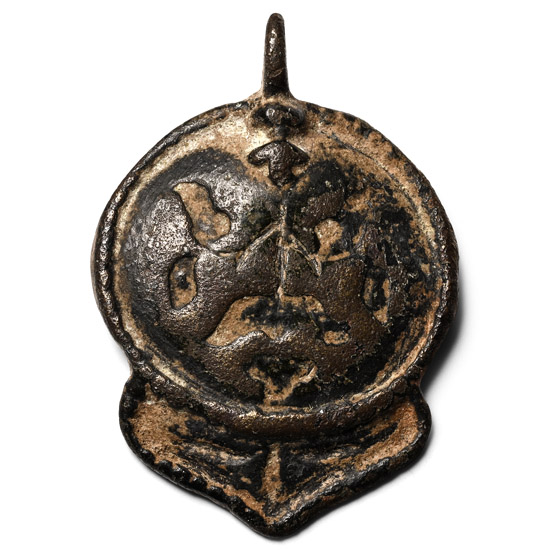
Eastern Roman Bronze Horse Harness Pendant
Circa 15th century A.D.Sold for (Inc. bp): £59
Comprising a slightly domed disc with raised border and triangular flange to the lower edge; suspension loop above and remains of slider bar to reverse; incuse foliage design. 10.4 grams, 45 mm
From the private collection of a European gentleman (1942-2024), formed since the 1970s. -
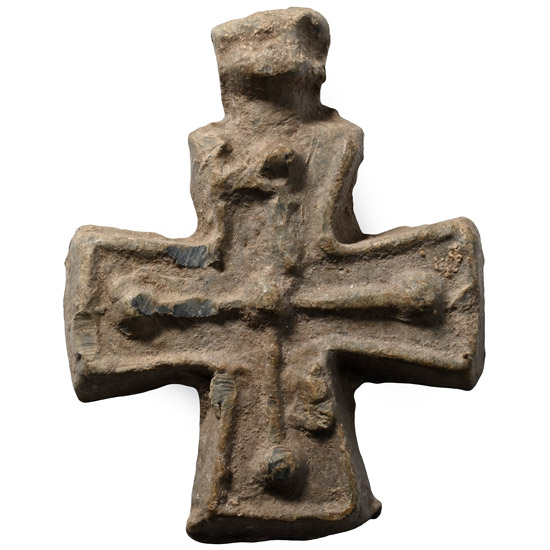
Byzantine Lead Cross Pendant
Circa 6th-8th century A.D.Sold for (Inc. bp): £20
Heavy equal-armed cross with raised borders and a raised central cross motif, integral loop. 27.8 grams, 40 mm
From the private coin collection of a West London, UK, gentleman, formed since the mid 1980s. -
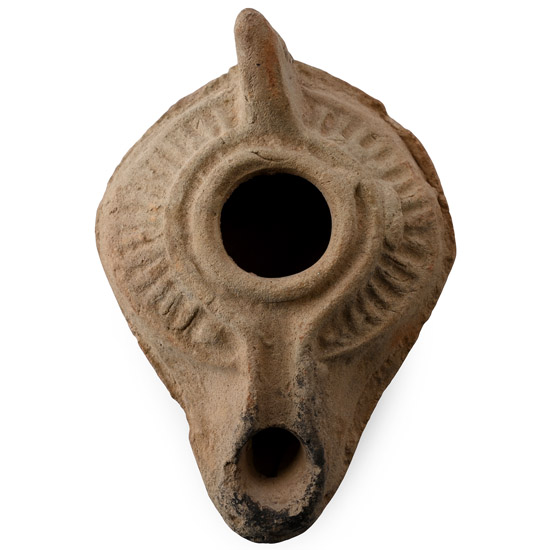
Byzantine Terracotta Oil Lamp with Stub Handle
Circa 7th-8th century A.D.Sold for (Inc. bp): £65
Small lamp with linear decoration on the shoulder, tapering handle to the rear and low basal ring. 73 grams, 84 mm
From the collection of a Cambridge, UK, gentleman, by direct descent from his father, who acquired the items in London in circa 1960. -
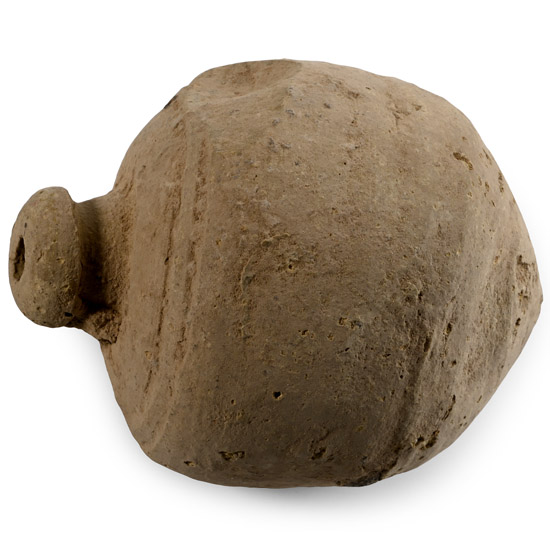
Byzantine 'Greek Fire' Ceramic Fire Bomb or Hand Grenade
9th-11th century A.D.Sold for (Inc. bp): £91
Bulbous body with pointed base and domed mouth, two circumferential bands on the shoulder; intended to be filled with explosive liquid and a wick, and used as a hand grenade. 378 grams, 10.3 cm
From an important specialist collection, London, UK, 1990s. Accompanied by an academic paper by military specialist Dr Raffaele D'Amato, dated 15 July 2019 and titled 'Eastern Roman Empire - Greek Fire Bomb or Hand Grenade (μεσαίον kακάβιον) 9th-11th century AD'.
Apart from the use of siphons or manual flame-throwers called cheirosiphona, special corps of Roman soldiers employed terracotta grenades, in the form of small jars, abundantly evidenced in archaeological excavations. They were called μεσαία kακαβιά or κυτροκακάβια, where the former had a bulbous shape and the latter a more cylindrical form. -
.jpg)
Byzantine Bronze Ring with Warrior Saint
12th-13th century A.D.Sold for (Inc. bp): £91
D-section hoop with keeled shoulders, polygonal bezel with a stylised nimbate figure. 6.65 grams, 23.80 mm overall, 18.91 mm internal diameter (approximate size British Q 1/2, USA 8 1/4, Europe 18.12, Japan 17)
Acquired on the UK and EU art market before 2000. From the private collection of a Surrey, UK, gentleman.
This category of rings had a hexagonal-rounded chaton raised above the link. Conforming to the iconography of the Orthodox countries under the influence of Byzantium, the possible decoration was related to military saints. -
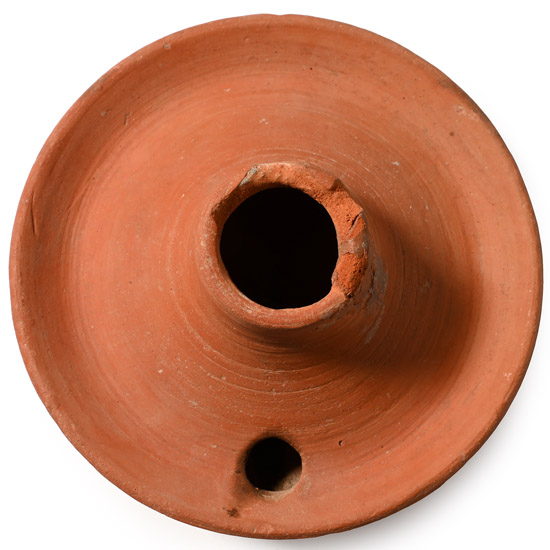
Byzantine Terracotta Discoid Oil Lamp
Circa 6th-8th century A.D.Sold for (Inc. bp): £33
Circular lamp with raised flange on the rim, short conical neck and a low basal ring. 181 grams, 95 mm
From an important collection of lamps, Germany, 1970s. -
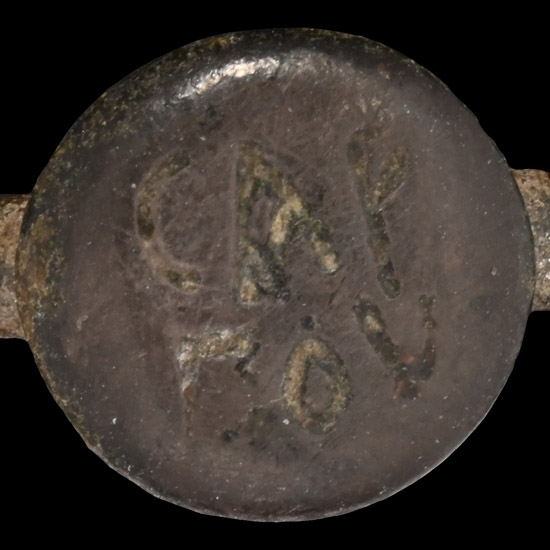
Byzantine Bronze Ring with Two-Line Inscription
6th-8th century A.D.Sold for (Inc. bp): £20
Featuring a slender hoop and circular bezel inscribed with 'CAP / ΓOV'. 1.59 grams, 21.30 mm overall, 17.50 mm internal diameter (approximate size British N, USA 6 1/2, Europe 13.72, Japan 13)
From the private collection of a European gentleman (1942-2024), formed since the 1970s. -
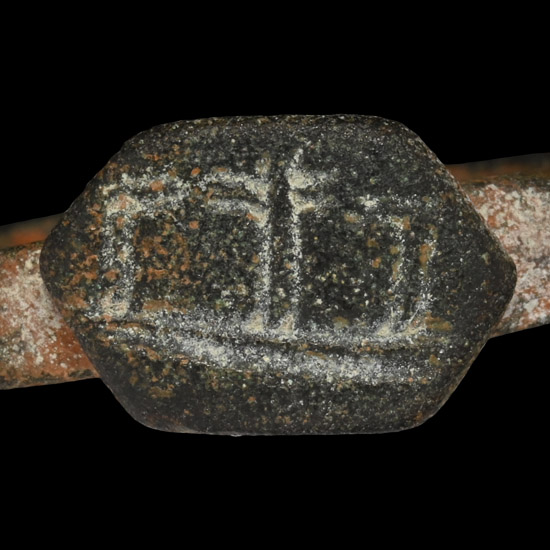
Byzantine Bronze Ring with Three Crosses of the Crucifixion
Circa 5th century A.D.Sold for (Inc. bp): £98
Comprising a D-section hoop and a hexagonal bezel with three crosses on a baseline. 4.23 grams, 23.24 mm overall, 19.00 x 17.01 mm internal diameter (approximate size British N 1/2, USA 6 3/4, Europe 14.35, Japan 13)
From the private collection of a European gentleman (1942-2024), formed since the 1970s. -
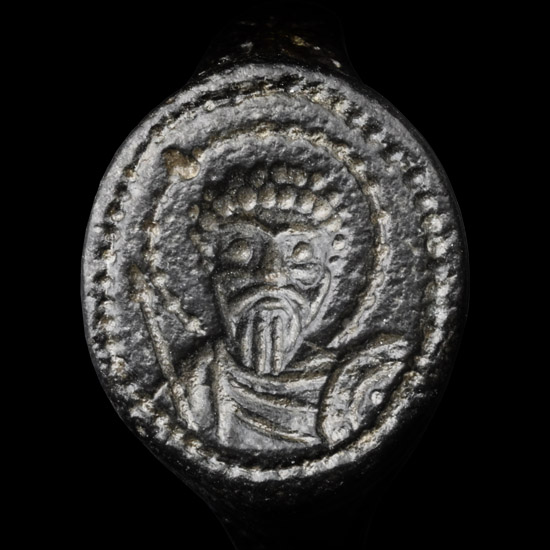
Byzantine Ring with Bust of Saint Theodore
12th-14th century A.D.Sold for (Inc. bp): £546
Slender hoop with decorated shoulders, an oval bezel with a facing nimbate bust holding a shield and a spear. 5.59 grams, 23.22 mm overall, 18.80 mm internal diameter (approximate size British Q, USA 8, Europe 18.12, Japan 17)
Ex German art market, 2000s. Acquired from an EU collector living in London. From the collection of a Surrey, UK, gentleman. -
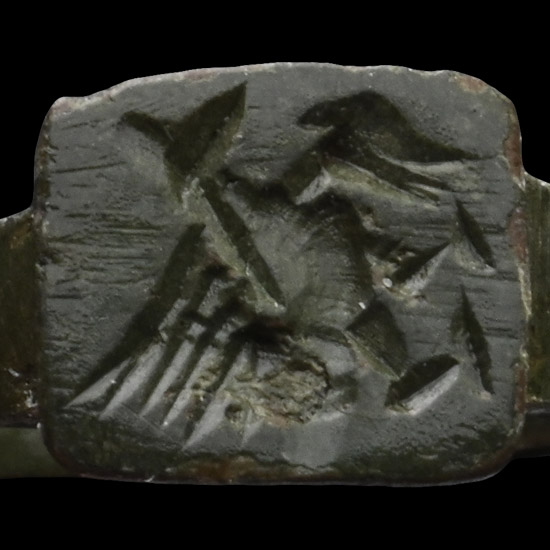
Byzantine Bronze Ring with Gryphon
6th-8th century A.D.Sold for (Inc. bp): £111
With a rectangular-section hoop and a raised rectangular bezel with a stylised gryphon. 3.05 grams, 22.01 mm overall, 17.76 mm internal diameter (approximate size British M, USA 6, Europe 12.46, Japan 12)
From a UK collection formed in the 1980s. Property of an Essex, UK, gentleman. -
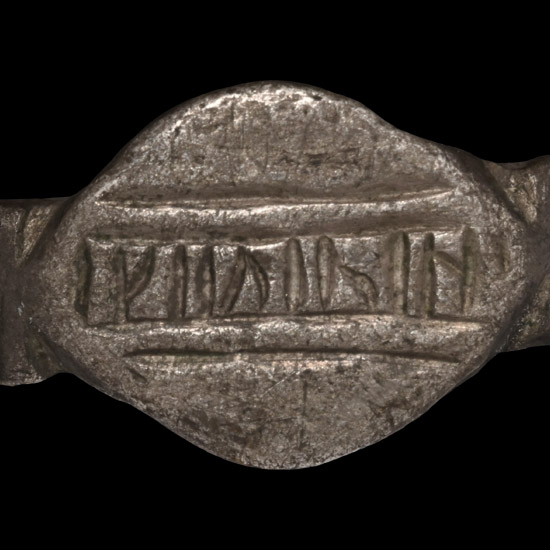
Byzantine Silver Ring with Inscription
6th-7th century A.D.Sold for (Inc. bp): £117
Featuring a flat-section hoop and a lentoid bezel with an inscription. 0.90 grams, 15.46 mm overall, 14.01 mm internal diameter (approximate size British F 1/2, USA 3, Europe 4.3, Japan 4)
From the private collection of a European gentleman (1942-2024), formed since the 1970s. -
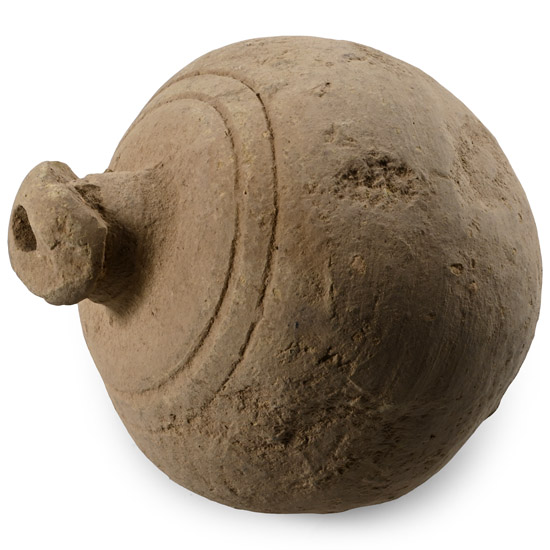
Byzantine 'Greek Fire' Ceramic Fire Bomb or Hand Grenade
9th-11th century A.D.Sold for (Inc. bp): £72
Bulbous body with pointed base and domed mouth, two circumferential bands above the shoulder; intended to be filled with explosive liquid and a wick, and used as a hand grenade. 403 grams, 10.5 cm
From an important specialist collection, London, UK, 1990s. Accompanied by an academic paper by military specialist Dr Raffaele D'Amato, dated 15 July 2019 and titled 'Eastern Roman Empire - Greek Fire Bomb or Hand Grenade (μεσαίον kακάβιον) 9th-11th century AD'.
Apart from the use of siphons or manual flame-throwers called cheirosiphona, special corps of Roman soldiers employed terracotta grenades, in the form of small jars, abundantly evidenced in archaeological excavations. They were called μεσαία kακαβιά or κυτροκακάβια, where the former had a bulbous shape and the latter a more cylindrical form.

