-
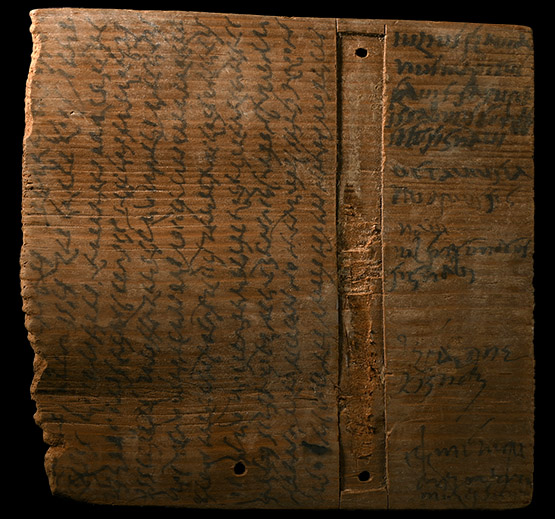
Roman Wooden Tablet with Marriage Pact Between Iulius Flavianus and the Mother of the Bride, Aurelia Salvia
322 A.D.Sold for (Inc. bp): £5,850
Rectangular wooden tablet, probably cedarwood, the outer side divided by a sulcus into a smaller part with names of witnesses and a greater part with 11 lines of inked text in Roman cursive script; three small holes near the rim, two in the sulcus, one on the right rim; the inner side with a recessed panel filled with wax with traces of writing; in an excellent state of preservation with signs of age. 24.97 grams, 13.5 x 14 cm
Acquired by Albert Sfez in the early 1950s. Formerly the property of Monsieur Alain Sfez, a Belgium collector; acquired by gift from his father Albert Sfez, in 1965. Acquired by a London dealer in 1973. From an important London collection since 1975; thence by descent. Accompanied by a copy of an illustrated academic report by Professor Dr phil. Peter Rothenhöfer.
Professor Dr Peter Rothenhöfer, Department of History (Zhuhai Campus) states: 'This important tablet shows that its use was apparently not restricted to the administrative sphere but widely spread in civic life and used for private purposes. As handwritten documents from the late 3rd and 4th century AD are quite rare, this tablet is generally of great importance for the history of Latin palaeography. The text is fluently written and shows a uniform typeface. Typical features of ancient writing can be observed: The text is continuously written without any separation between words (scriptio continua), sentences have no dots at the end.' Wax tablets written in Greek or Latin, were used by Romans as account registers (codices accepti et expensi); for transactions (for example, the tablets of the banker Lucius Caecilius Iucundus found in Pompeii); for lists of goods, inventories, and notes to be kept and archived; for Roman magistrates to annotate the salient events of their bureaucratical activities; for writing letters; for drawing up legal texts of various kinds: legacies, declarations of births and citizenship, reports of trials and diplomata militaria; and especially testaments in private civil law. -
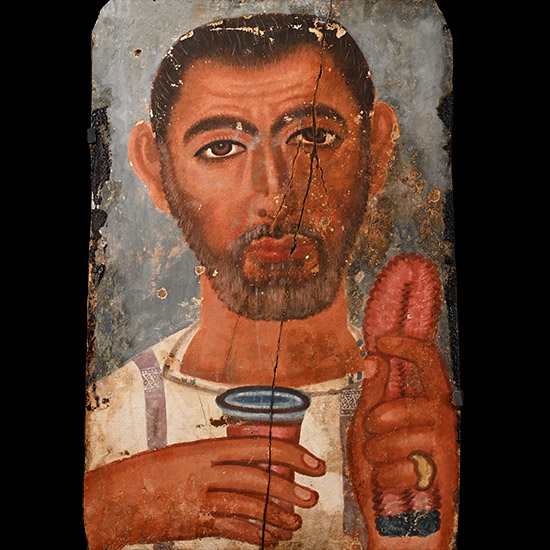
Roman Fayum Wooden Portrait of a Bearded Man
Egypt, 3rd-4th century A.D.Sold for (Inc. bp): £49,400
An intimate portrait depicting a middle-aged man with a slightly doleful expression, receding hair with grey flecks, and a furrowed brow, wearing a white tunic with lilac-coloured clavi (vertical stripes) and white stitching over a white undertunic; holding a glass vessel containing red liquid in his right hand, most probably wine, whilst his left hand cradles a garland of roses, a ring visible on the little finger of his left hand; the figure set against a pale blue background, painted in tempera on a wooden panel; set in a glazed display frame. 8.53 kg total, 50 x 37.5 cm including frame
International art market, by at least 1997. with Sotheby’s, London, 12 June 1997, Western Asiatic Antiquities and Cylinder Seals from the Erlenmeyer Collection (Part II), no.338 (£40,000-£50,000). Private collection of an Italian scholar, New York. Accompanied by a copy of an Art Loss Register certificate no.S00271547. Accompanied by copies of the relevant Sotheby's catalogue pages. This lot has been checked against the Interpol Database of stolen works of art and is accompanied by search certificate number no.13315-257736.
From the late 19th century onwards, a large number of painted wooden portraits began to appear on the European and American art market, originating from the Fayum region of Egypt, to the southwest of Cairo, where wealthy Romano-Egyptian families buried their dead. Following ancient custom, the mummified body was fitted with a painted wood portrait over its face, preserving the likeness of the deceased for eternity. In 1887, over three hundred such portraits were acquired by the Austrian dealer Theodor Graf (1840–1903) from the cemetery of Er-Rubayat, on the northeast side of the Fayum. Portraits from this area are characteristically identifiable by their clipped upper corners and the undertunics worn by the subjects, both features present in this work. During his lifetime, Graf sold ninety of these portraits, with the remainder disposed of by his heirs after his death. Examples from his collection entered many of the world's great institutions, including the Staatliche Museen zu Berlin, the National Gallery, London, and the British Museum, London. Two particularly close comparanda are of note. A portrait of a boy holding a garland and a glass vessel containing liquid, also from Er-Rubayat, is held in the Brooklyn Museum (see The Brooklyn Museum Handbook, Brooklyn, 1967, p. 100). An even closer parallel exists in the J. Paul Getty Museum, Malibu, likewise from Er-Rubayat (see E. Doxiadis, The Mysterious Fayum Portraits: Faces from Ancient Egypt, 1995, p. 221, no. 7; and S. Walker and M. Bierbrier, Ancient Faces: Mummy Portraits from Roman Egypt, exhibition catalogue, London, 1997, p. 102, no. 95). Significantly, the distinguished scholar Dr Klaus Parlasca attributed both the Brooklyn and Getty portraits to a single anonymous master he designated as the Brooklyn Painter, and some years ago suggested that the present portrait may be attributed to the same hand. Should this attribution hold, this work joins a small and distinguished group of panels recognised as the output of one of the most accomplished artists working in Roman Egypt. -
.jpg)
Roman Bronze Pyre on Base Dedicated by Aurelius Rufus
Circa 3rd century A.D.Sold for (Inc. bp): £2,210
Model of an altar with tiered flames, socle base with flared base and pointillé Greek inscription in two lines: 'AYPHΛ [vine leaf] POYΦΟC THEω ΦΑΛ / [/]AMAE ZAMΕΝΟC ]ANETHEKEN': for 'Aurelius Rufus dedicated this for the god FAL ... The Roman name of the dedicant as well as the letter forms point most probably to the 3rd century A.D. 731 grams, 11.5 cm
Ex collection, before 1980. Private collection, Netherlands. -
.jpg)
Roman Bronze Figure of Hercules with Lion-Skin Headdress
2nd century B.C.Sold for (Inc. bp): £780
Depicting Hercules in heroic nudity, standing with his legs slightly apart, the right leg set back and the left, slightly bent, advanced outward; his right arm raised, the forearm bent at a right angle, while the clenched hand originally held a club, now lost; the left arm extending forward and supporting the lion skin; the left hand, also clenched, probably held a further attribute; the stylised lion skin draped over the hero's head, terminating in two pointed flaps at either side, and fastened across the chest with the so-called 'Heracles knot', beneath which the forepaws of the lion are rendered with deeply incised claw; accompanied by a display stand. 443 grams total, 14 cm including stand
The surface retains a thick, undisturbed green patina. Minor losses are present and may plausibly be interpreted as the result of ritual damage in antiquity.
Acquired in Germany before 2000s. English private collection. Bertolami Fine Art, London, Auction 85, 14 December 2020, no.11. This lot has been checked against the Carabinieri Database of stolen works of art.
The sculpture reproduces the iconographic type of the charging Hercules, a motif widely attested in ancient Italy, particularly in the Umbro-Sabellian region, and ultimately derived from the Magna Graecia artistic tradition. The widespread adoption of this iconographic scheme, repeated with only minor variations, reflects the development of local cults dedicated to the hero, who was at times assimilated to indigenous deities. It has also been suggested that this type ultimately derives from a bronze original identified as the Herakles Alexikakos, attributed to the Argive sculptor Hageladas, active between the late 6th and early 5th century B.C. -
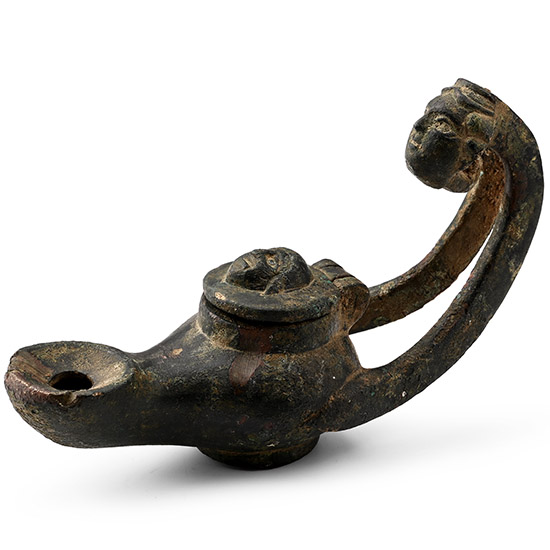
Roman Bronze Oil Lamp with Masks
1st-2nd century A.D.Sold for (Inc. bp): £1,170
With an elongated body, long nozzle with a rounded tip; raised rim to filling hole with hinged lid bearing a mask with sockets to the eyes for silver inserts; handle curved and terminating in a female mask with hair dressed in tiers, eyes recessed to be inlaid with silver; broad nozzle with cup and raised rim; socket to underside for mounting on a stand. 560 grams, 15.5 cm
From the collection of a gentleman, acquired on the London art market in the 1990s.
The lamp is crafted in a very fine style, probably in a classical form from the 1st or 2nd century. It belongs to a type known and widespread in the Mediterranean, with parallels in Paris, Madrid, the museums of Cadiz, Tarragona, and Aquileia. -
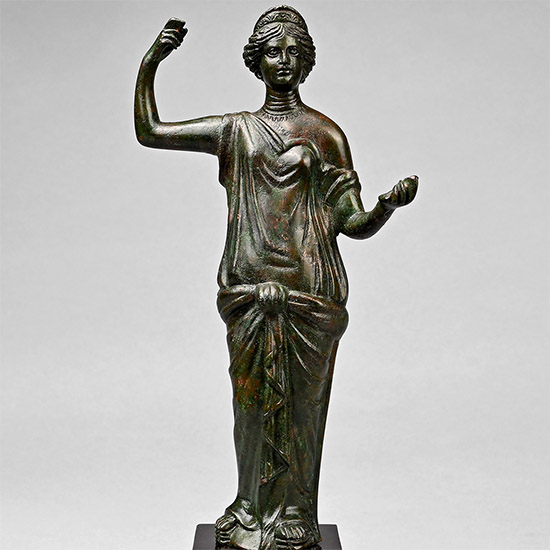
Roman Bronze Statuette of the Goddess Juno
3rd-4th century A.D.Sold for (Inc. bp): £9,750
A substantial hollow-form figure of Juno (Greek Hera) standing with right hand in gripping pose, left hand extended palm-upwards, engraved collar to the neck and diadem to the hair, palla gathered at the waist, slipping from the right shoulder; mounted on a custom-made stand. 693 grams total, 25 cm high including stand
Horatio and Patsy Melas Collection, Alexandria and later Switzerland, acquired by 1960 and until 1989. Kyros Melas Collection, London, 1989 until 1999. with Bonhams, Knightsbridge, 21 October 1999, no.178 [£6,000-£8,000]. Private collection, London. Accompanied by copies of the relevant Bonhams catalogue pages. This lot has been checked against the Interpol Database of stolen works of art and is accompanied by search certificate number no.13308-258228.
The figure's pose recalls that of the statue of Juno Sospita in the Vatican Museum, Rome, inv. no.241. Horatio Melas was born in 1904 into a family of Greek merchants established in Alexandria, Egypt. It was there that he met and, in 1960, married Patsy, and together they maintained the family collection. Following the family's departure from Egypt in 1967, the collection was relocated to Switzerland, remaining there until 1989, when their son, Kyros Melas, settled in London. Kyros, who worked in the City as a private equity trader, continued to care for the collection and occasionally added to it during the 1990s. -
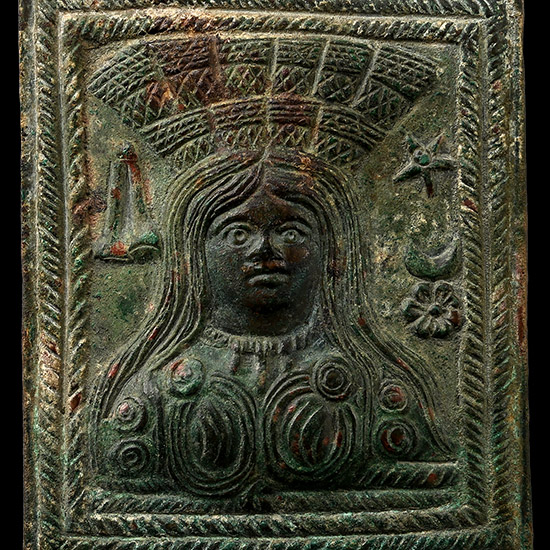
Roman Bronze Plaque with Goddess Cybele
3rd century A.D.Sold for (Inc. bp): £2,340
Rectangular plaque with stepped herringbone border, facing bust of Cybele with flaring turret-crown and cascading hair, symbols in the field. 430 grams, 94 mm
From the collection of a European gentleman living in South London; acquired 1970-1980. This lot has been checked against the Interpol Database of stolen works of art and is accompanied by search certificate number no.13307-258227.
Cybele was the great Phrygian mother of the gods, and goddess of motherhood, fertility and the mountain wilds. -
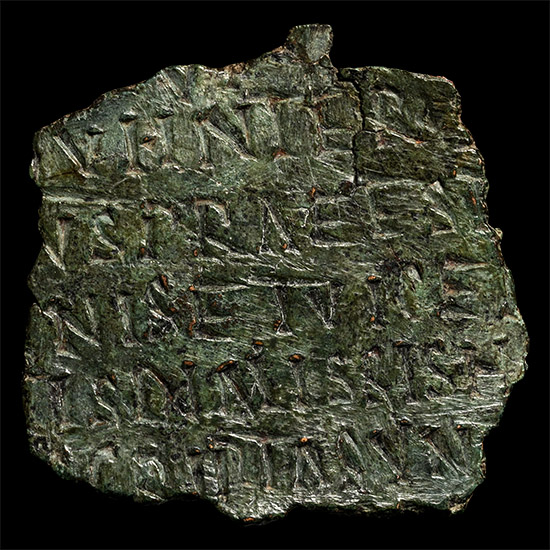
Fragment of a Roman Bronze Military Diploma Granted by Emperor Septimius Severus
195 A.D.Sold for (Inc. bp): £1,300
Issued for a member of the equites singulares Augusti, the emperor’s horse guards; granted by Septimius Severus in the summer of AD 195, during his Parthian expedition; obverse with seven lines of text with well engraved letters: (1) [… IMP] • VI • C[OS …] / (2) [EQVITIBVS Q]VI•INTER•S[INGVLAR MILITAVERVNT CASTRIS] / (3) [NOVIS QVIB]VS PRAEEST [. . .] / (4) [TRIBVNVS QVI]NIS ET VICEN[IS PLVRIBVSVE STIPENDIS] / (5) [EMERI]TIS DIMISSIS H[ONESTA MISSIONE QVORVM] / (6) [NOMINA SVB]SCRIPTA SVNT [CIVITATEM ROMANAM] / (7) . . . + ++ . . . . On the inner face traces of 7 lines of text: (1) [- - -]MAX·TR[IB / (2) [- - -]+ COS [- - -] / (3)[EQVITIBVS QVI I]NTER·SINCV[LAR MILITAVER CASTRIS] / (4) [NOVIS QVIBVS] PRAEEST + [- - -] /(5) TRIBVNVS] QVINIS ET VI[CENIS PLVRIBVSVE STIPENDIS] / (6) [EMERITIS] DIM[ISSIS HONESTA MISSIONE QVORVM] / (7) +++. 27.13 grams, 50 mm
Property of a European gentleman, acquired on the London art market. -
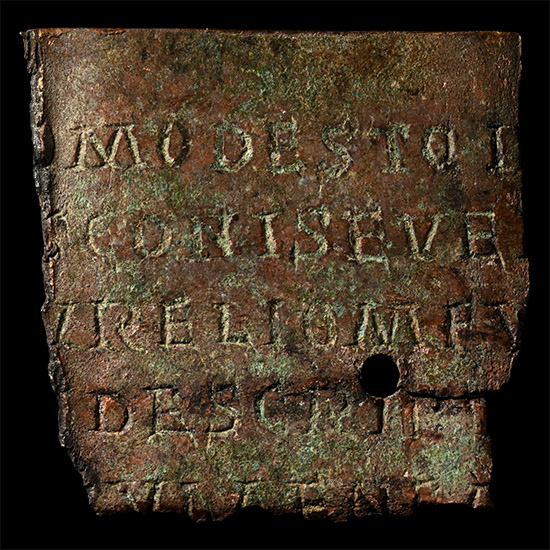
Roman Bronze Diploma Fragment
3rd century A.D.Sold for (Inc. bp): £1,170
Bifacial fragment with piercing at one corner; Side A - trilinear margin with seriffed legend 'QVI MILI[TAVERUNT ...IN CO-] / HORTIBVS [PRAETORIIS SE-]/ VERIANIS [DECEM I II III] / IV V VI [VII VIII VIIII X] / PIIS VIND[ICIBUS]' and below ']TAVERVN['; Side B - legend set perpendicular to reverse 'MODESTO / S CONISEVE / M A]VRELIO M F V[LP SECVNDO --- / +DESCRIPT[VM ---'. 20.75 grams, 46 mm
Ex German art market, 2000s. Acquired from an EU collector living in London. From the collection of a Surrey, UK, gentleman. -
.jpg)
Roman Bronze Diploma Fragment
228 A.D.Sold for (Inc. bp): £910
Rectangular fragment with irregular clipped edges; Side A - trilinear concentric border to the corner; Side B - inscription in serifed capitals '[.]NAS IN MATRI[MONIO / [D]VXERINT PRIO[---] / [.]TOLLANT AC SI [---] / [CIVI]BVS RO[M]ANIS [---] / [ID]VS IANQATICI / [M.] MAECIO PRO[BO COS] / [.]A SEVERIANA'. 28.4 grams, 56 mm
Ex German art market, 2000s. Acquired from an EU collector living in London. From the collection of a Surrey, UK, gentleman. -
.jpg)
Life-Size Roman Bronze Head of an Empress
Mid-3rd century A.D.Sold for (Inc. bp): £33,800
A member of the Imperial family, possibly an empress, depicted with an elaborate coiffure, the hair at the back of the head parted in the middle and the two strands folded over each other, then pulled to the front to form a looped horizontal layer parted in the middle of the smooth forehead and drawn back, individual curls represented as vertical lines along the forehead hairline up to the exposed ears, two locks hanging down the sides behind the ears, extending to the upper part of the neck; beautiful facial rendering with stoic expression, exquisite detailing to the eyebrows, eyelids and pupils; snub-nose, closed lips, thin and graceful neck; mounted on a custom-made display stand. 4.07 kg, 40.5 cm high including stand
Acquired on the German art market, early 1970s. German private family collection; by gift to the owner's son in 2015. Private collection, London. Accompanied by an academic report by Dr Raffele D'Amato, and Dr Marina Mattei, former curator of the Capitoline Museums for over 40 years. This lot has been checked against the Interpol Database of stolen works of art and is accompanied by a search certificate number no.12607-234556.
The oval, gaunt, deep-set eyes and the folds at the sides of the nose and mouth reveal the mature age of the woman depicted in the portrait. The woman’s head shows the typical traits of the full and mature 3rd century A.D., executed in a Hellenistic style tradition. Our sculpture fits well in the imperial portrait type, bearing technical and aesthetic parallels to portraits in bronze. The hairstyle could be Scheitelzopf (or reverse plait), tightened by a hairnet, pinned to the top of the head. The same type of hairstyle, albeit with variations in the details (decorative curls and position of the hair loop), is found on a few other portraits of women that were dated to the period of Gallienus by Marianne Bergmann. Some of the portraits in this typologically related group are likely to be private portraits. Hereby, physiognomic features and especially imperial coin portraits need to be taken into account. In this context, it is important to compare the portrait with that of Trebonianus Gallus in the MET. Like the sculpture of Trebonianus Gallus, the head fits stylistically with Roman provincial bronzes from the Eastern Mediterranean or North Africa, possibly from workshops of Asia Minor or from the great metropolis of Alexandria, where bronze statuary was more common and Hellenistic influences remained strong. -
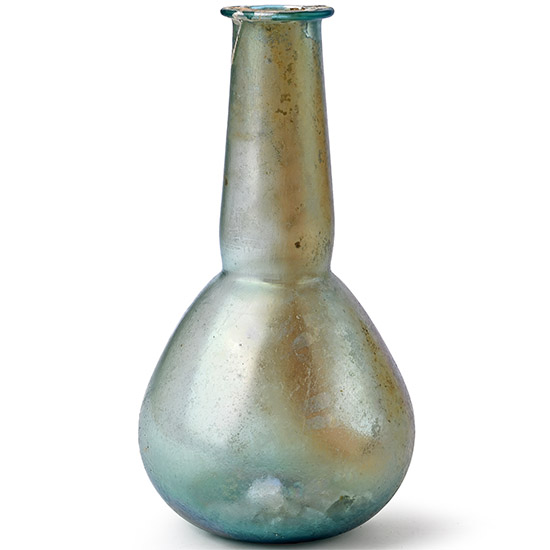
Large Roman Blue Glass Toilet Bottle
1st century A.D.Sold for (Inc. bp): £494
With a piriform body with a dimple base, a long tubular neck with an everted rim. 194 grams, 18.2 cm
From an important London, UK, collection 1980-2020.
The toilet bottle corresponds to the Isling Form 28a or Vessberg flask type A.III.a. The transparent greyish green glass suggests that the object belongs to the Hayes' fabric 2 of Cypriot blown glass.

