-
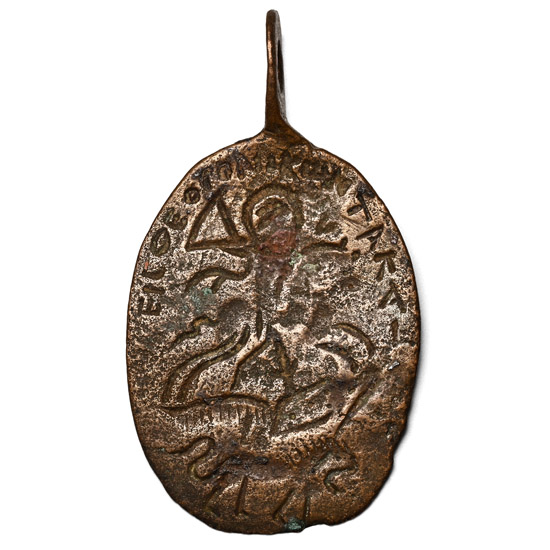
Eastern Roman Bronze Amulet with Saint Spearing the Dragon
Circa 14th century A.D.Sold for (Inc. bp): £247
Oval pendant with integral suspension loop, one side with armoured Saint Theodore or Saint George on horseback slaying the dragon with a barbed spear, a lion beneath and a Greek inscription on the upper edge 'EICΘEOCONIKѠNTAKAK = εἷς θεός ὁ νικῶν τά κακ(ά)' = the one god who defeats evil; the reverse with four animals (two lions, a snake, an ibis and a scorpion) reaching towards an altar or a boat, a Greek inscription above 'ПІΝѠCAΒAѠΘΜIΧAΗΛ' = I drink, The God of the hosts, Michael. 8.77 grams, 56 mm
From the private collection of a European gentleman (1942-2024), formed since the 1970s. -
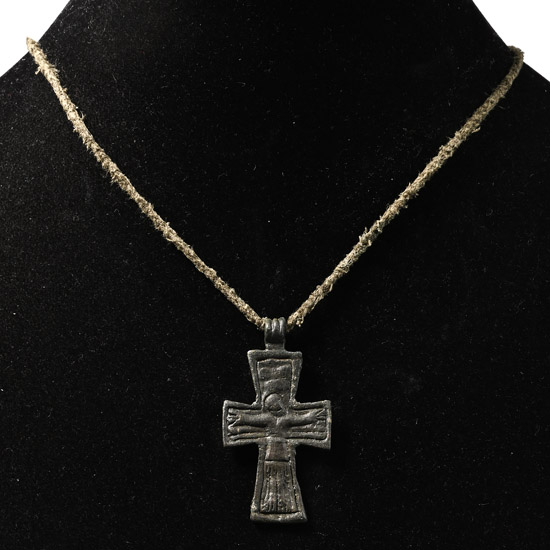
Byzantine Bronze Cross Pendant
Circa 10th-12th century A.D.Sold for (Inc. bp): £221
Expanding cross pendant with integral ribbed loop and a low-relief Corpus Christi on the obverse, suspended from a later fabric cord. 11.3 grams total, pendant: 53 mm
Acquired at the York Fair. Property of a Lancashire, UK, collector. -
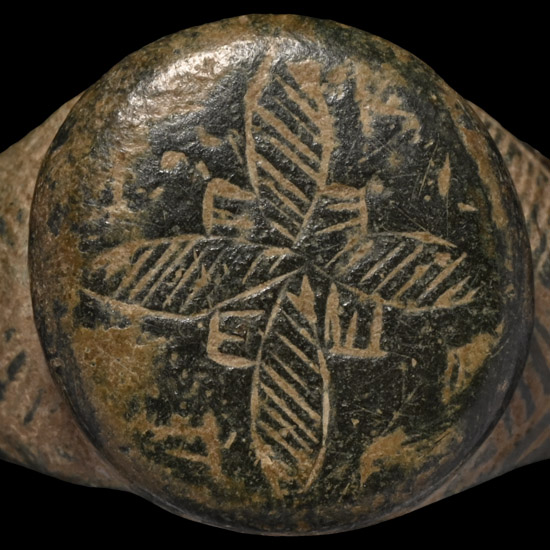
Byzantine Bronze Ring with Floral Cross
Circa 6th-8th century A.D.Sold for (Inc. bp): £65
With broad hoop and stud to the underside, drum-shaped bezel with hatching to the shoulders, incuse hatched cross. 15.11 grams, 26.76 mm overall, 19.02 mm internal diameter (approximate size British Q 1/2, USA 8 1/4, Europe 18.12, Japan 17)
From the private collection of Mr Brian Edwards, New Malden, Surrey, UK, formed from the late 1970s-early 1980s; thence by descent. Accompanied by the original collector's data sheet(s) with reference no.A89. -
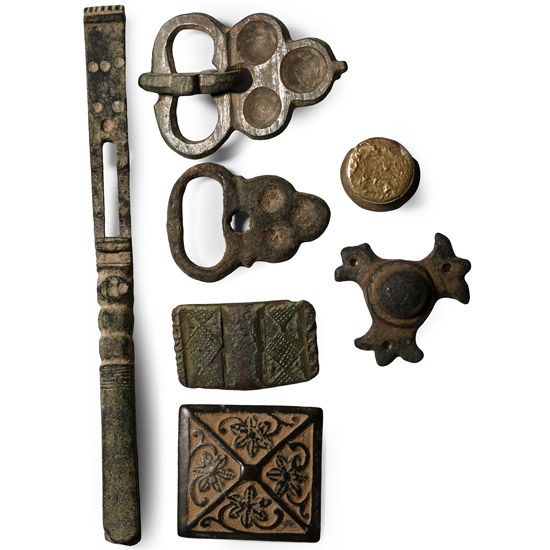
Byzantine Bronze Artefact Collection
6th-12th century A.D.Sold for (Inc. bp): £39
Including a book-clamp with sliding catch, belt buckle with trefoil plate and other items. 51.8 grams total, 14-96 mm
From the private collection of Mr Brian Edwards, New Malden, Surrey, UK, formed from the late 1970s-early 1980s; thence by descent. -
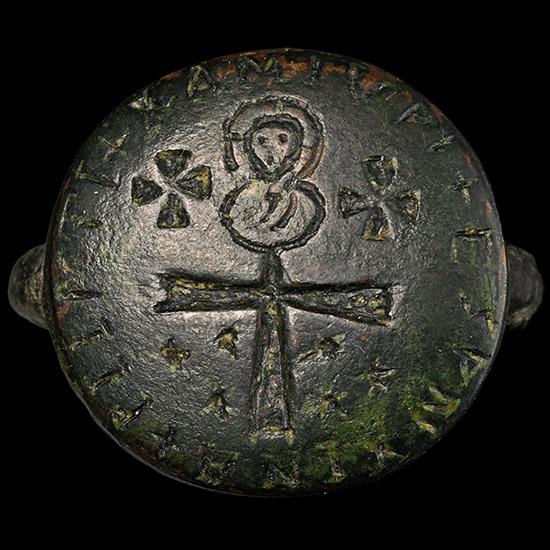
Large Byzantine Bronze Ring with Cross and Saint
Circa 6th-7th century A.D.Sold for (Inc. bp): £117
Comprising a thick round-section hoop and integral disc bezel; incuse cross with nimbate bust above flanked by two equal-arm crosses, enigmatic legend to the rim. 18.62 grams, 30.50 mm overall, 23.22 mm internal diameter (approximate size British U 1/2, USA 10 1/4, Europe 23.15, Japan 22)
Acquired circa 1980. Property of a Middlesex gentleman. -
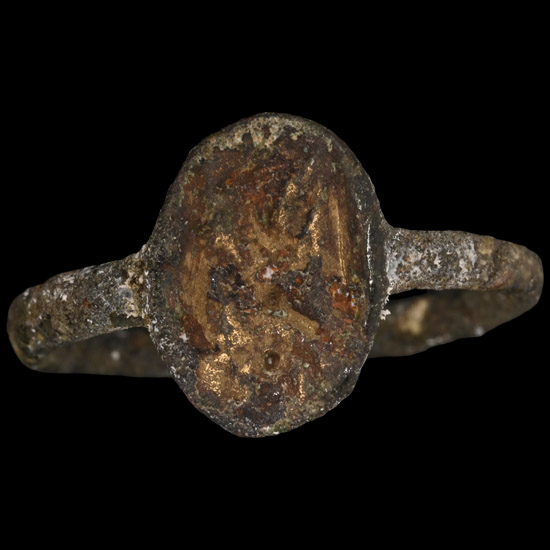
Byzantine Bronze Ring with Saint
6th-7th century A.D.Sold for (Inc. bp): £20
Featuring a D-section hoop and a perpendicular oval hoop with a standing saint holding a staff. 2.17 grams, 23.65 mm overall, 20.39 mm internal diameter (approximate size British U, USA 10, Europe 22.52, Japan 21)
From the private collection of a European gentleman (1942-2024), formed since the 1970s. -
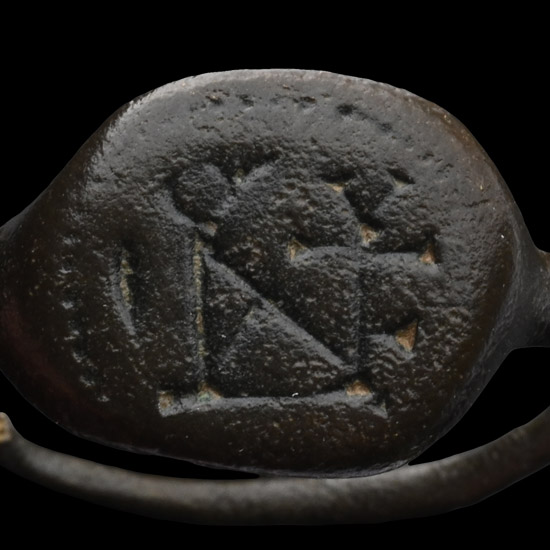
Byzantine Bronze Ring with Monogram
Circa 6th-8th century A.D.Sold for (Inc. bp): £26
Slender round-section hoop with an oval bezel bearing a monogram, the hoop split. 4.58 grams, 24.60 mm overall, 21.30 mm internal diameter (approximate size British U 1/2, USA 10 1/4, Europe 23.15, Japan 22)
Ex German art market, 2000s. Acquired from an EU collector living in London. From the collection of a Surrey, UK, gentleman. -
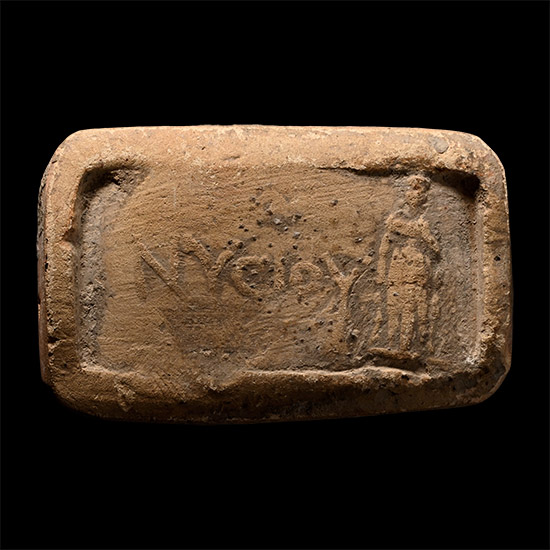
Byzantine Terracotta Tile with NYCIOY
6th-8th century A.D.Sold for (Inc. bp): £33
Rectangular in plan with raised lip enclosing scene with standing female figure in ankle-length robe, legend 'ΝΥCΙΟΥ' (for νησιού 'belonging to Nisios'). 28.3 grams, 45 mm
From the private collection of Mr Brian Edwards, New Malden, Surrey, UK, formed from the late 1970s-early 1980s; thence by descent. -
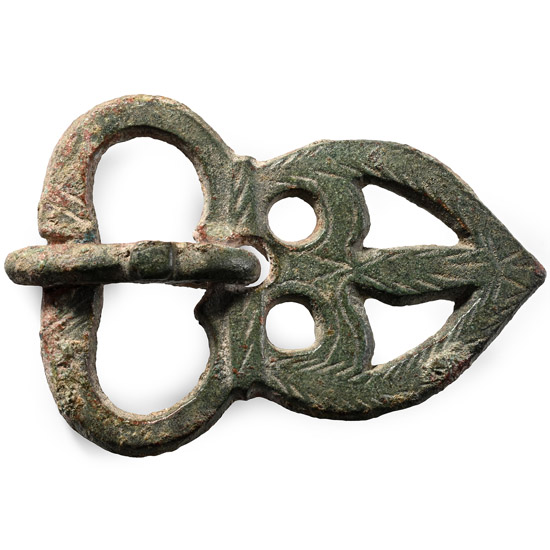
Byzantine Decorated Bronze Buckle
6th-8th century A.D.Sold for (Inc. bp): £72
Openwork integral plate with hatched decoration and a kidney-shaped loop, two pierced lugs on the underside. 27.4 grams, 56 mm
From the private coin collection of a West London, UK, gentleman, formed since the mid 1980s. -
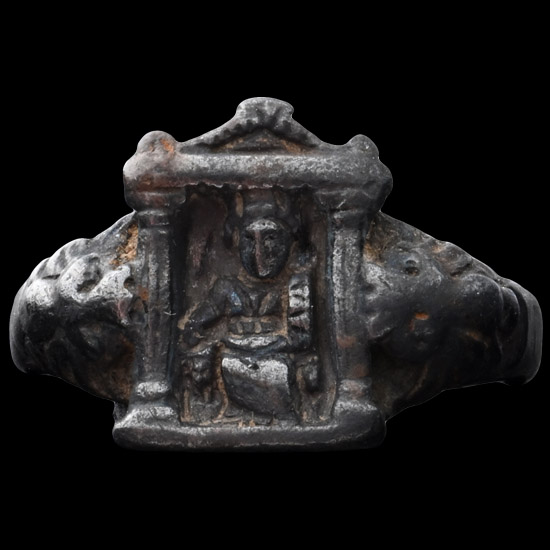
Byzantine Silver Architectural Ring Bezel
Circa 6th-8th century A.D.Sold for (Inc. bp): £156
The bezel formed as an open facade of a building with a pediment, a robed figure inside, seated on a throne with lion-head arms. 6.67 grams, 22 mm
From the private collection of Graham Slater (1927-2024), Cambridge, UK; formed 1980s-1990s. -
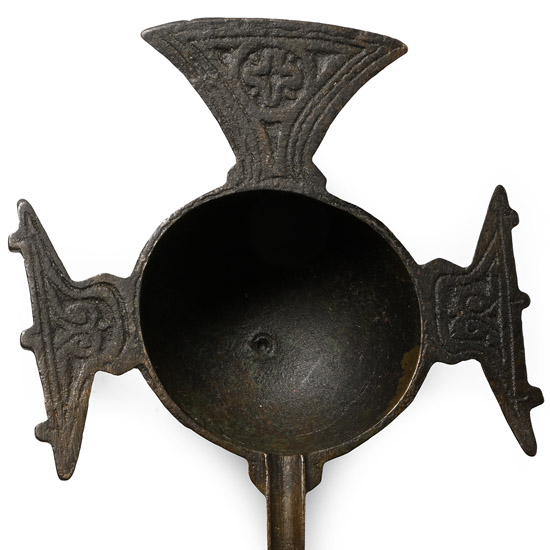
Byzantine Bronze Oil Lamp
Circa 7th-10th century A.D.Sold for (Inc. bp): £247
Formed as a stylised bird with a hemispherical body, U-shaped nozzle forming the head, two projecting wings with incised decoration, and a large flaring tail forming the handle with a central cross motif, three stub legs on the underside. 65.9 grams, 12 cm
From an important collection of lamps, Germany, 1970s. -
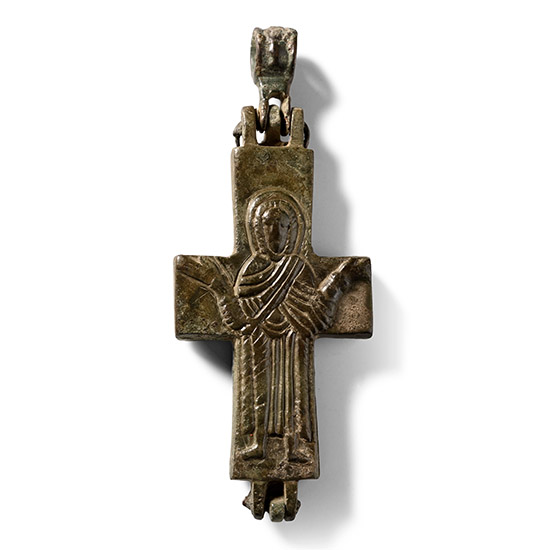
Large Byzantine Bronze Reliquary Cross Pendant with Christ and Saint
Circa 10th-12th century A.D.Sold for (Inc. bp): £377
Enkolpion with hinged and ribbed loop; low-relief nimbate figure in orans pose to reverse wearing draped robes; robed Corpus Christi to reverse with cross above. 36.9 grams, 82 mm
From the private coin collection of a West London, UK, gentleman, formed since the mid 1980s.

