-
.jpg)
Roman Garnet Cameo of Eros the Greek God of Love
1st century A.D. or laterSold for (Inc. bp): £780
Discoid in plan with a high-relief plastic head of Cupid (Greek Eros). 0.42 grams, 8 mm
Private English collection, formed between the late 1970s and early 1990s. Private collection, London, UK.
The finely engraved head on the cameo represents a young child, probably intended as Eros (Cupid). Such depictions were produced in numerous variations to illustrate the stages of childhood and the capacity of children to undertake meaningful or symbolic actions. The high relief type appears to have been especially popular and was probably derived from metalwork, like the plaster medallion from Begram, Afghanistan. -
.jpg)
Large Roman Carnelian Gemstone with Hercules
1st-2nd century A.D.Sold for (Inc. bp): £260
Ellipsoid type with incuse design of Hercules standing under the tree of Hesperides, holding one of the apples; repaired; supplied with a museum-quality impression. 3.2 grams, 25 mm
From the private collection of a European gentleman (1942-2024), formed since the 1970s. -
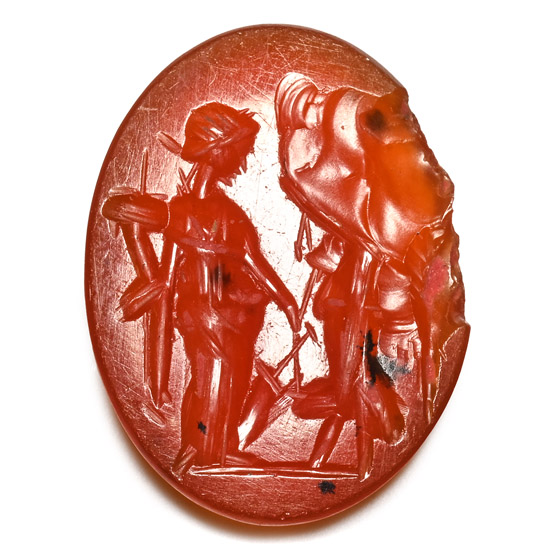
Roman Carnelian Gemstone with Goddesses
1st-2nd century A.D.Sold for (Inc. bp): £98
Tabular type with incuse design of Fortuna standing with a cornucopia and rudder, goddess Victory before her holding tainia, the tips of her wings visible; edge chipped; supplied with a museum-quality impression. 1.02 grams, 17 mm
From the private collection of a European gentleman (1942-2024), formed since the 1970s.
A group of carnelian intaglios found in the Snettisham Hoard, Norfolk, comprised subjects like Fortuna, Diana, Spes, a modius with corn, a bird and a dolphin, from the mid-2nd century A.D. -
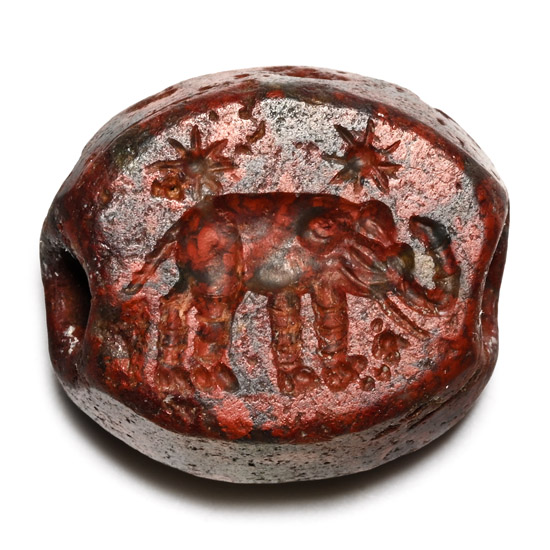
Roman Red Variegated Gemstone with Elephant
3rd century A.D.Sold for (Inc. bp): £1,040
Scaraboid type with incuse design to the underside of an elephant with stars above; supplied with a museum-quality impression. 3.04 grams, 17 mm
From the private collection of a European gentleman (1942-2024), formed since the 1970s.
The Romans first encountered elephants in Pyrrhos' army, and the representation of elephants in Roman art begins from this period. Victorious emperors like Caesar and Vespasian celebrated elephants on their coins. Apart from the celebration of elephants as ‘war machines’, the image of elephants was linked to other aspects in the Roman Imperial Period. Before becoming emperor, Elagabalus was one of the priests of Helios-Sun worship in Emesa. He had elephant depictions on his coins during his reign. The elephants raise their heads to the sun when the sun rises. Thus, the sun is represented on the gemstone together with the elephant. -
.jpg)
Roman Bronze Marriage Mirror with Facing Busts and Inscription
Circa 4th century A.D.Sold for (Inc. bp): £845
Discoid in plan with a beaded rim and concentric rings; at the centre, two draped busts, a male and a female, with faint remains of inscription surrounding; the other side polished and tinned. 130 grams, 91 mm
UK private collection before 2000. London collection, acquired on the UK art market.
The image on the back of the mirror depicts an imperial couple from the 4th century. The type of diadem worn by the male figure, clad in a paludamentum and cuirass, and the man's profile suggest a depiction of Constantine and Fausta, or of Constantine and his mother Helena. -
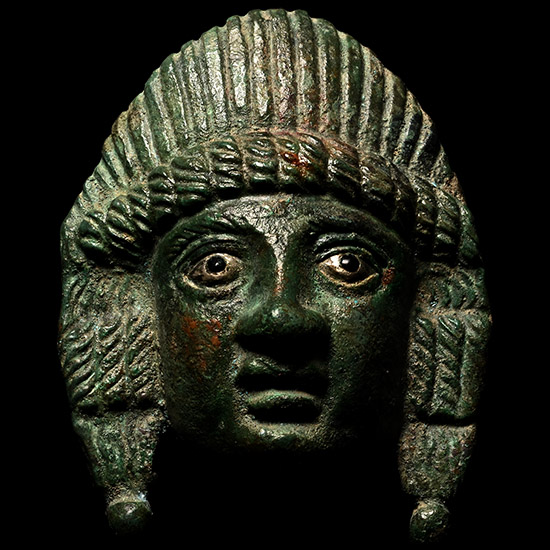
Roman Bronze Theatrical Mask Mount
2nd-4th century A.D.Sold for (Inc. bp): £624
Modelled in the half-round with large eyes and hair arranged in orderly curls, applied silver panels to the eyes and enamel pupils. 57.3 grams, 64 mm
Ex German art market, 2000s. Acquired from an EU collector living in London. From the collection of a Surrey, UK, gentleman. -
.jpg)
Roman Bronze Head of an Emperor
2nd century A.D.Sold for (Inc. bp): £1,170
Hollow-formed with long neck, abundant thick hair and beard, broad mouth; probably intended to represent an emperor. 440 grams, 10 cm
Acquired by a Swiss family in the mid-1980s to late 1990s, thence by descent. Private collection, Switzerland, since the late 1990s.
The portrait seems to be a provincial bronze representing Hadrian, apparently aged around 30, recognisable from his incipient beard, moustache and distinctive physiognomy. However, the portrait is in an extremely provincial style, exemplified by the wide spacing of the eyes. The beard is lightly incised, and the highly stylised curls around the front of the head give way to simple incised locks on the back. -
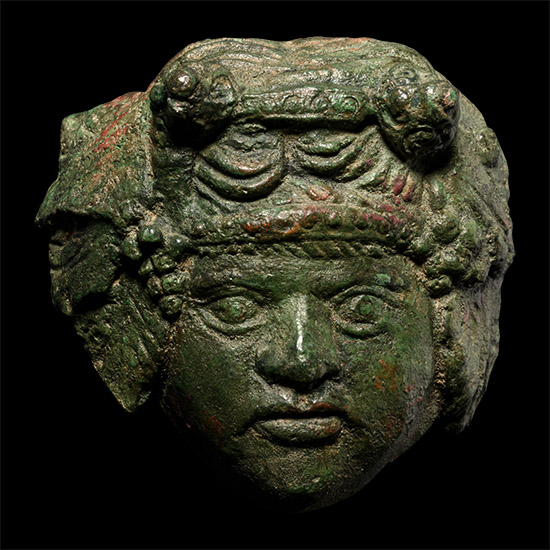
Roman Bronze Head of Dionysus Mount
1st-2nd century A.D.Sold for (Inc. bp): £546
Large convex mount depicting the head of the god of wine, shown facing with rounded cheeks and staring eyes, large vine leaves with bunches of grapes framing his face; ferrous spike on the reverse. 103 grams, 61 mm
Ex German art market, 2000s. Acquired from an EU collector living in London. From the collection of a Surrey, UK, gentleman. -
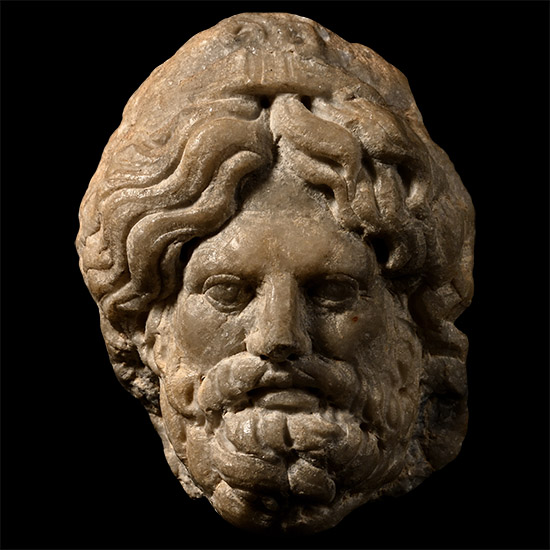
Roman Marble Head of Jupiter
1st-2nd century A.D.Sold for (Inc. bp): £1,560
Modelled in the half-round with luxuriant curls to the hair and beard, strong nose and brow with lentoid eyes; undercut modelling to the nose, mouth and hair; large mounting socket to the right side of the brow and smaller beneath the chin. 574 grams, 10.5 cm
The father of Christopher Frederick, a general practitioner based in Brighton, East Sussex, who acquired it prior to 1969. Thence by descent to his son, Christopher Frederick, Brighton, East Sussex. Acquired from the above by the present owner. -
.jpg)
Roman Marble Left Foot from a Sculpture
2nd century A.D.Sold for (Inc. bp): £3,900
Comprising an elegantly carved lower part of the calf and foot, a detailed rendering of the toes; the proportions suggesting that the subject was a child or a young woman; mounted on a custom-made display stand. 771 grams total, 15 cm high including stand
Nicolas Koutoulakis (1910-1996), thence by descent. Ex Galerie Dominique Thirion, Brussels, 1990s. Private collection of Mr K.A., France. with Kallos Gallery, London, UK. Accompanied by an academic report by Dr Raffaele D'Amato. This lot has been checked against the Interpol Database of stolen works of art and is accompanied by a search certificate number no.13010-246748.
The foot was a prominent feature on sculptures: more susceptible to weathering and the ravages of time than a head or a torso, the fragments that survive are often badly damaged. It is also possible that this piece belonged to a sculpture created via the acrolith technique, in which the sculptor focused his attention solely on the unclothed parts of the figure, which were made from a more valuable material than the rest of the piece. -
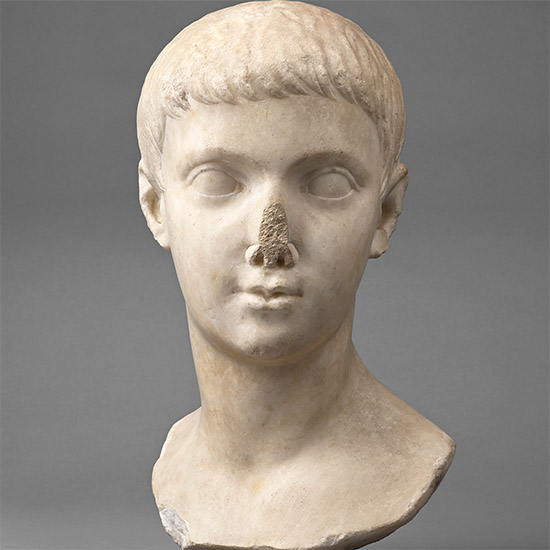
Roman Marble Portrait of Drusus the Younger
13 B.C.-23 A.D.Sold for (Inc. bp): £24,700
Finely carved bust of Drusus, son of Emperor Tiberius; the hair shaped in a mop of short locks combed forward towards the brow; the features adolescent with soft lips and smooth skin; the nose chipped; mounted on a custom-made stand. 15.15 kg total, 35 cm high including stand
Previously mounted in an 18th-19th century bust. Private collection, Northern England, acquired in the 1980s. This lot has been checked against the Interpol Database of stolen works of art and is accompanied by search certificate number no.13361- 259006.
The facial features of the sculpture reveal the physiognomic characteristics of a Julio-Claudian prince; specifically, Drusus the Younger, supported by comparisons with coin portraits. -
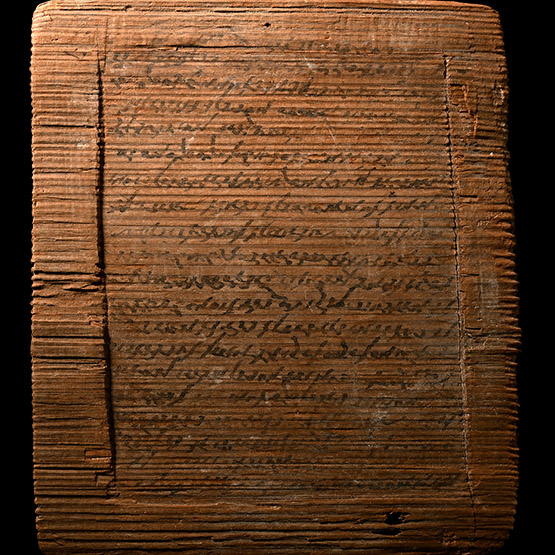
Roman Wooden Tablet with 'Pactum Dotis' Marriage Contract
First half of 4th century A.D.Sold for (Inc. bp): £4,160
Rectangular wooden tablet, probably cedarwood, the inner side with a recessed panel inscribed with 20 lines of inked text in Roman cursive script, two small holes, the bigger in the upper rim, the smaller in the centre of the lower rim; the flat outer side inscribed with 14 lines of inked text; in a good state of preservation with signs of age and parts of the text barely visible. 27 grams, 14 x 16.1 cm
Acquired by Albert Sfez in the early 1950s. Formerly the property of Monsieur Alain Sfez, a Belgian collector; acquired by gift from his father, Albert Sfez, in 1965. Acquired by a London dealer in 1973. From an important London collection since 1975; thence by descent. Accompanied by a copy of an illustrated academic report by Professor Dr phil. Peter Rothenhöfer.
Professor Dr Peter Rothenhöfer, Department of History (Zhuhai Campus) states: 'This important tablet shows that its use was apparently not restricted to the administrative sphere but widely spread in civic life and used for private purposes. As handwritten documents from the late 3rd and 4th century AD are quite rare, this tablet is generally of great importance for the history of Latin palaeography. The text is fluently written and shows a uniform typeface. Typical features of ancient writing can be observed: The text is continuously written without any separation between words (scriptio continua), sentences have no dots at the end.' Wax tablets written in Greek or Latin, were used by Romans as account registers (codices accepti et expensi); for transactions (for example, the tablets of the banker Lucius Caecilius Iucundus found in Pompeii); for lists of goods, inventories, and notes to be kept and archived; for Roman magistrates to annotate the salient events of their bureaucratic activities; for writing letters; for drawing up legal texts of various kinds: legacies, declarations of births and citizenship, reports of trials and diplomata militaria.

