-
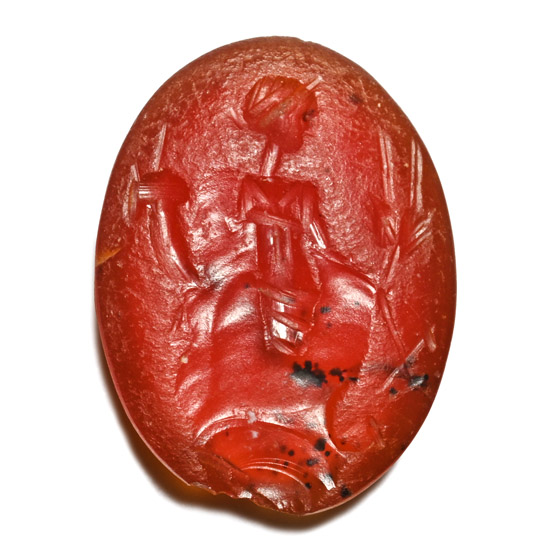
Roman Carnelian Gemstone with Fortuna
2nd-3rd century A.D.Sold for (Inc. bp): £78
Biconvex type with incuse design of Fortuna standing with a cornucopia; supplied with a museum-quality impression. 0.59 grams, 13 mm
From the private collection of a European gentleman (1942-2024), formed since the 1970s. -
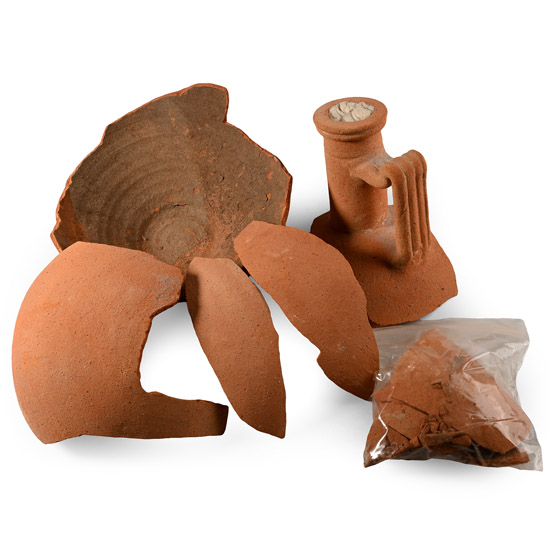
Large Complete Roman Redware Flagon in Pieces for Restoration
2nd-4th century A.D.Sold for (Inc. bp): £52
Complete set of fragments comprising a flagon with flared foot, tubular neck and strap handle. 782 grams total, 3-17 cm
From the private collection of Mr Brian Edwards, New Malden, Surrey, UK, formed from the late 1970s-early 1980s; thence by descent. -
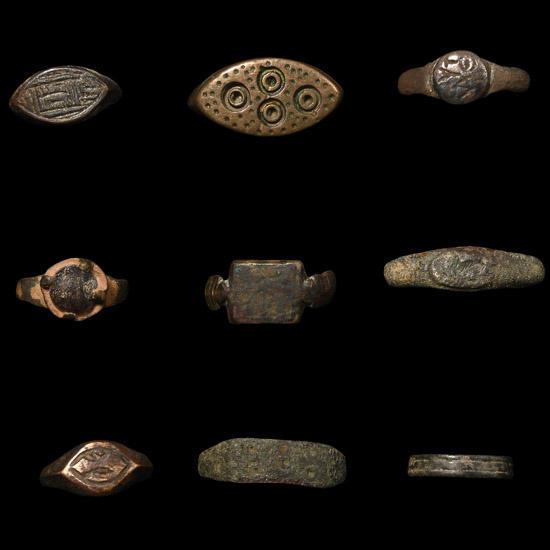
Roman to Medieval Bronze Ring Group
1st-16th century A.D.Sold for (Inc. bp): £169
Comprising: a large ring with a lentoid bezel bearing four ring-and-dot motifs; a slender ring with a rectangular bezel with five ring-and-dot motifs; a ring with a rectangular bezel with traces of niello; a ring with angled shoulders and a circular bezel with a Greek inscription; a slender ring with a circular ring set with a round cabochon; a flat-section ring with grooved circumferential lines; a ring with angled shoulders; a ring with keeled hoop and a lentoid bezel; a ring with keeled hoop and lentoid bezel with linear motifs. 30.3 grams total, 15-25 mm
From the private collection of a European gentleman (1942-2024), formed since the 1970s. -
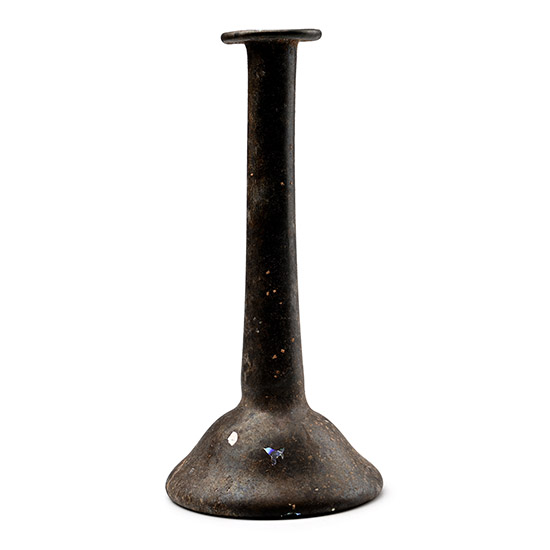
Roman Tall Glass Flask
Circa 1st-4th century A.D.Sold for (Inc. bp): £124
Comprising a squat conical body with a dimple at the base, long tubular neck with wide rim. 27 grams, 15 cm
From a London, UK, collection of glass, 1970-2000s. -
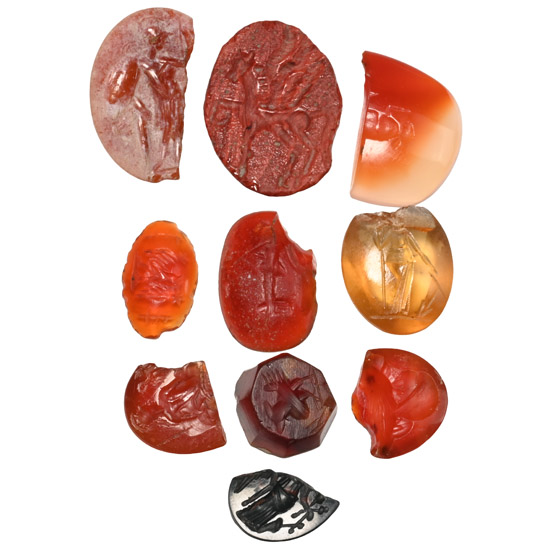
Roman Gemstone Group
2nd-3rd century A.D.Sold for (Inc. bp): £72
Including a warrior with a long shield, a standing figure with a spear, Isis Minerva with cornucopia and rudder and other types; nine supplied with a museum-quality impression. 5.05 grams total, 9-16 mm
From the private collection of a European gentleman (1942-2024), formed since the 1970s. -
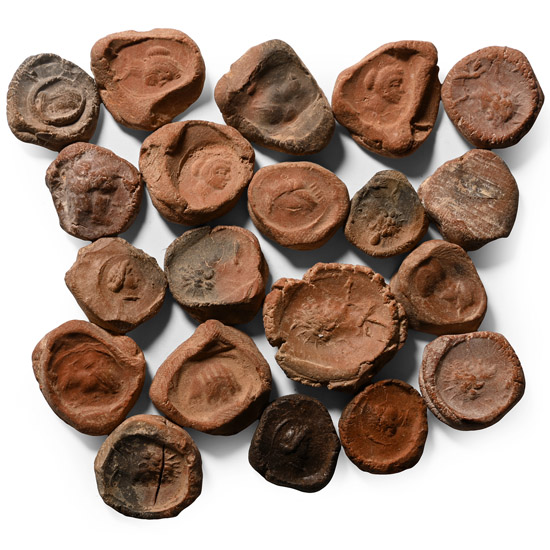
Roman Terracotta Bullae, Tesserae or Token Group
3rd century B.C.-1st century A.D.Sold for (Inc. bp): £143
A mixed group of ceramic bullae, tesserae or theatre tokens bearing low-relief motifs, mainly consisting of profile busts of deities. 34.8 grams total, 15-24 mm
From the private collection of a European gentleman (1942-2024), formed since the 1970s.
The term 'tessera' was used in Roman times to convey the Greek term σύμβολον (token). Small tiles are known as tokens, often shaped like coins, made of metal (copper, lead, iron), clay, bone, wood, or glass, stamped as well as engraved. The tokens, however, are not exclusively coin-shaped, as the Latin term 'tessera' refers to a four-sided shape. Tokens and tesserae seem to have been used both in Athens and Rome for the distribution of goods. According to written sources, the term ‘token’ is identified with credentials of the official authorities. They have also been interpreted as tokens of identity, as entrance tickets to theatre performances, tribunals or assemblies of citizens, archival material of seal engraving, as pawns in games, Charon’s obols and even as amulets. -
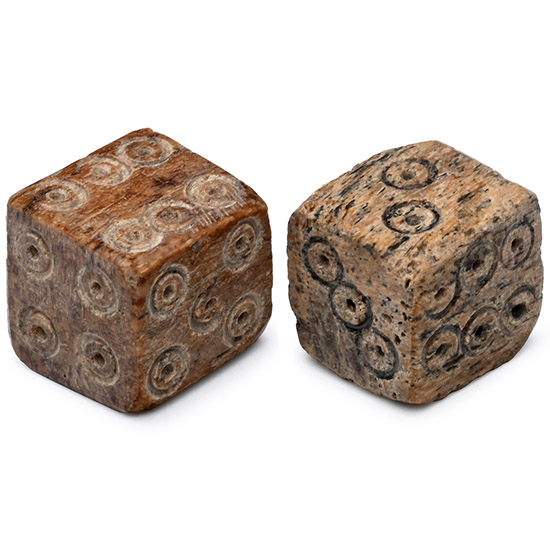
Roman Bone Gaming Dice Pair
1st-4th century A.D.Sold for (Inc. bp): £156
Pair of cuboid gaming dice with ring-and-dot markings disposed 1:6, 2:5, 3:4. 2.9 grams total, 9-10 mm
Ex German art market, 2000s. Acquired from an EU collector living in London. From the collection of a Surrey, UK, gentleman. -
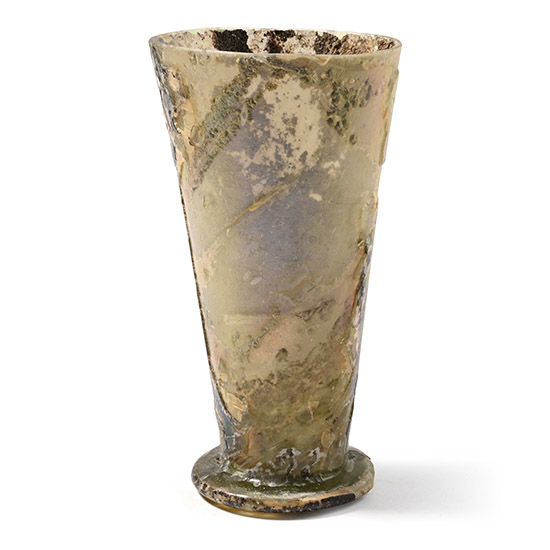
Roman Iridescent Glass Footed Beaker
2nd-3rd century A.D.Sold for (Inc. bp): £338
Comprising a conical body and a flaring foot with a rolled rim. 93 grams, 10.2 cm
Acquired in the 1990s from London dealerships and auction houses. From the Lonson collection. -
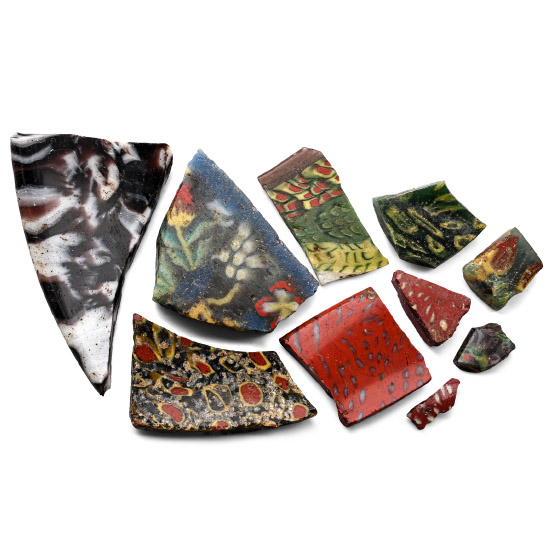
Roman Mosaic Glass Fragment Collection
1st-4th century A.D.Sold for (Inc. bp): £338
Comprising various polychrome fragments, one showing intricate flower details. 64.5 grams total, 15-66 mm
Acquired on the European art market. -
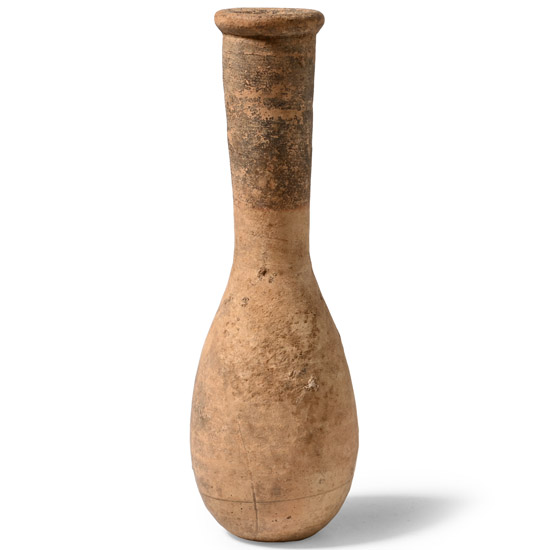
Roman Terracotta Bottle
Circa 2nd century A.D.Sold for (Inc. bp): £91
With piriform body, tapering tubular neck with everted flange rim; collector's label 'F/20' to base. 68 grams, 12.6 cm
From the collection of the late Bernard C. Pickard, Hampshire, UK, the owner of Bernard C. Pickard Antiquities, which closed in 1987, he had been collecting since the mid 1950s.
Bernard Pickard was a close friend of Richard Hattatt, the renowned author of several books on ancient brooches. Hattatt acknowledges in his first book, Ancient & Romano-British Brooches, published in 1982, that Mr Pickard first aroused his interest in brooches and inspired him in writing his books during his retirement. Mr Pickard also wrote the foreword to the section on Roman animal brooches, op.cit. p.158-160. -
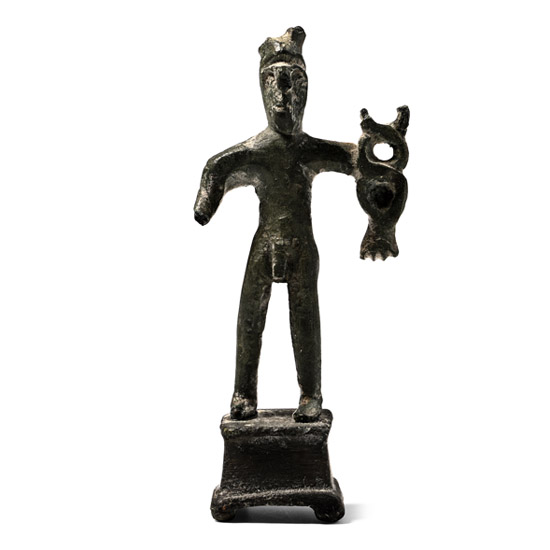
Romano-Celtic Bronze Statuette of the God Mercury
2nd-4th century A.D.Sold for (Inc. bp): £442
Modelled nude and standing on a pedestal, holding a caduceus in his outstretched left hand and wearing a winged hat. 53.7 grams, 88 mm
From the private collection of a European gentleman (1942-2024), formed since the 1970s. -
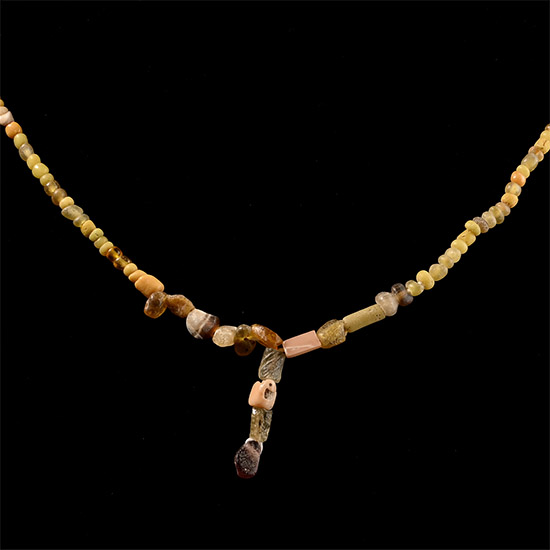
Roman Yellow Glass and Other Bead Necklace String
1st-4th century A.D. and laterSold for (Inc. bp): £20
Composed mainly of annular and oblate beads with a central drop, restrung. 6.8 grams, 36.5 cm
Acquired in the 1990s. Ex London, UK, collection.

