
-
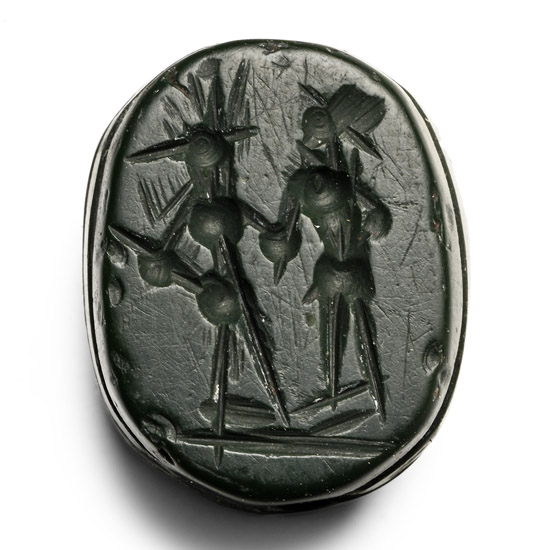
Egyptian Black Stone Scarab
Late Period, 664-332 B.C.Sold for (Inc. bp): £111
With linear detailing to the carapace, the underside with a drilled image of two figures holding hands on a baseline; supplied with a museum-quality impression. 2 grams, 13 mm
From the private collection of a European gentleman (1942-2024), formed since the 1970s. -
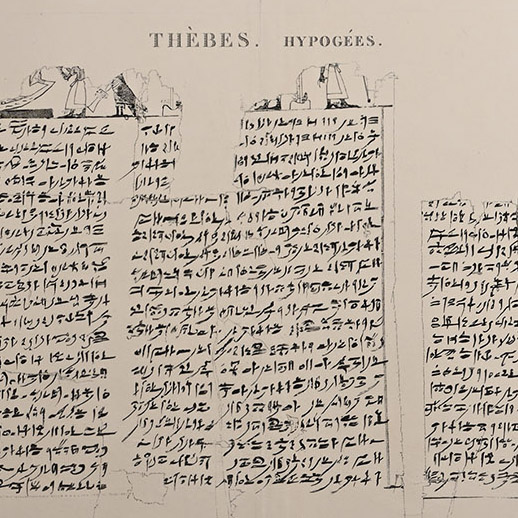
Very Large Egyptian Expedition Lithograph of the Hypogees Papyrus Manuscript from Thebes
Early 19th century A.D.Estimate: £80 - 100 (+bp*)
Proof etching on laid paper of plate 71 from Vol .II of Description de l'Égypte : ou, Recueil des observations et des recherches qui ont été faites en Égypte pendant l'expédition de l'armée française entitled Thèbes. Hypogées. Manuscrit sur papyrus. 264 grams, 102 x 69 cm
From the collection of a North American priest. Acquired between 1981-1996. Property of a North American collector.
Produced between February 1802 and 1830 on the orders of Napoleon Bonaparte; published between 1809 and 1828. Just 1,000 copies were distributed to various institutions, printed on laid paper with an 'Égypte ancienne et moderne' watermark. The book is subtitled Recueil des observations et des recherches qui ont été faites en Égypte pendant l’expédition de l’Armée française, publié par les ordres de Sa Majesté l’Empereur Napoléon le Grand (Gathering of observations and discoveries which were made in Egypt during the expedition of the French army, published on the orders of His Majesty the Emperor Napoleon the Great). It was the world's first encyclopedia devoted exclusively to the remains of ancient Egypt. The plates of this book are the first to present the archaeological sites of Thebes (Luxor). The papyrus manuscript was recovered from an underground tomb chamber (hypogeum). -
.jpg)
Very Large Egyptian Expedition Lithograph of Elephantine Island
Early 19th century A.D.Sold for (Inc. bp): £98
Proof etching on laid paper of plate 31 from Vol.I of Description de l'Égypte : ou, Recueil des observations et des recherches qui ont été faites en Égypte pendant l'expédition de l'armée française. entitled Ile d'Eléphantine et Syène. Plan général de l'Île d'Eléphantine, de Syène, et des carrières de granit exploitées par les Anciens Egyptiens. 223 grams, 105.5 x 69 cm
From the collection of a North American priest. Acquired between 1981-1996. Property of a North American collector.
Produced between February 1802 and 1830 on the orders of Napoleon Bonaparte; published between 1809 and 1828. Just 1,000 copies were distributed to various institutions, printed on laid paper with an 'Égypte ancienne et moderne' watermark. The book is subtitled Recueil des observations et des recherches qui ont été faites en Égypte pendant l’expédition de l’Armée française, publié par les ordres de Sa Majesté l’Empereur Napoléon le Grand (Gathering of observations and discoveries which were made in Egypt during the expedition of the French army, published on the orders of His Majesty the Emperor Napoleon the Great). It was the world's first encyclopedia devoted exclusively to the remains of ancient Egypt. The plates of this book are the first to present the archaeological sites of Thebes (Luxor). Elephantine Island holds archaeological remains that span the entire history of ancient Egypt. Syene is the Greek name for the ancient Egyptian city of Swennet, now known as Aswan. -
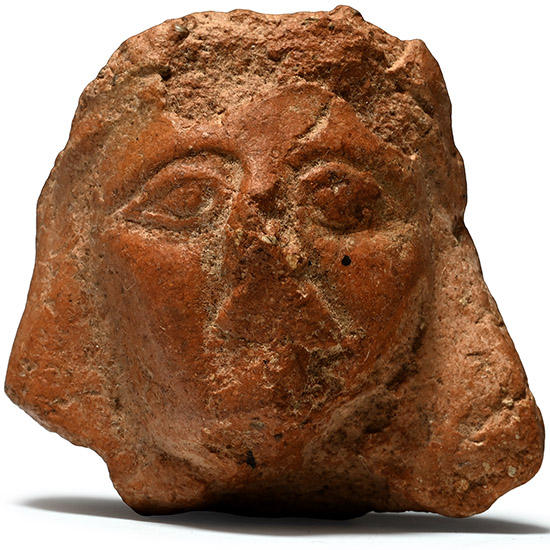
Phoenician Terracotta Head
6th-5th century B.C.Sold for (Inc. bp): £111
Tongue-shaped fragment depicting a figure with almond-shaped eyes and wearing a headdress. 65 grams, 58 mm
From the private collection of a European gentleman (1942-2024), formed since the 1970s. -
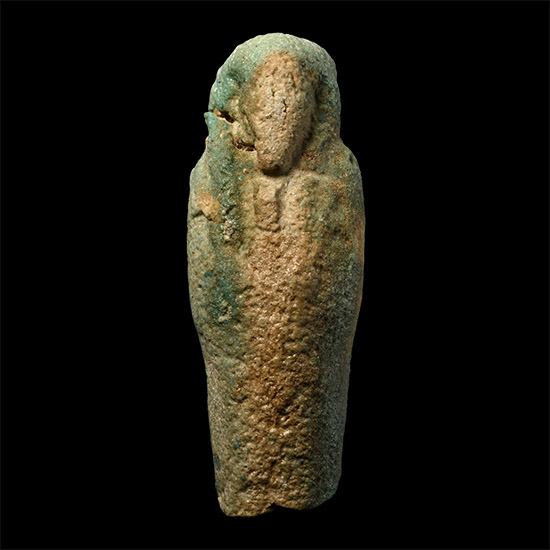
Egyptian Faience Shabti
Late Period, 664-332 B.C.Sold for (Inc. bp): £59
Plano-convex in section with moulded piriform face and wig, tools in the crossed hands, accompanied by an old handwritten note 'faience. Ceramic composed of crushed quartz or quartz sand with small amounts of lime and plant ash or naron. Coated with a bright blue or green glaze or soda[...]' and to verso 'Late period 700-400 BC Ex Margaret Seton-Jones from Flinders Petrie'. 10.5 grams, 49 mm
Ex Margaret Seton-Jones from Flinders Petrie. From the private collection of a Canadian gentleman living in Essex, UK, formed since the 1920s-circa 1990. Property of an Essex lady until the late 1990s; thence by descent. From the private collection of an Essex gentleman since the late 1990s. Accompanied by a handwritten slip with description and provenance. -
.jpg)
Very Large Egyptian Expedition Lithograph of the Hypogees Papyrus Manuscript from Thebes
Early 19th century A.D.Estimate: £80 - 100 (+bp*)
Proof etching on laid paper of plate 68 from Vol .II of Description de l'Égypte : ou, Recueil des observations et des recherches qui ont été faites en Égypte pendant l'expédition de l'armée française. entiled Thèbes. Hypogées. Manuscrit sur papyrus. 256 grams, 104 x 68.5 cm
From the collection of a North American priest. Acquired between 1981-1996. Property of a North American collector.
Produced between February 1802 and 1830 on the orders of Napoleon Bonaparte; published between 1809 and 1828. Just 1,000 copies were distributed to various institutions, printed on laid paper with an 'Égypte ancienne et moderne' watermark. The book is subtitled Recueil des observations et des recherches qui ont été faites en Égypte pendant l’expédition de l’Armée française, publié par les ordres de Sa Majesté l’Empereur Napoléon le Grand (Gathering of observations and discoveries which were made in Egypt during the expedition of the French army, published on the orders of His Majesty the Emperor Napoleon the Great). It was the world's first encyclopedia devoted exclusively to the remains of ancient Egypt. The plates of this book are the first to present the archaeological sites of Thebes (Luxor). The papyrus manuscript was recovered from an underground tomb chamber (hypogeum). The text is written in a cursive style of hieroglyphs known as hieratic. -
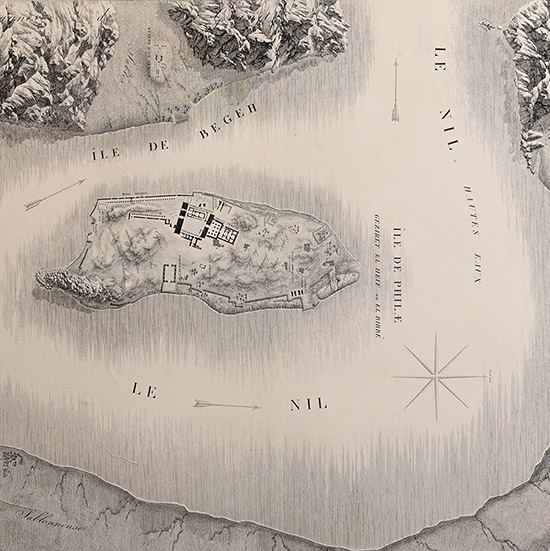
Very Large Egyptian Expedition Lithograph of the Isle of Philae
Early 19th century A.D.Sold for (Inc. bp): £98
Proof etching on laid paper of plate 1 from Île de Philae entitled Plan Général de l'île et de ses environs. 255 grams, 104 x 69 cm
From the collection of a North American priest. Acquired between 1981-1996. Property of a North American collector.
Produced between February 1802 and 1830 on the orders of Napoleon Bonaparte; published between 1809 and 1828. Just 1,000 copies were distributed to various institutions, printed on laid paper with an 'Égypte ancienne et moderne' watermark. The book is subtitled Recueil des observations et des recherches qui ont été faites en Égypte pendant l’expédition de l’Armée française, publié par les ordres de Sa Majesté l’Empereur Napoléon le Grand (Gathering of observations and discoveries which were made in Egypt during the expedition of the French army, published on the orders of His Majesty the Emperor Napoleon the Great). It was the world's first encyclopedia devoted exclusively to the remains of ancient Egypt. The plates of this book are the first to present the archaeological sites of Thebes (Luxor). The Philae temple complex was one of the monuments moved during the construction of the Aswan High Dam. It was carefully dismantled piece by piece and reassembled on the island of Agilkia. -
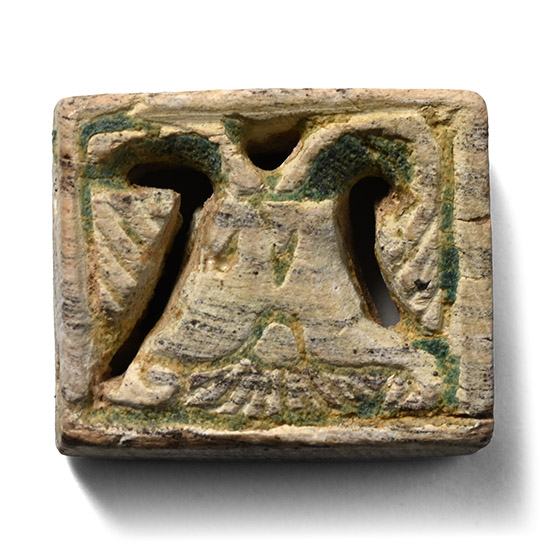
Egyptian Steatite Plaque Amulet with Lotus
Late Period, 664-332 B.C.Estimate: £100 - 140 (+bp*)
Rectangular openwork plaque with two blooming lotus flowers, one on each side, pierced twice for suspension. 1.77 grams, 14 mm
From an early 20th century UK collection. Accompanied by a previously illustrated catalogue card with provenance. -
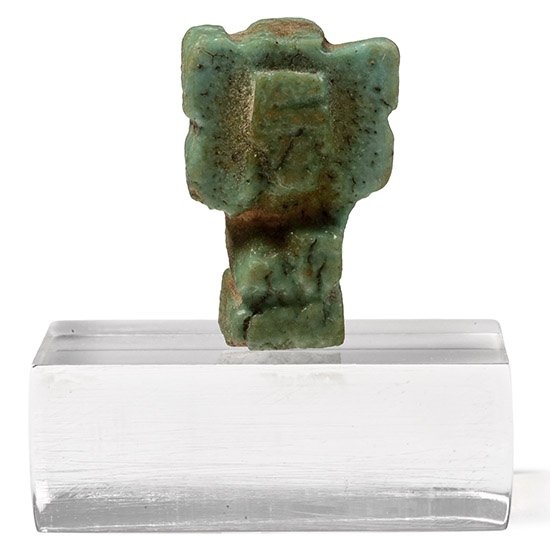
Egyptian Faience Shu Amulet
Late Period–Ptolemaic Period, 664-30 B.C.Sold for (Inc. bp): £46
Schematically modelled a kneeling figure of the god with arms raised above his head, holding a stylised solar disc, pierced through the dorsal pillar; supplied with a stand. 1.49 grams, 18 mm
From the collection of David Donlan (1947-2025), a dedicated and lifelong collector with a passion for the ancient world and the natural sciences, forming his collection from 1960s onwards, using many reputable dealers across the United Kingdom, including the well-regarded Coincraft and The Parthenon Gallery.
Shu amulets could serve both the dead and the living: they were placed between the mummy bandages on the lower part of the deceased’s torso, allowing the dead to pass smoothly on their journey towards rebirth; they could also serve as a magical amulet at birth, symbolising a protector of new life. -
.jpg)
Egyptian Faience Lotus Flower Amulet
18th Dynasty, Amarna Period, 1353-1336 B.C.Sold for (Inc. bp): £104
A blue glazed composition pendant in the form of a lotus, with some repair to the suspension loop. 0.26 grams, 14 mm
Ex early 20th century London collection. -
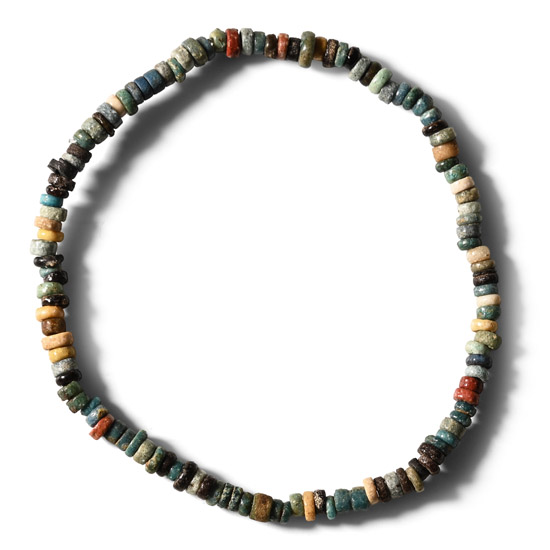
Egyptian Faience Mummy Bead Bracelet
Late Period, 664-332 B.C.Sold for (Inc. bp): £182
Composed of blue, cream, black, green and red annular beads, restrung with an elasticated string. 2.23 grams, 18 cm
Ex Ancient Art Shop, Windsor, UK, 1990s. Ex private collection. -
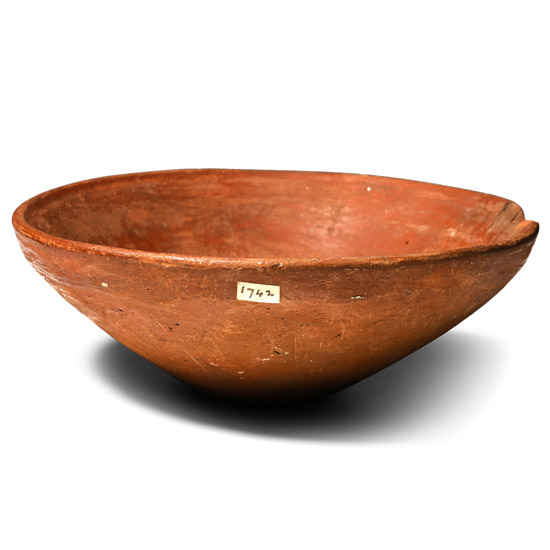
Egyptian Terracotta Bowl
Predynastic Period, 4th millennium B.C.Sold for (Inc. bp): £442
Conical in profile with narrow foot; old collector's notation to underside: 'Found by Petrie location Ballas and Naqada in 1895'. 375 grams, 15.5 cm wide
From the collection of David Donlan (1947-2025), a dedicated and lifelong collector with a passion for the ancient world and the natural sciences, forming his collection from 1960s onwards, using many reputable dealers across the United Kingdom, including the well-regarded Coincraft and The Parthenon Gallery.
Naqada (ancient Nubt) is situated on the west bank of the Nile, and is the type-site for the Predynastic period (Naqada I–III). It was a major centre of trade, craft production, and the process of unifying Egypt. Ballas is situated on the east bank opposite Naqada, and contains important Predynastic and Early Dynastic cemeteries excavated extensively by Flinders Petrie and James Quibell in conjunction with their work at Naqada. Their report was published in 1895.

