
-
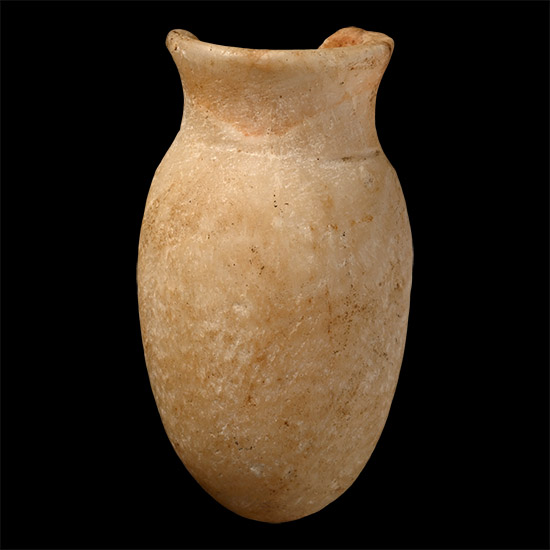
Egyptian Miniature Alabaster Jar
New Kingdom, 1550-1295 B.C.Sold for (Inc. bp): £104
Miniature alabsatron with ovoid body and flared rim to the mouth; collector's inked number '1' inside mouth; rim chipped. 22 grams, 41 mm
From the collection of David Donlan (1947–2025), a dedicated and lifelong collector with a passion for the ancient world and the natural sciences, forming his collection from 1960s onwards, using many reputable dealers across the United Kingdom, including the well-regarded Coincraft and The Parthenon Gallery. -
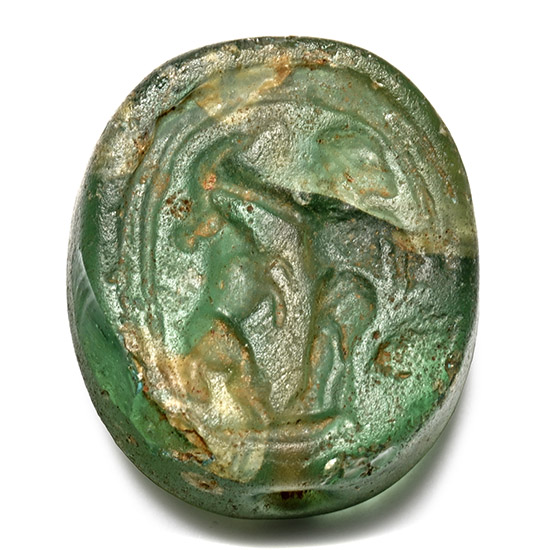
Egypto-Phoenician Glass Scarab Seal with Beast-Tamer Scene
Circa 800-600 B.C.Sold for (Inc. bp): £156
Ellipsoid in plan with transverse piercing, impressed intaglio scene of 'beast-tamer' motif (human figure in profile with one arm extended towards a rampant ibex); aqua glass; repaired. 4.28 grams, 19 mm
Ex the private collection of the late Mr S.M., London, UK, formed from 1979-1999. -
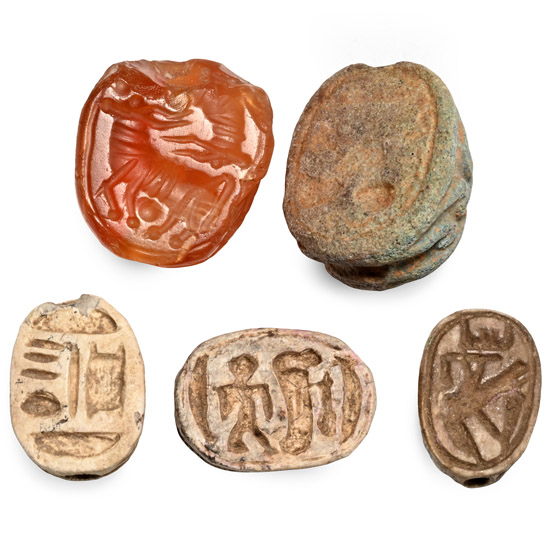
Egyptian Stone Scarab Group
Late Period-Ptolemaic Period, 664-30 B.C. and laterSold for (Inc. bp): £287
Comprising five scarabs with anatomical detailing: one carnelian with two antelopes tête-bêche; one with worn hieroglyphs on the underside; one with two neb signs flanking others; one with two neb signs flanking a standing human figure, uraeus and nefer; and one with the Horus falcon above the sign for gold (nbw). 7.5 grams total, 12-16 mm
From the private collection of a European gentleman (1942-2024), formed since the 1970s.
The falcon on the sign of gold, meaning 'Golden Horus (or falcon)', is found in the titles of Egyptian kings and was therefore considered a potent symbolic motif on scarabs. -
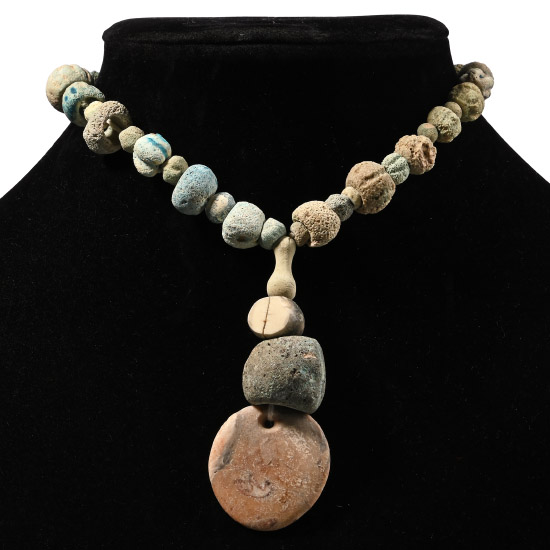
Romano-Egyptian Faience and Other Bead Necklace String
Roman Period, 30 B.C.-323 A.D.Sold for (Inc. bp): £59
Composed mainly of alternating melon and oblate beads, the central feature with a large melon bead and a large discoid pendant, restrung. 42 grams, 29 cm
Ex Ancient Art Shop, Windsor, UK, 1990s. Ex private West County, UK, collection. -
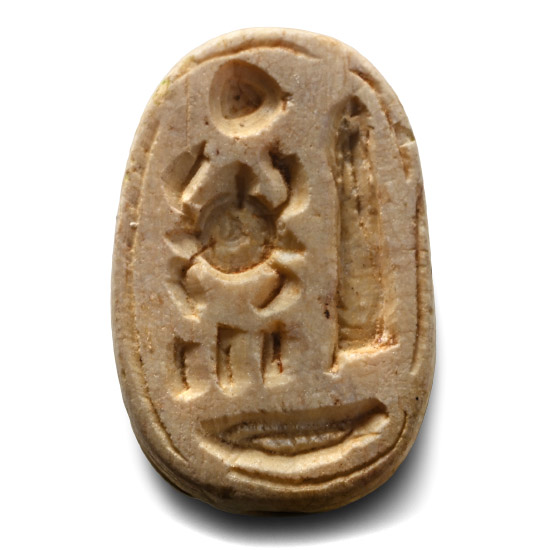
Egyptian Steatite Scarab
Late Period, 664-332 B.C.Sold for (Inc. bp): £208
Anatomical detailing on the carapace and the body is pierced longitudinally, with five hieroglyphic signs on the underside. 2 grams, 16 mm
From the private collection of a European gentleman (1942-2024), formed since the 1970s.
The three hieroglyphs on the left side, together with the bottom sign, spell out the throne name of Tutankhamun (Neb-kheperu-Ra), although the long sign to the right, resembling a reed leaf or Maat feather, indicates that it may be a good luck legend, perhaps interpreted as 'True Lord of Manifestations is Ra'. -
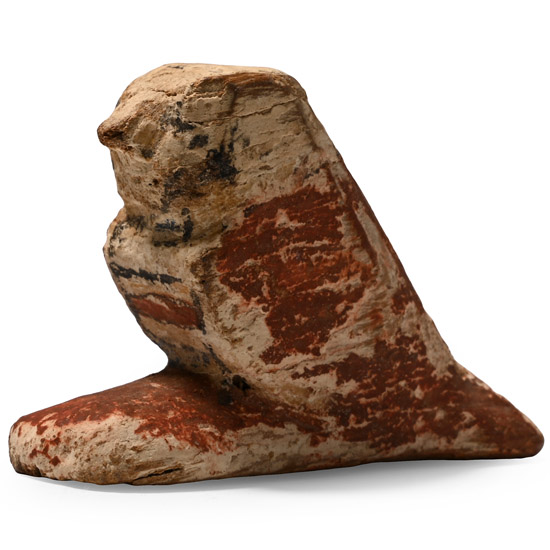
Egyptian Polychrome Wooden Sokar Falcon
Late Period, 664-332 B.C.Sold for (Inc. bp): £312
Statuette depicting the couchant falcon god Sokar with wings folded along the sides of the body; chest, wings, and legs with painted details; inked legend on the underside reading 'Ex George Wathen / 1893 / 12'. 16 grams, 71 mm
Ex George Henry Wathen collection from 1843, who wrote and illustrated the important work 'The Arts, Antiquity and Chronology of Ancient Egypt'. From the collection of David Donlan (1947–2025), a dedicated and lifelong collector with a passion for the ancient world and the natural sciences, forming his collection from 1960s onwards, using many reputable dealers across the United Kingdom, including the well-regarded Coincraft and The Parthenon Gallery.
Wooden images of the raptor-form god Sokar typically decorated the tops of rectangular wooden coffins and canopic chests, which held jars containing the deceased’s mummified organs. Sokar was a protective god of the Memphite necropolis and was often merged with the funerary god Osiris and Ptah, the creator deity of Memphis. George Henry Wathen, FGS (21 November 1816 – 10 November 1879) was a geologist, author, magazine publisher, and South African politician of the Victorian era known primarily for his books on the antiquities of Egypt and the gold fields of Victoria, Australia. -
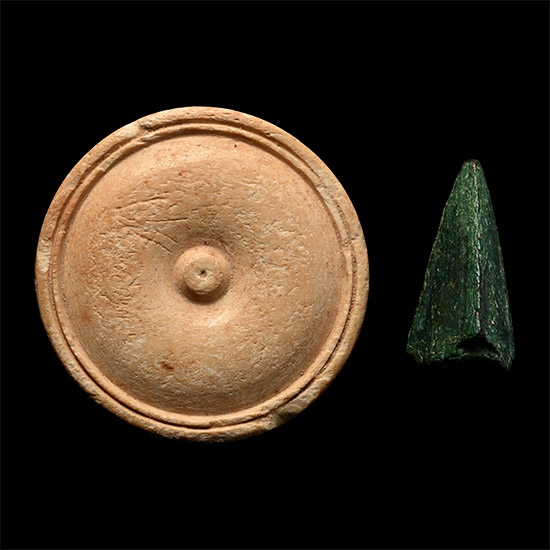
Egyptian Bone Gaming Counter and Bronze Arrow Tip
Graeco-Roman Period, circa 3rd century B.C.-2nd century A.D.Sold for (Inc. bp): £52
Comprising: turned discoid counter with raised tiered rim and central boss, plain reverse with incised 'L · III' legend (numeral '53'); triangular-section arrowhead with low flanges to one face and mounting hole, socket to rear. 4.82 grams total, 17-26 mm
Ex John Cummings Ltd., Lincolnshire, UK. From the private collection of a Canadian gentleman living in Essex, UK, formed since the 1920s-circa 1990. Property of an Essex lady until the late 1990s; thence by descent. From the private collection of an Essex gentleman since the late 1990s. Accompanied by an old information card. -
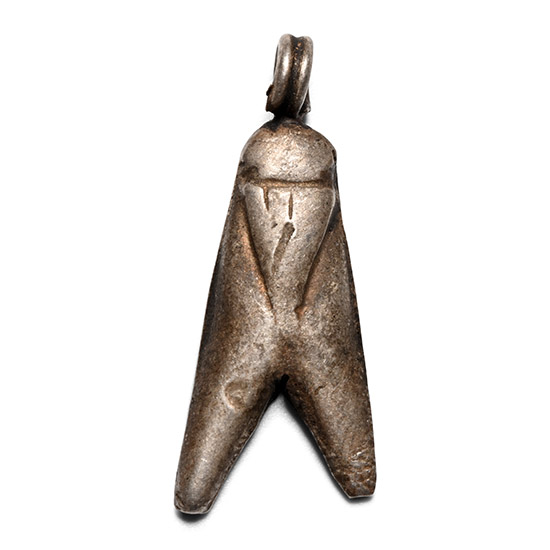
Egyptian Silver Fly Amulet
Late Period, 664-332 B.C.Sold for (Inc. bp): £143
With detailing to the body and head, ribbed suspension loop above the head. 0.94 grams, 19 mm
Ex London, UK, gentleman, 1990s.
Fly amulets were believed to protect against insect bites and to ward off troublesome flying creatures through apotropaic magic. Some believe they may have even symbolised the fly’s fecundity. Additionally, pharaohs would bestow gold fly-shaped pendants as military awards to honour the bravery and persistence of soldiers in battle. -
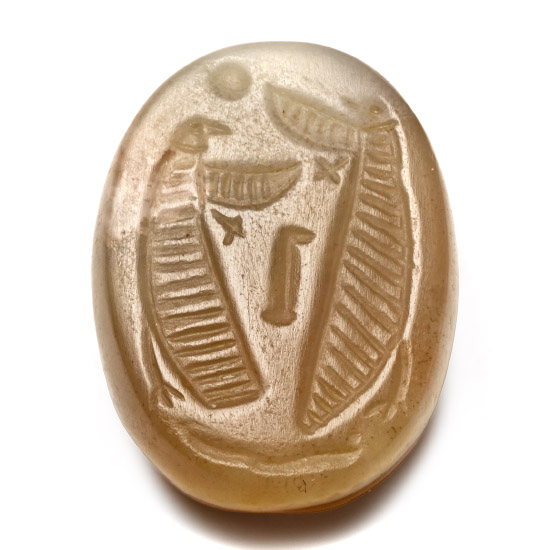
Egypto-Phoenician Agate Scarab
8th-6th century B.C.Sold for (Inc. bp): £156
Plano-convex in section with incised segmentation to the carapace, underside with two hatched avian figures; supplied with a museum-quality impression. 5.65 grams, 20 mm
From the private collection of a European gentleman (1942-2024), formed since the 1970s. -
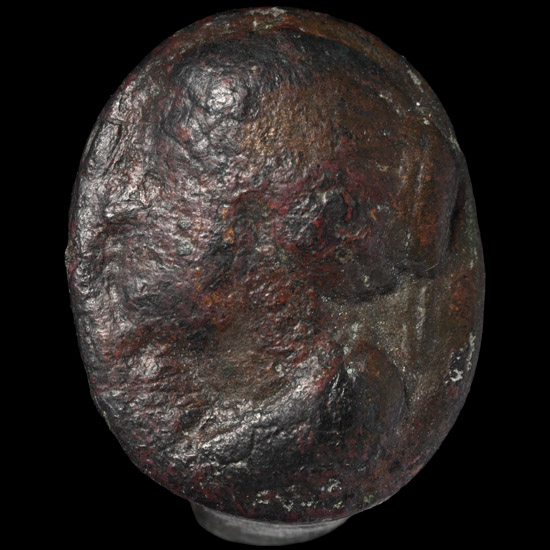
Romano-Egyptian Bronze 'Cleopatra' Ring
Ptolemaic Period, circa 1st century B.C.Sold for (Inc. bp): £169
Thick rounded hoop with ellipsoid bezel, low-relief female profile bust with hair dressed in a chignon. 11.66 grams, 24.82 mm overall, 17.22 mm internal diameter (approximate size British M 1/2, USA 6 1/4, Europe 13.09, Japan 12)
From the private collection of Mr Brian Edwards, New Malden, Surrey, UK, formed from the late 1970s-early 1980s; thence by descent. Accompanied by the original collector's data sheet(s) with reference no.A127. -
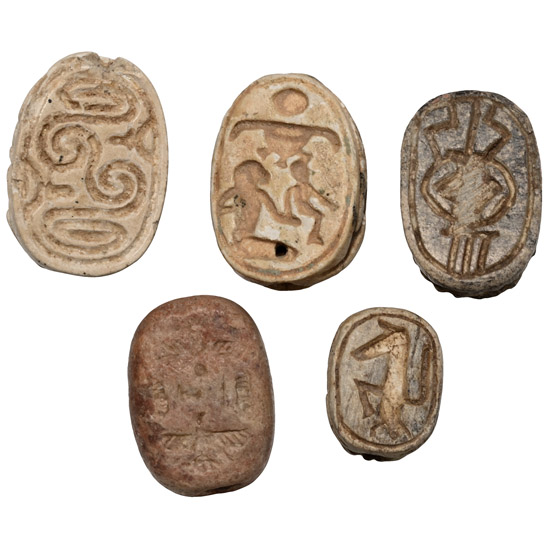
Egyptian and Phoenician Stone Scarab Group
Second Intermediate Period, circa 1650 B.C. and laterSold for (Inc. bp): £286
Comprising: one with interlocking spirals; one depicting an adult and child with the hieroglyphs for gold (nbw) and the sun disc above; one bearing the schematic image of Bes; one pink stone scaraboid with two birds with open wings and other symbols; and one with a kneeling figure with hand to mouth. 4.85 grams total, 9-14 mm
From the private collection of a European gentleman (1942-2024), formed since the 1970s. -
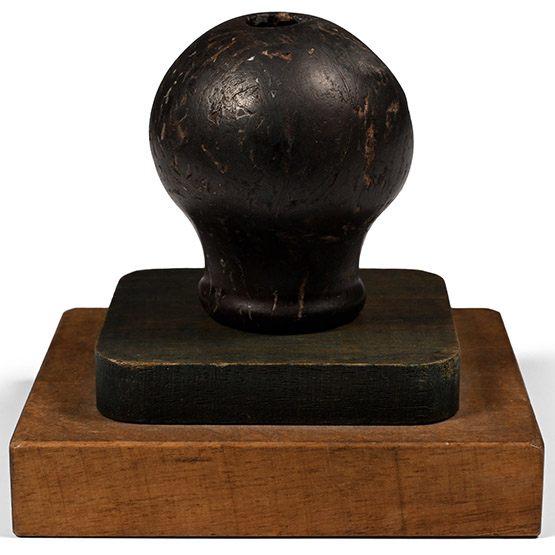
Egyptian Haematite Mace Head
4th-3rd millennium B.C.Sold for (Inc. bp): £286
Globular body with short socket and thickened rim; accompanied by a custom-made display stand. 457 grams total, mace: 60 mm high
Ex Norman Fargo collection. with Olympia Auctions, 26 June 2024, no.119. This lot is accompanied by an illustrated lot declaration signed by the Head of the Antiquities Department, Dr Raffaele D'Amato.
Norman Fargo was born in Los Angeles, California in 1945, the son of Hungarian immigrant Frank and his wife, Rose. His lifelong passion for collecting began at the age of six with a simple interest in rocks. By the 1960s, Norman had become a dedicated student of antique arms and armour, developing a deep appreciation for both craftsmanship and historical context. He began collecting at a time when many items now considered rare were still relatively accessible. A friendship with renowned collector Howard Curtis—whose important collection was partially sold at Christie’s, London in 1984—opened doors to early and exceptional material. Norman also acquired outstanding pieces from respected figures such as Frank Bivens and others known today through museum and auction catalogue provenance. Alongside his core collection of arms and armour (c.1450-1700), Norman developed an eye for period furniture and accessories. He also built a growing collection of Pre-Columbian art with an emphasis on Southern Mexican cultures, particularly Veracruz, as well as fine examples of Japanese Satsuma ware and cloisonné.

