-
.jpg)
Etruscan Carnelian Scarab with Bust of a Warrior in Later Victorian Gold Brooch
5th-4th century B.C. and laterSold for (Inc. bp): £2,860
The scarab with anatomical detailing on the carapace, underside with a profile bust of a helmetted warrior; set in a later brooch frame with swivel mount for the scarab. 10.35 grams, 55 mm
Acquired on the European art market. This lot has been checked against the Interpol Database of stolen works of art and is accompanied by search certificate number no.13358- 257891.
Egyptian-style scarabs and scaraboids were characteristic of Etruscan art from the 8th century B.C. Originally made in Phoenicia, Cyprus or Rhodes, these objects were made of faience, blue paste, glass paste, bone, or semi-precious stones of varying hardness, from steatite to quartz, onyx and jasper. Mounted in settings on revolving pendants of precious metal, later imitated by Etruscan goldsmiths, these Egyptianising items performed prophylactic-religious functions. -
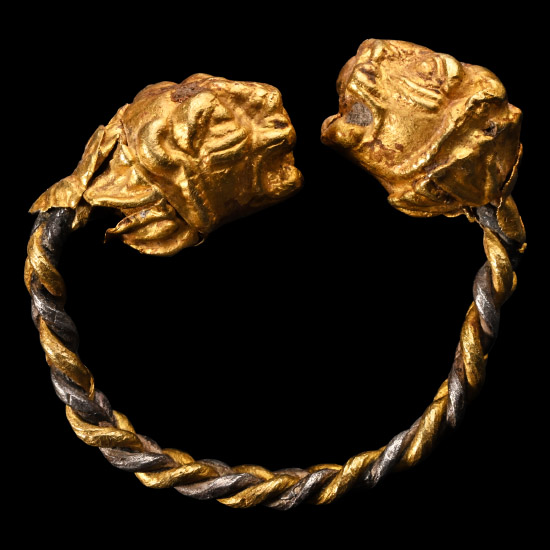
Greek Gold Lion Head Ring with Plaited Band
3rd century B.C. and laterSold for (Inc. bp): £1,690
Formed as a plaited band of gold and silver rods, the finials formed as large lion heads with gaping jaws, a rosette with a rivet behind the neck; possibly a marriage. 8.43 grams, 32 mm
Acquired in London, 1979. -
.jpg)
Greek Carnelian Bead with Gold End Caps
Hellenistic, 1st century B.C.-1st century A.D.Sold for (Inc. bp): £780
Columnar bead with sheet-gold cap to each end, each with beaded circlets and applied granule clusters, domed end with loop; possibly assembled. 17.44 grams, 60 mm
Acquired in the mid 1980s-1990s. Private collection, Switzerland, thence by descent. Private collection, since the late 1990s.
The very elaborate versions of earrings with large domes and pendants composed of clusters of hollow spheres and granulation are most typically Romano-Syrian, but they begin to be produced in the Late Hellenistic Age. They were diffused in the Levant, Egypt and on the frontier area between the Roman and the Arsacid Empire. -
.jpg)
Etruscan Amber Head Pendant
Etruria, 5th century B.C.Sold for (Inc. bp): £2,210
Carved from translucent red-brown amber as a profile head with stylised Archaic features, large almond eye beneath a defined brow ridge, a softly smiling mouth, and carefully delineated hair arranged in striated bands sweeping back from the face; a drilled perforation at the crown indicates its original function as a suspended ornament; accompanied by a display stand. 23 grams, 50 mm (242 grams total, 81 mm including stand)
Sotheby's, London, 14-15 December 1981, no.206. American private collection; acquired at the above sale. This lot has been checked against the Interpol Database of stolen works of art and is accompanied by search certificate number no.13329-257968.
Amber was a prestigious imported material in Etruria, highly prized for its rarity, colour, and perceived apotropaic power. From the late 6th century B.C. onwards, figured amber pendants appear in elite tombs, particularly those of women, reflecting both personal identity and a protective role within funerary belief systems. The prominent, wide-open eye here may have served as a talismanic motif, thought to ward off malign forces and ensure the wearer’s vigilance and well-being in life and beyond the grave. This piece reflects the distinctive aesthetic of Etruscan amber carving, in which Mediterranean influences are reinterpreted with a locally expressive sculptural style. -
.jpg)
Eastern Greek Carnelian Scaraboid Gemstone with Nude Hero Holding Lions
6th-5th century B.C. or laterSold for (Inc. bp): £780
Scaraboid type with incuse design to the underside of a nude hero facing, holding one lion by the neck and another by the hind leg; supplied with a museum-quality impression. 4.25 grams, 19 mm
From the private collection of a European gentleman (1942-2024), formed since the 1970s.
The gem could be considered a representation of Heracles, even if the iconography is unusual, and is influenced by the Mesopotamian environment, from where it borrows the frontal image of the hero (Gilgamesh or Enkidu) fighting with two beasts. The hero is beardless and holding an inverted lion. He is acting like a master of the animals, showing eastern traits reminiscent of Graeco-Phoenician art. In the Phoenician tradition, a similar image of the god Bes, holding two lions, as posis theron (‘Master of the Animals’), is common. The type is more frequent in the Eastern Mediterranean than in the West and is found on scarabs in carnelian and chalcedony. -
.jpg)
Greek Carnelian Onyx Gemstone with Horseman
1st century B.C.Sold for (Inc. bp): £546
Plano-convex 'eye' type with incuse design to the upper face of a huntsman on a rearing horse attacking a lion; supplied with a museum-quality impression. 4.14 grams, 17 mm
From the private collection of a European gentleman (1942-2024), formed since the 1970s. -
.jpg)
Etruscan Variegated Agate Scaraboid Gemstone with Dancing Satyrs
4th century B.C.Sold for (Inc. bp): £182
Scaraboid type with incuse design to the underside of two opposed dancing satyrs, heads and arms missing, possibly unfinished or cut down from a depiction of a lion and hero; supplied with a museum-quality impression. 2.75 grams, 17 mm
From the private collection of a European gentleman (1942-2024), formed since the 1970s. -
.jpg)
Etruscan Carnelian Scarab with Deer
5th century B.C.Sold for (Inc. bp): £468
With carved anatomical detailing, the underside featuring a running stag with a long spear about to pierce its neck from behind. 1.1 grams, 11 mm
Acquired on the European art market. -
.jpg)
Minoan Facetted Carnelian Stamp Seal
Circa 20th-15th century B.C.Sold for (Inc. bp): £44,200
Four-sided bead with an oval panel on each side: panel 1: reclining feline with frontal head with apotropaic eyes; panel 2: three-leaved plant opposite a goblet(?) with four pellets and two crosses; panel 3: a plant and a big frontal apotropaic eye; panel 4: three segments, a plant, a butterfly or a bird; accompanied by museum-quality impressions. 4.21 grams, 21 mm
From the collection of the late Mr Priday, Hertfordshire, UK, thence by descent. This lot has been checked against the Interpol Database of stolen works of art and is accompanied by search certificate number no.13339-258812.
Four-sided prisms are usually fashioned in jasper, light-coloured chalcedony and lightly banded carnelian. The workmanship is usually excellent. Largely on stylistic grounds, these seals are datable mostly to MMII (c. 2100–1875 B.C.), although they occur both slightly earlier and later. -
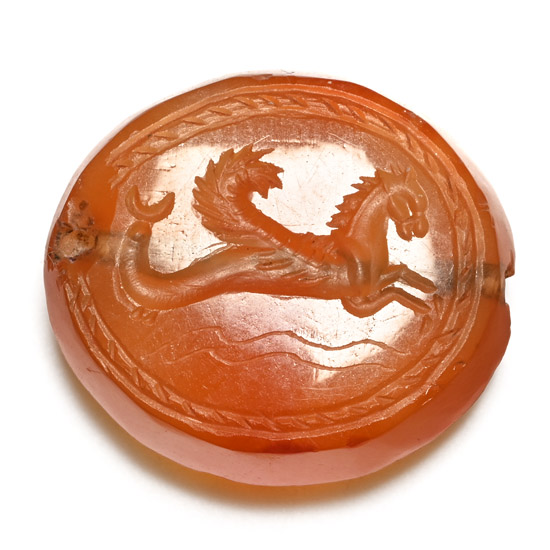
Greek Carnelian Gemstone with Hippocamp
4th century B.C.Sold for (Inc. bp): £650
Scaraboid type with incuse design to the underside of a winged hippocamp inside a ropework border, possibly later engraved water waves; supplied with a museum-quality impression. 2.29 grams 16 mm
From the private collection of a European gentleman (1942-2024), formed since the 1970s. -
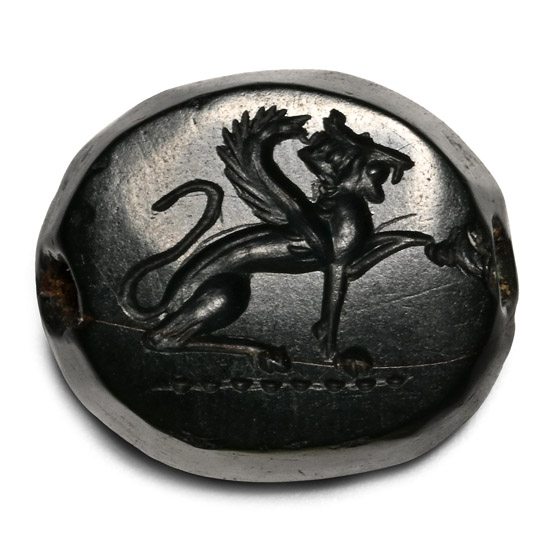
Eastern Greek Scaraboid Gemstone with Gryphon
4th-2nd century B.C. or laterSold for (Inc. bp): £650
Scaraboid type with incuse design to the underside of a winged gryphon with one foreleg raised; supplied with a museum-quality impression. 1.24 grams, 13 mm
From the private collection of a European gentleman (1942-2024), formed since the 1970s. -
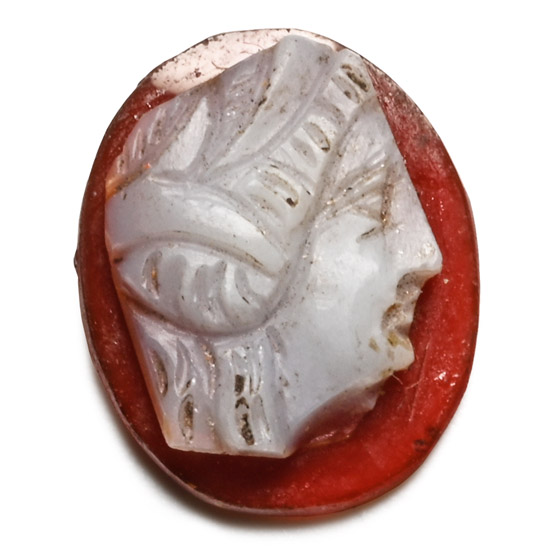
Roman Agate Cameo with Bust of an Empress
Circa 2nd century A.D.Sold for (Inc. bp): £104
An oval gemstone showing a female facing right. 0.26 grams, 9 mm
From the private collection of a European gentleman (1942-2024), formed since the 1970s.

