-
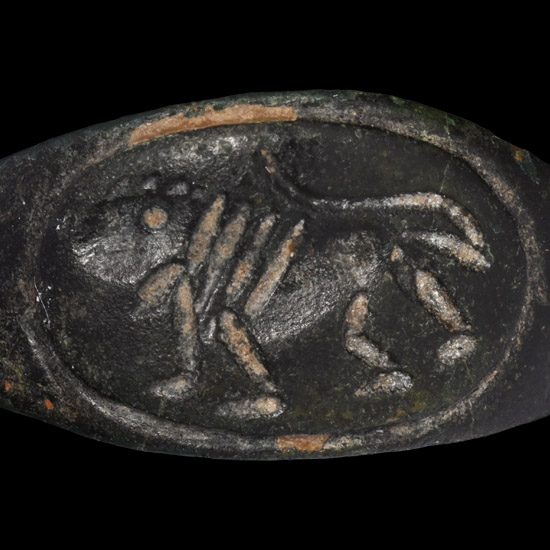
Roman Bronze Ring with Gladitorial Lion
Circa 1st-4th century A.D.Sold for (Inc. bp): £91
The hoop expanding towards the shoulders, with an oval bezel with an incuse image of a lion. 4.20 grams, 23.11 mm overall, 20.35 x 15.45 mm internal diameter (approximate size British M, USA 6, Europe 12.46, Japan 12)
Acquired on the UK art market. Private collection, Suffolk, UK. -
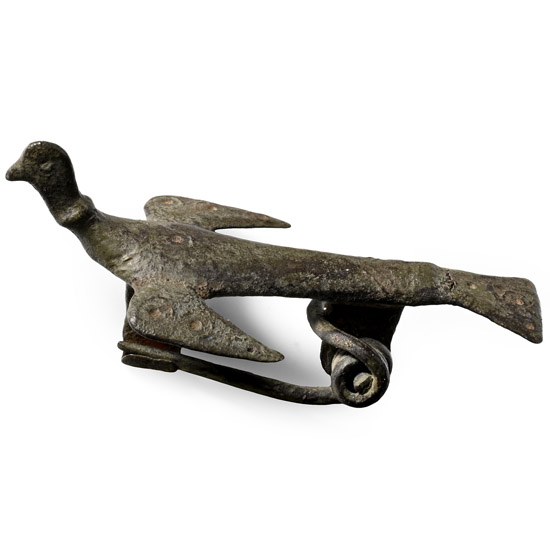
Roman Bronze Bird in Flight Plate Brooch
5th century A.D.Sold for (Inc. bp): £169
Depicting a bird with open wings and a fan-shaped tail, a springed pin, and a catchplate on the reverse. 5.89 grams, 41 mm
From the private coin collection of a West London, UK, gentleman, formed since the mid 1980s. -
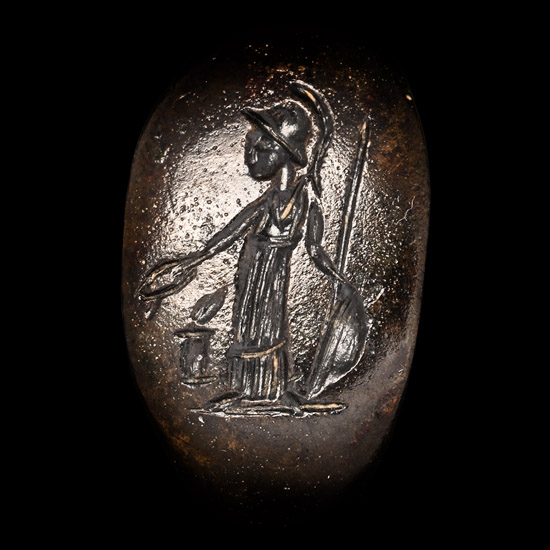
Roman Bronze Ring with Minerva Standing
1st-2nd century A.D.Sold for (Inc. bp): £195
With a slender D-section hoop expanding at the shoulders, the oval bezel with Minerva facing left, holding a spear and a shield in her left hand, and a wreath in her right hand, with a flaming altar to the side. 3.88 grams, 21.28 mm overall, 18.70 mm internal diameter (approximate size British R, USA 8 1/2, Europe 18 3/4, Japan 18)
Ex German art market, 2000s. Acquired from an EU collector living in London. From the collection of a Surrey, UK, gentleman. -
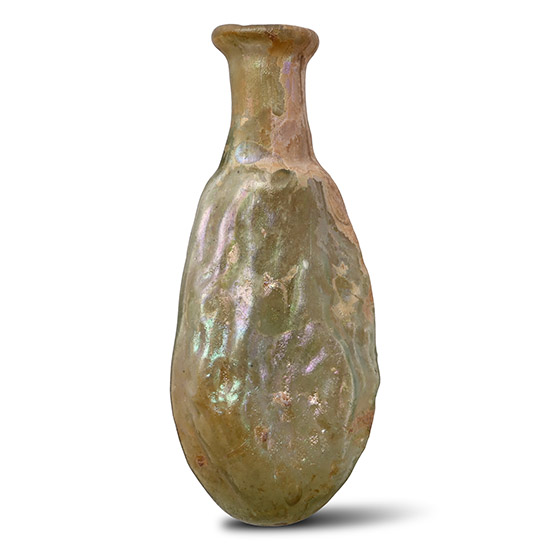
Roman Pale Green Glass Mould Blown Date Flask
1st century A.D.Sold for (Inc. bp): £260
With an elliptical body, short neck and thick everted rim, with modelled wrinkles imitating the texture of a dried date. 16.22 grams, 78 mm
Acquired from Millennium Antiquities, Lancashire, UK, in 2001. From the collection of a Bedfordshire, UK lady. Accompanied by an original Millennium Antiquities invoice dated 28 June 2001.
Dates were not only a staple of the Mediterranean diet, used to sweeten food and wine, but also a symbol for the New Year and a fruit often given as a gift on the occasion. -
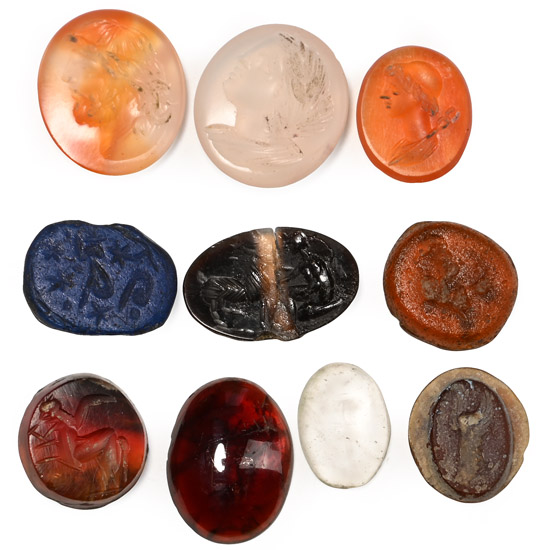
Roman and Later Gemstone Collection
Circa 2nd-3rd century A.D. and laterSold for (Inc. bp): £156
Comprising ten stone and glass intaglios and cabochons, including two with a female bust, one with a male bust, one with a cross, and others; one repaired. 6.24 grams total, 10-15 mm
Acquired on UK art market. Property of a Middlesex gentleman. -

Roman Aubergine Glass Bead Necklace String
1st-4th century A.D. and laterSold for (Inc. bp): £26
Composed of mixed beads and bead fragments, restrung. 20.2 grams, 41.5 cm
Acquired in the 1990s. Ex London, UK, collection. -
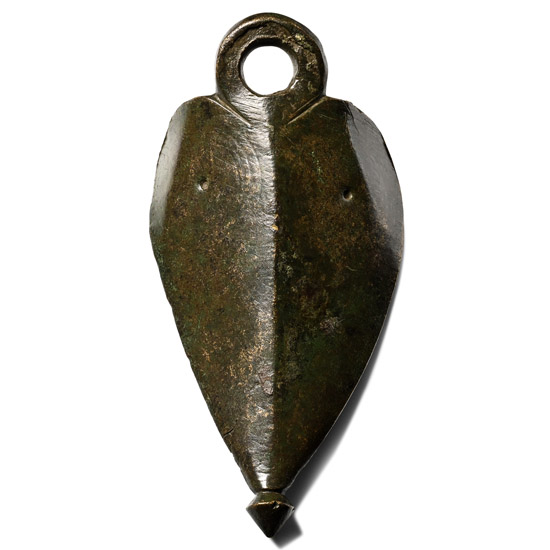
Large Roman Horse Harness Pendant
2nd-4th century A.D.Sold for (Inc. bp): £85
Heart-shaped pendant with large suspension loop and a knopped finial, concentric circle decoration around a central pellet. 58.7 grams, 11.4 cm
Ex German art market, 2000s. Acquired from an EU collector living in London. From the collection of a Surrey, UK, gentleman. -

Roman Bronze Artefact Collection
1st-4th century A.D.Sold for (Inc. bp): £26
Including two seal box lids and other items. 30.69 grams total, 27-79 mm
Found Norfolk, UK. -

Late Roman Haematite Four-Sided Amulet with FIgures
4th-5th century A.D.Sold for (Inc. bp): £104
Pierced longitudinally, the first side with a figure standing below a large tree (the god Hop?), the second with a tree and three animals, the third with an altar with two birds and a dancing pair of figures below, the fourth side with a dog, symbols above. 3.9 grams, 20 mm
From the private collection of a European gentleman (1942-2024), formed since the 1970s. -
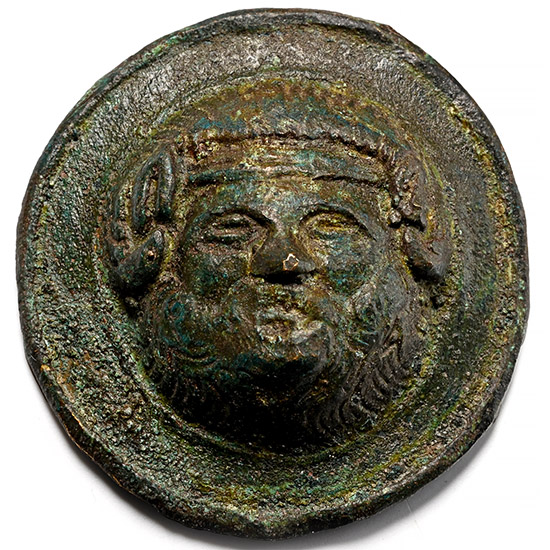
Roman Bronze Mount with Satyr Face
1st-4th century A.D.Sold for (Inc. bp): £91
Discoid mount with a raised bearded face at the centre in three-quarter view, browband resting on the forehead, pointy goat's ears and curving horns. 24.3 grams, 43 mm
Found Lincolnshire, UK. -
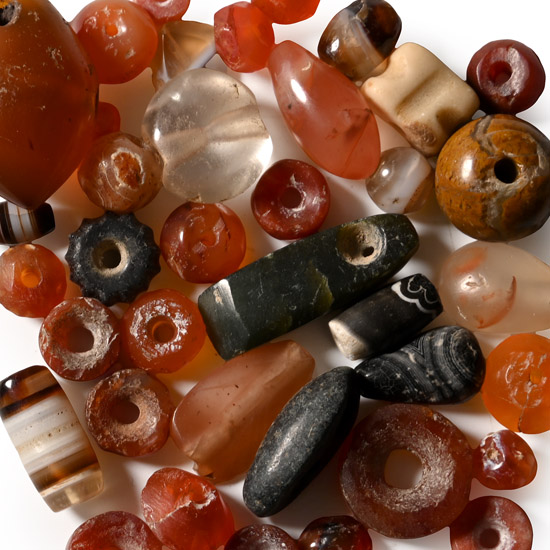
Roman Agate and Carnelian Bead and Pendant Collection
1st-4th century A.D. and laterSold for (Inc. bp): £143
Including oblate, biconical, cylindrical, and other types, including a rock crystal bead. 29 grams total, 4-23 mm
From the private collection of a European gentleman (1942-2024), formed since the 1970s. -

Roman Fresco Wall Plaster Collection
1st century A.D.Sold for (Inc. bp): £416
Fragments of wall plaster with rendered surface painted with mainly Pompeii red, pale blue and white detailing; some with impression of timber laths to the reverse. 475 grams total, 59-95 mm
Acquired in the 19th century. Ex Jeger collection, Switzerland. UK gallery, early 2000s.
These small fragments, for analogies with the fragments of Pompeii, seem to belong to the second style of Roman painting, red panels representing highlight and shadow, decorated with vegetal interlaces. Some panels were probably framed by a red grenade fillet. A fragment shows alternate blue and red colour over a cream background, maybe pertinent to a socle.

