-
.jpg)
Etruscan Bronze Statue of a Satyr
Circa 6th century B.C.Sold for (Inc. bp): £6,500
Modelled in the round in energetic pose with left hand resting on the hip and right arm raised, head tilted slightly upwards, tail curled gracefully over the rump; on a square base with papyrus stalk detailing; on a later gilt-metal stand mounted on a polished stone cube. 679 grams total, 20.4 cm including stand
Iris Cornelia Love (1933–2020), New York, collection primarily formed in the 1950s-1970s. This lot has been checked against the Interpol Database of stolen works of art and is accompanied by search certificate number no.13335-258241.
Many of the scenes show satyrs in Etruscan art transgressing the limits of accepted behaviour. As symbol of inversion of order, the satyr reflects the rules of the life and culture of the Etruscans and their values. Satyrs in comic, surprising situations indicate the Etruscans' sense of humour. They got their inspiration from Greek art when illustrating myths and narratives, often with a light-hearted approach of their own. The Etruscans were known to be devoted to religious rites and satyrs appear in such scenes too. Satyrs, connected with the Dionysian cortege, appear also on vases in sacrifice scenes and it is suggested here that satyrs dancing and gambolling around a wine vessel are performing a cultic dance in honour of Dionysos. -
.jpg)
Large Etruscan Statue of a Priest with Patera
2nd century B.C.Sold for (Inc. bp): £21,320
Modelled in the round standing figure with palla draped over the left shoulder and from the hips, extending to calf-length; the head with aquiline nose and dimpled chin modelled with a wreath of large leaves around the brow forming a corona; exaggerated eyes left blank to accept silver inserts; left arm bent, hand holding an incense-holder with cruciform design; right arm extended at shoulder-height with phiale mesomphalos offering dish; socket beneath left foot and screw-threaded post beneath right, repairs to both lower legs. 1.23 kg, 28.4 cm high
Sotheby's, New York, 17 December 1996, no.79. Private collection, New York, USA. Accompanied by copies of the relevant Sotheby's catalogue pages. This lot has been checked against the Interpol Database of stolen works of art and is accompanied by search certificate number no.13355-255463.
The figure is probably a devotee or priest of Diana preparing to make ritual observances with the offering plate and incense burner. A group of similar figures was recovered from the shallows of Lake Nemi south of Rome, close to the site of the Temple of Diana. -
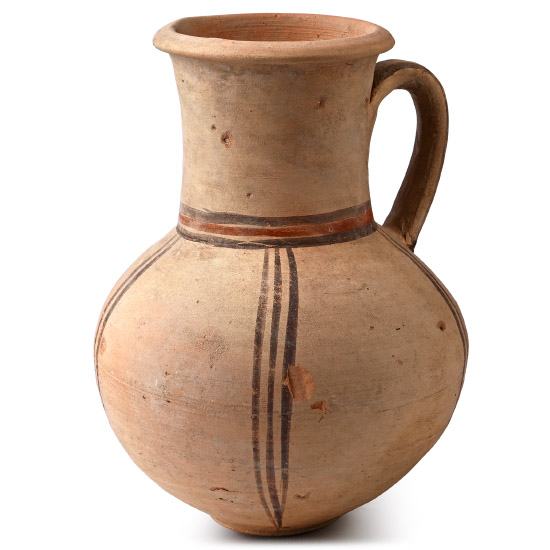
Large Eastern Mediterranean Painted Terracotta Pitcher
1st millennium B.C.Sold for (Inc. bp): £1,105
With a wide mouth, everted rim, and elongated, cylindrical neck, bulbous body with painted polychrome bands, a strap handle with painted linear decoration. 1.03 kg, 22.5 cm
From a 1980s UK collection. Acquired on the UK art market in the early 2000s. Property of a London, UK, antiquarian. -
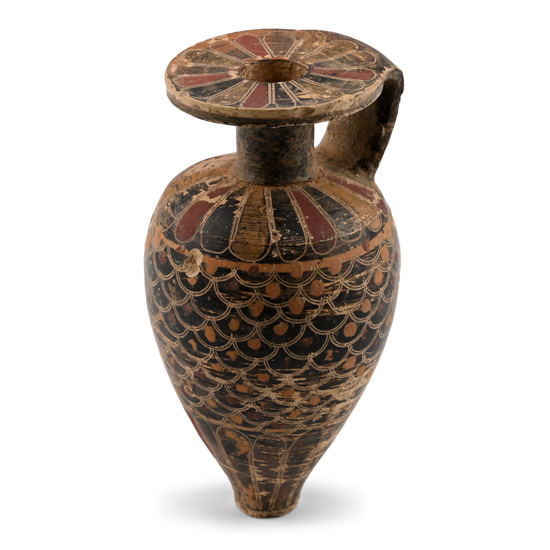
Proto-Corinthian Painted Terracotta Aryballos
7th century B.C.Sold for (Inc. bp): £2,080
Comprising a piriform body and a tubular neck with a wide rim, a strap handle to the rear, the rim with painted polychrome petals, the pattern repeating beneath the neck and on the base of the vessel; the body decorated with fishscale decoration. 79 grams, 10.5 cm
Swiss private collection, assembled in the 1960s and 1970s. Acquired by the present owner in 2004. Accompanied by an academic report by Dr Raffaele D’Amato. This lot has been checked against the Interpol Database of stolen works of art and is accompanied by search certificate number no.30017-246794.
The aryballoi were used to hold perfumed oil, an essential item for the wealthy middle classes of the time. Similar piriform vases are fairly common in Corinthian contexts. There is utmost precision in both the potting and the execution of the incised scale pattern of the present example. The fish-scale decoration was realised with the incision technique, by executing the scales neatly with their ends meeting. -
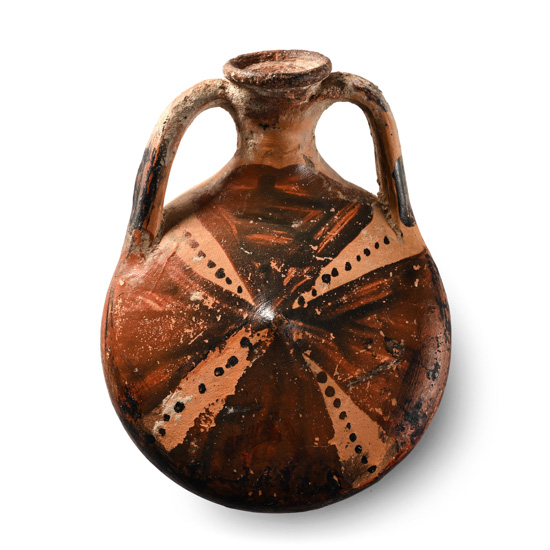
Mycenaean Painted Pottery Flask
14th-13th century B.C.Sold for (Inc. bp): £1,820
Comprising a circular body with a rounded base and two strap handles, a short neck with an everted rim; the body with a painted expanding cross motif with the arms separated by a band of pellets. 132 grams, 11.1 cm
Private collection, Switzerland, acquired in the 1994. Private family collection since the late 1990s. Accompanied by an academic report by Dr Raffaele D'Amato. This lot has been checked against the Interpol Database of stolen works of art and is accompanied by search certificate number no.13018-246795.
Mycenaean ceramics were influenced by Minoan shapes and decorative styles from the late Middle Helladic period. This close relationship – likely accompanied by the development of shared cultural practices and etiquette – creates the hypothesis that pilgrim flasks were introduced to Greece via Crete. Pilgrim flasks were produced in Mycenaean contexts from the Late Helladic IIA:1 period (1420-1390 B.C.). -
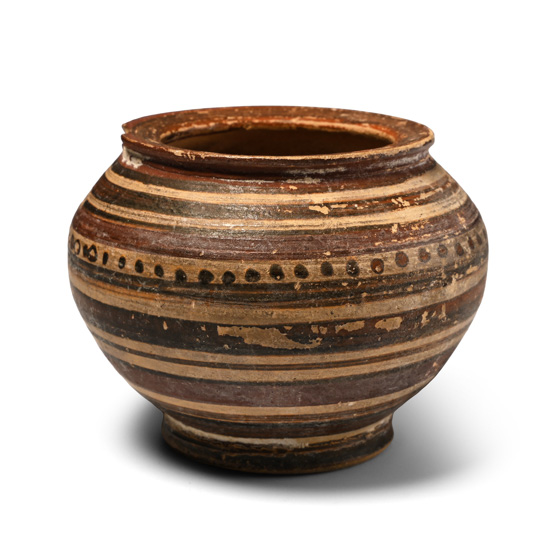
Phoenician Bowl with Crimson and Black Decorations
4th century B.C.Sold for (Inc. bp): £1,040
With a narrow basal ring, a flared rim, and painted circumferential bands. 49.2 grams, 63 mm
Private collection, Los Angeles, USA. Acquired on the American art market. European private collection.
Similar pottery has been found in the Phoenician necropolis of Villaricos near Madrid (tomb 1082), although undecorated. The pottery seems to be of Iberian-Phoenician style, being bowls of similar type and decorated found also in the necropolis of Tutugi, Galera, Granada, Andalusia. -
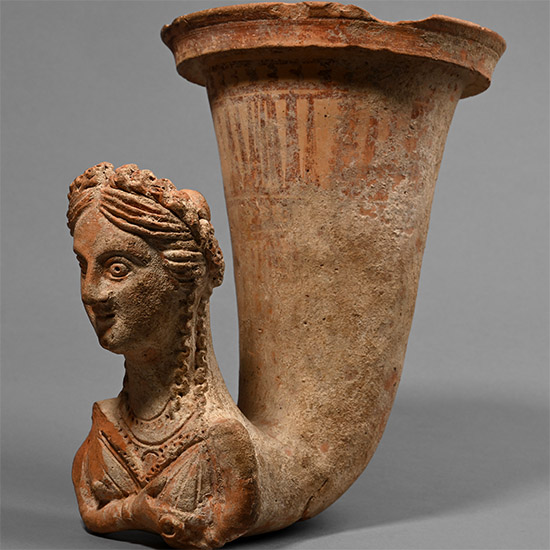
Greek Terracotta Rhyton of a Goddess
3rd-2nd century B.C.Sold for (Inc. bp): £5,720
With flanged and stepped rim, tapering curved body, figural finial of the goddess with diadem; bands of red and cream geometric detail to the rim and upper body, red wave patterns to the inner face; the goddess modelled with carefully dressed hair and floral diadem, ringlets cascading to her collar bone, alert facial expression with almond-shaped eyes and prominent nose, with C-shaped billetted collar and chiton, cupping her left breast in her right hand; mounted on a custom-made stand. 1.25 kg, 24 cm
Private collection, London, UK; formed 1970s-1980s. Accompanied by an academic report by Dr Raffaele D’Amato. This lot has been checked against the Interpol Database of stolen works of art and is accompanied by search certificate number no.13312-258233.
It is challenging to identify the divinity represented on our vessel: it can be associated with Ariadne, wife of the god Dionysus, but also with a Parthian goddess such as Anahita. She was a Zoroastrian goddess associated with water, fertility, and wisdom, widely venerated across the Parthian Empire and often invoked alongside Ahura Mazda in royal and religious inscriptions. Rhyta in her likeness, typically terminating in a zoomorphic or divine protome, were used as ceremonial drinking vessels, reflecting Anahita's close association with libation and purification rites. -
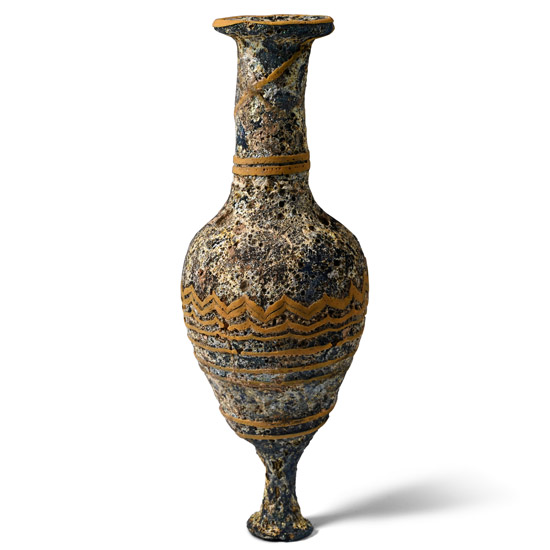
Greek Core-Formed Glass Amphoriskos
5th-3rd century B.C.Sold for (Inc. bp): £1,300
With applied yellow festooning and trails, knop foot and everted rim to the mouth. 35 grams, 12 cm high
Acquired on the UK art market, 1990s. Private collection, New York, USA. -
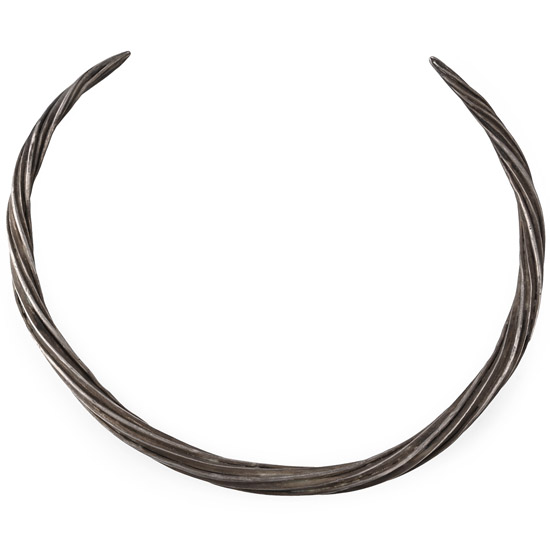
Thracian Silver Twisted Torc
5th century B.C.Sold for (Inc. bp): £702
Penannular torc twisted around its axis with tapering finials. 221 grams, 19.7 cm
Acquired in the early 1970s. Private collection, Suffolk. -
.jpg)
Greek Gold Ring and Carnelian Gemstone with Asclepius and Hygeia
Hellenistic, 1st century B.C.-1st century A.D.Sold for (Inc. bp): £2,340
Comprising a gold wire hoop with panels of baluster detailing, scrolled and securing a gold cell with an inset cabochon gemstone; to the domed face, the god Asclepius with caduceus symbol; to the flat face, goddess Hygeia standing holding a serpent; some usage wear. 2.12 grams, 22.48 mm overall, 14.21 x 16.13 mm internal diameter (approximate size British F 1/2, USA 3, Europe 4.3, Japan 4)
Private collection, UK. This lot has been checked against the Interpol Database of stolen works of art and is accompanied by search certificate number no.13357- 259200.
Asclepius, son of Apollo and Coronis, was the Graeco-Roman god of medicine, healing and prophecy. He had two daughters with Epione, the goddess of soothing - Hygeia (goddess of health) and Panacea (goddess of healing). -
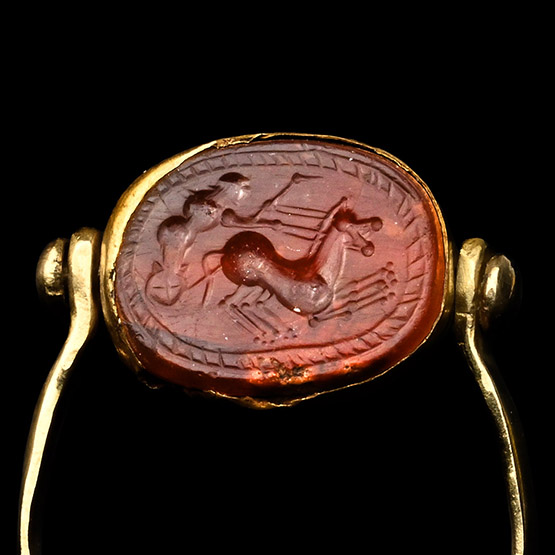
Etruscan Carnelian Scarab of a Charioteer in Gold Ring
Late 4th century B.C.Sold for (Inc. bp): £2,860
Opaque scaraboid engraved in globolo style with a dynamic scene of a charioteer driving a biga with his whip raised; set in a later sheet-gold mount and swivel ring, possibly 19th century; supplied with a museum-quality impression. 4.26 grams, 25.07 mm overall, 17.77 x 16.22 mm internal diameter (approximate size British O, USA 7, Europe 14.98, Japan 14)
Private English collection, formed between the late 1970s and early 1990s. Private collection, UK. This lot has been checked against the Interpol Database of stolen works of art and is accompanied by search certificate number no.12948-245985.
In line with trends introduced from the Eastern Mediterranean increasing use was made by the Etruscans of war chariots, even more luxurious in appearance and faced with embossed sheets of bronze. In addition to transporting warriors, they proved an effective means of controlling outlying areas, and in case were status symbols of great prestige. The Orientalizing period also saw the importation of swift and nimble breeds that were particularly suited for use as cavalry mounts. -
.jpg)
Etruscan Carnelian Scarab of a Fletcher in Gold Ring
Late 4th-3rd century B.C.Sold for (Inc. bp): £1,170
With carapace detailing and intaglio of a crouching male carving an arrow, set within a dotted border; set into a later gold swivel ring. 4.24 grams, 27.12 mm overall, 18.38 x 18.49 mm internal diameter (approximate size British P 1/2, USA 7 3/4, Europe 16.86, Japan 16)
Private collection, Europe. Acquired on the English art market.

