-
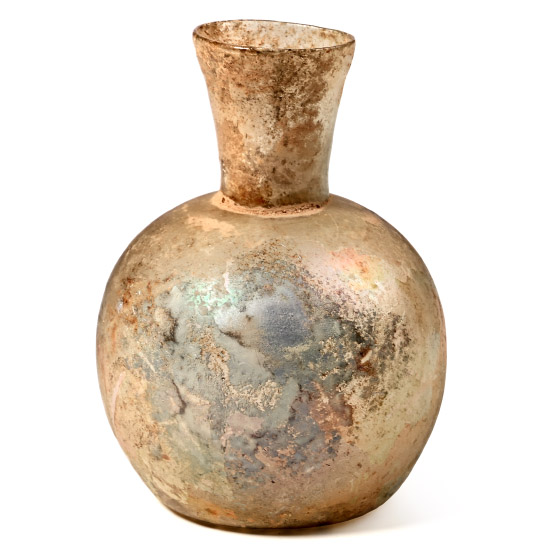
Roman Iridescent Glass Flask with Flared Neck
3rd-4th century A.D.Sold for (Inc. bp): £195
Bulbous body with dimple base and a trumpet-shaped neck. 30 grams, 10 cm
Acquired in the 1990s from London dealerships and auction houses. From the Lonson collection. -
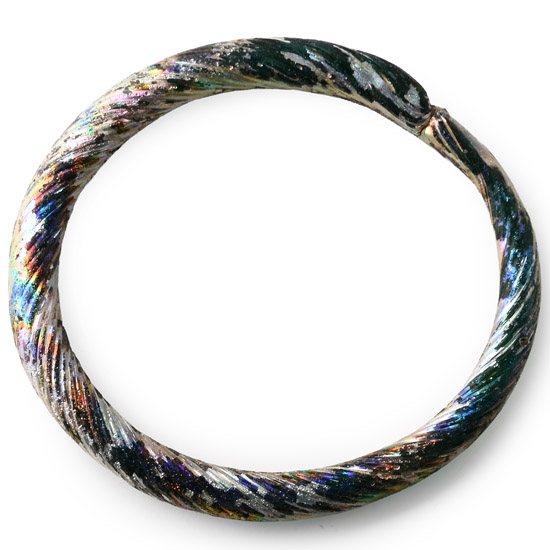
Roman Twisted Iridescent Glass Bangle
1st-4th century A.D.Sold for (Inc. bp): £111
Lentoid-section annular type with diagonal barleytwist construction; iridescence to the outer face. 7.9 grams, 56 mm
From the private collection of Mr Brian Edwards, New Malden, Surrey, UK, formed from the late 1970s-early 1980s; thence by descent. Accompanied by the original collector's data sheet(s) with reference no.A177. -
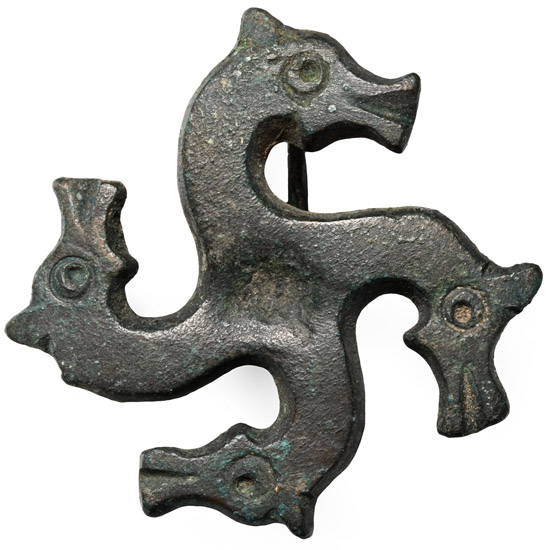
Roman Bronze Horse-Head Whorl Plate Brooch
3rd-4th century A.D.Sold for (Inc. bp): £286
With horse-head decoration to each arm, each head with punched ring-and-dot eye; a catchplate and hinged pin to verso. 14.2 grams, 41 mm
From the private coin collection of a West London, UK, gentleman, formed since the mid 1980s. -
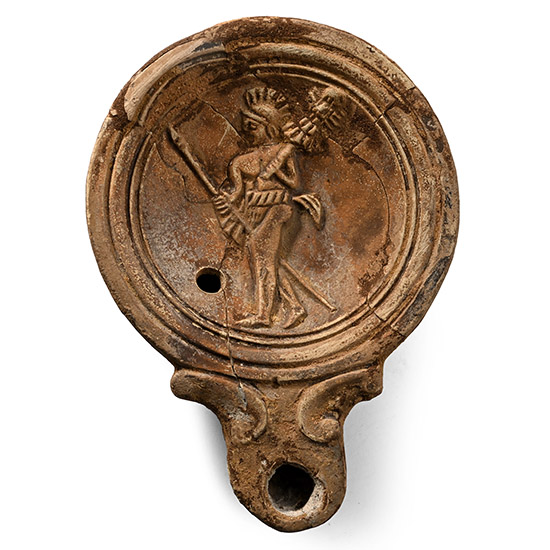
Roman Terracotta Oil Lamp with Mars
1st century A.D.Sold for (Inc. bp): £338
Squat in profile with large discus, concentric rings to the shoulder, scrolls to the base of the nozzle; low relief profile image of Mars helmeted with spear and thyrsus; repaired. 68.7 grams, 11.5 cm
From the private collection of Mr Brian Edwards, New Malden, Surrey, UK, formed from the late 1970s-early 1980s; thence by descent. -
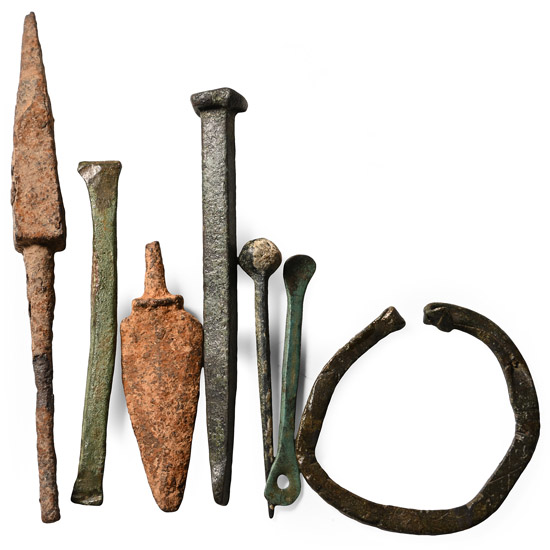
Roman Bronze and Iron Artefact Collection
Circa 1st-4th century A.D.Sold for (Inc. bp): £98
Comprising: ball-headed dess pin; stylus with eraser; cosmetic scoop; penannular quoit brooch with recurved ends; clout nail; leaf-shaped arrowhead; quarrel head with long tang. 50 grams total, 45-87 mm
From the private collection of Mr Brian Edwards, New Malden, Surrey, UK, formed from the late 1970s-early 1980s; thence by descent. Accompanied by the original collector's data sheet(s) with reference nos.A63, A64, A65, A74, A96, A97 & A107. -
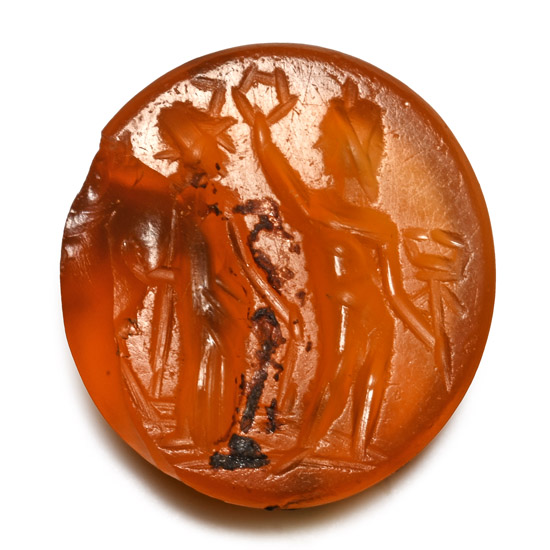
Roman Carnelian Gemstone with Minerva and Mercury
2nd-3rd century A.D.Sold for (Inc. bp): £117
Discoid type with incuse design of two figures on a baseline, helmetted Minerva left with cloak and Mercury with caduceus holding a victory wreath above her head. 0.70 grams, 12 mm
From the private collection of a European gentleman (1942-2024), formed since the 1970s. -
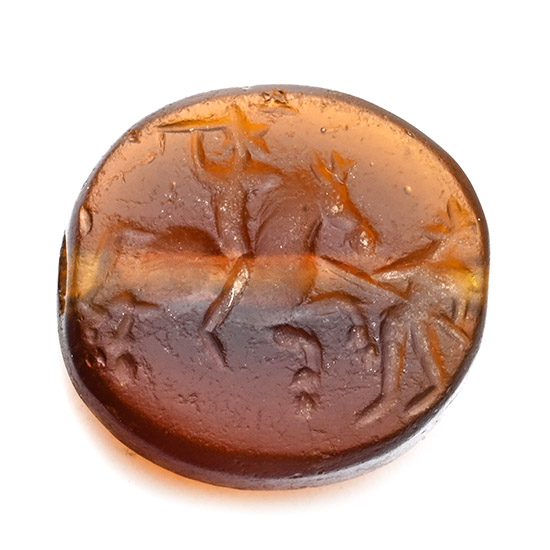
Roman Agate Gemstone with Rider Combat Scene
Circa 1st century B.C.Sold for (Inc. bp): £91
Plano-convex in section with incuse scene: rider advancing from left with sword in his raised hand, opposed standing figure with spear levelled at the horse's chest. 1.97 grams, 15 mm
Property of a European gentleman, acquired from the estate of a London collector (formed before 2000). -
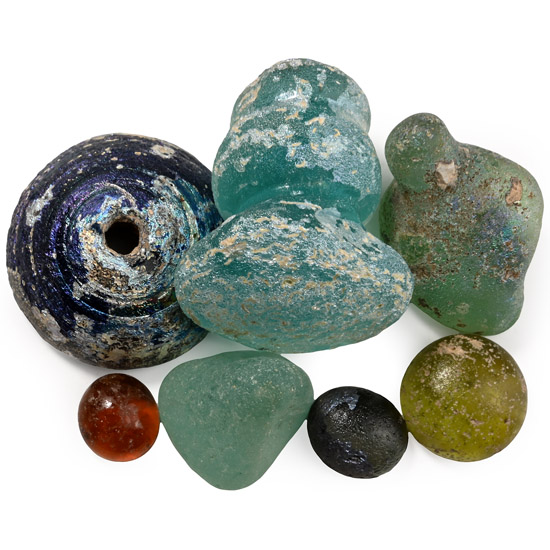
Roman Glass Artefact Collection
1st-4th century A.D.Sold for (Inc. bp): £33
Including aqua glass stopper with knop handle, plano-convex spindle whorl with iridescent surface and other items; probably used as counters in boardgames. 32 grams total, 9-27 mm
From the private collection of Mr Brian Edwards, New Malden, Surrey, UK, formed from the late 1970s-early 1980s; thence by descent. Accompanied by the original collector's data sheet(s) with reference nos.A70, A99, & A118. -
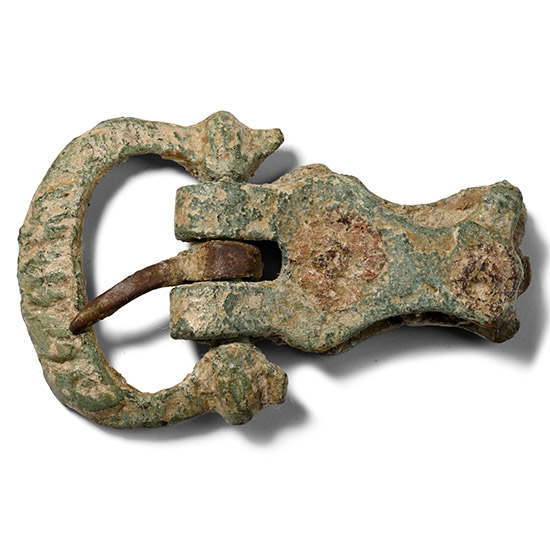
Roman Bronze Military Buckle with Plate
3rd-4th century A.D.Sold for (Inc. bp): £78
Comprising a flat, D-shaped loop with ribbed detailing to the forward edge, small curved tongue, folded buckle-plate with scooped edges and attachment rivets in situ. 11.1 grams, 43 mm
From the private collection of the late collection of Mr M., Waterlooville, Hampshire, UK, formed from the late 1980s to early 1990s. -
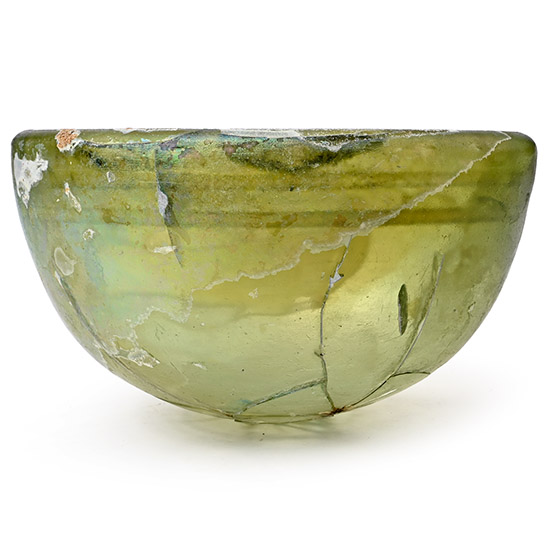
Roman Green Glass Bowl
150-50 B.C.Sold for (Inc. bp): £468
Hemispherical body with a wheel-cut decoration on the inside rim. 280 grams, 12.8 cm wide
From an important London, UK, collection 1980-2020.
Such bowls were mainly produced in the Eastern Mediterranean and diffused in Rome since the 2nd century B.C., when the sea was becoming a Mare Nostrum for the Res Publica. They were characterised by a hemispherical body with a round and convex bottom, but especially by concentric circular grooves. -
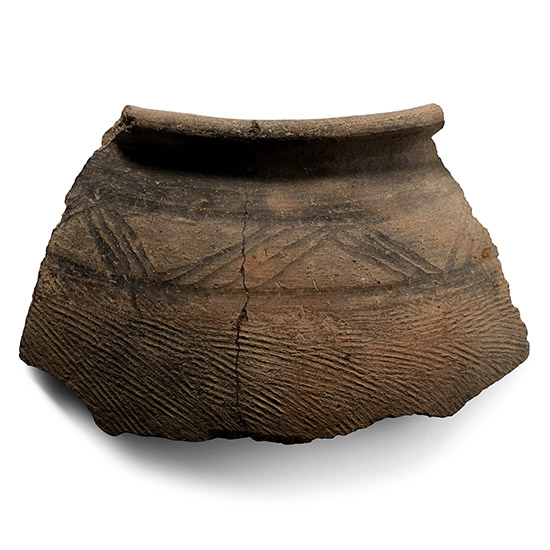
Large Romano-British Decorated Black-Burnished Ware Pot Sherd
Circa 2nd century A.D.Sold for (Inc. bp): £39
Substantial fragment from a bulbous vessel with an everted rim, a band of linear decoration below the rim, and the body decorated with a combing technique; the reverse with an old inked collection note 'opp. railstation Braughing'. 487 grams, 23 cm
Found near the village of Braughing in Hertfordshire, UK, in the early 1960s. By descent to the son of a late Hertfordshire gentleman collector, whose collection was formed from the 1960s. -
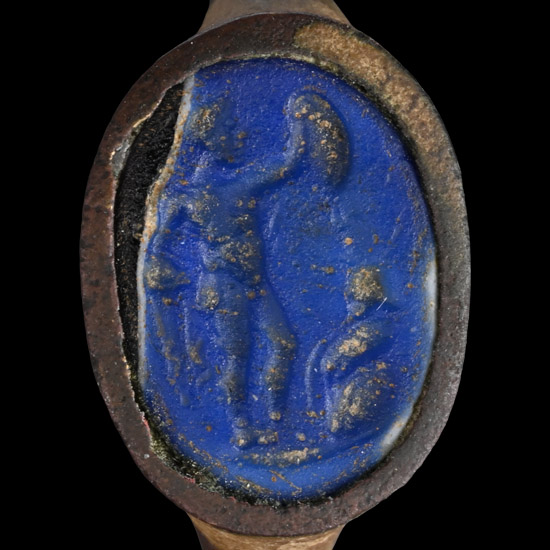
Roman Bronze Ring with Naked Male Gemstone
2nd-3rd century A.D.Sold for (Inc. bp): £156
D-section hoop widening at the shoulders, tall oval bezel set with blue glass intaglio with a standing nude male, bow behind back, holding a wine skin in upraised hand. 4.33 grams, 21.61 mm overall, 16.10 mm internal diameter (approximate size British K, USA 5 1/4, Europe 9.95, Japan 9)
Ex property of a gentleman; from a Mayfair, London, UK, gallery. Private collection, Suffolk, UK.

