
Ancient Art, Antiquities, Books, Natural History, Stamps & Coins
Days 1-5
Open For Bidding
Open For Bidding

-
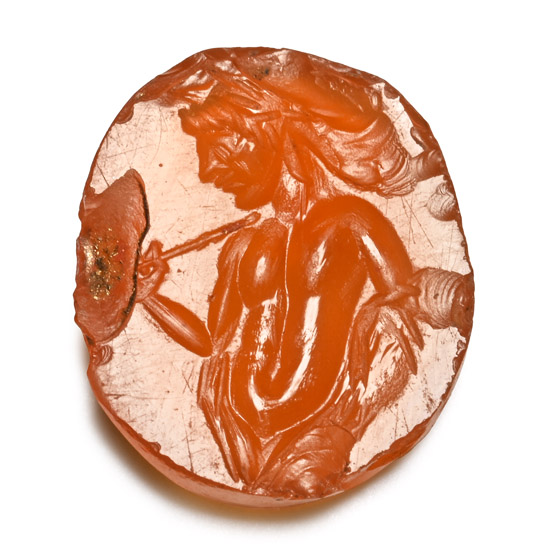
Roman Carnelian Gemstone with Dionysos
2nd-3rd century A.D.Estimate: £200 - 300 (+bp*)
Opening Bid: £5
Ellipsoid type with incuse design of Dionysos standing bare-chested with flowing hair; supplied with a museum-quality impression. 0.59 grams, 12 mm
From the private collection of a European gentleman (1942-2024), formed since the 1970s. -
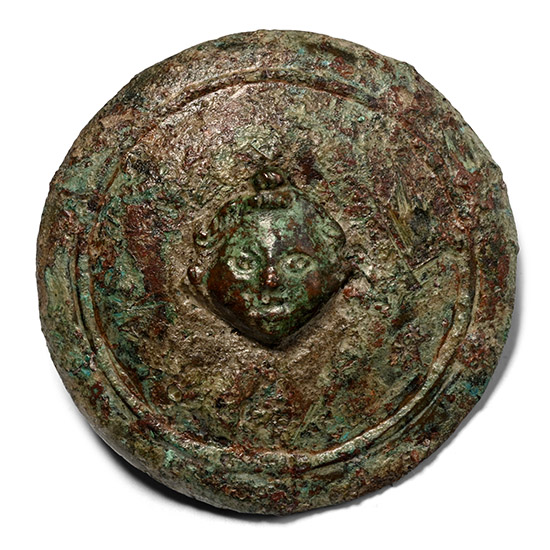
Roman Bronze Mount with Cherub's Face
1st-4th century A.D.Estimate: £30 - 40 (+bp*)
Opening Bid: £5
Domed body with a raised circumferential band on the outer edge, the centre with a face of a cherub in three-quarter view. 50.3 grams, 50 mm
Found near Lincoln, Lincolnshire, UK. Acquired on the UK art market. Property of a Lancashire, UK, collector. -
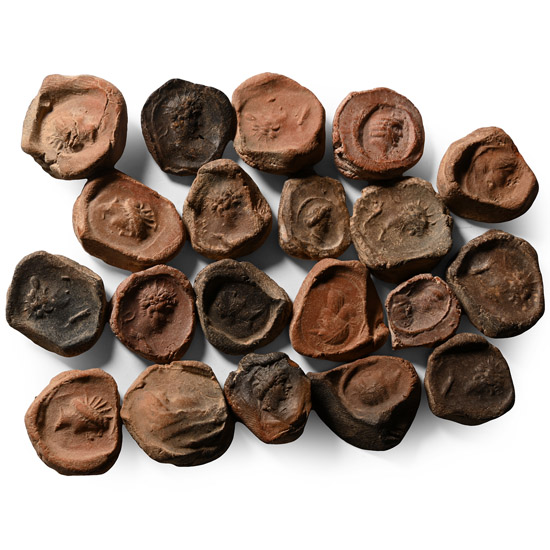
Roman Terracotta Bullae, Tesserae or Token Group
3rd century B.C.-1st century A.D.Estimate: £100 - 140 (+bp*)
Opening Bid: £5
A mixed group of ceramic bullae, tesserae or theatre tokens bearing low-relief motifs, mainly consisting of profile busts of deities. 38.8 grams total, 15-22 mm
From the private collection of a European gentleman (1942-2024), formed since the 1970s.
The term 'tessera' was used in Roman times to convey the Greek term σύμβολον (token). Small tiles are known as tokens, often shaped like coins, made of metal (copper, lead, iron), clay, bone, wood, or glass, stamped as well as engraved. The tokens, however, are not exclusively coin-shaped, as the Latin term 'tessera' refers to a four-sided shape. Tokens and tesserae seem to have been used both in Athens and Rome for the distribution of goods. According to written sources, the term ‘token’ is identified with credentials of the official authorities. They have also been interpreted as tokens of identity, as entrance tickets to theatre performances, tribunals or assemblies of citizens, archival material of seal engraving, as pawns in games, Charon’s obols and even as amulets. -
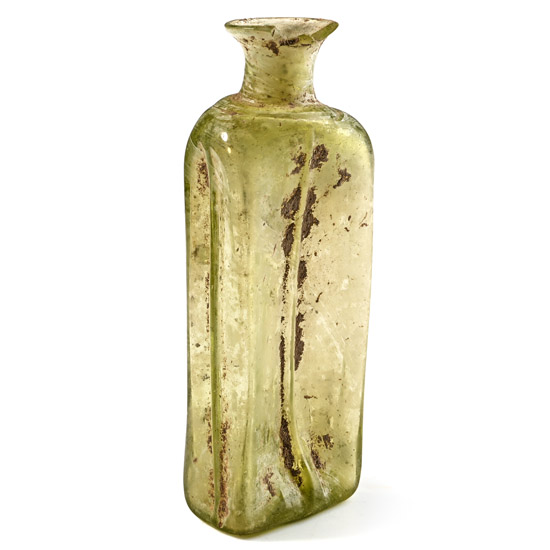
Late Roman Pale Green Glass Bottle
Circa 3rd-5th century A.D.Estimate: £60 - 80 (+bp*)
Opening Bid: £5
Rectangular body with raised rib on each side, short tubular neck with an everted rim. 44.75 grams, 98 mm
Ex German art market, 2000s. Acquired from an EU collector living in London. From the collection of a Surrey, UK, gentleman. -
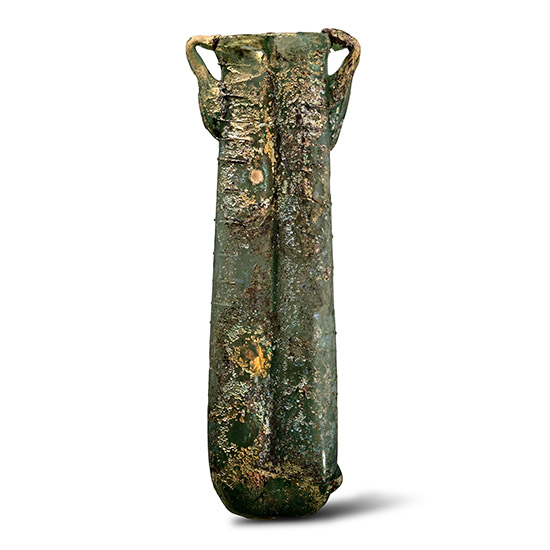
Roman Iridescent Green Glass Double Balsamarium
Circa 4th century A.D.Estimate: £150 - 200 (+bp*)
Opening Bid: £5
Twin-handled, rounded bottom with trailing around body. 46.5 grams, 12.6 cm
Acquired from Shirley Warren Antique Glass, Surrey, UK, in 1993 with reference no.SW. From the collection of a Bedfordshire, UK, lady. Accompanied by an original Shirley Warren invoice no.2347 dated 27 March 1993 (£180.00). -
.jpg)
Roman Bronze Gnostic Ring with Chnoubis
3rd-4th century A.D.Estimate: £200 - 300 (+bp*)
Opening Bid: £100
With a D-section hoop and an oval bezel with the solar deity Chnoubis, its snake-body coiled and its lion head surrounded by seven rays of light. 5.35 grams, 22.96 mm overall, 19.07 mm internal diameter (approximate size British S, USA 9, Europe 20, Japan 19)
Ex German art market, 2000s. Acquired from an EU collector living in London. From the collection of a Surrey, UK, gentleman. -
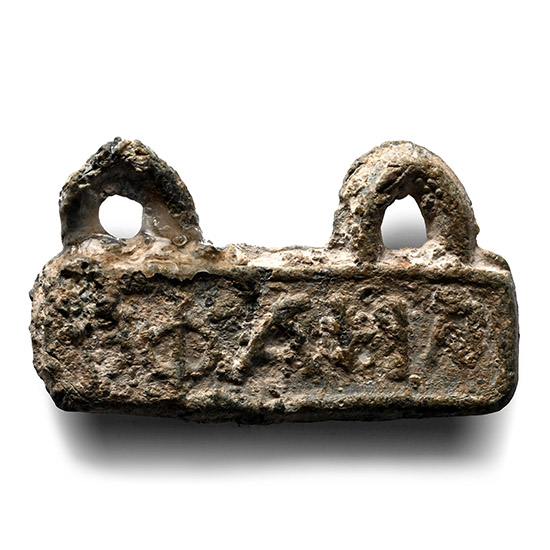
Roman Inscribed Bifacial Lead Pendant with Names of the Archangels
6th-7th century A.D.Estimate: £60 - 80 (+bp*)
Opening Bid: £5
Rectangular pendant with two loops on the upper edge with Greek inscriptions referring to the archangels, one side with the inscription 'PAΦAHΛ', (Raphael); the other side with reversed inscription reading 'ΓABPHIΛ' (Gabriel); repair to one loop. 4.97 grams, 27 mm
Ex German art market, 2000s. Acquired from an EU collector living in London. From the collection of a Surrey, UK, gentleman. -
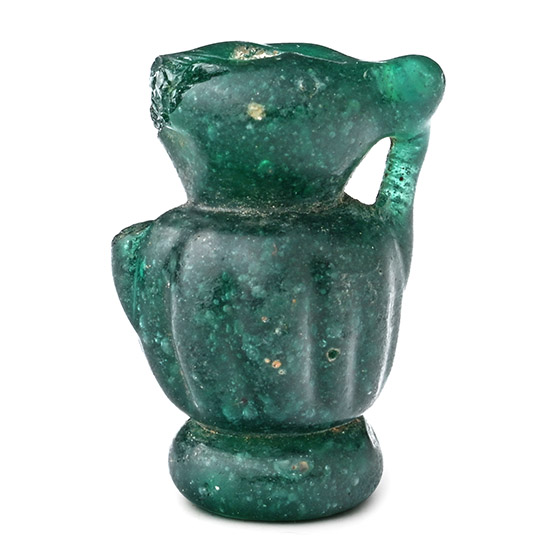
Roman Green Glass Pendant Jug with Ribbed Body
Circa 1st-4th century A.D.Estimate: £70 - 90 (+bp*)
Opening Bid: £5
Modelled in the round with a fluted body and flaring foot and rim, an angular handle to one side, pierced through the body for suspension. 2.13 grams, 17 mm
Ex private collection of the late Mr S.M., London, UK, 1970s-1990s. -
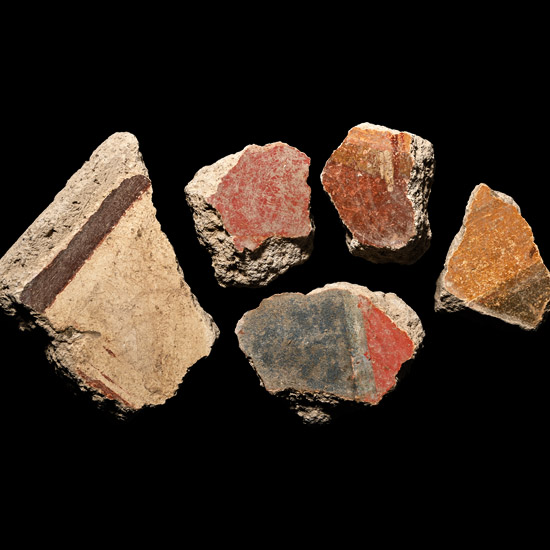
Roman Fresco Wall Plaster Collection
1st century A.D.Estimate: £50 - 70 (+bp*)
Opening Bid: £5
Fragments of wall plaster with rendered surface painted with mainly Pompeii red, pale blue, brown and cream detailing; some with an impression of timber laths to the reverse. 1 kg total, 8.2-13.4 cm
Acquired in the 19th century. Ex Jeger collection, Switzerland. UK gallery, early 2000s.
These small fragments, for analogies with the fragments of Pompeii, seem to belong to the second style of Roman painting, red panels representing highlight and shadow, decorated with vegetal interlaces. A red grenade fillet probably framed some panels. A fragment shows alternate blue and red colours over a cream background, maybe pertinent to a socle. -
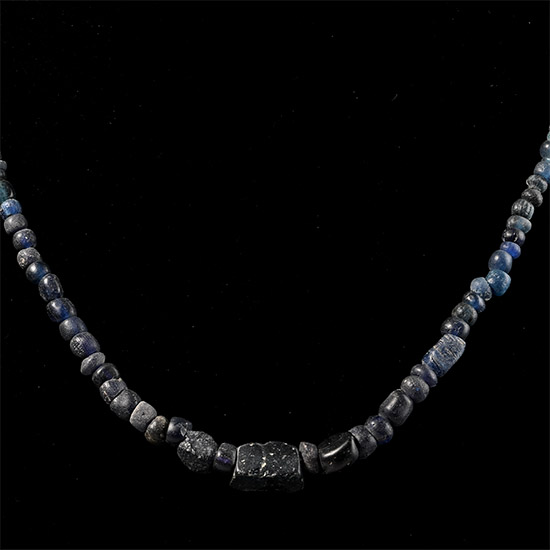
Roman Blue Glass and Other Bead Necklace String
1st-4th century A.D. and laterEstimate: £50 - 70 (+bp*)
Opening Bid: £5
Composed of graduated oblate bead with a large rectangular bead at the centre, restrung. 19.6 grams, 46.3 cm
Acquired in the 1990s. Ex London, UK, collection. -
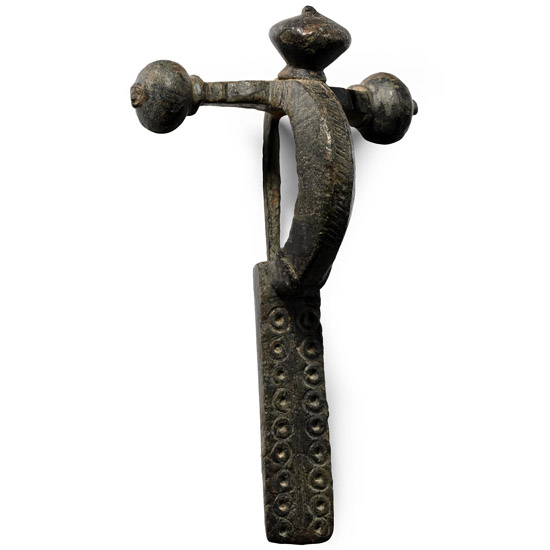
Roman Bronze Crossbow Brooch
4th century A.D.Estimate: £70 - 90 (+bp*)
Opening Bid: £5
With onion knop finials, deep bow, stepped junction with foot, trapezoidal foot with ring-and-dot motifs and integral catch; hinged pin to reverse. 44.8 grams, 78 mm
From the private coin collection of a West London, UK, gentleman, formed since the mid 1980s. -
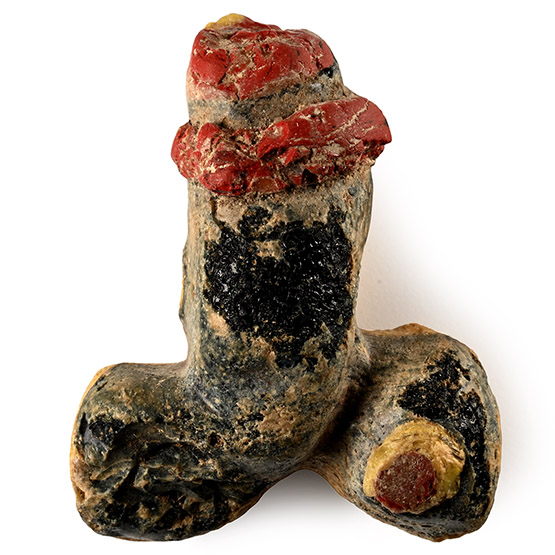
Roman Glass Phallic Amulet
1st century B.C.-1st century A.D.Estimate: £400 - 600 (‡+bp*)
Opening Bid: £200
Modelled in the round with applied red-glass collar, pierced through the shaft for suspension. 11.4 grams, 32 mm
Acquired in the mid 1980s-1990s. Private collection, Switzerland, thence by descent. Private collection, since the late 1990s.
In the Roman world, the phallus was a symbol of luck or fertility, and it was believed to have apotropaic functions. Pendants, amulets and small objects were worn by all sorts of people as symbols of protection, especially by young children, according to Varro and Pliny the Elder. The phallus is also commonly found on reliefs, frescoes and lamps from the Graeco-Roman world.
