
-
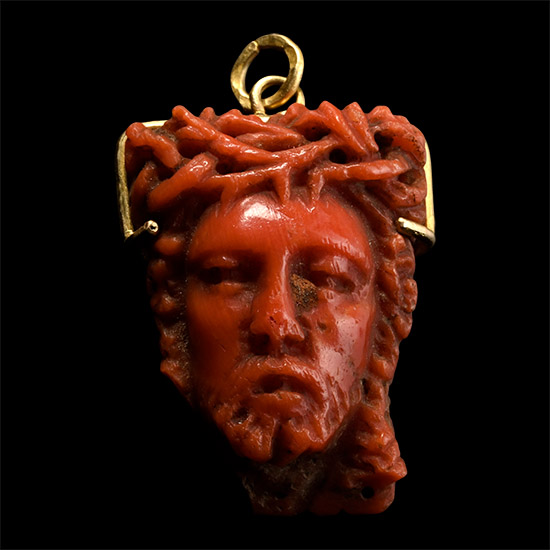
Post Medieval Coral Memento Mori Janus Chaplet Bead with Head of Christ and Skull
17th-18th century A.D.Estimate: £1,500 - 2,000 (+bp*)
Opening Bid: £700
Devotional prayer bead featuring a grimacing skull on one side and the other with the face of Jesus wearing the crown of thorns; set in a simple gold frame with suspension loop. 13.31 grams, 39 mm
Acquired on the European art market. -
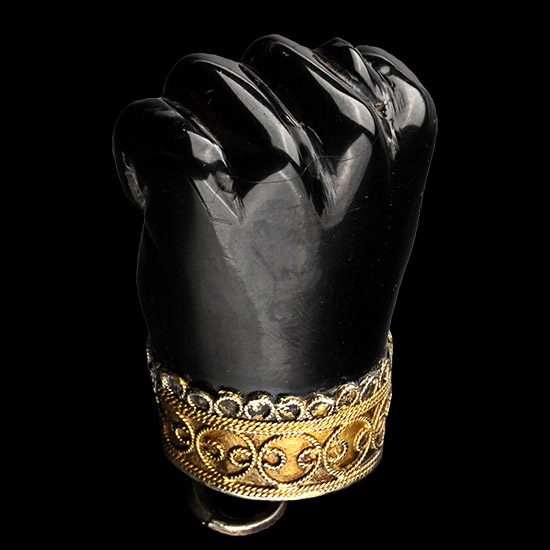
Silver-Gilt Mounted Jet 'Figa' Amulet
Spain, 17th century A.D.Estimate: £600 - 800 (+bp*)
Opening Bid: £300
Formed as a hand showing figa gesture, silver mount with applied twisted wires; attachment loop and ring to the top. 19.6 grams, 56 mm
Private collection, Europe. Acquired on the English art market.
Mano Fico, as protective amulets, have been used since antiquity. It was believed to protect from the evil eye and other dark and magical forces and to promote fertility. In ancient Rome, the fig sign, or mano fico, was made by the pater familias (father of the family) to ward off the evil spirits of the dead as a part of the Lemuria ritual. The ancient Greeks wore amulets of the gesture around the neck to protect from the evil eye, and also used the gesture in artwork. What they considered an overtly sexual gesture was expected to distract evil spirits from causing harm. The pendant would have been worn from a belt or from a chatelaine containing other protective talismans. This carving would have served as a token representing a person's pilgrimage to Santiago de Compostela, one of the very few places in which jet can be found and mined since at least the Middle Ages. -
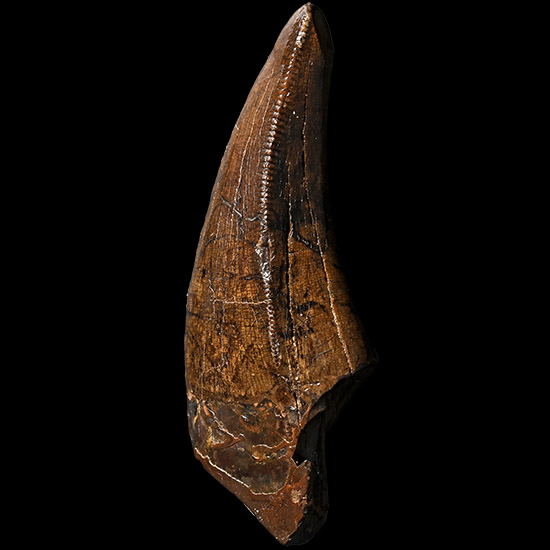
The Tooth of a North American Tyrannosaurus-Rex from Montana
Maastrichtian, Upper Cretaceous, circa 67-66 million years B.P.Estimate: £4,000 - 6,000 (+bp*)
Bids: 2 | Current Bid: £2,500
A well-preserved large tooth with knife-like serrations on two edges, designed to slice through flesh and bone, displaying beautiful dark brown patina. 53 grams total, tooth: 54 mm, 12.5 cm including stand
Found in the Hells Creek Formation, Montana, USA. Property of a Bristol, UK, gentleman collector.
The most famous and iconic of all dinosaur species, the Tyrannosaurus rex, was first described by Henry Fairfield Osborn in 1905 from a skeleton found in 1902, from the Hell Creek Formation in Montana. An adult Tyrannosaurus would have weighed almost nine tonnes, standing over 4 meters tall at the hip and exceeding 13 meters in length. It is no wonder this theropod was the top predator of the Late Cretaceous, and amongst the last dinosaurs to walk the Earth before their mass extinction. The present tooth offers an incredible insight into how these ferocious creatures lived, characterised by its unique curved and serrated shape, which was specifically adapted to help the dinosaur tear through hides and flesh, with the curvature allowing maximum force to be applied as it tore into its prey. -
.jpg)
Large Iridescent Placenticeras Ammonite from Alberta
Bear Paw Formation, Upper Cretaceous Period, circa 76-73 million years B.P.Estimate: £4,500 - 6,500 (+bp*)
Bids: 2 | Current Bid: £2,500
Placenticeras costatum with gem quality fossilised shell with some visible suture lines, conserved and stabilised with natural polish and acrylic lacquer, with excellent iridescence showing red, green, orange and gold colours. 952 grams, 26 cm
Found St Mary River Valley, Lethbridge Mining District, Alberta, Canada. Property of a Bristol, UK, gentleman collector. Accompanied by a certificate of authenticity, exportable under Moveable Cultural Property Permit no.7021-25-12-22-0102.
The striking iridescence of these ammonites from Alberta, Canada, termed 'ammolite', was given the status of a gemstone by CIBJO in 1981. An iridescent opal-like play of colour is shown in fine specimens, and is caused by the microstructure of aragonite, the same mineral contained in pearls and nacre. The thicker the structural layers, the more reds and greens are produced; the thinner the layers, the more blues and violets predominate. The ammonites are a group of molluscs that lived in the seas from the mid-Devonian (approximately 400 million years ago) to the end of the Cretaceous (65 million years ago). The sequence of events that famously killed off the dinosaurs also drove the ammonites to extinction. -
.jpg)
Sericho Meteorite Cross-Section
Circa 4.5 billion years B.P.Estimate: £8,000 - 10,000 (+bp*)
Bids: 2 | Current Bid: £5,000
A spectacular polished slice displaying the characteristic crystalline structure of pallasites, with translucent amber-coloured olivine crystals suspended in a shimmering metallic iron-nickel matrix; accompanied by a custom-made display stand. 1.3 kg, 48.5 cm
Discovered in Isiolo County, Eastern Kenya, 2016. Private collection, USA.
Comprising 0.2% of all meteorites, pallasites are the rarest and most aesthetic examples and are highly sought after by collectors and museums. This cross-section reveals their mesmerising internal structure, consisting of translucent amber-coloured olivine crystals suspended in a shimmering iron-nickel matrix which has been polished to a mirror finish. Of all known pallasites, Sericho is especially renowned for its high concentration of olivine, often displaying hues of orange, yellow and green when spotlit or in direct sunlight. Cross-sections of this scale and integrity are particularly rare. While prized for their beauty, Sericho meteorites are also notoriously prone to oxidation if not treated correctly. This piece has been carefully prepared, resulting in a stable specimen that retains both its visual clarity and structural integrity. -
.jpg)
Seymchan Meteorite Cross-Section
Circa 4.5 billion years B.P.Estimate: £6,000 - 8,000 (+bp*)
Bids: 1 | Current Bid: £3,000
A magnificent polished cross-section from the Seymchan pallasite meteorite, revealing the honeycomb-like structure characteristic of pallasites, with translucent olivine crystals embedded within iron-nickel crystals; accompanied by a custom-made display stand. 356 grams, 23.2 cm
Discovered in 1967, recovered from the bed of the river Hekandue in the Magadan District, Russia (62° 54’ N, 152° 26’ E).
The main mass of 272.3 kilograms was found during a survey in June 1967 by geologist F. A. Mednikov. The mass was a triangular-shaped thumb-printed meteorite lying among the stones of the brook bed. A second specimen of 51 kilograms was found with a mine detector at a distance of 20 meters from the first in October 1967 by I. H. Markov. During a new expedition in 2004, Dmitri Kachalin recovered about 50 kilograms of new material. Remarkably, about 20% of the new specimens were found to contain olivine crystals, and so revealed the silicate nature of the meteorite. The pallasitic structure was not previously discovered during studies on small metal-only sections of the original mass. The distortion of the Widmanstatten patterns is interpreted as shearing of the superheated meteorite as it broke up in the Earth's atmosphere.

