
-
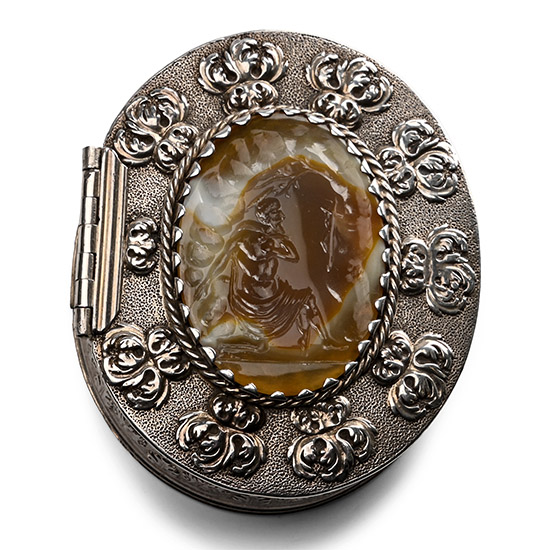
Post Medieval Silver Snuff Box Set with Agate Intaglio of Saint Jerome
Italy, 16th-17th century A.D.Estimate: £1,000 - 1,400 (+bp*)
Opening Bid: £500
Decorated with a repeating motif of acanthus leaves and facing masks of Bacchus; lid of set with an agate intaglio of Saint Jerome kneeling before a crucifix within a rope-twist and dog's tooth border, surrounded by leafy swags on a pounced field; old collector's label 'Walecki Collection 207006' to inner lid. 52.7 grams, 53 mm
Private collection, Europe. Acquired on the English art market. -
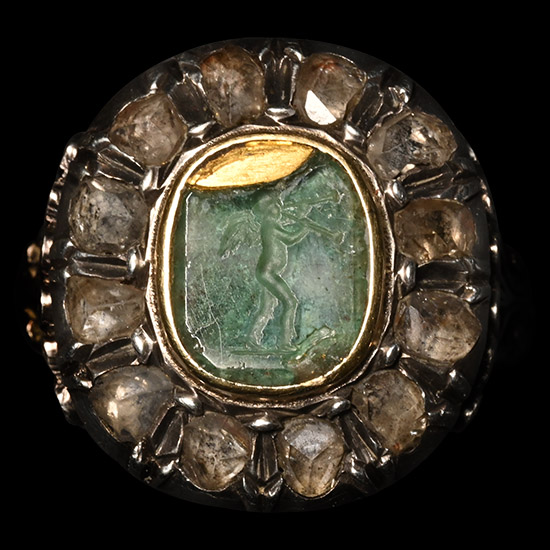
Diamond Locket Ring Set with Emerald Intaglio of Amor, God of Love, Playing Diaulos
Late 19th century A.D.Estimate: £1,200 - 1,700 (+bp*)
Opening Bid: £600
Comprising a segmented hoop with scroll-shaped shoulders, a hinged oval bezel with a secret compartment, and a bezel decorated with twelve cut diamonds around a central green stone intaglio of a winged Amor standing on a prora playing a diaulos. 5.82 grams, 23.60 mm overall, 16.50 mm internal diameter (approximate size British L 1/2, USA 6, Europe 11.87, Japan 11)
Private collection, Europe. Acquired on the English art market. -
.jpg)
Silver Pendant in the form of Saint Anthony of Padua and Christ Child
Spain, 17th century A.D.Estimate: £600 - 800 (+bp*)
Opening Bid: £300
Modelled in the round, Saint Anthony standing on a square base and holding the infant Jesus, who is holding a lily in his left hand; the saint dressed in long robes tied at the waist with a rope, loop at the rear and a separately made base. 64 grams, 58 mm
Acquired on the European art market. -
.jpg)
German Silver-Gilt and Enamelled Figure of a Sailor
17th century A.D.Estimate: £700 - 900 (+bp*)
Opening Bid: £350
The mariner modelled in a lively stance, holding a coiled rope in both hands, which falls in a naturalistic spiral at his feet, wearing a brimmed and gilt-edged cap, a red enamelled doublet with chased detail, and voluminous green enamelled trunk-hose, his boots and gloves parcel-gilt. 31.62 grams, 54 mm
Acquired on the European art market. -
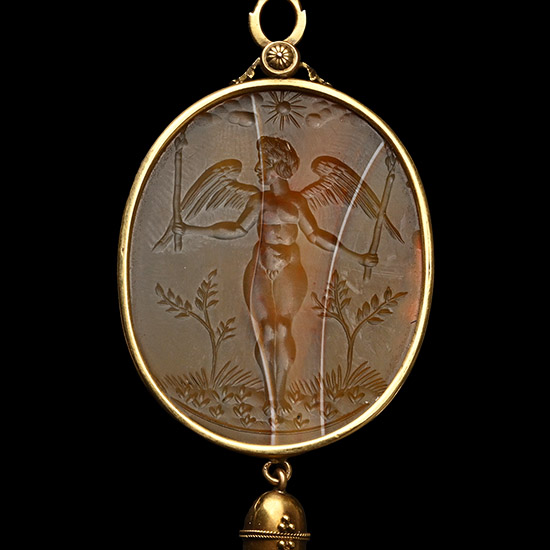
Renaissance Gold Pendant with Agate Gemstone of Cupid
Italy, late 16th-early 17th century A.D.Estimate: £2,000 - 3,000 (+bp*)
Opening Bid: £1,000
Cupid shown standing amid the vegetation, his wings and arms spread and holding two short staffs in his hands, clouds and the sun above; set in a gold frame with a conical pendant drop below; supplied with a museum-quality impression. 13.53 grams, 75 mm
Acquired on the European art market. This lot has been checked against the Interpol Database of stolen works of art and is accompanied by search certificate number no.13341-257981.
The cameo shows a Cupid in the same style as the one in the British Museum Sloane collection. Cupid was a very popular motif in 17th-century Italian artistic production. The presence of Cupid on the cameo implies amorous attachment, or sometimes, amorous conflict. The cameo shows a sophisticated atmosphere, relayed in the brown and grey colours. -
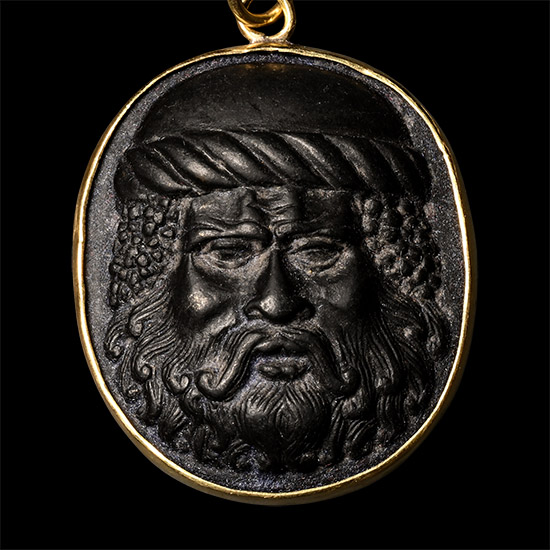
Gold Pendant with Glass Head
19th century A.D.Estimate: £500 - 700 (+bp*)
Opening Bid: £250
In low-relief, facing bust with braided band to his brow and bunch of grapes to each temple. 11.5 grams, 44 mm
Private collection, Europe. Acquired on the English art market. -
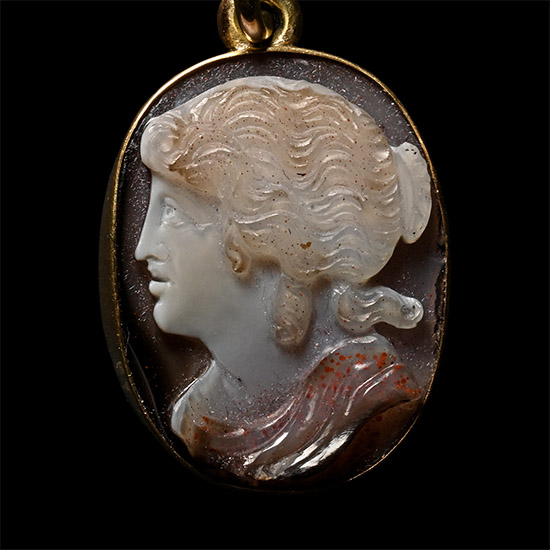
Post Medieval Agate Cameo of a Classical Muse in Gold Mount
Italy, 18th century A.D.Estimate: £700 - 900 (+bp*)
Opening Bid: £350
Gold cell with suspension loop, inset banded agate panel with reserved female profile bust with hair in a chignon. 7.8 grams, 38 mm
Private collection, Europe. Acquired on the English art market. -
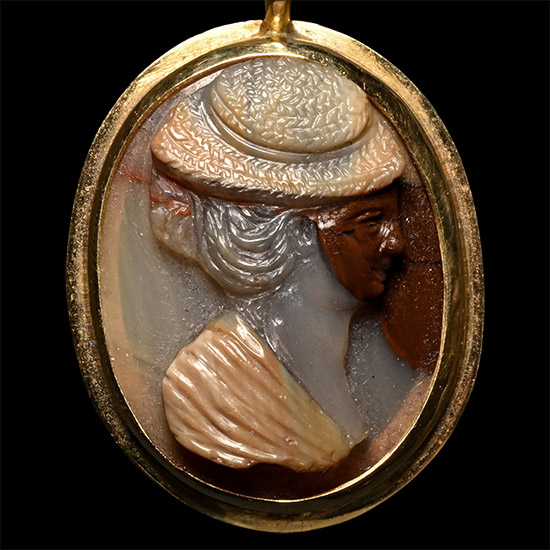
Post Medieval Agate Cameo of a Lady in Gold Pendant
19th century A.D.Estimate: £800 - 1,000 (+bp*)
Opening Bid: £400
Carved in low-relief, a female profile bust wearing a straw hat and mantle. 6.40 grams, 36 mm
Private collection, Europe. Acquired on the English art market. -
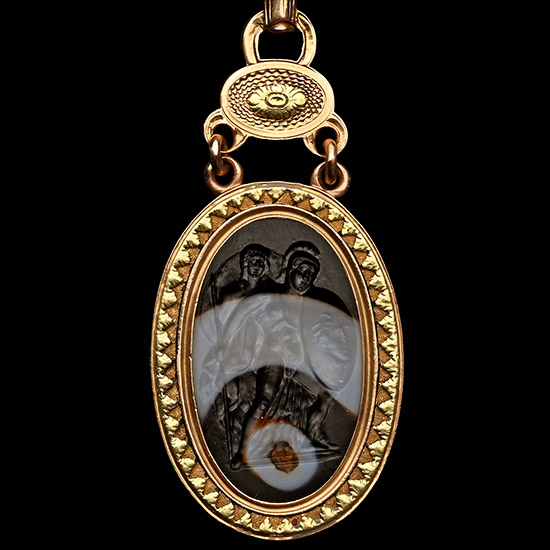
Banded Agate Intaglio Depicting Perseus and Andromeda in Gold Pendant
Italy, 17th-18th century A.D.Estimate: £4,000 - 6,000 (+bp*)
Bids: 1 | Current Bid: £2,000
Translucent intaglio featuring a dynamic mythological scene of Perseus rescuing Princess Andromeda; Perseus depicted nude and wearing a crested helmet, holding a round shield with a Medusa mask in his hand and a spear in the other, Andromeda standing behind him and dressed in long flowing robes; set in an elaborate late 18th-century English gold frame; supplied with a museum-quality impression. 13.64 grams, 61 mm
Acquired on the European art market. This lot has been checked against the Interpol Database of stolen works of art and is accompanied by search certificate number no.13343-257990.
Andromeda was the daughter of the Aethiopian king Cepheus and Cassiopeia. According to the legend, Cassiopeia angered Neptune by claiming that her daughter was more beautiful than the nereids, and Neptune, in revenge, sent a monster to ravage the coast. Told that the only way to save their country is to sacrifice their daughter to the creature, Andromeda’s parents chained her to a rock by the sea. The demigod Perseus, son of Jupiter, killed the sea monster by petrifying it with the head of Medusa and rescued Andromeda. -
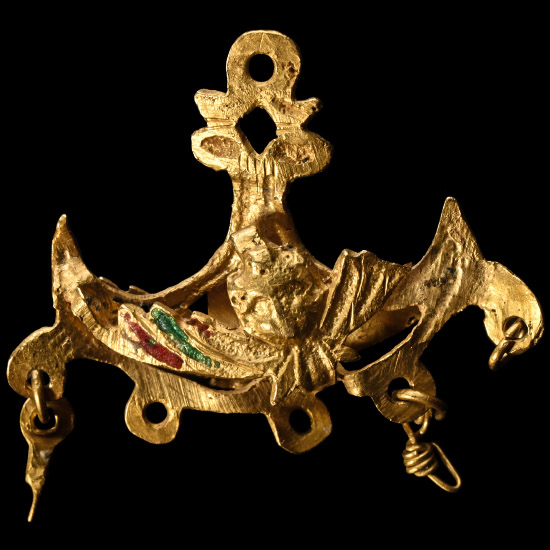
Elizabethan Period Enamelled Gold Ship Pendant
16th century A.D.Estimate: £800 - 1,000 (+bp*)
Bids: 1 | Current Bid: £40
Crescentic bifacial pendant with winged putti on each side with traces of original polychrome enamel on the wings, five loops on the underside and a decorated suspension loop above. 2.78 grams, 27 mm
From a Cambridgeshire, UK, collection, 1990s. -
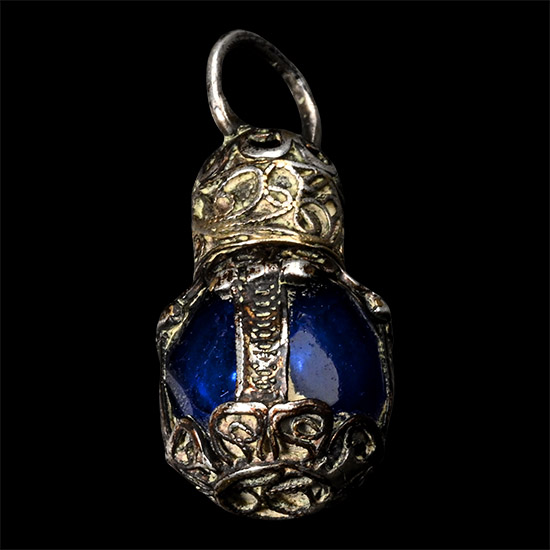
Miniature Blue Glass Scent Bottle with Silver Filigree Mounts
England, 17th century A.D.Estimate: £400 - 600 (+bp*)
Opening Bid: £200
Of facetted deep blue glass, enclosed within an elegant silver filigree cage mount retaining traces of its original gilding; the domed screw-cap similarly decorated with scrolling filigree ornament and fitted with a suspension loop, indicating that it was intended to be worn on a chain or ribbon, with an original clear glass stopper. 4.62 grams, 28 mm
Acquired on the European art market.
Delicate in scale yet refined in execution, the bottle is a characteristic example of late 17th-century English personal luxury wares. -
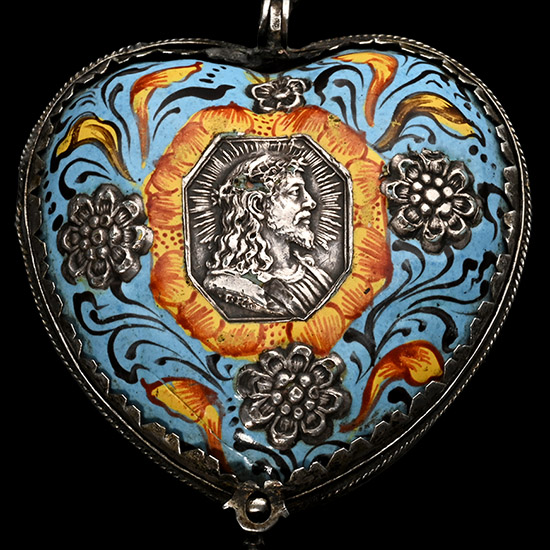
Enamelled Pendant in the form of a Heart with Silver Decorations
Germany, 17th century A.D.Estimate: £2,000 - 3,000 (+bp*)
Bids: 1 | Current Bid: £1,000
Hinged pendant decorated in blue, yellow and red enamel with silver floral decoration, one side with a silver profile of the Virgin, and the other side with the profile of Christ; inside decorated with light blue enamel; possibly used to carry a relic or the host as a portable pyx. 29.8 grams, 67 mm
Acquired on the European art market. This lot has been checked against the Interpol Database of stolen works of art and is accompanied by search certificate number no.13405-257980.

