
-
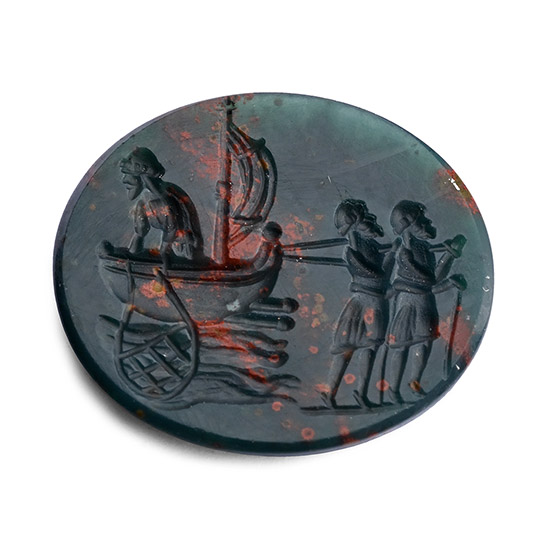
Georgian Period Bloodstone Gemstone with Christ Fishing
17th-18th century A.D.Estimate: £600 - 800 (+bp*)
Opening Bid: £300
Oval heliotrope intaglio showing a boat on water with an open sail, Christ casting a net in the water, and the boat drawn by the disciples; supplied with a museum-quality impression. 0.55 grams, 14 mm
Acquired on the European art market. -
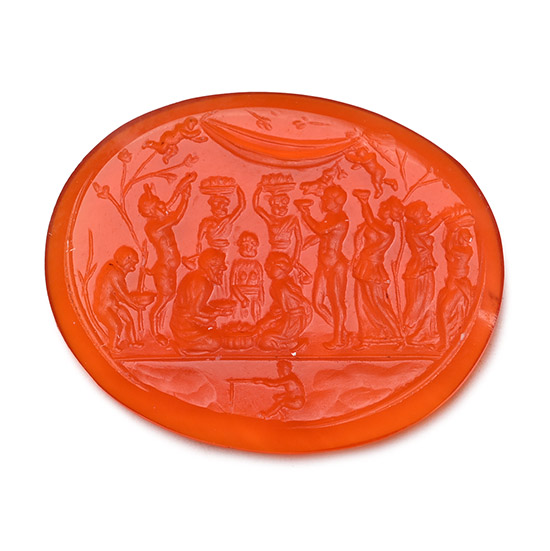
Renaissance Carnelian 'Michelangelo's Seal' Gemstone
18th century A.D.Estimate: £600 - 800 (+bp*)
Opening Bid: £300
Vibrant orange carnelian intaglio depicting a lively Bacchic scene with satyrs, wine-bearers and other participants beneath a canopy supported by two flying Cupids; below in the exergue, a small figure of a fisherman, fishing with a hook on the sea shore; supplied with a museum-quality impression. 1.21 grams, 21 mm
Acquired on the European art market.
The original 'Seal of Michelangelo' is a famous engraved carnelian gem, acquired by King Louis XIV in 1670. It is now housed in the Bibliothèque nationale de France. Long thought to be an ancient Greek masterpiece, and a subject of debate and controversy, it was subsequently identified by scholars as a Renaissance work by Pier Maria Serbaldi da Pescia. -
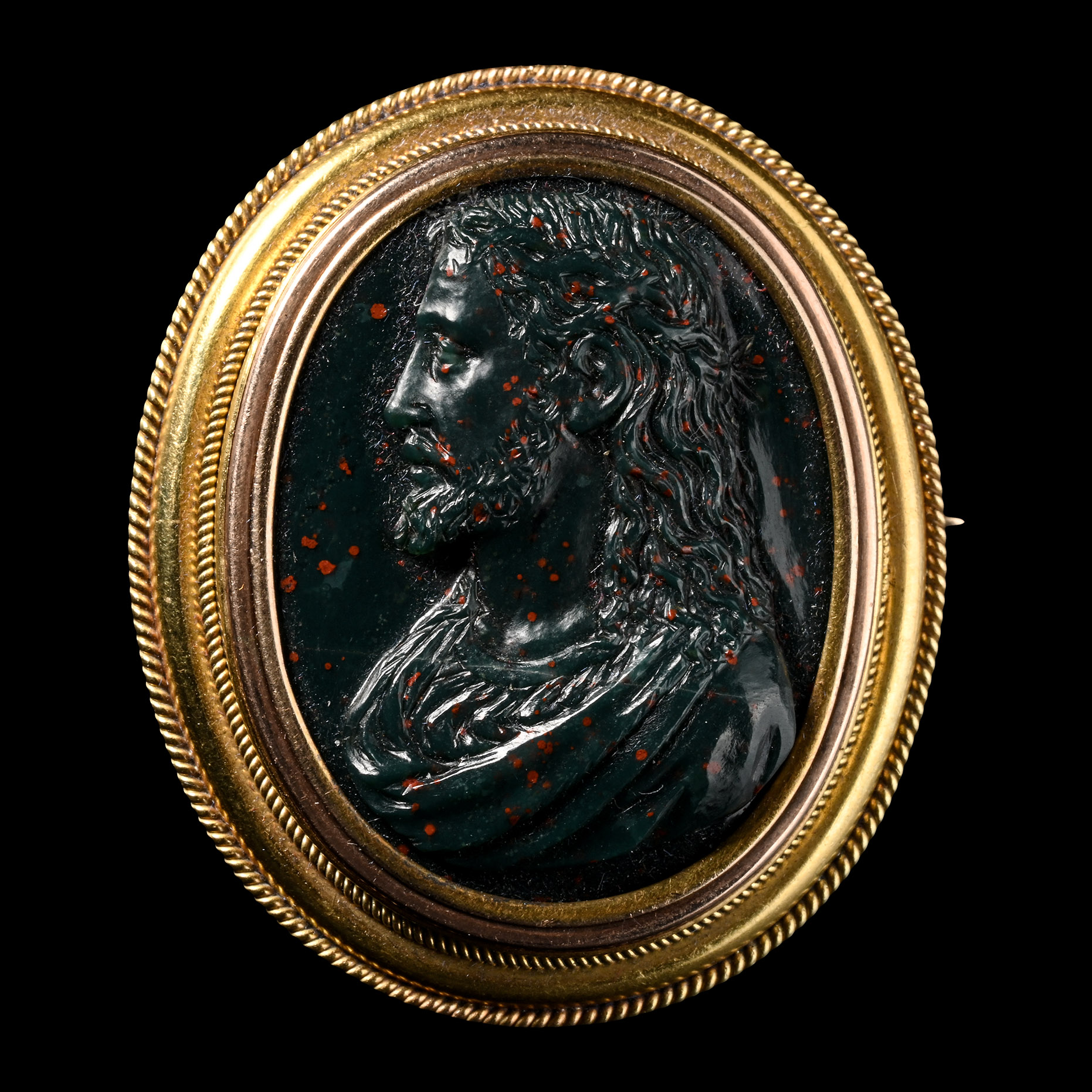
Heliotrope Cameo with Christ in Gold Mount
Italy, 17th century A.D.Estimate: £2,500 - 3,500 (+bp*)
Bids: 1 | Current Bid: £1,250
Carefully rendered bust of Christ facing left, crown of thorns resting on his curly hair, short beard and pained expression on his face; set in a gold mount with applied ropework collars, pin and catch on the reverse. 16.3 grams, 42 mm
Acquired on the European art market. This lot has been checked against the Interpol Database of stolen works of art and is accompanied by search certificate number no.13404-257986.
It was believed that the scarlet flecks in the stone were the blood of Christ, hence its popular use for the subject of Christ throughout the Middle Ages until the 19th century. -
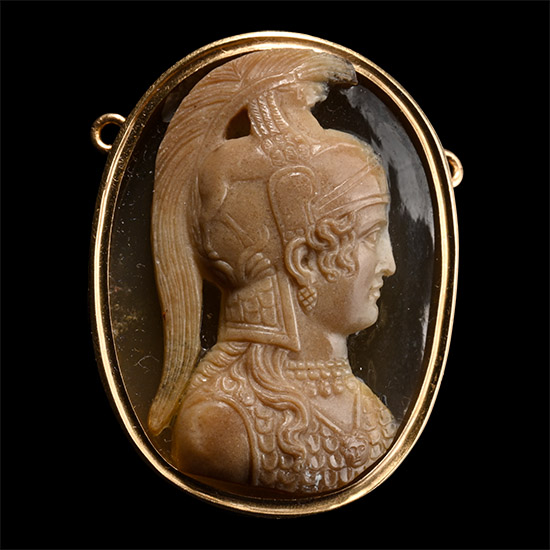
Sardonyx Cameo of the Greek Goddess Athena in Gold Mount
Europe, 18th century A.D.Estimate: £1,500 - 2,000 (+bp*)
Bids: 1 | Current Bid: £750
Finely carved, high-relief cameo depicting profile bust of the goddess, wearing a plumed helmet with the crest supported by a winged Pegasus, her hair modelled in soft curls framing the face and falling over the shoulder above articulated lorica (battle armour); small grape-shaped earrings and multiple necklaces carefully rendered, creating an appealing contrast between martial attributes and feminine ornament; set in an unmarked, high-carat gold frame, probably struck and finished in England after the gem’s return from the Grand Tour, two lateral suspension loops. 14.98 grams, 36 mm
Acquired on the European art market.
The relief shows confident toolwork: crisp contours to the facial profile, detailed treatment of the helmet and feathers, and subtle gradations of planes between the figure and the background. -
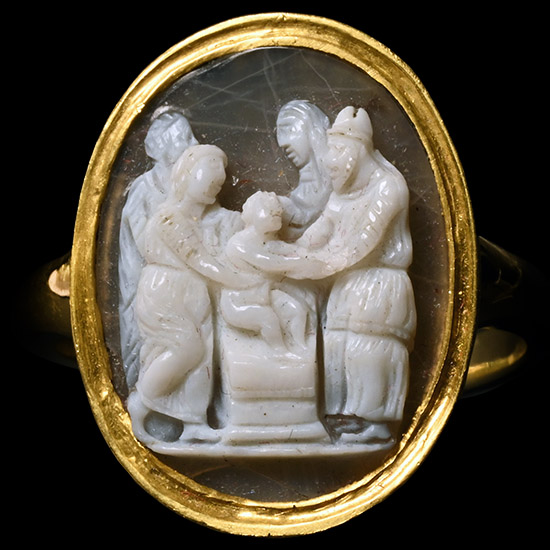
Renaissance Gold Ring with Agate Cameo of the Presentation of Christ at Jerusalem
Italy, circa 1600 A.D.Estimate: £2,500 - 3,500 (+bp*)
Bids: 2 | Current Bid: £1,500
Ellipsoid bezel with flange rim, inset cameo with a group of four adults holding an infant on a plinth; a rare subject for depiction. 8.91 grams, 24.68 mm overall, 19.41 x 17.44 mm internal diameter (approximate size British P 1/2, USA 7 3/4, Europe 16.86, Japan 16)
Private collection, Europe. Acquired on the English art market. This lot has been checked against the Interpol Database of stolen works of art and is accompanied by search certificate number no.13152-248333. -
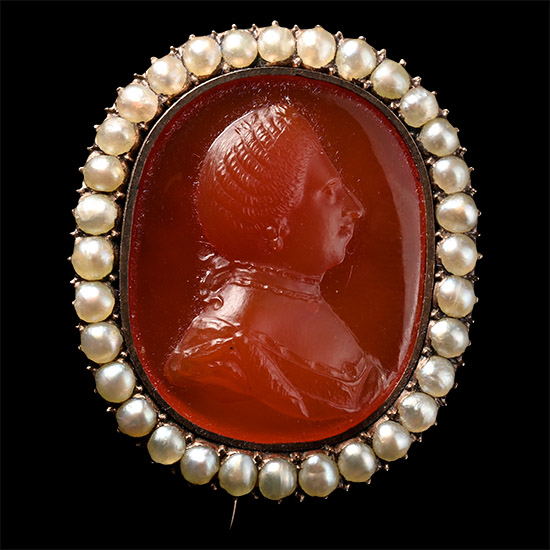
German Carnelian Cameo of Maria Theresa Mounted in a Brooch
18th century A.D.Estimate: £1,000 - 1,400 (+bp*)
Opening Bid: £500
Skilfully carved cameo depicting the jewelled profile bust of Maria Theresa facing right, the background is highly polished, whilst the relief is rendered with contrasting polished and matt elements; the high-carat gold brooch setting likely original to the jewel and set with a border of blister pearls. 9.69 grams, 37 mm
Acquired on the European art market.
Maria Theresa Walburga Amalia Christina (c.1717-80) was ruler of the Habsburg dominions from 1740 until she died in 1780, and the only woman to hold the position suo jure. She was the sovereign of Austria, Hungary, Croatia, Bohemia, Transylvania, Mantua, Milan, Lodomeria and Galicia, the Austrian Netherlands, and Parma. -
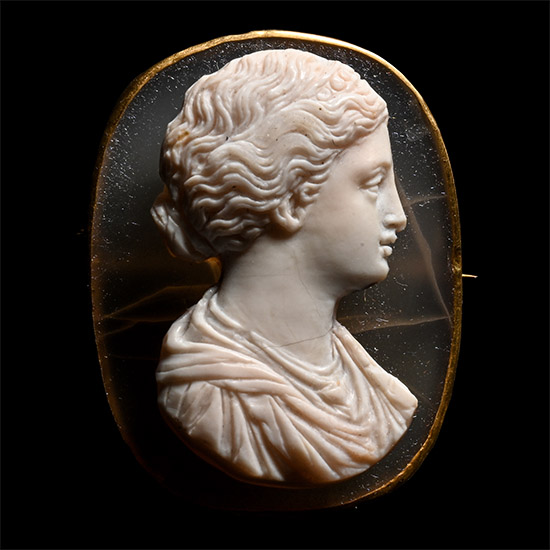
Renaissance Sardonyx Cameo of a Young Woman
Italy, 16th century A.D.Estimate: £1,000 - 1,400 (+bp*)
Opening Bid: £500
High-relief bust of a young lady facing right, her curly hair neatly pulled back to a chignon at the nape of her neck, jewelled diadem resting on top of the head; mounted in an unmarked high-carat gold brooch setting dating to the 19th century. 9.59 grams, 30 mm
Acquired on the European art market. -
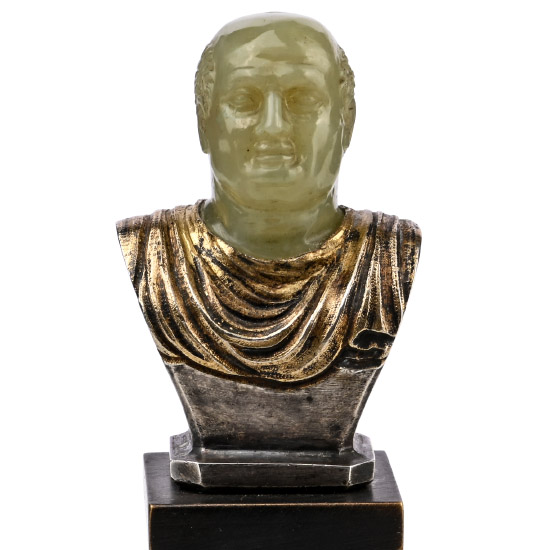
Chalcedony and Silver-Gilt Bust of the Emperor Vespasian
Italy, 17th-18th century A.D.Estimate: £1,500 - 2,000 (+bp*)
Opening Bid: £750
The head, carved from pale green chalcedony, polished to a smooth lustre and with a drilled aperture at the crown, the hair in tight curls around the nape and crown; the silver-gilt torso dressed in a draped toga carefully chased with deep folds and traces of gilding across the high points; mounted on a later patinated bronze column stand in the neoclassical manner. 208 grams total, 10.9 cm high including stand
Acquired on the European art market.
This small-scale portrait evokes the Roman tradition of imperial portraiture and the early modern fascination with the ancient world. From the seventeenth century onwards, artists and collectors revived classical subjects through hardstone and gilt-metal compositions, often intended for display in Kunstkammer or Grand Tour contexts. The combination of a reused ancient or earlier element with a later mount was a practice typical of the Renaissance and Baroque periods, reflecting the period’s reverence for antiquity and its imaginative recontextualisation of ancient forms. -
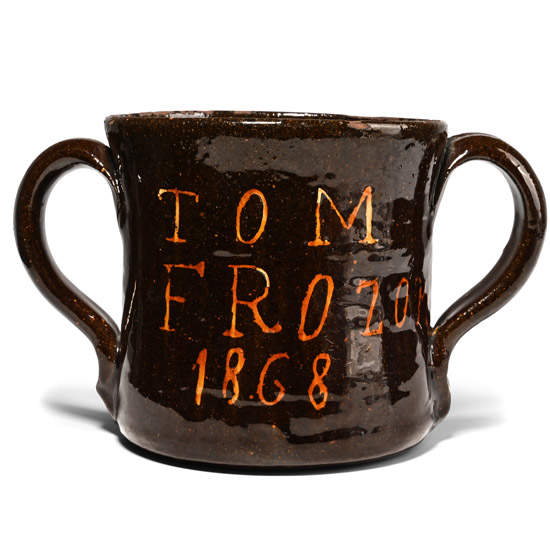
Slipware Frog 'Loving Cup' Named Tom Frozon
Halifax, England, 1868 A.D.Estimate: £400 - 600 (+bp*)
Bids: 4 | Current Bid: £32
The two-handled pottery cup named and dated in slip 'Tom Frozon 1868' on the side; a frog located inside the base to surprise the unwary drinker; an exceptional example made at Howcans Pottery, Halifax, Yorkshire. 938 grams, 21.5 cm wide
From the Martin Harrison collection, North Wales. Ex John Howard, English pottery specialist. Property of a Kent, UK, lady collector. Accompanied by a copy of the John Howard catalogue listing. -
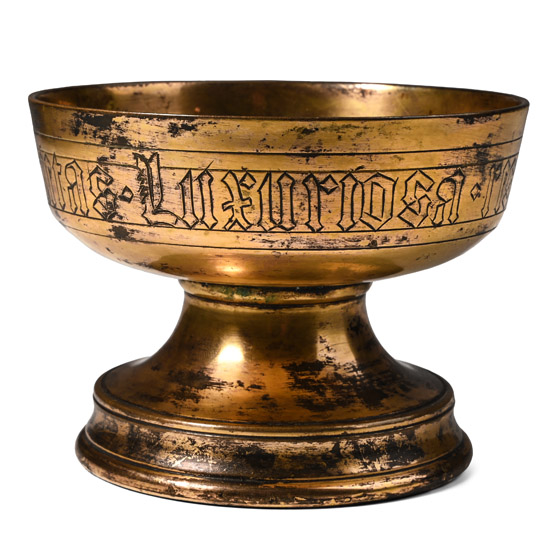
Post Medieval Gilt Bronze Chalice with Biblical Proverb in Latin
Continental Europe, circa 19th century A.D.Estimate: £800 - 1,000 (+bp*)
Opening Bid: £400
Squat in profile with stepped and carinated foot, deep shoulder to the bowl; engraved to the outer face in batada script between double horizontal rulings the legend 'Luxuriosa res vinum et tumultuosa ebrietas', a quotation from the biblical book of Proverbs, 20:1, translating to 'Wine is [a] luxurious [thing], and drunkenness is riotous'. 575 grams, 11.2 cm wide
Acquired in Paris, France, circa 2000. Personal collection of a Suffolk lady, UK.
The biblical sentence was retaken by Saint Paul, who, wanting to warn the believers against the power of wine, similarly instructed by saying: ‘Beware of drunken wine, where there is luxury’. This kind of gluttony was considered by the Fathers of the Church dangerous, in that, after it has deprived the drinker of all rational sense, it opens and reveals and releases from his chest every secret, every hidden thing: it was considered a prodigal throwaway of its own goods and those of others, deaf to rebukes, and a destroyer of every praiseworthy custom. -
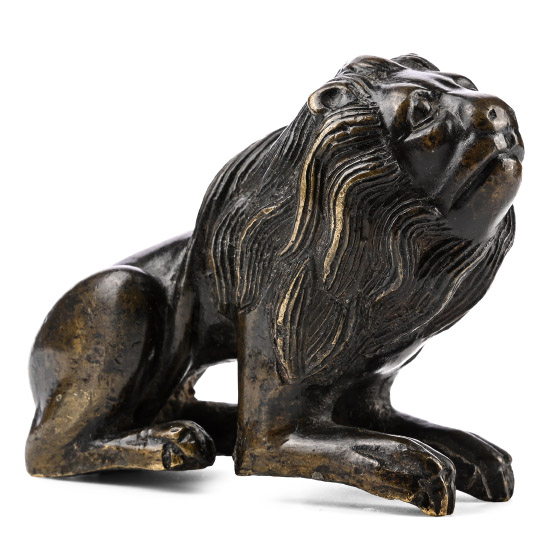
Nuremberg Brass Lion Statue
Germany, 16th century A.D.Estimate: £500 - 700 (+bp*)
Opening Bid: £250
Modelled in a half-seated pose, gazing upwards with compact body, broad forequarters, the mane rendered in long, parallel strands; the tail emerging from underneath the body and resting diagonally on top of the neck. 855 grams, 96 mm
Acquired on the European art market.
The treatment reflects the continuation of late Gothic conventions within German workshops, while also aligning with the more classicising tendencies found in North Italian bronze production of the period. The anatomical structure is simplified yet purposeful, characteristic of functional or cabinet bronzes produced across central Europe in the sixteenth century. Its scale and form correspond to small bronzes intended for Kunstkammer settings or as elements within larger composite objects such as inkstands or caskets, where the lion served as an emblem of vigilance, authority, and learned taste. -
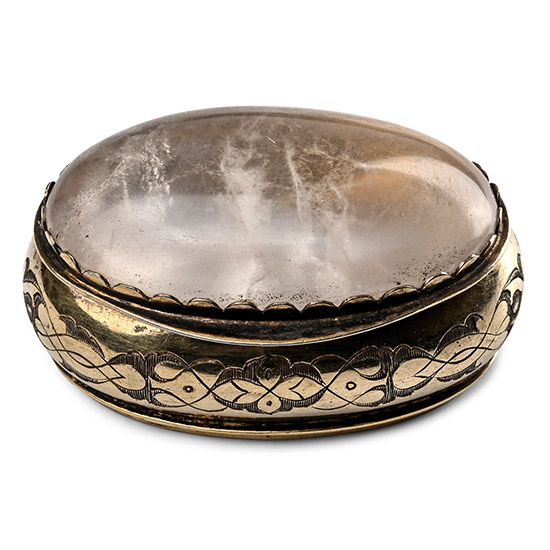
Post Medieval Engraved Silver-Gilt Rock Crystal Set Box
Germany, 18th century A.D.Estimate: £700 - 900 (+bp*)
Opening Bid: £350
Lid set with a large rock crystal cabochon; gilded interior; sides engraved with a continual Renaissance interlace and similar to the base; small French duty mark to the front of the base of the box and to the rim of the lid. 65 grams, 59 mm
Private collection, Europe. Acquired on the English art market.

