
-
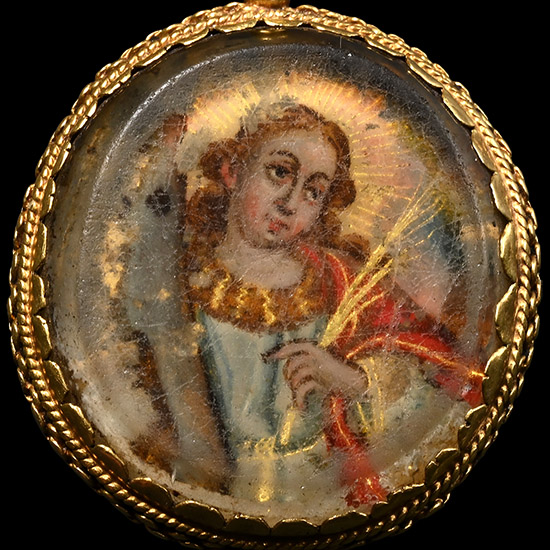
Bourbon Era Gold Devotional Pendant with Verre Eglomise Miniatures of Saint Catherine of Alexandria and Saint John of Nepomuk
Spain, circa 1700 A.D.Estimate: £1,000 - 1,400 (+bp*)
Opening Bid: £500
Featuring a gold mount with twisted ropework border and scalloped edges securing bevelled glass coverings, one side depicting nimbate Saint Catherine of Alexandria wearing a pale blue dress with a red cloak, holding a gilt palm frond; the other side with Saint John of Nepomuk dressed in clerical attire and holding a gilt cross and a palm frond. 29.1 grams, 43 mm
Acquired on the European art market.
Saint Catherine of Alexandria was a Christian saint and virgin who was martyred in the early 4th century at the hands of the Emperor Maxentius. She was both a princess and a noted scholar who became a Christian around the age of 14, converted hundreds of people to Christianity and was martyred around the age of 18. More than 1,100 years after Catherine's martyrdom, Joan of Arc identified her as one of the saints who appeared to and counselled her. Saint John of Nepomuk (c. 1345 – 20 March 1393) was the saint of Bohemia (Czech Republic) who was drowned in the Vltava River at the behest of Wenceslaus IV of Bohemia. Later accounts state that he was the confessor of the queen of Bohemia and refused to divulge the secrets of the confessional. Based on this account, John of Nepomuk is considered the first martyr of the Seal of the Confessional, a patron against calumnies and, because of the manner of his death, a protector from floods and drowning. Verre églomisé is a French term referring to the process of applying both a design and gilding onto the rear face of glass to produce a mirror finish. The name is derived from the 18th-century French decorator and art-dealer Jean-Baptiste Glomy (1711–1786), who was responsible for its revival. Glomy's technique was a relatively simple one of applying decorative designs in a combination of plain colour and gilding, usually to glass picture frames. However, over time, it has come to be used to describe nearly any process involving back-painted and gilded glass, however elaborate. -
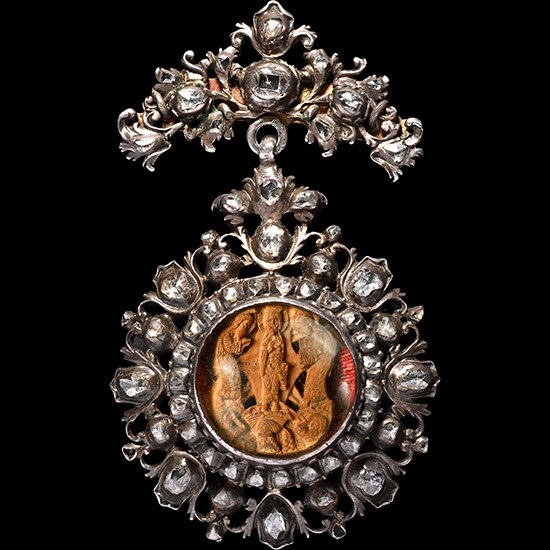
Silver and Diamond Pendant with Holy Trinity
Spain, circa 1700 A.D.Estimate: £2,000 - 3,000 (+bp*)
Opening Bid: £1,000
The elaborate openwork pendant set with old-cut diamonds, the hanger centred with a table-cut diamond; at the centre a circular glazed compartment containing a Greek Orthodox, micro-sandalwood carving of the Holy Trinity, featuring three elaborately carved nimbate figures; the reverse of the pendant with a flowering tulip; a brooch pin added in the 19th century to the reverse. 31.97 grams, 66 mm
Acquired on the European art market. -
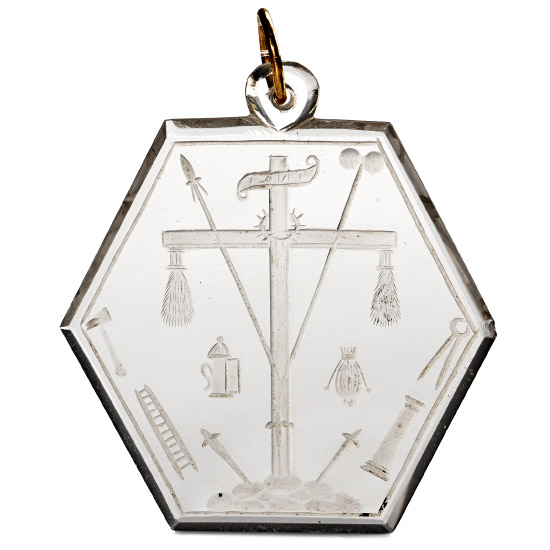
Large Rock Crystal Pendant with Cross
Italy, 17th century A.D.Estimate: £1,500 - 2,000 (+bp*)
Bids: 1 | Current Bid: £800
Transparent hexagonal slice of polished rock crystal engraved with the Arma Christi, instruments of the passion, relating to the crucifixion of Christ. 32.3 grams, 84 mm
Acquired on the European art market. -
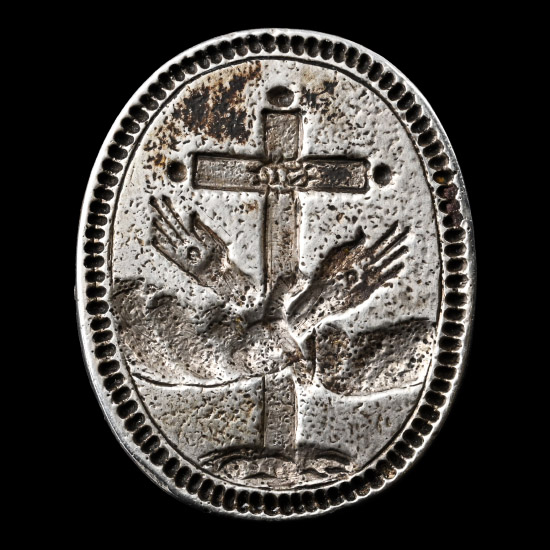
Post Medieval Silver Religious Seal with Boxwood Handle
17th-18th century A.D.Estimate: £400 - 600 (+bp*)
Opening Bid: £200
Comprising a balustered wooden handle and a silver stamp seal with a large cross behind two crossed hands with stigmata, the cross with an inscription, supplied with a museum-quality impression. 51.96 grams, 85 mm
Acquired on the European art market. -
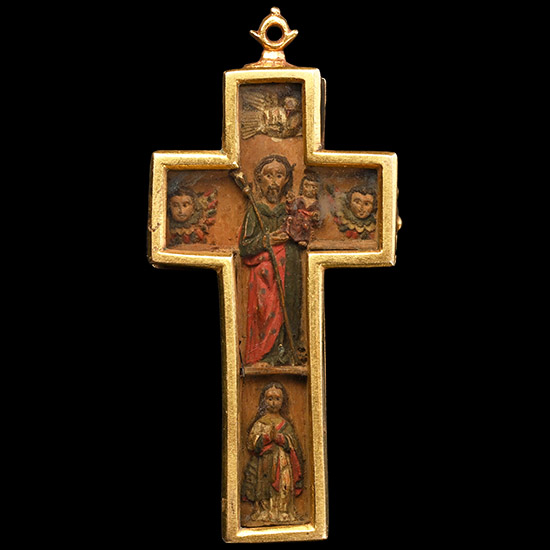
Mexican Gold Mounted Wooden Cross with Saint Joseph
Circa 1600 A.D.Estimate: £5,000 - 7,000 (+bp*)
Bids: 4 | Current Bid: £4,400
The wooden cross set behind glass panels set within a large gold mount, the cross carved to one side with Saint Joseph holding the Christ child, beneath the Dove of the Holy Spirit, flanked by angels and above the praying Virgin; the other side with the crucified Christ, flanked on three sides by angels and above a Nun Saint. 50.7 grams, 81 mm
Acquired on the European art market. This lot has been checked against the Interpol Database of stolen works of art and is accompanied by search certificate number no.13345-257977.
The tradition of carving tiny devotional wooden reliefs for pendants began in the 16th century and continued throughout the 17th and 18th centuries in Mexico. The carvings were often sent to Spain, where they were mounted in pendants of silver and gold. Relicarios, The Forgotten Jewels of Latin America, by Martha J. Egan: ‘When ivory became difficult to obtain in Europe during the Middle Ages, following the Ottoman conquest of North Africa, European sculptors of miniature works, notably in the Netherlands and northern Europe, found boxwood to be a serviceable substitute. While only items of limited size can be carved in this hard, fine-grained wood, it can be highly polished, its light color is attractive, its density renders it unlikely to split or chip, and when finished, the carved material can resemble ivory.' -
.jpg)
Spanish Rock Crystal and Enamelled Gold Crucifixion Pendant
Early 17th century A.D.Estimate: £4,000 - 6,000 (+bp*)
Bids: 1 | Current Bid: £3,600
Devotional pendant with a finely chased and adorned frame with black enamel, encased within a double-sided polychrome enamelled gold Calvary scene, depicting Christ upon the cross with St. John the Evangelist and the Virgin Mary standing on either side; each side with domed pieces of rock crystal, which open to expose both crucifixion scenes. 12.58 grams, 34 mm
Acquired on the European art market. This lot has been checked against the Interpol Database of stolen works of art and is accompanied by search certificate number no.13400-257999. -
.jpg)
Gold and Enamelled Pendant for the Order of Saint Dominic
Spain, circa 1630 A.D.Estimate: £2,000 - 3,000 (+bp*)
Opening Bid: £1,000
Bifacial openwork pendant decorated with black and white enamel, featuring a central cross with fleur-de-lys terminals, the border decorated with alternating lozenges and annulets; some re-enamelling. 18.33 grams, 56 mm
Acquired on the European art market. This lot has been checked against the Interpol Database of stolen works of art and is accompanied by search certificate number no.13401-257987. -
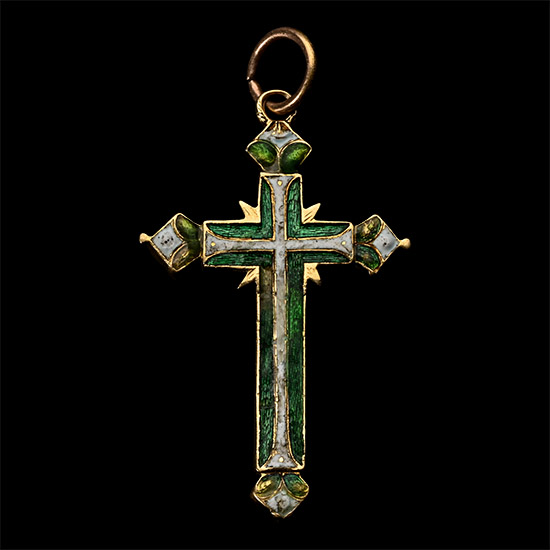
Enamelled Gold Cross Pendant with Instruments of Passion
Germany, 17th century A.D.Estimate: £2,000 - 3,000 (+bp*)
Bids: 3 | Current Bid: £1,300
A finely executed devotional pendant in the form of a Latin cross, worked in high-carat gold and elaborately decorated on both sides; the obverse set with twelve table-cut almandine garnets, each enclosed within raised rub-over collets and inset with finely painted polychrome enamel scene depicting symbols of the Arma Christi, the Instruments of the Passion, including the scourge, hammer and pincers, the column of flagellation, rooster, dice, crown of thorns, and other emblematic motifs; the upper terminal with black enamel and bearing a gilt inscription 'INRI', an abbreviation of 'Iesus Nazarenus Rex Iudaeorum' for 'Jesus of Nazareth, King of the Jews'; the reverse with guilloché enamel in translucent green and opaque white, forming a cross with stylised foliate terminals; the pendant retaining its original integral suspension loop; some restoration on the enamel. 4.06 grams, 43 mm
Acquired on the European art market. This lot has been checked against the Interpol Database of stolen works of art and is accompanied by search certificate number no.13403-257997.
This pendant typifies early 17th-century German devotional jewellery, in which vivid enamelwork and miniature Passion iconography converge in portable, contemplative forms of piety. -
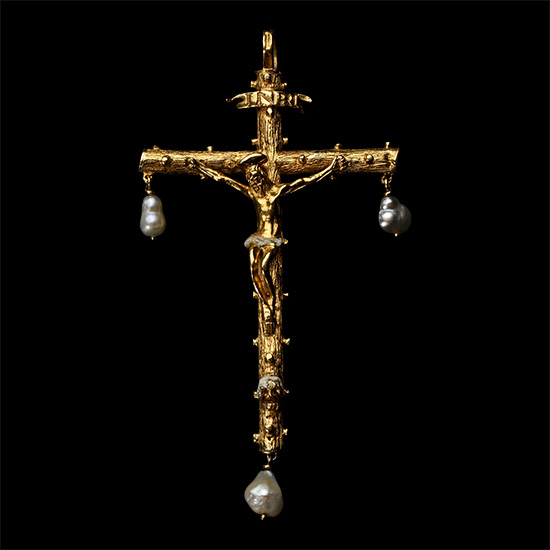
Renaissance Gold and Enamelled Crucifix Pendant
Spain, 16th century A.D.Estimate: £3,000 - 4,000 (+bp*)
Bids: 2 | Current Bid: £3,500
The limp body of Christ hanging from the cross, wearing an enamelled loincloth, the bones of Adam at his feet; above his head a plaque mocking the saviour, hung by Pilate with the initials ‘INRI’, an abbreviation of the Latin ‘Iēsus Nazarēnus, Rēx Iūdaeōrum’, translating as 'Jesus the Nazarene, King of the Jews’; carefully rendered three-dimensional cross imitating the grain, knots and stumps of the wood, a baroque pearl suspended from both arms and the base of the cross. 8.56 grams, 75 mm
Acquired on the European art market. This lot has been checked against the Interpol Database of stolen works of art and is accompanied by search certificate number no.13402-257995. -
.jpg)
Renaissance Gold Fob Seal with Carnelian Gemstone of a Herm and Figures
16th-19th century A.D.Estimate: £1,000 - 1,400 (+bp*)
Opening Bid: £500
An oval intaglio finely engraved with a classical scene, at the centre a herm upon a plinth, flanked by two figures: the woman on the left wearing a gown with loose drapery falling across her arms, while the figure to the right is shown nude, the body scarcely veiled by a fine transparent cloth; at the far right a sacrificial altar surmounted by a lyre, introducing a musical or poetic dimension to the scene and emphasising its votive character; mounted in an ornate 18th-century French gold fob mount, pierced with scrolling foliate ornament and stamped with duty marks; supplied with a museum-quality impression. 6.60 grams, 25 mm
Acquired on the European art market.
The gem, cut in the 16th century, reflects the Renaissance revival of antique glyptic art, where Roman prototypes were carefully studied and reinterpreted with elegance and precision. The finely executed incision and harmonious arrangement of clothed and unclothed figures highlight the engraver’s technical mastery and antiquarian erudition. -
.jpg)
Gold Fob Seal Set with Jasper Intaglio of Zeus
England, 19th century A.D.Estimate: £500 - 700 (+bp*)
Opening Bid: £250
Comprising a fluted bezel and looped handle, set with an oval intaglio bearing a profile bust of Zeus with long hair and beard, wearing a wreath on his head; supplied with a museum-quality impression. 14.7 grams, 32 mm
Acquired on the European art market. -
.jpg)
Georgian Era Gold Fob Seal with Carnelian Intaglio of Inigo Jones Attributed to Edward Burch
England, 18th century A.D.Estimate: £1,500 - 2,000 (+bp*)
Opening Bid: £750
Vibrant red carnelian intaglio skilfully carved with a bust of a mature man in three-quarter view, gazing right, wearing a wide-collared, buttoned tunic and a cap, long curly hair framing his bearded face with a deeply furrowed forehead; set in a gold frame with an amphora-like looped handle; supplied with a museum-quality impression. 11.72 grams, 33 mm
Acquired on the European art market.
Edward Burch (1730–1814) was a distinguished English gem engraver and miniaturist, celebrated for his intricate craftsmanship and artistic versatility. A founding member of the Royal Academy of Arts in 1768, Burch gained acclaim for his engraved gemstones, which often depicted classical and mythological themes, reflecting the neoclassical style of the Georgian era. His skill in miniature painting further demonstrated his artistic range and mastery of detail. Highly respected in his time, Burch’s works remain admired for their technical precision and elegance, preserving his legacy as a key figure in 18th-century British art. Inigo Jones (1573–1652) was a pioneering English architect who is widely regarded as the first significant figure to introduce the principles of Renaissance architecture to England. Influenced by his studies in Italy and the works of Andrea Palladio, Jones designed elegant structures characterised by classical symmetry, proportion, and restraint. His most famous works include the Banqueting House at Whitehall, the Queen’s House in Greenwich, and contributions to the layout of Covent Garden. Jones’s adoption of Palladian ideals marked a departure from the Gothic style that had dominated English architecture, laying the foundation for subsequent developments in the Classical tradition.

