
-
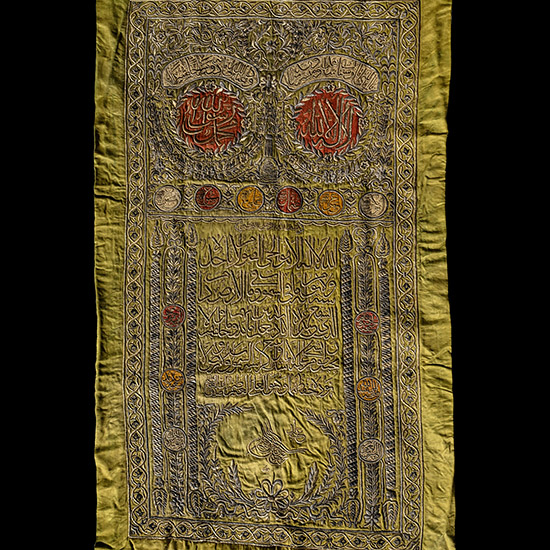
Metal-Thread Embroidered Silk Panel with the Tughra of Sultan Mahmud II
Ottoman Empire, circa 1808-1839 A.D.Estimate: £15,000 - 20,000 (+bp*)
Opening Bid: £7,500
Rectangular in plan, the lime green silk field with two large roundels of red silk tied by a tassel in the rococo style, signature of Sultan Mahmud II contained within a mosque lamp, ten smaller roundels of alternating cream, orange and cream silk; large central rectangular panel and two bands above incorporating inscriptions in Thuluth, tughra of the Sultan framed by swags in lower part of field, ground richly decorated with floral swags and vegetal motifs, backed. 17.8 kg, 294 x 179 cm
Acquired before 2000. Private collection, UK. with Bonhams, London, 6 October 2008, no.216 (est. £80,000 - £120,000). This lot has been checked against the Interpol Database of stolen works of art and is accompanied by a search certificate number no.12741-235157.
The inscriptions comprise: in two horizontal cartouches: Qur'an, surah al-Ahzab (XXXIII, verses 45-46) inscription contained in mosque lamp; the signature of Sultan Mahmud Il in the two large roundels: the Shahadah in the six roundels above central rectangular panel; the names of the four Orthodox Caliphs, and the Imams Hasan and Husain in the central panel; Quran, surah al-Baqarah (Il), verse 255, ayat al-Kursi in the six side panels; the names of the companions of the Prophet in the lower part; the tughra of Sultan Mahmud. -
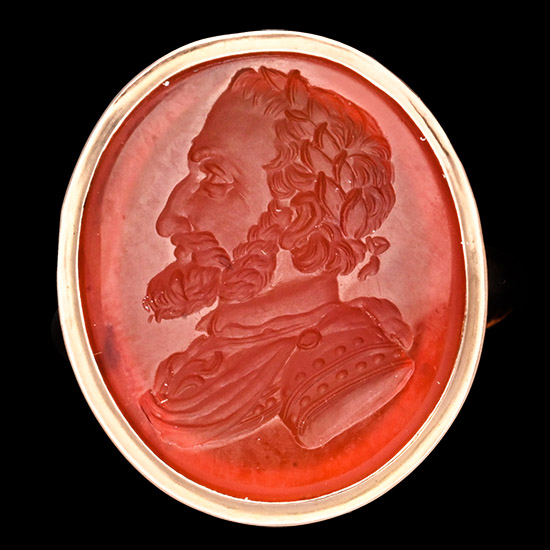
French Carnelian Gemstone with King Henry IV in Gold Ring
19th century A.D.Estimate: £1,200 - 1,700 (+bp*)
Opening Bid: £600
Finely engraved intaglio portraying a left-facing bust of Henry IV (1553–1610), King of France, in armour, with a decorated gorget and distinctive curled beard, set in a high-carat gold bezel and later fitted with a modern plain shank; supplied with a museum-quality impression. 5.24 grams, 21.83 mm overall, 19.35 mm internal diameter (approximate size British P, USA 7 1/2, Europe 16.23, Japan 15)
Acquired on the European art market.
The engraving is directly after a medallic portrait by Guillaume Dupré, Henry IV’s official medallist, which was widely circulated during the king’s reign and thereafter. The king’s profile is clearly drawn from a familiar medallic type, often used in the 17th and 18th centuries as a symbol of royal authority and dynastic legitimacy. -
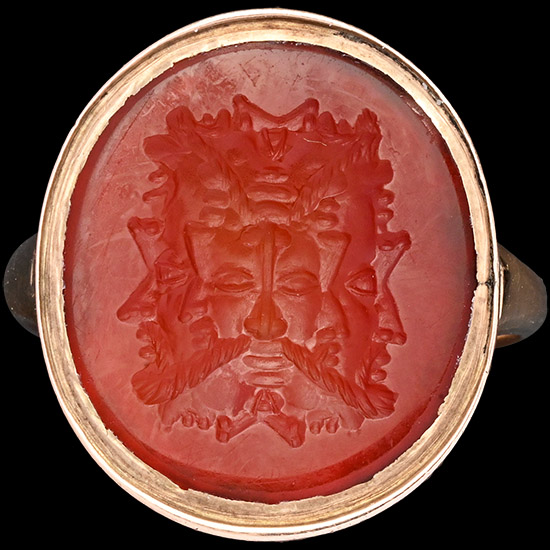
Post Medieval Gold Ring with Carnelian Gemstone with Fourteen Faces
Italy, 17th-18th century A.D.Estimate: £3,500 - 4,500 (+bp*)
Opening Bid: £1,750
Composed of a D-section large hoop and an oval collet set with an intaglio intricately carved with a composite head composed of at least fourteen distinct faces, based on an image engraved after Jean Berain c.1675; supplied with a museum-quality impression. 4.66 grams, 22.60 mm overall, 20.70 mm internal diameter (approximate size British Q 1/2, USA 8 1/4, Europe 18.12, Japan 17)
Acquired on the European art market. This lot has been checked against the Interpol Database of stolen works of art and is accompanied by search certificate number no.13397-257946. -
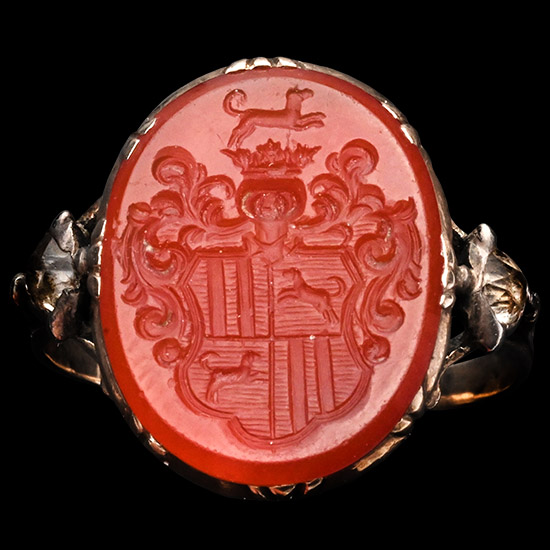
Holy Roman Empire Gold Signet Ring with Carnelian Intaglio
Germany, 18th century A.D.Estimate: £1,500 - 2,000 (+bp*)
Bids: 2 | Current Bid: £40
Comprising a fluted band with openwork shoulders set with facetted rock crystals, rub-over setting engraved with floral motifs on the reverse and set with a red carnelian intaglio carved with the coat of arms of the owner; supplied with a museum-quality impression. 5.64 grams, 24.89 mm overall, 21.56 x 17.76 mm internal diameter (approximate size British U, USA 10, Europe 22.52, Japan 21)
Acquired on the European art market. -
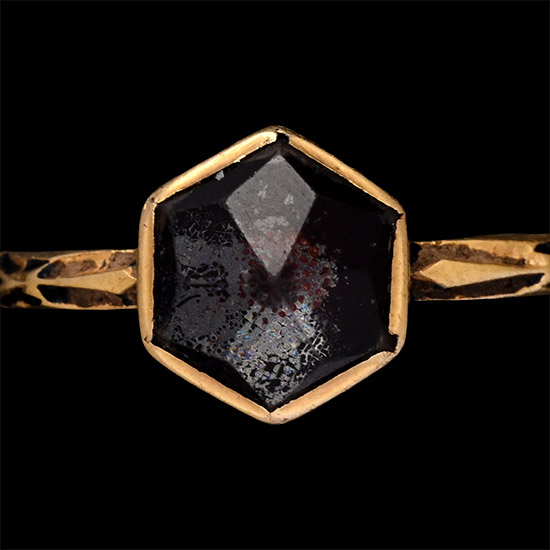
Renaissance Gold Enamelled Ring with Rock Crystal
16th century A.D.Estimate: £1,500 - 2,000 (+bp*)
Bids: 2 | Current Bid: £600
Featuring a slender hoop with black-enamelled shoulders, a hexagonal collet setting with point-cut quartz with foil backing, and black-enamelled decoration beneath the setting. 2.91 grams, 26.70 mm overall, 18.36 x 17.64 mm internal diameter (approximate size British Q 1/2, USA 8 1/4, Europe 18.12, Japan 17)
Acquired on the European art market. -
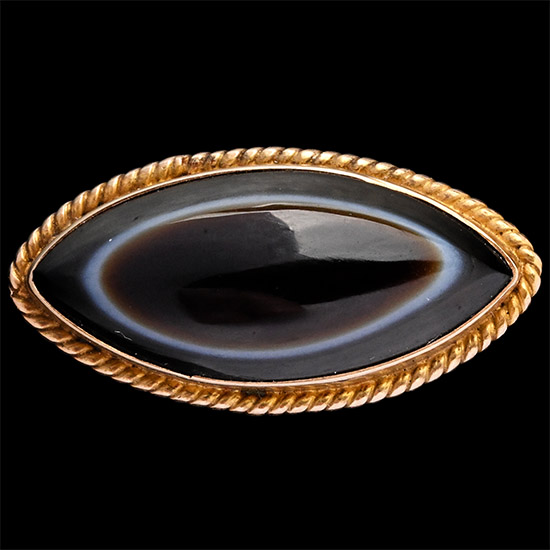
Archaelogical Revival Apotropaic 'Eye' Ring
Europe, 19th century A.D.Estimate: £600 - 800 (+bp*)
Opening Bid: £300
The ring with a U-shaped hoop and lentoid bezel with ropetwist border, set with a polished banded agate resembling the all-seeing eye. 3.57 grams, 24.17 mm overall, 19.26 x 17.26 mm internal diameter (approximate size British P 1/2, USA 7 3/4, Europe 16.86, Japan 16)
Acquired on the European art market.
Eye beads, often crafted with concentric circle motifs resembling an eye, served as powerful amulets thought to offer protection against the evil eye and malevolent forces. -
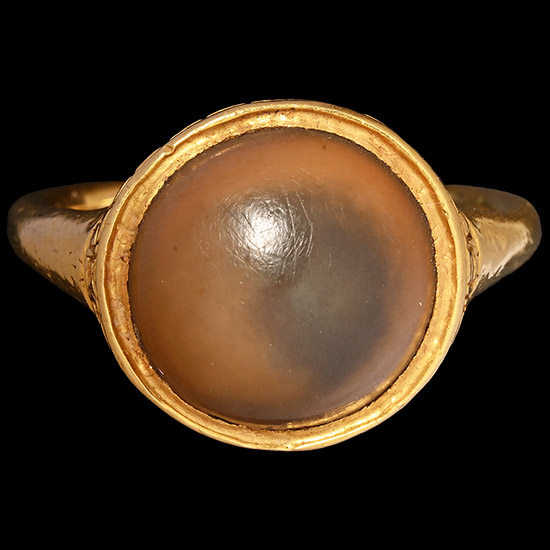
Renaissance Gold Ring with Toadstone
Western Europe, 16th century A.D.Estimate: £8,000 - 10,000 (+bp*)
Opening Bid: £4,000
Featuring a round-section large hoop expanding towards the shoulders, a large circular bezel with a Greek key motif encircling the outer rim and set with a brown 'toadstone'. 13.01 grams, 32.42 mm overall, 23.12 x 19.25 mm internal diameter (approximate size British V 1/2, USA 10 3/4, Europe 24.4, Japan 23)
Acquired on the European art market. This lot has been checked against the Interpol Database of stolen works of art and is accompanied by search certificate number no.13398-257996.
William Shakespeare’s As You Like It, circa 1599: 'Sweet are the uses of adversity, Which, like the toad, ugly and venomous, Wears yet a precious jewel in his head.' Toadstones are mythical stones that were thought to be found inside the head of a toad. They were believed to sweat, change colour or even heat up in the presence of poison. It was thought that a toadstone placed on bites from snakes, insects, spiders and shrews would extract poison from the wound. They were thought to bring good luck and ward off evil, whether in the present life or in the afterlife. The Book of Secrets from the 13th century recommends swallowing the stone to 'cleanse the bowels of filth and excrements'. The stone could then be retrieved and used again. They were often set as amulets and talismans, a practice that continued in Europe until the 18th century. Toadstones are actually the button-like fossilised teeth of Lepidotes, an extinct genus of fish common in the Jurassic and Cretaceous Periods, 200 to 100 million years ago. -
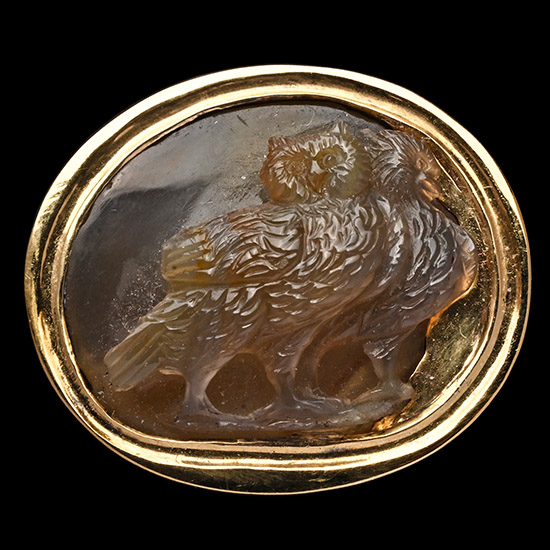
Renaissance Agate Cameo of Two Owls in Gold Ring
Italy, 17th century A.D.Estimate: £3,000 - 4,000 (+bp*)
Opening Bid: £1,500
Comprising a D-section hoop expanding towards the open-backed setting set with a large brown agate intaglio modelled as two conjoined standing owls, the one at the front facing, and the other looking to the right, intricate feather and facial details, the cameo with a loss on the right-hand side, with the ring incorporating a fine gold repair. 12.74 grams, 24.90 mm overall, 17.00 mm internal diameter (approximate size British M 1/2, USA 6 1/4, Europe 13.09, Japan 12)
Acquired on the European art market. This lot has been checked against the Interpol Database of stolen works of art and is accompanied by search certificate number no.13318-257961.
Even in the Italian Renaissance, the owl, an ancient symbol of the goddess Athena, symbolised wisdom. The owl was also a symbol of the night and death, as is so eloquently illustrated in the 17th-century painting Vanité à la chouette in the Musée des Beaux-Arts de Dijon, which depicts an owl sitting on a human skull next to an extinguished candle. -
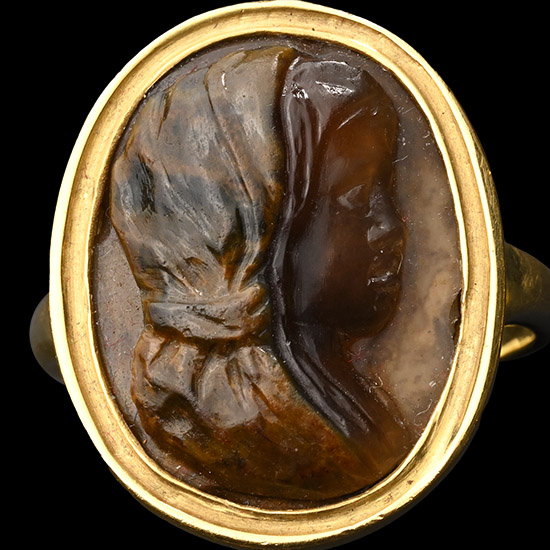
Renaissance Agate Cameo of a Woman in Gold Ring
Italy, 16th-17th century A.D.Estimate: £2,000 - 3,000 (+bp*)
Opening Bid: £1,000
Brown oval cameo depicting a profile bust of a veiled young woman with large eyes and a small button nose, set in a ring with a closed-back setting. 10.26 grams, 24.74 mm overall, 18.91 mm internal diameter (approximate size British N, USA 6 1/2, Europe 13.72, Japan 13)
Acquired on the European art market. This lot has been checked against the Interpol Database of stolen works of art and is accompanied by search certificate number no.13399-257955. -
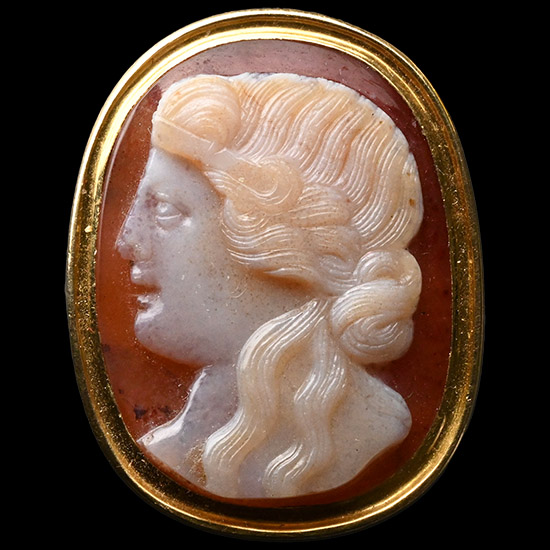
Georgian Gold Ring with Renaissance Cameo of a Muse
16th-18th century A.D.Estimate: £3,000 - 4,000 (+bp*)
Opening Bid: £1,500
Comprising a D-section hoop and a large fluted bezel set with a cameo depicting a female profile bust, her hair pulled to a chignon at the nape of her neck, with two loose strands elegantly resting on her shoulder. 11.70 grams, 27.74 mm overall, 18.38 mm internal diameter (approximate size British P, USA 7 1/2, Europe 16.23, Japan 15)
Acquired on the European art market. This lot has been checked against the Interpol Database of stolen works of art and is accompanied by search certificate number no.13319-257965.
This refined bust captures the timeless elegance of ancient iconography: delicate profile turned to the left, hair held by a chignon and diadem allowing the locks to escape and forming braids. The cameo is Italian and dates to the 16th century, the ring is 18th century. -
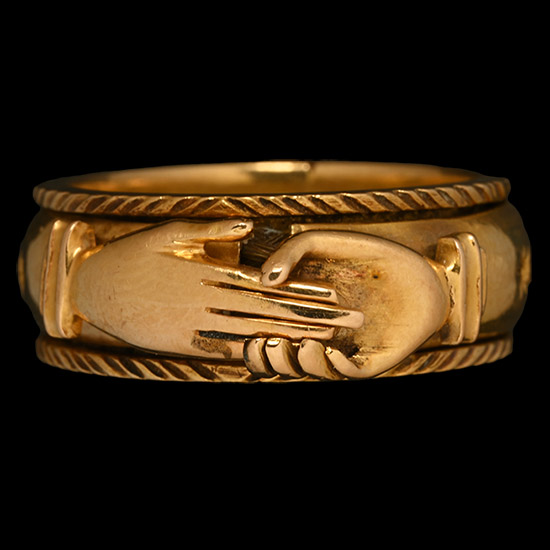
Georgian Gold Mourning Ring with Opening Clasped Hands
Dated 14th December 1774 A.D.Estimate: £400 - 600 (+bp*)
Bids: 14 | Current Bid: £1,500
Formed of a wide band with faux-ropework borders and plaited brown hair, hinged outer cover with the locking mechanism formed as two clasping hands, three circular openings with decorative cuts on each arm; inside engraved with 'Dbre 14/74'. 8.44 grams, 24.71 mm overall, 17.09 mm internal diameter (approximate size British N, USA 6 1/2, Europe 13.72, Japan 13)
From the old family collection of a West Country, UK, lady; acquired by descent from her grandfather circa 2001.
This ring features the ancient fede motif of two hands clasped together. These symbols represented love and fidelity. The ring was likely a token of love symbolising everlasting devotion, or possibly a betrothal ring. The motif of the two clasped hands was already in use in ancient Rome, as a symbol of pledging of vows, which derives from the Roman dextarum iunctio (right hand joined). Fede rings remained popular throughout Europe until well into the 19th century. -
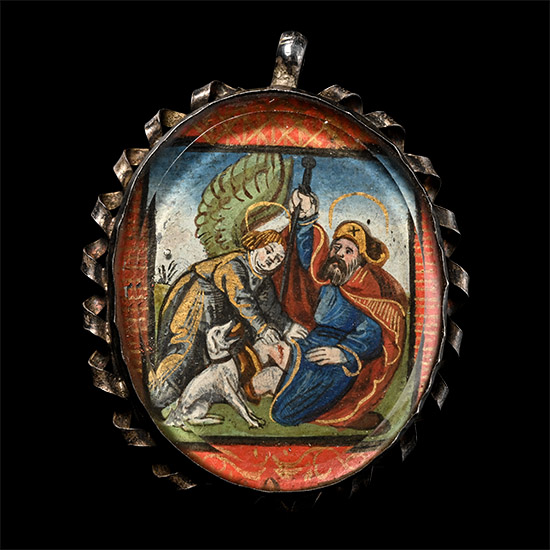
Silver Illuminated Miniature Pendant
France, 16th century A.D.Estimate: £1,000 - 1,400 (+bp*)
Bids: 2 | Current Bid: £900
The glazed silver pendant containing illuminated miniatures on each side, one side depicting Saint Roch and the other Saint Matthew; Saint Roch shown seated on the ground while an angel is attending his bubonic plague sore on his thigh, and a white dog at his feet; Saint Matthew on the other side depicted writing the Gospel with a young attendant holding a book beside him; the frame with a fixed bale to the top and the sides adorned with a twisted silver wire decoration. 36.2 grams, 58 mm
Acquired on the European art market.
Saint Roch (c. 1348–1379) is a Catholic saint, revered as the patron of plague victims, dogs, and the sick. Born in Montpellier, France, he devoted his life to caring for those suffering from the plague. According to legend, he contracted the disease himself but was miraculously healed with the help of a dog that brought him food and licked his wounds. He is often depicted with a pilgrim’s staff, a dog by his side, and a wound on his leg. His feast day is celebrated on August 16. Saint Matthew was one of the twelve apostles of Jesus and the traditional author of the Gospel of Matthew. Before following Jesus, he was a tax collector, known as Levi. He is considered the patron saint of accountants, bankers, and tax collectors. His gospel emphasises Jesus as the Messiah and the fulfilment of Old Testament prophecies. According to tradition, he preached in various regions, including Ethiopia and Persia, before being martyred. His feast day is celebrated on September 21.

