
-
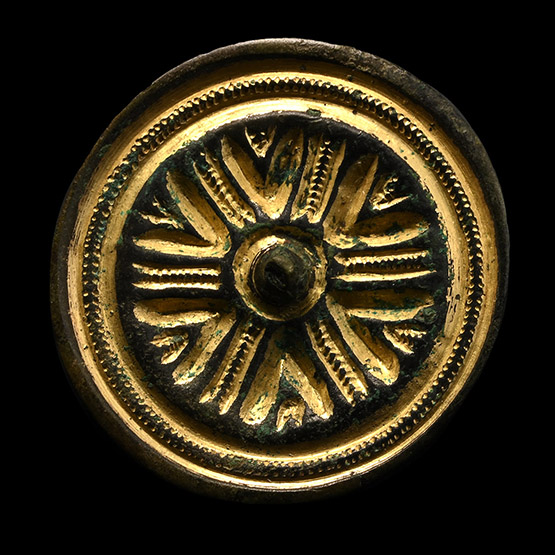
Large Anglo-Saxon Gilt Bronze Saucer Brooch
Late 5th-6th century A.D.Estimate: £800 - 1,000 (+bp*)
Bids: 1 | Current Winning Bid: £350
Discoid in plan with raised rim and inner ridge decorated with notches, six radiating arms with notch detailing and interstitial chevrons; central knop rivetted from reverse; remains of catch to reverse. 20.4 grams, 37 mm
Found Seaham, Co Durham, UK. Property of a Durham private collector.
The saucer brooch was one of the commonest types of brooches used by Anglo-Saxon women, usually occurring in matched pairs on the chest. This typology extends in time from the 5th to the late 6th century, especially diffused south of the Humber and East of the Severn, with a concentration in the south Midlands and Upper Thames Valley. -
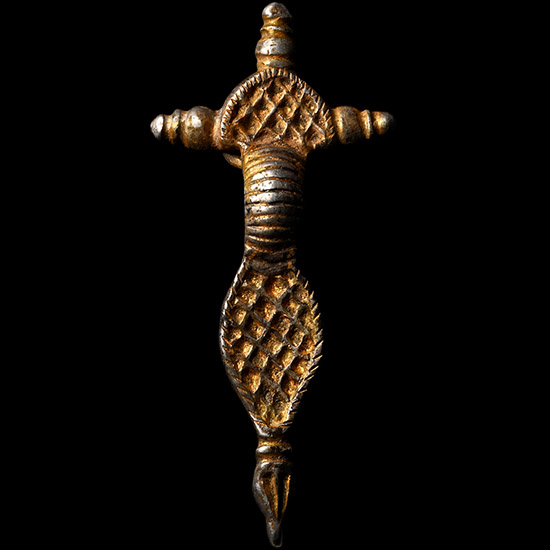
Frankish Silver-Gilt Radiate-Headed Bow Brooch
Circa 6th century A.D.Estimate: £400 - 600 (+bp*)
Bids: 1 | Current Winning Bid: £200
Comprising a D-shaped headplate with notched border and reserved lattice ornament; three collared knops to the outer edge; shallow segmented bow; lozengiform footplate with notched border, reserved lattice ornament and collared knop finial; spring, pin and catchplate to the reverse. 23.8 grams, 76 mm
Ex German art market, 2000s. Acquired from an EU collector living in London. From the collection of a Surrey, UK, gentleman. -
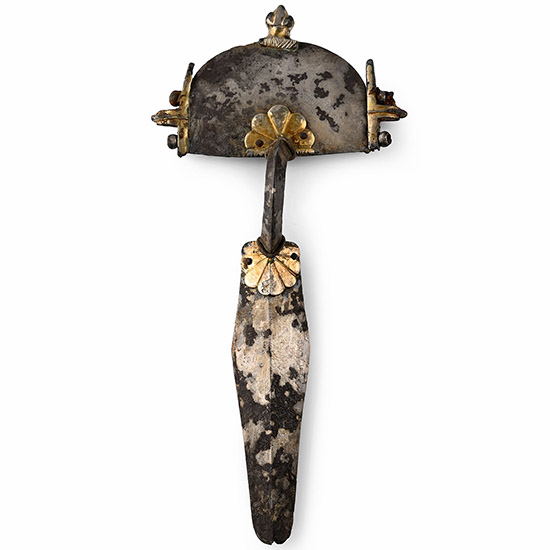
Large Gothic Silver-Gilt Fibula
Bosphorean Culture, 5th century A.D.Estimate: £3,000 - 4,000 (‡+bp*)
Opening Bid: £1,500
Comprising: a semi-circular headplate with a ram-head knop at the apex and applied gilt projections at the sides forming part of the spring mechanism; deep keeled bow with a petalled finials; keeled subrectangular footplate with a rounded finial and a tapering catchplate below. 67 grams, 20.7 cm
L. De Clercq collection, Belgium, 1980s. Ex private European collection. Accompanied by an academic report by Dr Raffaele D’Amato. This lot has been checked against the Interpol Database of stolen works of art and is accompanied by search certificate number no. 13013-246783.
Fibulae of this type were mainly found in female burials and were placed on the right side of the chest and on the left shoulder. It was from this period that the custom of wearing wide belts with buckles and a pair of brooches on the shoulders spread along the south-western Black Sea coast, having originated among the Germanic tribes of the western Roman provinces. -
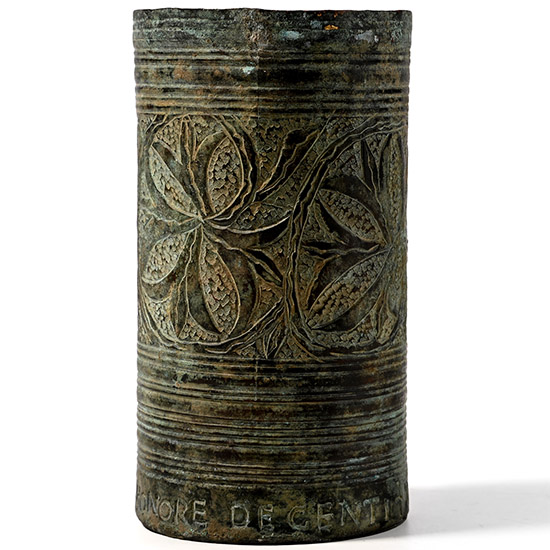
Dark Age Bronze Decorated Pyxis
Circa 5th-6th century A.D. or laterEstimate: £500 - 700 (+bp*)
Opening Bid: £250
Tubular in section with planar base; circumferential ribbing to the sidewall and pounced field with reserved tendrils and leaves; with later Lombardic script legend above base '+ XTVS EVANGELII REDIMITVS HONORE DECENTI' (Christ ... of the Gospel submitted with noble honour). 56.9 grams, 77 mm
Ex German art market, 2000s. Acquired from an EU collector living in London. From the collection of a Surrey, UK, gentleman.
A similar dedicatory inscription appears on the Farfa Casket. -
.jpg)
Viking Age Inlaid Iron Horse Bit Cheek Piece Pair with Opposing Beasts
Northern Europe, 11th-12th century A.D.Estimate: £1,800 - 2,400 (+bp*)
Opening Bid: £900
Matched pair of bridle fittings formed as two opposing fantastical creatures with their heads turned back and front legs resting on a globe forming a passage for a strap, the bodies decorated with bands of herringbone decoration. 79.2 grams total, 79 mm each
From a European collection, 1990s. This lot has been checked against the Interpol Database of stolen works of art and is accompanied by search certificate number no.13379-257911.
On these types of horse-bits, two heads or a head/tail normally face each other. But an unusual piece from Edsvära in Västergötland, Sweden, depicts two heads turned outwards, like in the current example. The mount from Edsvära, with its attached iron bit, was found in 1906 next to a horse's skeleton. -
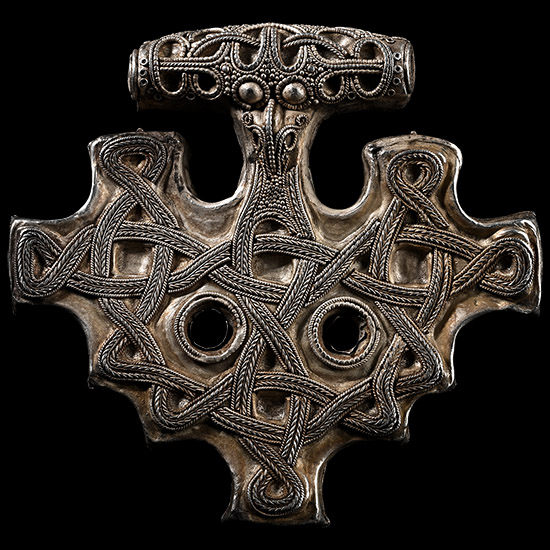
Very Large Scandinavian Viking Silver Tau Cross Pendant
10th-12th century A.D.Estimate: £4,000 - 6,000 (+bp*)
Bids: 23 | Current Winning Bid: £3,200
Hollow-formed type with barrel-shaped suspension bar, narrow neck, trefoil plaque with two lateral piercings; applied filigree knotwork to the plaque and suspension bar, domed 'eyes' and nose at the junction with the plaque; plain reverse. 23.1 grams, 71 mm
Private collection formed in Europe in the 1980s. Westminster collection, central London, UK. This lot has been checked against the Interpol Database of stolen works of art and is accompanied by a search certificate number no.13299-256161.
Although the ornament is decorated with a traditional double-braid band, it no longer features animal ornamentation, but intertwined rings made of multi-row filigree wire. The shape of the Tau cross also finds parallels with the patrices of the Busdorf hoard (Schleswig-Holstein). -
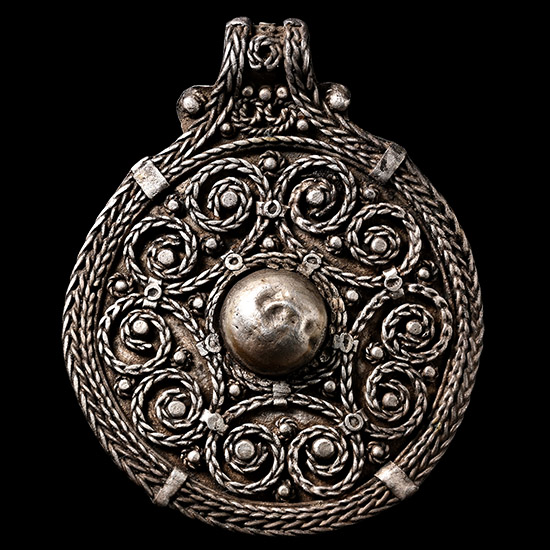
Scandinavian Viking Silver Filigree Pendant with Scrolls
9th-11th century A.D.Estimate: £800 - 1,000 (+bp*)
Bids: 18 | Current Winning Bid: £430
Discoid type with hollow boss to centre, ropework border enclosing scrolled filigree and granulation ornament. 4.05 grams, 35 mm
Private collection formed in Europe in the 1980s. Westminster collection, central London, UK. -
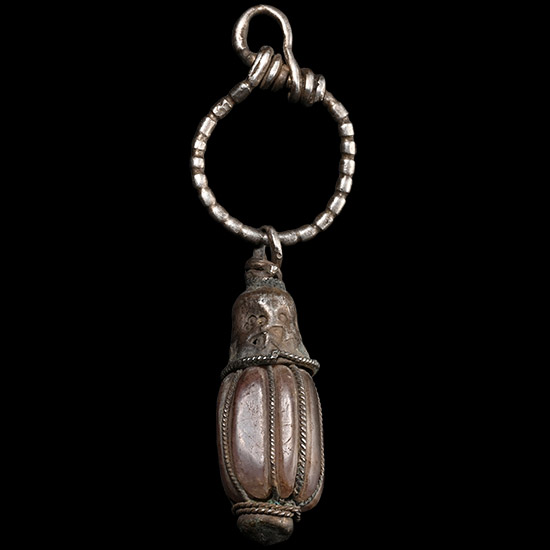
Scandinavian Viking Silver Pendant with Magical Amethyst Gem
9th-11th century A.D.Estimate: £1,200 - 1,700 (+bp*)
Bids: 15 | Current Winning Bid: £160
Comprising a beaded wire hoop with a returned fastening, a pendant with a bell-shaped cap and a filigree cage enclosing a square-section amethyst bead grooved to accept the filigree wires. 10.29 grams, 63 mm
Private collection formed in Europe in the 1980s. Westminster collection, central London, UK. -
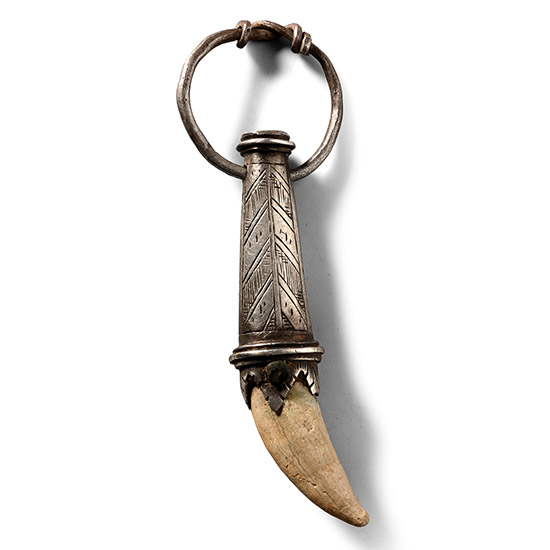
Viking Age Silver Pendant with Wolf's Tooth
10th-11th century A.D.Estimate: £300 - 400 (+bp*)
Bids: 25 | Current Winning Bid: £1,950
Comprising a tubular sleeve with raised collar above and below, the body with chevrons and hatched panels, ring loop above, set with a canine tooth secured with a rivet. 16.2 grams, 85 mm
From the private collection of a London gentleman, from his grandfather's collection formed before the early 1970s. -
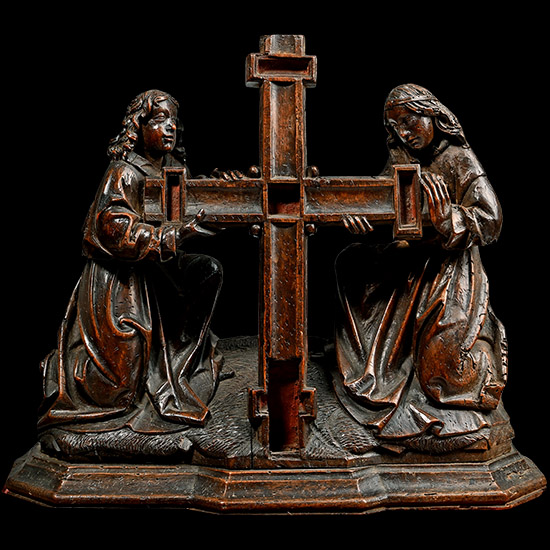
Medieval Carved Wooden Panel with Kneeling Angels Supporting the Cross
South Netherlands, 1500-1520 A.D.Estimate: £3,000 - 4,000 (+bp*)
Opening Bid: £1,500
A finely carved late Gothic group depicting two kneeling angels supporting the Cross, executed in walnut with a deep, time-worn patina, the angels, shown in reverent adoration, kneeling upon a naturalistic ground, their flowing drapery falling in deep, angular folds; each figure gently steadying the cross with expressive, delicately carved hands; on the reverse apertures indicating the former attachment of separately carved wings, now lost; the recessed compartments within the cross retaining traces of red pigment, suggesting that it originally housed relics or fragments of the True Cross; accompanied by a fabric-covered display stand. 6.4 kg total, 40.7 cm high
Acquired on the European art market. This lot has been checked against the Interpol Database of stolen works of art and is accompanied by search certificate number no.13380-258014.
The composition is devotional in nature and was likely conceived as part of a larger altarpiece or reliquary ensemble dedicated to the Adoration or Exaltation of the Holy Cross. The sculptor’s sensitive modelling and rhythmic treatment of drapery reflect the refined workmanship characteristic of the Southern Netherlands during the early sixteenth century. -
.jpg)
Medieval Wooden Bench Finial in the Form of an Elephant and Castle
England, 15th century A.D.Estimate: £3,000 - 4,000 (+bp*)
Opening Bid: £1,500
Carved stylised elephant with elongated ears supporting a palanquin in the form of a castle with a carved cross, foliage motif to the reverse; mounted on a velvet-covered stand. 1.31 kg total, 34.2 cm including stand
Private collection, Europe. Acquired on the English art market. This lot has been checked against the Interpol Database of stolen works of art and is accompanied by search certificate number no.13088-248391.
The image of an elephant carrying warriors in a howdah originated from Alexander the Great's battle against King Porus's war elephants at the Battle of Hydaspes in 326 BC. This motif became widely known in European art through the spread of Bestiaries which were medieval texts combining natural history with moralising Christian stories. One of the most well known was Matthew Paris’s imagined depictions of elephants, most notable in this case is his war elephant illustrated in Chronica maiora II, circa 1240-1255 (Cambridge, Corpus Christi College, MS 016II). Another well known manuscript - The Rochester Bestiary, circa 1230-1240 (British Library, London, Royal MS 12 F.xiii) contains a miniature with a war elephant in the midst of battle, above another image of elephants supposedly in their natural habitat. Since very few live elephants were seen in Europe during the medieval period, their representations were often more imaginative than realistic. Other Medieval bench end carvings of elephants in English churches are known, amongst them are: St Peter and St Paul, Tuttington, Norfolk; St Andrew, South Lopham, Norfolk; St Edmund, South Burlingham, Norfolk; St Andrew, Holme Hale, Norfolk. Elephants can also be found on misericords, some examples can be found at: Cathedral Church of Saint Peter, Exeter; Cathedral Church of St Peter, Gloucester; and St Mary's Church, Beverley. -
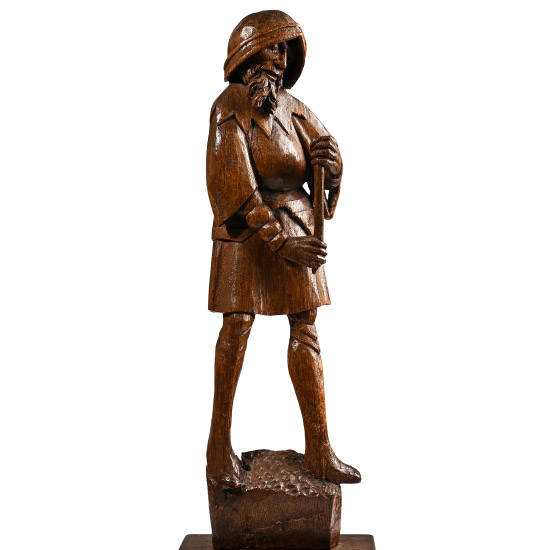
Medieval Oak Statue of Saint Longinus
Antwerp, 16th century A.D.Estimate: £1,000 - 1,400 (+bp*)
Bids: 3 | Current Winning Bid: £250
Modelled standing with downcast eyes, wearing a short tunic, helmet and holding the shaft of a lance in his hands. 1.26 kg, 53.2 cm
Acquired on the European art market.
Longinus is the Roman soldier who pierced the side of the crucified Christ with a spear to see if he had died. As Christ had already passed, the wound released both water and blood (as described in John 19:34).

