-
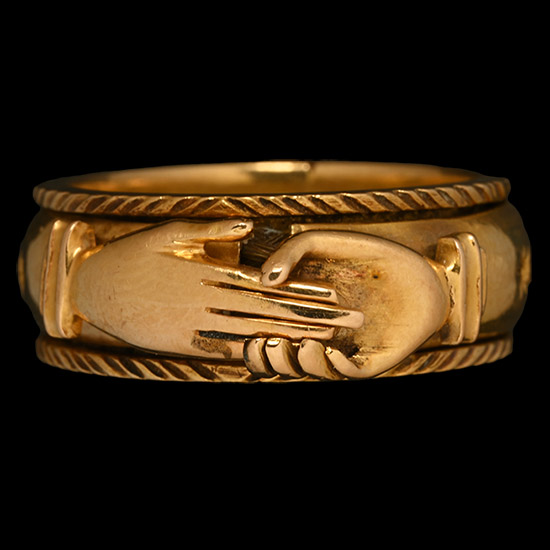
Georgian Gold Mourning Ring with Opening Clasped Hands
Dated 14th December 1774 A.D.Sold for (Inc. bp): £2,860
Formed of a wide band with faux-ropework borders and plaited brown hair, hinged outer cover with the locking mechanism formed as two clasping hands, three circular openings with decorative cuts on each arm; inside engraved with 'Dbre 14/74'. 8.44 grams, 24.71 mm overall, 17.09 mm internal diameter (approximate size British N, USA 6 1/2, Europe 13.72, Japan 13)
From the old family collection of a West Country, UK, lady; acquired by descent from her grandfather circa 2001.
This ring features the ancient fede motif of two hands clasped together. These symbols represented love and fidelity. The ring was likely a token of love symbolising everlasting devotion, or possibly a betrothal ring. The motif of the two clasped hands was already in use in ancient Rome, as a symbol of pledging of vows, which derives from the Roman dextarum iunctio (right hand joined). Fede rings remained popular throughout Europe until well into the 19th century. -
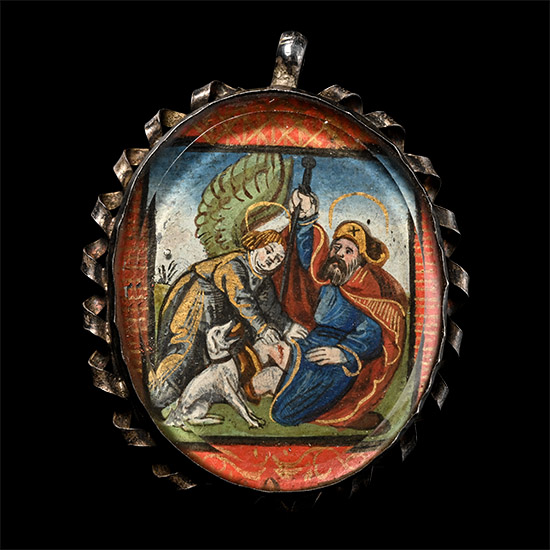
Silver Illuminated Miniature Pendant
France, 16th century A.D.Sold for (Inc. bp): £1,950
The glazed silver pendant containing illuminated miniatures on each side, one side depicting Saint Roch and the other Saint Matthew; Saint Roch shown seated on the ground while an angel is attending his bubonic plague sore on his thigh, and a white dog at his feet; Saint Matthew on the other side depicted writing the Gospel with a young attendant holding a book beside him; the frame with a fixed bale to the top and the sides adorned with a twisted silver wire decoration. 36.2 grams, 58 mm
Acquired on the European art market.
Saint Roch (c. 1348–1379) is a Catholic saint, revered as the patron of plague victims, dogs, and the sick. Born in Montpellier, France, he devoted his life to caring for those suffering from the plague. According to legend, he contracted the disease himself but was miraculously healed with the help of a dog that brought him food and licked his wounds. He is often depicted with a pilgrim’s staff, a dog by his side, and a wound on his leg. His feast day is celebrated on August 16. Saint Matthew was one of the twelve apostles of Jesus and the traditional author of the Gospel of Matthew. Before following Jesus, he was a tax collector, known as Levi. He is considered the patron saint of accountants, bankers, and tax collectors. His gospel emphasises Jesus as the Messiah and the fulfilment of Old Testament prophecies. According to tradition, he preached in various regions, including Ethiopia and Persia, before being martyred. His feast day is celebrated on September 21. -
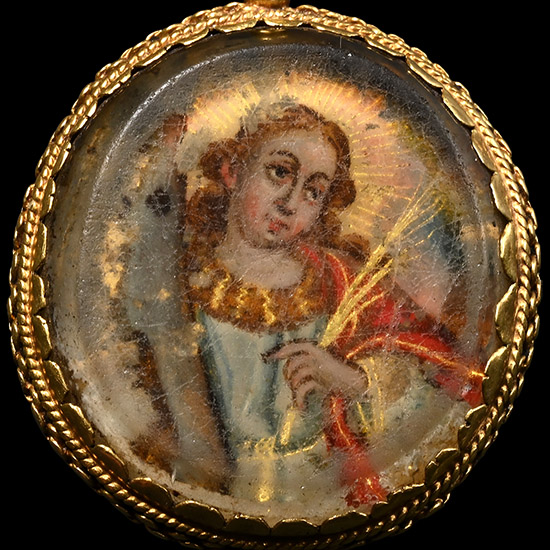
Bourbon Era Gold Devotional Pendant with Verre Eglomise Miniatures of Saint Catherine of Alexandria and Saint John of Nepomuk
Spain, circa 1700 A.D.Sold for (Inc. bp): £1,170
Featuring a gold mount with twisted ropework border and scalloped edges securing bevelled glass coverings, one side depicting nimbate Saint Catherine of Alexandria wearing a pale blue dress with a red cloak, holding a gilt palm frond; the other side with Saint John of Nepomuk dressed in clerical attire and holding a gilt cross and a palm frond. 29.1 grams, 43 mm
Acquired on the European art market.
Saint Catherine of Alexandria was a Christian saint and virgin who was martyred in the early 4th century at the hands of the Emperor Maxentius. She was both a princess and a noted scholar who became a Christian around the age of 14, converted hundreds of people to Christianity and was martyred around the age of 18. More than 1,100 years after Catherine's martyrdom, Joan of Arc identified her as one of the saints who appeared to and counselled her. Saint John of Nepomuk (c. 1345 – 20 March 1393) was the saint of Bohemia (Czech Republic) who was drowned in the Vltava River at the behest of Wenceslaus IV of Bohemia. Later accounts state that he was the confessor of the queen of Bohemia and refused to divulge the secrets of the confessional. Based on this account, John of Nepomuk is considered the first martyr of the Seal of the Confessional, a patron against calumnies and, because of the manner of his death, a protector from floods and drowning. Verre églomisé is a French term referring to the process of applying both a design and gilding onto the rear face of glass to produce a mirror finish. The name is derived from the 18th-century French decorator and art-dealer Jean-Baptiste Glomy (1711–1786), who was responsible for its revival. Glomy's technique was a relatively simple one of applying decorative designs in a combination of plain colour and gilding, usually to glass picture frames. However, over time, it has come to be used to describe nearly any process involving back-painted and gilded glass, however elaborate. -
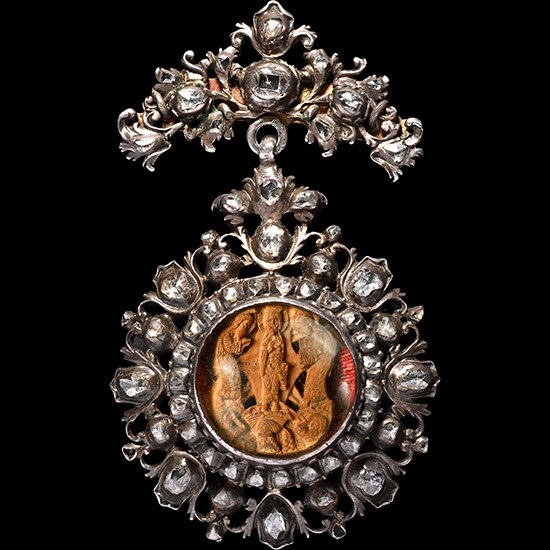
Silver and Diamond Pendant with the Transfiguration
Spain, circa 1700 A.D.Sold for (Inc. bp): £2,340
The elaborate openwork pendant set with old-cut diamonds, the hanger centred with a table-cut diamond; at the centre a circular glazed compartment containing a Greek Orthodox, micro-sandalwood carving of the Metamorphosis, featuring the three elaborately carved nimbate figures of Christ, Heliah and Moises, and the three apostles Peter, John and James at their feet; the reverse of the pendant with a flowering tulip; a brooch pin added in the 19th century to the reverse. 31.97 grams, 66 mm
Acquired on the European art market. This lot has been checked against the Interpol Database of stolen works of art and is accompanied by search certificate no.13450-257984.
The central scene represents the Transfiguration of Christ, as it is described in the Gospels of Matthew, Luke and Mark. Having led his companions up the holy Mount Tabor to pray, the men are awoken the following day by the startling sight of Christ floating above the mountain at Galilee. He is flanked by the prophets Elijah and Moses, who stand serenely talking to him from two rocky outcrops. Christ hovers within an aureole, which represents divine uncreated light, and makes a sign of blessing. As the disciples, still ‘heavy with sleep’, stare with amazement to see him in his deified humanity, a voice speaks out from a cloud: ‘This is my Beloved Son, in whom I am well pleased; hear ye him’ (Matthew 17:5). In confusion they scramble and fall. John loses a sandal. James stumbles and shields his eyes. -
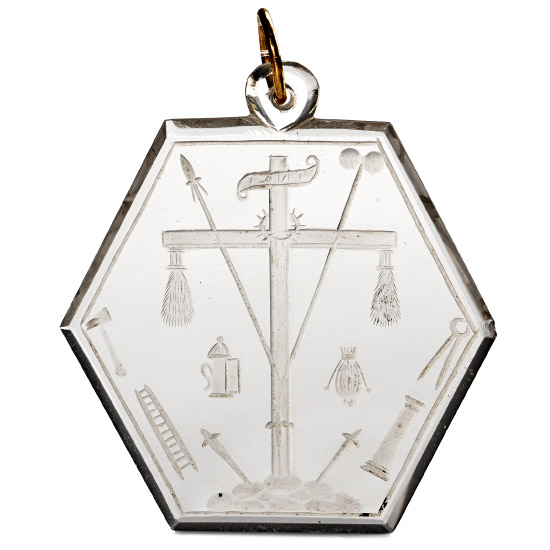
Large Rock Crystal Pendant with Cross
Italy, 17th century A.D.Sold for (Inc. bp): £3,900
Transparent hexagonal slice of polished rock crystal engraved with the Arma Christi, instruments of the passion, relating to the crucifixion of Christ. 32.3 grams, 84 mm
Acquired on the European art market. -
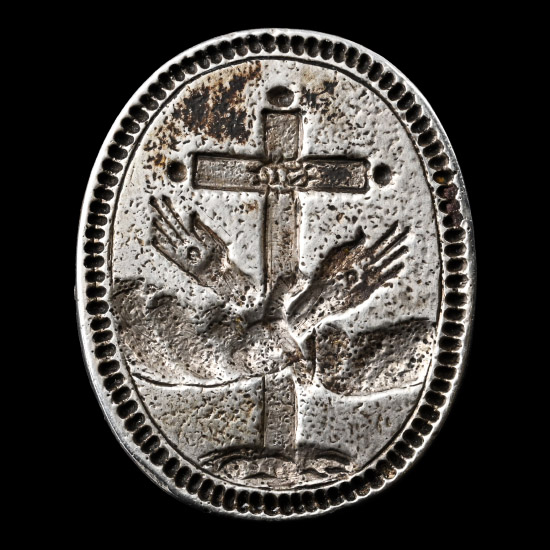
Post Medieval Silver Religious Seal with Boxwood Handle
17th-18th century A.D.Sold for (Inc. bp): £468
Comprising a balustered wooden handle and a silver stamp seal with a large cross behind two crossed hands with stigmata, the cross with an inscription, supplied with a museum-quality impression. 51.96 grams, 85 mm
Acquired on the European art market. -
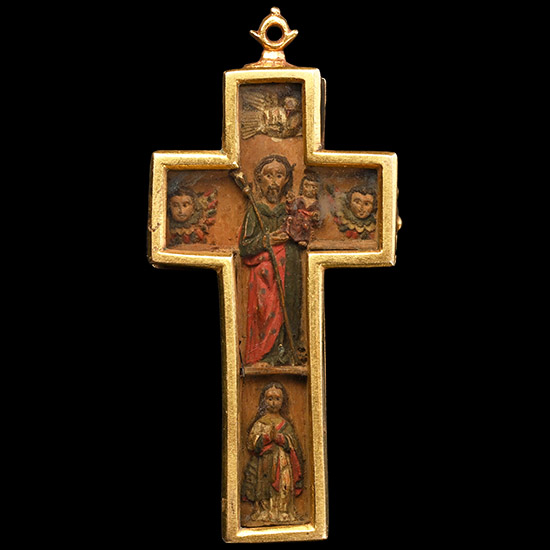
Mexican Gold Mounted Wooden Cross with Saint Joseph
Circa 1600 A.D.Sold for (Inc. bp): £5,720
The wooden cross set behind glass panels set within a large gold mount, the cross carved to one side with Saint Joseph holding the Christ child, beneath the Dove of the Holy Spirit, flanked by angels and above the praying Virgin; the other side with the crucified Christ, flanked on three sides by angels and above a Nun Saint. 50.7 grams, 81 mm
Acquired on the European art market. This lot has been checked against the Interpol Database of stolen works of art and is accompanied by search certificate number no.13345-257977.
The tradition of carving tiny devotional wooden reliefs for pendants began in the 16th century and continued throughout the 17th and 18th centuries in Mexico. The carvings were often sent to Spain, where they were mounted in pendants of silver and gold. Relicarios, The Forgotten Jewels of Latin America, by Martha J. Egan: ‘When ivory became difficult to obtain in Europe during the Middle Ages, following the Ottoman conquest of North Africa, European sculptors of miniature works, notably in the Netherlands and northern Europe, found boxwood to be a serviceable substitute. While only items of limited size can be carved in this hard, fine-grained wood, it can be highly polished, its light color is attractive, its density renders it unlikely to split or chip, and when finished, the carved material can resemble ivory.' -
.jpg)
Spanish Rock Crystal and Enamelled Gold Crucifixion Pendant
Early 17th century A.D.Sold for (Inc. bp): £5,460
Devotional pendant with a finely chased and adorned frame with black enamel, encased within a double-sided polychrome enamelled gold Calvary scene, depicting Christ upon the cross with St. John the Evangelist and the Virgin Mary standing on either side; each side with domed pieces of rock crystal, which open to expose both crucifixion scenes. 12.58 grams, 34 mm
Acquired on the European art market. This lot has been checked against the Interpol Database of stolen works of art and is accompanied by search certificate number no.13400-257999. -
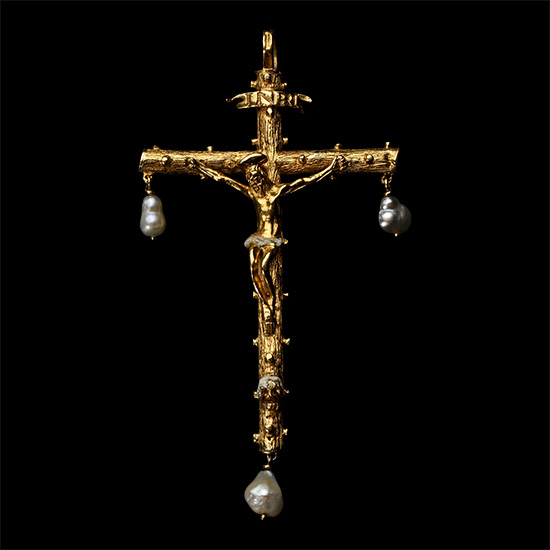
Renaissance Gold and Enamelled Crucifix Pendant
Spain, 16th century A.D.Sold for (Inc. bp): £4,550
The limp body of Christ hanging from the cross, wearing an enamelled loincloth, the bones of Adam at his feet; above his head a plaque mocking the saviour, hung by Pilate with the initials ‘INRI’, an abbreviation of the Latin ‘Iēsus Nazarēnus, Rēx Iūdaeōrum’, translating as 'Jesus the Nazarene, King of the Jews’; carefully rendered three-dimensional cross imitating the grain, knots and stumps of the wood, a baroque pearl suspended from both arms and the base of the cross. 8.56 grams, 75 mm
Acquired on the European art market. This lot has been checked against the Interpol Database of stolen works of art and is accompanied by search certificate number no.13402-257995. -
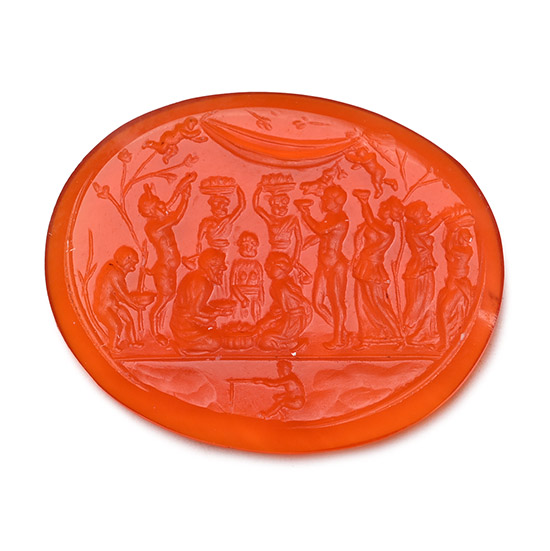
Renaissance Carnelian 'Michelangelo's Seal' Gemstone
18th century A.D.Sold for (Inc. bp): £702
Vibrant orange carnelian intaglio depicting a lively Bacchic scene with satyrs, wine-bearers and other participants beneath a canopy supported by two flying Cupids; below in the exergue, a small figure of a fisherman, fishing with a hook on the sea shore; supplied with a museum-quality impression. 1.21 grams, 21 mm
Acquired on the European art market.
The original 'Seal of Michelangelo' is a famous engraved carnelian gem, acquired by King Louis XIV in 1670. It is now housed in the Bibliothèque nationale de France. Long thought to be an ancient Greek masterpiece, and a subject of debate and controversy, it was subsequently identified by scholars as a Renaissance work by Pier Maria Serbaldi da Pescia. -
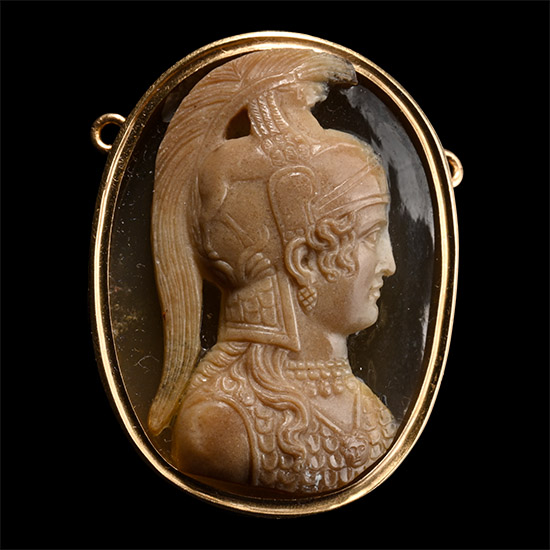
Sardonyx Cameo of the Greek Goddess Athena in Gold Mount
Europe, 18th century A.D.Sold for (Inc. bp): £1,690
Finely carved, high-relief cameo depicting profile bust of the goddess, wearing a plumed helmet with the crest supported by a winged Pegasus, her hair modelled in soft curls framing the face and falling over the shoulder above articulated lorica (battle armour); small grape-shaped earrings and multiple necklaces carefully rendered, creating an appealing contrast between martial attributes and feminine ornament; set in an unmarked, high-carat gold frame, probably struck and finished in England after the gem’s return from the Grand Tour, two lateral suspension loops. 14.98 grams, 36 mm
Acquired on the European art market.
The relief shows confident toolwork: crisp contours to the facial profile, detailed treatment of the helmet and feathers, and subtle gradations of planes between the figure and the background. -
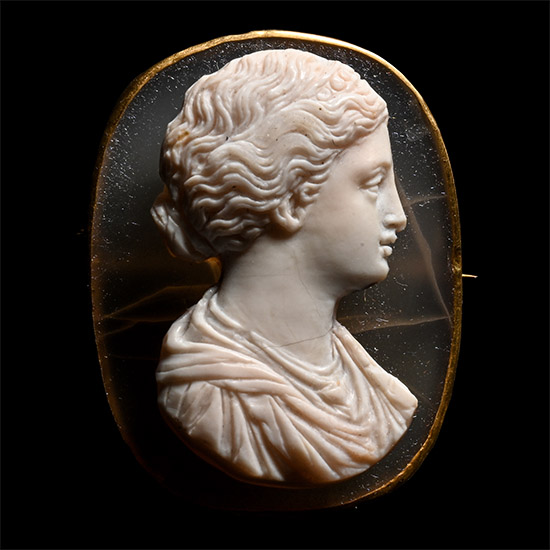
Renaissance Sardonyx Cameo of a Young Woman
Italy, 16th century A.D.Sold for (Inc. bp): £1,170
High-relief bust of a young lady facing right, her curly hair neatly pulled back to a chignon at the nape of her neck, jewelled diadem resting on top of the head; mounted in an unmarked high-carat gold brooch setting dating to the 19th century. 9.59 grams, 30 mm
Acquired on the European art market.

