-
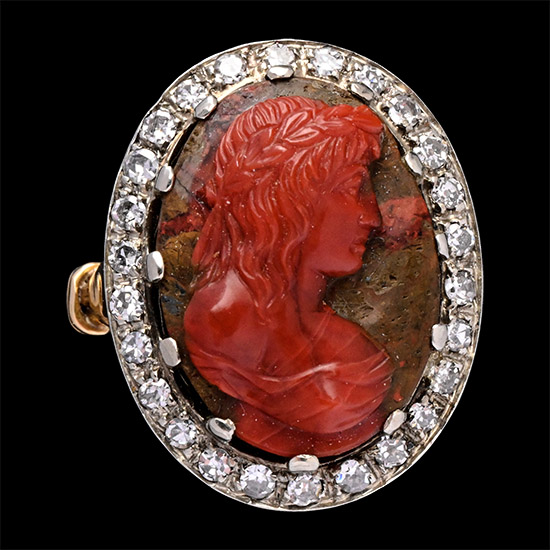
Hardstone Cameo of a Muse in Ring
Italy, 18th century A.D.Sold for (Inc. bp): £2,340
Carved in two-coloured red and brown agate, depicting a classical muse in right-facing profile with flowing hair, and drapery, the laurel wreath identifying her as an embodiment of poetic or artistic inspiration; the cameo set in a 19th-century mount with a border of single-cut diamonds set in platinum, a pierced, open-backed construction and bifurcated shoulders enriched with classical leaf motifs. 6.47 grams, 25.88 mm overall, 16.12 mm internal diameter (approximate size British J 1/2, USA 5, Europe 9.32, Japan 9)
Acquired on the European art market. This lot has been checked against the Interpol Database of stolen works of art and is accompanied by search certificate number no.13327-257906.
The union of an eighteenth-century Italian gem engraving with a later English mount reflects a broader nineteenth-century practice of integrating earlier engraved gems into newly conceived settings. -
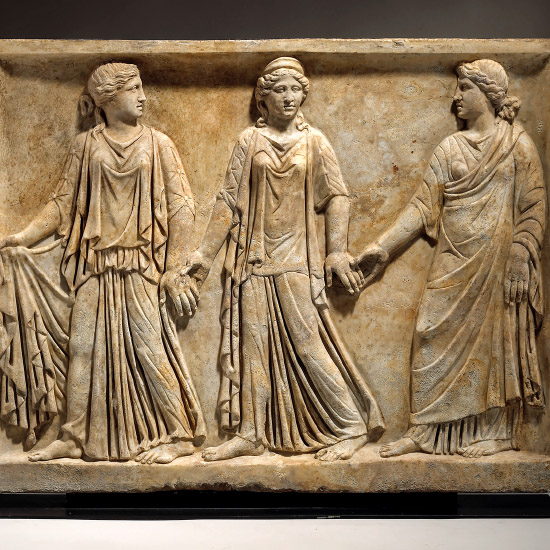
Large Marble Relief with Three Figures
18th-19th century A.D.Sold for (Inc. bp): £5,720
Rectangular slab with raised border and high-relief scene; three standing females wearing floor-length draped and tiered robes, holding hands; the left figure with right hand extended slightly, holding out the folds of her robe, head turned back towards the middle figure whose hand she holds; middle figure facing with diadem in her neatly dressed hair, holding the extended hand of the third figure holding the hem of her robe and angled stiffly away from the others. 145 kg total including stand, 106.5 cm wide
Private collection, UK. This lot has been checked against the Interpol Database of stolen works of art and is accompanied by search certificate number no.13391-259010.
A group of three young females is often interpreted as the Three Graces. However, in classical art, these three figures usually stand close together and are nude or sparsely clothed - unlike the females in this carving. Groups of three goddesses - such as Persephone, Demeter and Hekate - may denote the phases of the moon or, more broadly, the three phases of a female life as maiden / mother/ elder. The scene bears some resemblance to the 1st century AD relief of 'Three dancing nymphs' in Santa Barbara Museum of Art, California; however, that has a more exuberant and lively air contrasted with the rigid formality of the piece. -
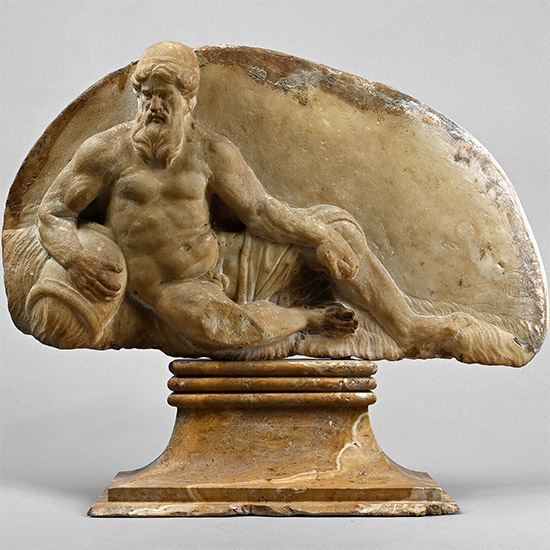
Baroque Period Marble Frieze Depicting a River God
17th-18th century A.D.Sold for (Inc. bp): £3,380
Depicted lying on a riverbed, leaning on his right side, his aged face framed by a rich, flowing beard, his wavy hair held back by a taenia; his body, naked and corpulent, is covered only by a light cloak wrapping his legs; his left hand is stretched forward, his right hand resting on a vase pouring water from the river; the figure stands out against a smooth, semicircular cut wall; mounted on an old collection marble base. 13 kg, 44.5 cm wide
With evidence of break along outer edges suggesting the fragment was once part of a larger composition or fountain. Areas of old glue remnants to the broken edge. The marble is stable, with age staining to the entire surface; minor chips throughout but generally in very good condition.
Previously in an old European collection, probably from the 18th/19th century, based on the old collection marble base and mounting technique. Private collection, France. This lot has been checked against the Interpol Database of stolen works of art and is accompanied by search certificate no. 13239-251810.
The representations of river or sea divinities usually depicted them in the same position, with naked torso wrapped only in a wide cloak, and usually bearded. The sculpture bears similarities with the sculpture of a river divinity, in the Archaeological Museum of Napoli (inv. 5977), from Rome and belonging to the Farnese Collection, from the second half of the 2nd century A.D. -
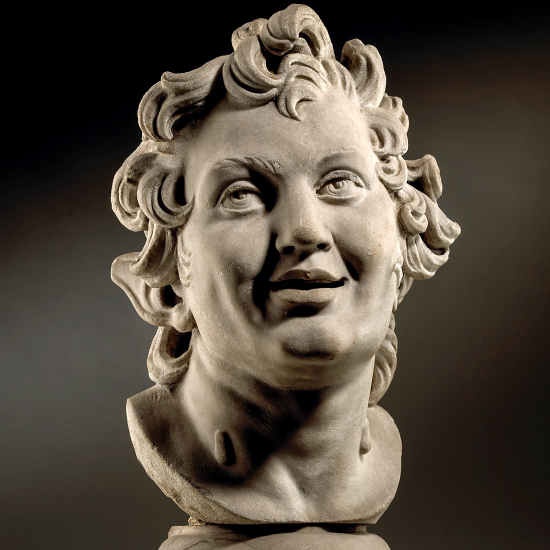
Life-Size Stone Head of a Centaur
18th century A.D.Sold for (Inc. bp): £3,640
Carved in the round bust depicting a faun or centaur with a youthful face; the hair falling in exuberant curls over the goat-like ears, the mouth parted in laughter, the eyes set beneath a stern brow; on an integral pedestal base with repair to reverse. 21.4 kg, 45 cm high
Private collection, UK. This lot has been checked against the Interpol Database of stolen works of art and is accompanied by search certificate number no.13392-259012.
Monumental marble centaurs were excavated together at Hadrian's Villa in December 1736. Pope Clement XIII secured them for the Capitoline Museum, where they remain to this day. Bronze reproductions of the famous centaurs were very much in vogue amongst the Grand Tour travellers of the 18th century. -
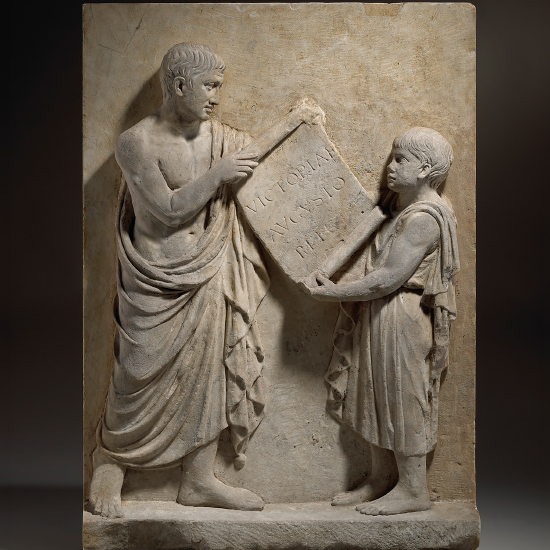
Large Marble Relief with Roman-Era Scene of a Boy Presenting a Scroll
18th-19th century A.D.Sold for (Inc. bp): £6,500
Rectangular scene with ledge to lower edge; high-relief carved scene depicting a standing male in loosely draped toga, holding the upper edge of a papyrus scroll; beside him, a small boy in similar attire holding the lower two corners of the document; legend in seriffed Roman capitals 'VICTORIAE / AVGVSTO / RE[...]' (to Victoria, to Augustus, ...). 127 kg total including stand, 87.5 cm high
Private collection, UK. This lot has been checked against the Interpol Database of stolen works of art and is accompanied by search certificate number no.13393-259011.
The relief recalls the images of the Propaganda Augusti, diffused by Julius Caesar Octavian after his victory over Marcus Antonius and Cleopatra at Actium. The aged man and the boy represent the old and new Roman world meeting in the Principate created by Augustus. -
.jpg)
Renaissance Agate Gemstone with Eros Riding a Hippocampus in Gold Ring
16th-17th century A.D.Sold for (Inc. bp): £2,340
Oval banded agate intaglio engraved with Eros riding a hippocampus through the waves and wielding a whip in his hand; set in a later gold ring with openwork shoulders. 4.57 grams, 25.29 mm overall, 17.36 mm internal diameter (approximate size British N 1/2, USA 6 3/4, Europe 14.35, Japan 13)
Acquired on the European art market. This lot has been checked against the Interpol Database of stolen works of art and is accompanied by search certificate number no.13348-257957.
The term hippocampus originates in the Renaissance, from Julius Caesar Arantius. He originated the term from the Greek word for seahorse (hippos [‘horse’] and kampos [‘sea monster’]). Arantius published his description of the hippocampus in 1587, in the first chapter of his work titled De Humano Foetu Liber. -
.jpg)
Roman Glass Mars Gradivus Gemstone in Gold Ring
2nd century A.D.Sold for (Inc. bp): £2,340
Vibrant red intaglio featuring the god of war striding left, carrying a spear with one hand and the other holding a trophy resting upon his shoulder; the reverse of the intaglio engraved with the word ‘ADYNAIE’, probably the name of the original owner; set in a modern gold ring; supplied with a museum-quality impression. 5.75 grams, 22.89 mm overall, 18.13 mm internal diameter (approximate size British O, USA 7, Europe 14.98, Japan 14)
Acquired on the European art market. This lot has been checked against the Interpol Database of stolen works of art and is accompanied by search certificate number no.13336-257953.
The moniker 'Mars Gradivus' is often translated as 'Marching Mars' from the Latin 'gradus' meaning step or march. -
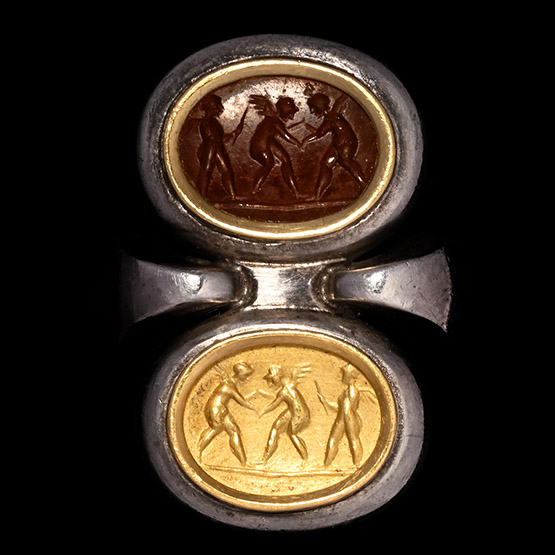
Roman Intaglio of Three Wrestling Erotes in Silver Ring
1st-2nd century A.D. and laterSold for (Inc. bp): £780
D-section hoop with widening lozenge-shaped shoulders supporting two discoid bezels; one with orange stone intaglio of three winged erotes, two engaged in a wrestling competition; a mirror image in gold below. 16.07 grams, 29.75 mm overall, 17.58 mm internal diameter (approximate size British O, USA 7, Europe 14.98, Japan 14)
Private collection, Europe. Acquired on the English art market. -
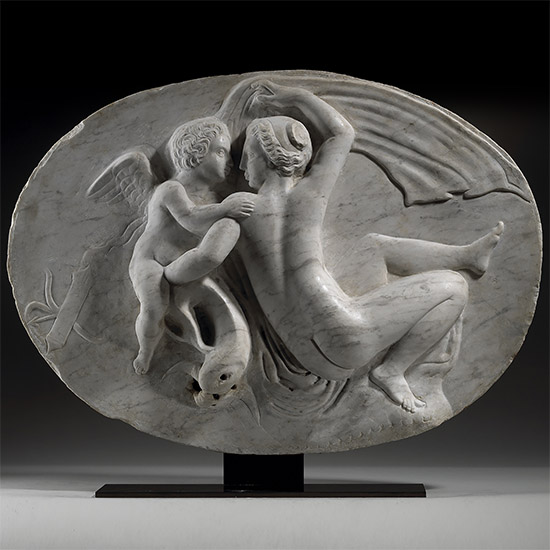
Renaissance Fontainebleau Marble Plaque with Psyche Revived by Eros's Kiss
France, 16th century A.D.Sold for (Inc. bp): £3,380
Ellipsoid plaque with carved high-relief scene depicting Psyche crouching with left leg extended, her right arm raised to support a veil, head turned towards Eros, left arm passing between the legs of Eros, standing nude with wings spread to kiss Psyche, his bow and quiver cast aside in the field. 33.5 kg total including stand, 63 cm wide
Private collection, UK. This lot has been checked against the Interpol Database of stolen works of art and is accompanied by search certificate number no.13396-259009. -
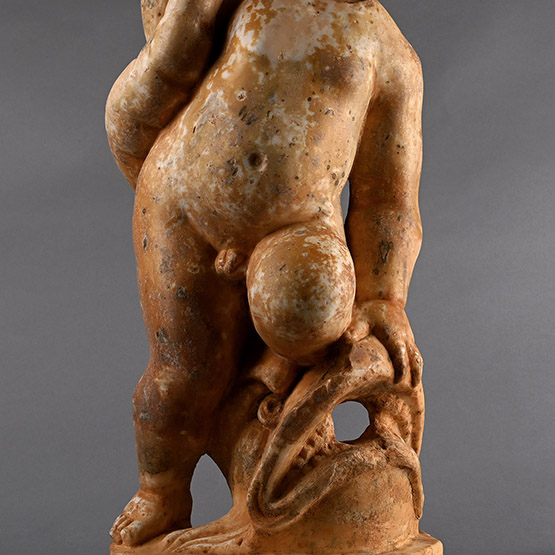
Marble Fountain Sculpture of a Putto Wrestling a Fish
Baroque, 17th century A.D.Sold for (Inc. bp): £598
Standing on an angular base resting his left knee on the open jaws of a fish, his left arm holding the jaws open, the body and tail held upright be the raised right hand (partly absent); with heavy sulphured patina. 20.75 kg, 48 cm
Acquired prior to 1970. From the estate of a Swiss gentleman, Ticino. Private collection, Zurich, Switzerland. This lot has been checked against the Interpol Database of stolen works of art and is accompanied by a search certificate number no.12790-240308.
In ancient Roman art and architecture, fountains were often decorated with sculptures of young boys or putti holding fish. These sculptures were known as 'putti with fish' or 'boy with fish' and were a popular motif in the decoration of fountains. The young boy or putto was shown holding a fish or a shell, which would spout water into the fountain basin below. The fish was a particularly popular motif because it symbolised abundance, fertility, and prosperity, which were all important values in ancient Roman society. Overall, the putti with fish sculptures are a notable example of the art and architecture of ancient Rome and have continued to be an enduring symbol of beauty, abundance, and prosperity throughout the centuries. Archaeological excavations in Pompeii have revealed many examples of sculptures of putti with fish. The putti with fish sculptures from Pompeii were usually made of bronze, marble, or terracotta. They were often placed in the centre of the fountain, surrounded by other decorative elements such as flowers, plants, and other sculptures. Many of these putti with fish sculptures are now on display in the National Archaeological Museum of Naples. The museum also houses a famous mosaic of a putto with a fish, which was discovered in the House of the Faun in Pompeii. The putti with fish sculptures from Pompeii and those in the Naples Museum provide valuable insights into the art and culture of ancient Rome. They demonstrate the importance of beauty and abundance in ancient Roman society and offer a glimpse into the everyday life of the people who lived in Pompeii over two thousand years ago. In the 17th and 18th centuries these sculptures were imitated and used to decorate the fountains of royal palaces and palaces. -
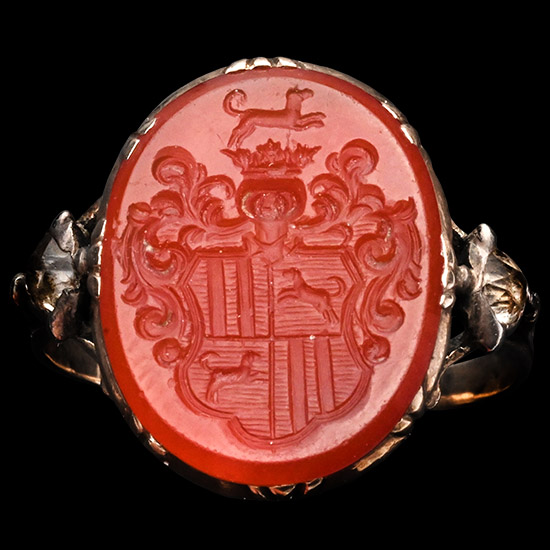
Holy Roman Empire Gold Signet Ring with Carnelian Intaglio
Germany, 18th century A.D.Sold for (Inc. bp): £2,210
Comprising a fluted band with openwork shoulders set with facetted rock crystals, rub-over setting engraved with floral motifs on the reverse and set with a red carnelian intaglio carved with the coat of arms of the owner; supplied with a museum-quality impression. 5.64 grams, 24.89 mm overall, 21.56 x 17.76 mm internal diameter (approximate size British U, USA 10, Europe 22.52, Japan 21)
Acquired on the European art market. -
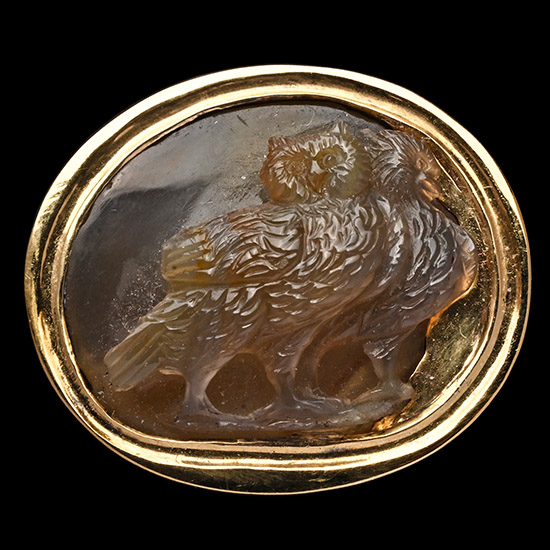
Renaissance Agate Cameo of Two Owls in Gold Ring
Italy, 17th century A.D.Sold for (Inc. bp): £5,200
Comprising a D-section hoop expanding towards the open-backed setting set with a large brown agate intaglio modelled as two conjoined standing owls, the one at the front facing, and the other looking to the right, intricate feather and facial details, the cameo with a loss on the right-hand side, with the ring incorporating a fine gold repair. 12.74 grams, 24.90 mm overall, 17.00 mm internal diameter (approximate size British M 1/2, USA 6 1/4, Europe 13.09, Japan 12)
Acquired on the European art market. This lot has been checked against the Interpol Database of stolen works of art and is accompanied by search certificate number no.13318-257961.
Even in the Italian Renaissance, the owl, an ancient symbol of the goddess Athena, symbolised wisdom. The owl was also a symbol of the night and death, as is so eloquently illustrated in the 17th-century painting Vanité à la chouette in the Musée des Beaux-Arts de Dijon, which depicts an owl sitting on a human skull next to an extinguished candle.

