-
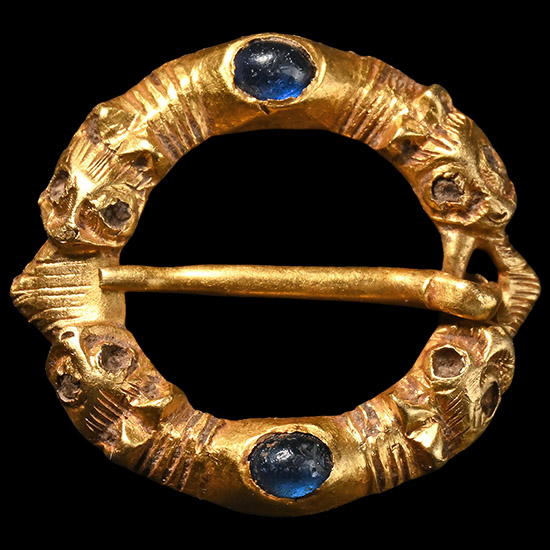
Medieval Gold Ring Brooch with Beast Heads
13th century A.D.Sold for (Inc. bp): £1,560
Annular brooch decorated with leopard heads, each originally with gem-set eyes, with two blue glass cabochons on each side of the pin. 1.18 grams, 14 mm
From the collection of Gordon Bailey, Essex, UK; formed since 1968.
An annular brooch is a type of brooch that is circular in shape, forming a complete ring. They were worn by both men and women of all social classes. The word 'annular' comes from the Latin word 'annulus', meaning ring. These brooches were popular in medieval Europe, particularly from the 13th to 15th centuries, and were used to fasten clothing such as tunics and cloaks. -
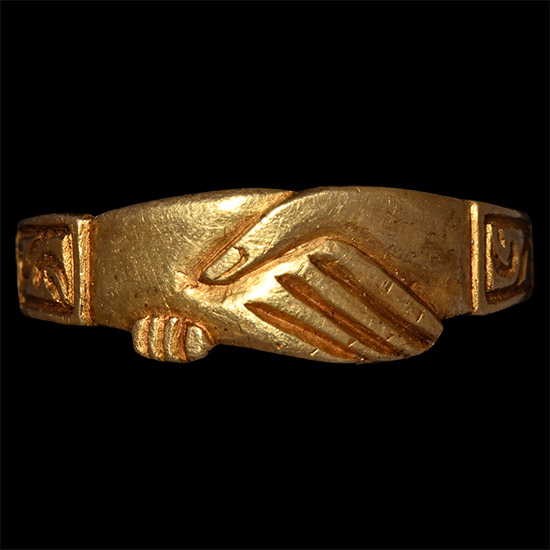
Post Medieval Gold Fede Ring
17th-18th century A.D.Sold for (Inc. bp): £1,170
Comprising a wide hoop, the shoulders with rectangular panels embellished with scrolling motifs framed by delicate wirework borders, the bezel formed as a pair of clasped hands, finely modelled in low relief, symbolising trust, fidelity, and contractual union, the hands articulated with tapering fingers and subtly defined cuffs. 4.08 grams, 21.08 mm overall, 18.89 mm internal diameter (approximate size British R, USA 8 1/2, Europe 18 3/4, Japan 18)
Acquired on the European art market.
The fede motif derives from the medieval formula mani in fede ('hands in trust'), a visual expression of loyalty and binding agreement. Rings of this type circulated widely from the late medieval period onward, gaining particular prominence in the seventeenth and eighteenth centuries as betrothal jewels embodying steadfast commitment. The present example, with its restrained decorative scheme and high gold purity, reflects the enduring appeal of intimate, symbolically charged jewels rooted in long-standing marital and devotional customs. -
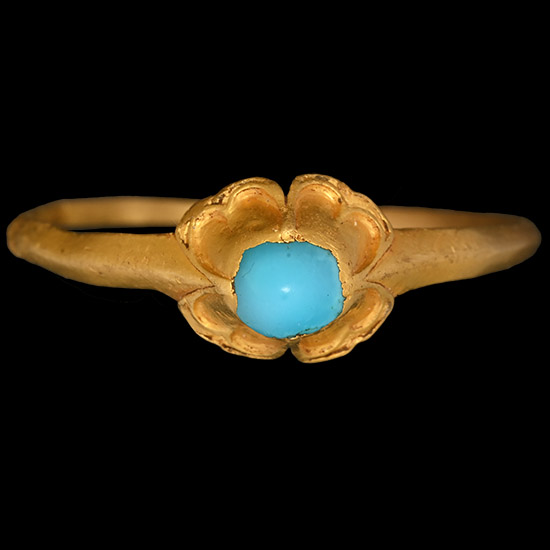
Large Medieval Gold Ring with Amuletic Turquoise Gemstone
1200-1500 A.D.Sold for (Inc. bp): £5,980
With a high conical bezel decorated with four bifid scallop-shaped depressions to the outer surface forming a quatrefoil, flower-like design with the scallops acting as petals; a circular and deep central setting holding a turquoise cabochon; the decoration continuing to the reverse of the bezel resulting in a scalloped design, the shoulders sloping down and extending from between two of the quatrefoil petals at opposite sides of the bezel, with restored fine narrow hoop of large wearable size. 2.75 grams, 27.20 mm overall, 20.05 mm internal diameter (approximate size British U, USA 10, Europe 22.52, Japan 21)
Found by Jason Ashley whilst searching with a metal detector near Hutton Conyers, Harrogate, North Yorkshire, UK, on Sunday, 2nd November 2025. Accompanied by a copy of the Report for H M Coroner on find of Potential Treasure with Treasure reference no.2025T1429. Accompanied by a copy of a letter from the British Museum disclaiming the Crown's interest in the find. Accompanied by a copy of the British Museum's Portable Antiquities Scheme (PAS) report no.YORYM-1E3B30. This lot has been checked against the Interpol Database of stolen works of art and is accompanied by search certificate number no.13293-255044.
The PAS report discusses that: 'Turquoise was not a particularly valuable stone in the Middle Ages, but one that was valued for its amuletic properties, protecting the wearer against poisoning, drowning, or having an accident while riding. It was also supposed to have the property of indicating the state of health of the wearer by the shade the Turquoise went.' -
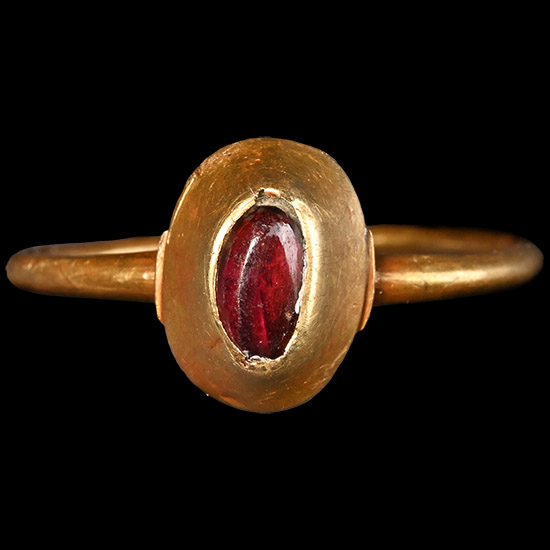
Medieval Gold Ring with Cabochon Garnet
13th-14th century A.D.Sold for (Inc. bp): £2,340
Featuring a round-section hoop and a large collet set with a vibrant red garnet cabochon. 2.93 grams, 24.96 mm overall, 19.05 mm internal diameter (approximate size British N, USA 6 1/2, Europe 13.72, Japan 13)
Acquired on the European art market. This lot has been checked against the Interpol Database of stolen works of art and is accompanied by search certificate number no.13387-258006.
During the Middle Ages, gemstones were often associated with magical and protective properties they were believed to possess. Gemstones could protect against evil or poisons, as well as heightening the individual’s characteristics and strengths. -
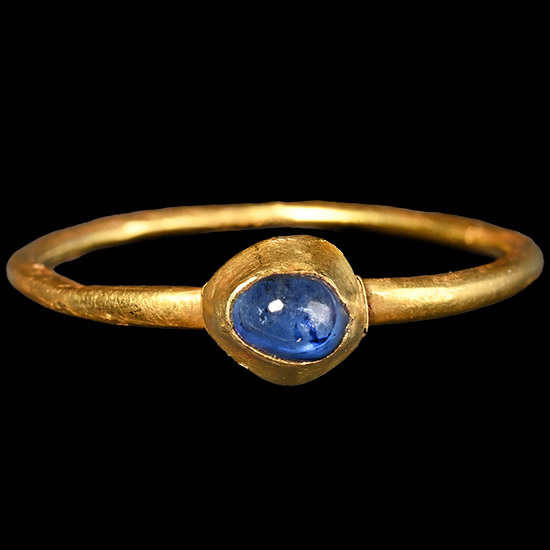
Medieval Gold Ring with Cabochon Sapphire
13th-14th century A.D.Sold for (Inc. bp): £4,160
Featuring a large round-section hoop and raised cell set with a polished sapphire cabochon. 2.03 grams, 26.68 mm overall, 19.10 x 19.45 mm internal diameter (approximate size British R 1/2, USA 8 3/4, Europe 19.38, Japan 18)
Acquired on the European art market. This lot has been checked against the Interpol Database of stolen works of art and is accompanied by search certificate number no.13388-258005.
During the Middle Ages, gemstones were often associated with magical and protective properties they were believed to possess. Gemstones could protect against evil or poisons, as well as heightening the individual’s characteristics and strengths. Sapphires were frequently worn by Bishops and other clergy, due to their ability to promote their bearer’s chastity and piety. Sapphires were believed to be able to change colour if the wearer acted sinfully or lacked faith; it was because of this belief that jewels set with sapphires were worn as symbols of honesty and devout faith. -
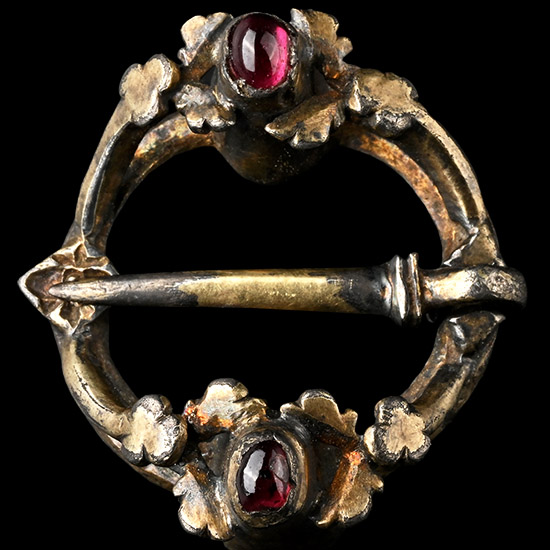
Medieval Silver-Gilt Ring Brooch with Garnet Cabochons
Europe, 13th-14th century A.D.Sold for (Inc. bp): £338
Annular in form with tapering cells to each end, with inset garnet cabochons, and leaf detailing, quatrefoil opposite the sword-shaped pin. 5.42 grams, 26 mm
Private collection, London, UK. -
.jpg)
Medieval Silver-Gilt Betrothal Ring
15th century A.D.Sold for (Inc. bp): £546
Featuring a fluted band with a crowned heart flanked by roses. 6.18 grams, 23.84 mm overall, 19.30 mm internal diameter (approximate size British R 1/2, USA 8 3/4, Europe 19.38, Japan 18)
Acquired on the European art market. -
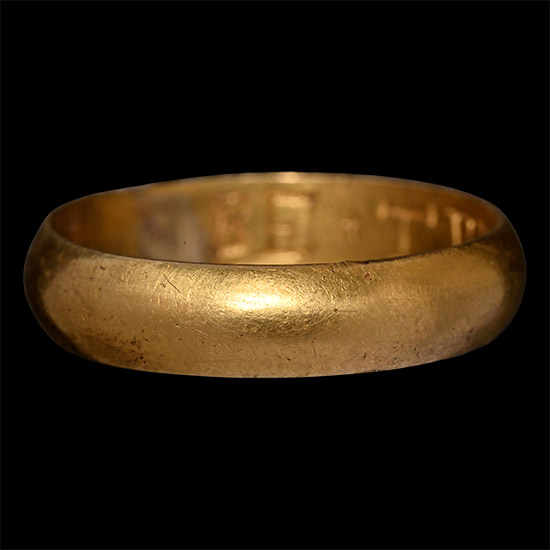
Tudor Gold 'BE . TRVE . IN . HART' Posy Ring
Circa 16th century A.D.Sold for (Inc. bp): £2,470
Featuring a smooth exterior and D-shaped in cross-section, a flat internal face with an inscription in upper case Roman letters, reading 'BE . TRVE . IN . HART' for 'Be true in heart' with the stops formed as small crosses and the N reversed. 4.25 grams, 20.66 mm overall, 18.06 mm internal diameter (approximate size British P, USA 7 1/2, Europe 16.23, Japan 15)
Found whilst searching with a metal detector near Edgmond, Telford & Wrekin, UK, by George Elymn, on 27 October 2024. Recorded with the British Museum's Portable Antiquities Scheme (PAS) with reference no.HESH-B237EA; handed in as Treasure under the Treasure Act, and subsequently disclaimed and returned to the finder. Accompanied by a copy of the Report for H M Coroner on finding of Potential Treasure, with reference no.2025T1645. Accompanied by a copy of a letter from the British Museum explaining that the Crown's interest in this find has been disclaimed.
The 'posy' name is derived from the 'poesy' (motto) engraved around the hoop. In medieval examples, the posy is usually found around the hoop exterior, although on later examples, inscriptions were more usually engraved on the interior. Rings with amatory inscriptions can be found from the 14th century AD onwards, when they served as love gifts, betrothal and wedding rings. Posy rings were also given to friends or used to mark significant occasions. Posies were composed by the giver, kept in stock by goldsmiths, or could be selected from published compendiums or commonplace books such as 'The Mysteries of Love or the Arts of Wooing' (1658 AD), or 'Love's Garland or Posies for Rings, Hand-kerchers and Gloves and such pretty tokens that Lovers send their Loves' (1674 AD). Rings were one genre of personal item amongst many to be adorned with posies at this time. -
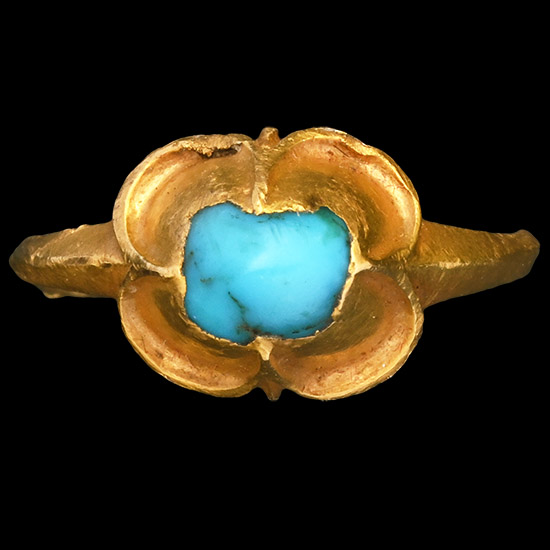
Medieval Gold Ring with Turquoise
1200-1500 A.D.Sold for (Inc. bp): £3,120
Comprising a slender hoop with a high pie-crust bezel with a cabochon turquoise within a rub-over setting. 3.46 grams, 22.77 mm overall, 16.01 mm internal diameter (approximate size British J, USA 4 3/4, Europe 8.69, Japan 8)
Acquired on the European art market. This lot has been checked against the Interpol Database of stolen works of art and is accompanied by search certificate number no.13328-257948.
This form of decorative ring with central stone setting is relatively common in the medieval period, when a focus on gemstones over metalwork became increasingly common. Several rings of this type are known and appear to have been popular in the 15th century. -
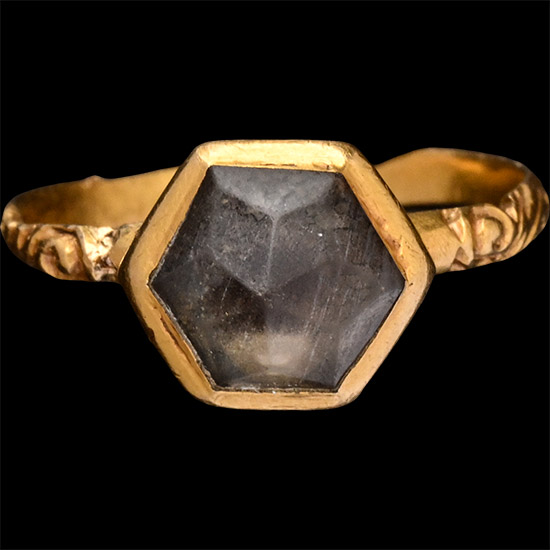
Renaissance Gold Ring with Gem
16th century A.D.Sold for (Inc. bp): £2,860
Comprising a slender hoop with scroll-decorated shoulders, a high hexagonal colette setting with a point-cut rock crystal with foil backing. 2.75 grams, 22.97 mm overall, 15.54 mm internal diameter (approximate size British I 1/2, USA 4 1/2, Europe 8.07, Japan 7)
Acquired on the European art market. -
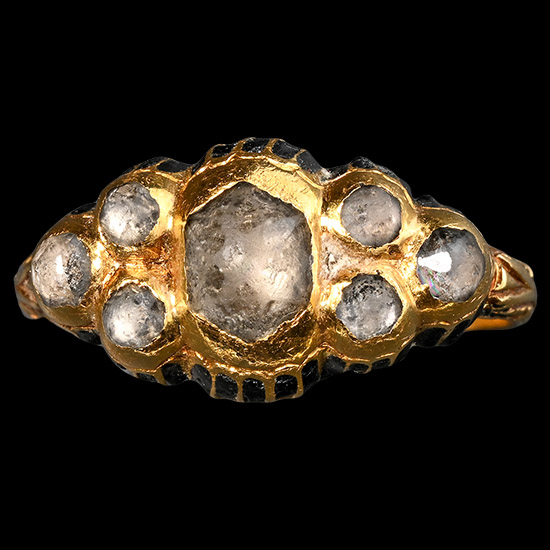
Renaissance Enamelled Gold Ring with Facetted Gems
17th century A.D.Sold for (Inc. bp): £2,990
With a closed back setting and carved shoulders, the bezel set with seven facetted paste gemstones in cut-down collets with black enamel decoration to the gallery; European workmanship. 5.75 grams, 25.32 mm overall, 19.74 mm internal diameter (approximate size British S, USA 9, Europe 20, Japan 19)
Acquired on the European art market. -
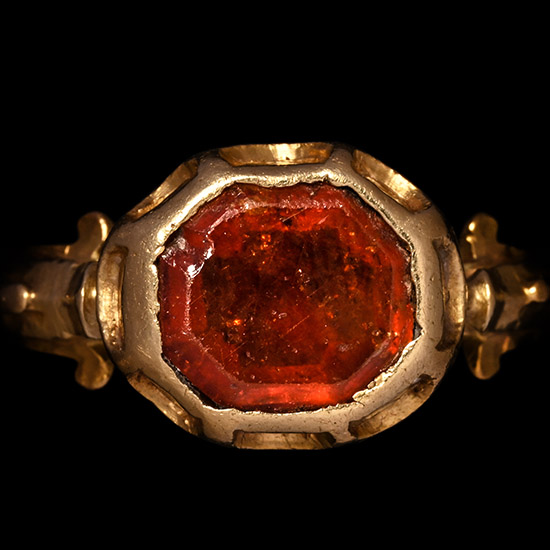
Renaissance Gold Ring with Table-Cut Hessonite Garnet
Western Europe, 16th century A.D.Sold for (Inc. bp): £3,380
Tiered hoop and shoulders supporting a cup bezel with scallop detailing, inset with an octagonal cloison. 7.07 grams, 27.56 mm overall, 19.87 x 19.76 mm internal diameter (approximate size British U, USA 10, Europe 22.52, Japan 21)
Private collection, Europe. Acquired on the English art market. This lot has been checked against the Interpol Database of stolen works of art and is accompanied by a search certificate number no.13048-248385.
Parallels for the ring type are dated 16th century. A related finger ring is also available in the British Museum collection. The chalice-shaped workmanship of the bezel betrays a strong Italian influence in the workmanship of the ring section.

