-
.jpg)
Monumental Egyptian Granite Statue Base For Prince Parahirwenemef
New Kingdom, 19th Dynasty, circa 1250 B.C.Sold for (Inc. bp): £52,000
The reddish granite base and lower part of a kneeling statue of Prince Parahirwenemef, preserving the feet and lower legs with finely detailed sandals and well-modelled toes; part of the kilt survives, with a line of sunken hieroglyphs on either side; a broad front pillar and narrower back pillar rise from the base, both inscribed, while hieroglyphic inscriptions continue around all four sides of the plinth; the mirrored base inscriptions comprise offering formulae invoking Amun-Ra on behalf of the prince together with a series of his royal and military titles, including "royal scribe", "overseer of horses", "troop commander", "group marshaler", and the previously unattested title tpy n mšꜥ ("chief of troops"); a separate inscription on the rear of the plinth names the noblewoman Wadjet-khayty as sn.t=f mr=f ("his sister/wife, his beloved"), providing the first substantial evidence for her relationship with the prince and strongly suggesting that she was his wife. 140 kg, 58.5 cm
Private collection of Mr A., acquired circa 1983-1984. Thence by descent, private collection since the late 1990s. This lot has been checked against the Interpol Database of Stolen Works of Art and is accompanied by a search certificate, no. 12887-241732. An article on this significant piece is currently being prepared by the Egyptologist Paul Whelan. The lot has been cleared against the Art Loss Register and is accompanied by a confirmation letter to that effect. This lot is accompanied by an illustrated lot declaration signed by the Head of the Antiquities Department, Dr Raffaele D'Amato.
Prince Parahirwenemef, the third son of Ramesses II and Queen Nefertari, is depicted in several relief scenes and two colossal statues associated with Ramesses II's temples, as well as in two smaller statues, both surviving only in fragmentary form. The inscriptions on this previously unrecorded statue base preserve the previously unattested military title tpy n mšꜥ ("chief of troops"), expanding the known titulary of Parahirwenemef and reinforcing his close association with the Ramesside chariot corps. The monument also provides the first substantial evidence concerning the noblewoman Wadjet-khayty, previously known only from a brief reference to a lost Karnak monument, strongly supporting her identification as the prince's wife. Together, the inscriptions make an important contribution to the study of Ramesside royal genealogy, military administration, and princely sculpture. -
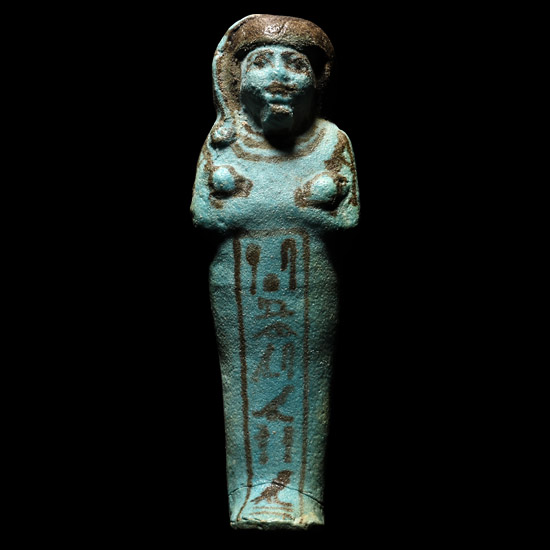
Egyptian Blue Glazed Shabti for Hor
New Kingdom, 19th Dynasty, 13th century B.C.Sold for (Inc. bp): £1,300
Modelled with a rounded wig and sidelock; painted black detailing to the eyes, lips, collar and agricultural tools held in the crossed hands; painted vertical panel to lower body with hieroglyphic legend “The illuminated one, the Osiris, the sem priest, the great director of craftsmen, Hor, justified” (sḥḏ wsı͗r sm wr ḫrp(w) ḥmw(w)t ḥr mꜣꜥ-ḫrw); repaired. 146 grams, 13.8 cm
Acquired on the UK art market, 1990s. Private collection, New York, USA. This lot has been checked against the Interpol Database of stolen works of art and is accompanied by search certificate no.13430-225467.
Although the inscription names the owner as Hor, it seems likely that this shabti was made for a high official named Hori. Several sem priests named Hori are known. It seems plausible that this shabti belonged to the Hori who was the son of Prince Khaemwaset, son of Ramesses II, since a similar example was found alongside those of the prince in a chamber in the Serapeum (Mariette, A., Le Sérapéum du Memphis, Paris, 1857, pl. 10). -
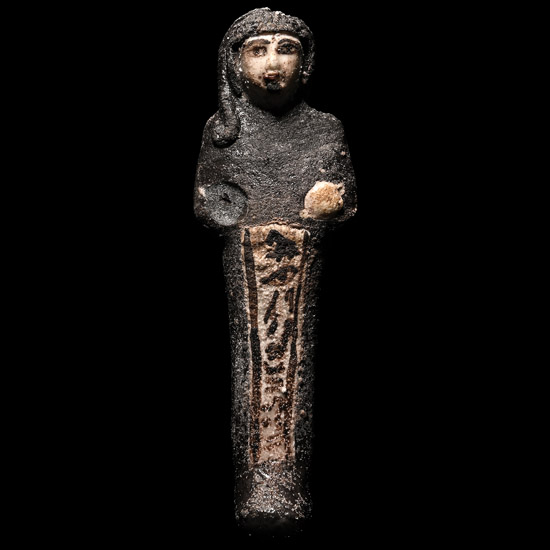
Egyptian Faience Shabti for the Fourth Son of Ramesses II, Prince Khaemwaset
New Kingdom, 19th Dynasty, 1279-1213 B.C.Sold for (Inc. bp): £1,950
In brownish-black and white faience with black detailing, depicted wearing a round wig featuring a side-lock, the white face displaying eyes, eyebrows, nostrils, and a short beard in black; the arms crossed, and the white-glazed hands (one missing) holding hoes; a slightly raised white-glazed frontal panel containing a column of hieroglyphic text reading: 'The Osiris, the sem (priest), the King's Son, Khaemwaset, True of Voice'. 103 grams, 12.7 cm
Acquired on the UK art market, 1990s. Private collection, New York, USA. This lot has been checked against the Interpol Database of stolen works of art and is accompanied by search certificate no.13431-225468.
Khaemwaset was the fourth son of Ramesses II, born to Queen Iset-Nofret. In addition to serving as the Sem-priest of Ptah at Memphis from an early age, he held various titles related to the Memphite cult, including High Priest of Ptah. The side-lock featured on all of Khaemwaset's shabtis is associated with his priestly role. Many shabtis of the prince are known, with the largest single group coming from the Serapeum at Saqqara; however, others have been found in numerous other locations. Since Khaemwaset's tomb has yet to be discovered, it appears that most of the known shabtis may have served as votive offerings in the sacred areas of the Memphite necropolis. His faience shabtis come in various colours, including green, blue, white, and black, and range in size from just under 10 cm to 15 cm in height. The distinctive glaze combination of this example, featuring a raised white-glazed panel contrasting with the darker body colour, is also found on some other 19th Dynasty shabtis (Cf. Janes, G., The Shabti Collections 3: Rochdale Arts & Heritage Service, Cheshire, 2011, pp.1-5, for those of Userhat from Sedment). -
.jpg)
Egyptian Predynastic Stone Frog
4th millennium B.C.Sold for (Inc. bp): £1,300
Pyramidal in form with shallow-carved hip and facial detailing. 537 grams, 81 mm
with Artemis Gallery, Munich, Germany, 2001. Private collection, Europe. This lot has been checked against the Interpol Database of stolen works of art and is accompanied by a search certificate number no.12580-232124.
The frog had a great role in ancient Egyptian mythology and was connected with the mythology of creation. A number of gods and goddesses were connected with the frog such as Heqet, Ptah, and Heh. The connection with the god Ptah as a god of creation was probably due to the idea that Ptah was the only god who created the world in ancient Egypt through his heart and his tongue. Every work of the god came about through what his heart devised and his tongue commanded. Frogs were often associated with Hekat, deity of birth and fecundity. Amulets of frogs were frequent votive gifts at such Predynastic and Archaic sites at Abydos, Naqada, and Saqqara. -
.jpg)
Egyptian Blue Glazed Faience Pectoral
Late Period, 664-332 B.C.Sold for (Inc. bp): £364
Large rectangular shrine-shaped pectoral with subtle cavetto cornice top; obverse with black-painted Anubis reclining on a low pedestal, the reverse with two stylised tyet flanking a djed pillar; four piercings through the rear edge. 20 grams, 45 mm
From a 20th century UK collection. -
.jpg)
Egyptian Bronze Seated Bastet Cat Amulet
Late Period, 664-332 B.C.Sold for (Inc. bp): £1,820
Modelled seated on a tongue-shaped base, with simple facial detailing and a suspension loop to the back. 5.76 grams, 21 mm
UK private collection before 2000. London collection, acquired on the UK art market.
The goddess Bastet was believed to be the daughter of the sun god and was shown with the features of a lion up until about 1000 B.C., when she was first portrayed as a cat or human with a cat head. As the daughter of Ra, she was associated with the rage inherent in the sun god's eye, which was considered to be his instrument of vengeance. Her development into a cat goddess occurred during the New Kingdom, but did not fully develop until the Late Period. She was still associated with the destructive power of the sun and was shown on the prow of the solar boat, decapitating the evil serpent Apophis in the Book of the Dead. The maternal, protective and hunting characteristics of the cat are obvious in Bastet, and she was seen as a protector of pregnant women and young children. In the Pyramid Texts, she is invoked by the deceased king to act as his protector and to help him reach the sky to join the sun god; the king proclaims that Bastet is his mother and nurse. Like her counterpart, Sekhmet, Bastet has an aggressive side and, in a text from Karnak, Amenhotep II described his enemies being slaughtered like the victims of Bastet. The goddess had a shrine at Karnak, where she is known as the 'Lady of Asheru', which aligns her closely with the goddess Mut, the consort of Amun-Ra. Her most famous shrine was in the north-east Delta region, at Bubastis, and was known as Per-Bastet or 'the House of Bastet.' Herodotus describes the festival of Bastet as one of the most elaborate in all of Egypt and identifies her with the Greek Artemis. Cemeteries of cats have been excavated at Bubastis, and at Saqqara and Memphis. -
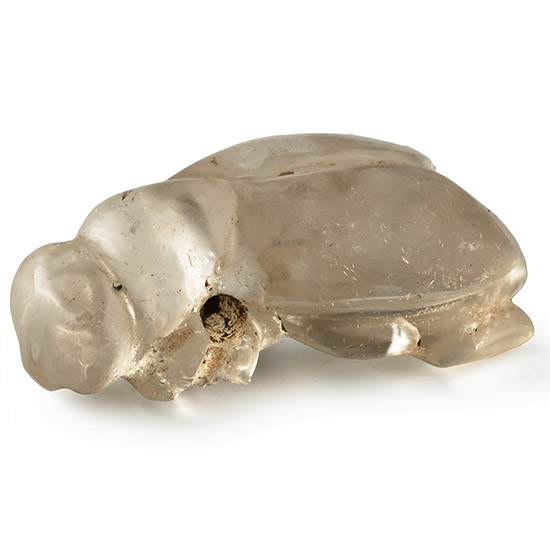
Egyptian Rock Crystal Locust Pendant
New Kingdom, circa 1400–1292 B.C.Sold for (Inc. bp): £650
Carved in the round with closed wings and a slightly curving body, pierced through the body for suspension. 3.7 grams, 26 mm
From the private collection of a European gentleman (1942-2024), formed since the 1970s.
The depiction somewhat resembles a cicada, although this would be very rare in ancient Egyptian plastic arts. The grasshopper and the locust were known in Egyptian as sꜣnḥm or snḥm. Although the insect was often depicted in Old Kingdom tomb scenes, it appeared in various other forms of visual art, such as amulets, cosmetic vessels, and beads, only during the New Kingdom, when it served as a symbol of regeneration. -
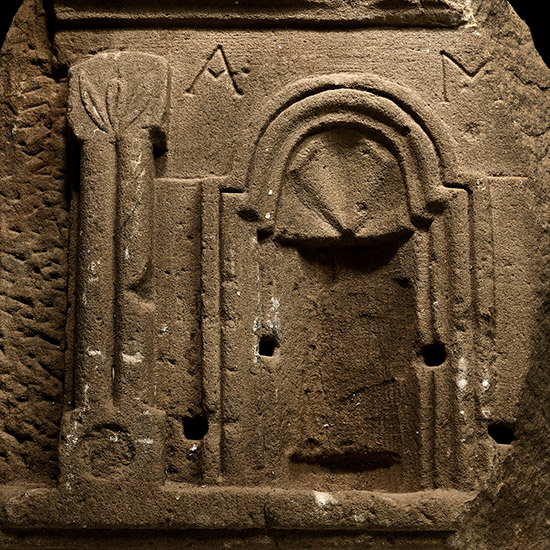
Romano-Egyptian Limestone Funerary Niche
Coptic, 5th-6th century A.D.Sold for (Inc. bp): £2,340
Carved architectural block fragment comprising: a shallow niche with arched top and parallel sides, with concentric mouldings to create a reveal and ledge below to accept offerings; horizontal tiered base; attachment sockets for two figurines (absent) flanking the niche; to left, a column modelled in the half-round with two parallel vertical stems, shallow roundel to the base and stylised foliage at the top; pediment above with scooped profile; above each figurine recess an incised initial, 'A' and 'M'; facing surface keyed for plaster finish. 57.55 kg, 49 cm
From the estate and private collection of Matthew Upham (1962-2025), an antiques trader from Budleigh Salterton, Devon, UK. Acquired at an estate sale at auction. Property of a Cambridgeshire, UK, gentleman. Accompanied by an academic report by Dr Raffaele D'Amato. This lot has been checked against the Interpol Database of stolen works of art and is accompanied by a search certificate number no. 13297-255939.
In the Christian Roman Empire, the stelae in the form of aedicula, which could be funerary monuments with crosses or the images of the deceased, or devotional niches with images of saints, appear to be independent sculptures. These stelae consisted of a rectangular body surmounted by a circular arch or trapezoidal structure. At the centre of the niche, the deceased was often depicted full-length, in a praying position (orans). Devotional stelae were also placed inside a church or shrine, with images of the Virgin and Child, or saints. -
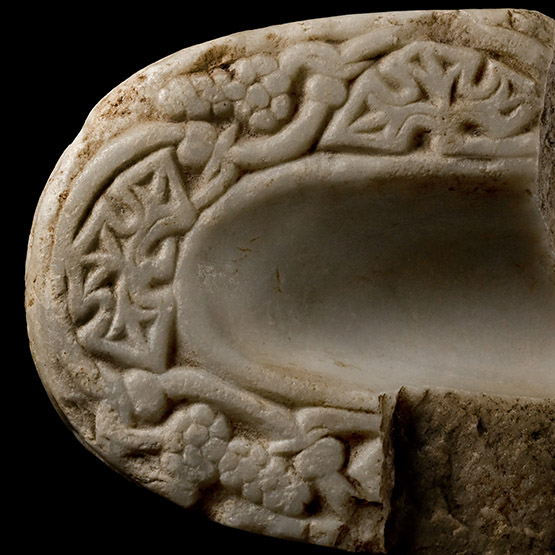
Coptic Marble Liturgical Vessel Fragment with Inscription
6th century A.D.Sold for (Inc. bp): £1,053
Tongue-shaped with low rounded pad on the underside, raised edge with low-relief decoration of grape vines and leaves, the edge with pairs of opposing doves eating grapes; dedicatory Demotic inscription on the underside. 87 grams, 55 mm
Acquired in the mid 1980s-1990s. Private collection, Switzerland, thence by descent. Private collection, since the late 1990s. Accompanied by an academic report by Dr Raffaele D'Amato. This lot has been checked against the Interpol Database of stolen works of art and is accompanied by a search certificate number no.12575-232108.
These vessels were used as liturgical objects for church offerings or ritual, and were extensively employed from late antiquity in ecclesiastical contexts. -
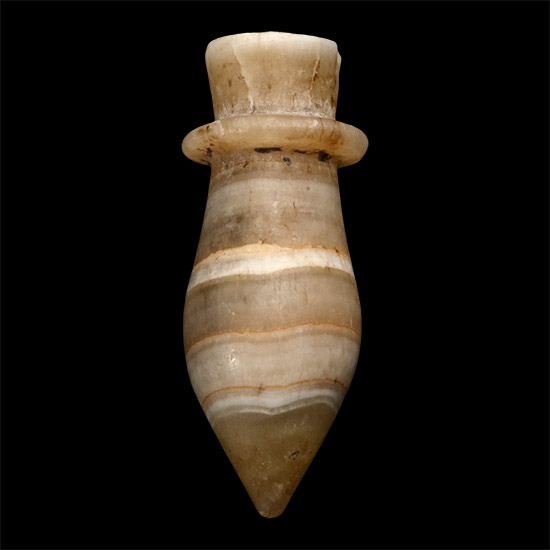
Romano-Egyptian Alabaster Alabastron
1st century B.C.-1st century A.D.Sold for (Inc. bp): £1,300
Small alabastron in banded Egyptian calcite-alabaster, pointed ovoid body and tall neck divided by a broad annular collar and finished with a plain straight rim. 7.71 grams, 44 mm
Acquired on the European art market in 1990s. English private collection.
A well-attested type produced from the Twenty-Seventh Dynasty through the Ptolemaic period and continuing into the early Julio-Claudian era. -
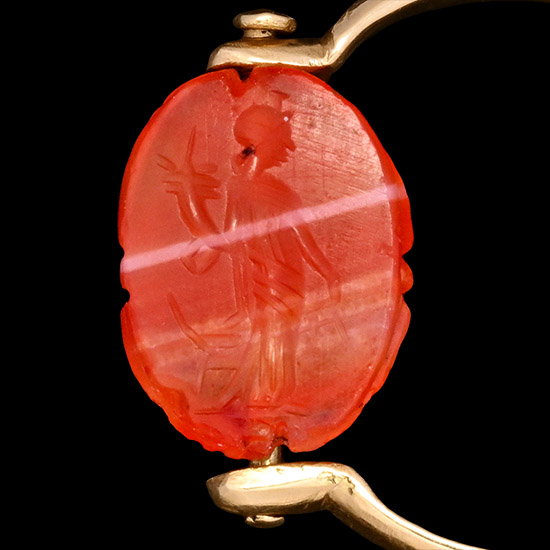
Romano-Egyptian Agate Scarab Engraved with the Goddess Fortuna Mounted in a Gold Ring
1st century B.C.-1st century A.D.Sold for (Inc. bp): £1,170
Scarab with incuse image to the underside of Fortuna with cornucopia and ship's rudder; in later gold swivel ring. 4.34 grams, 22.63 mm overall, 19.34 mm internal diameter (approximate size British N, USA 6 1/2, Europe 13.72, Japan 13)
Private collection, Europe. Acquired on the English art market. -
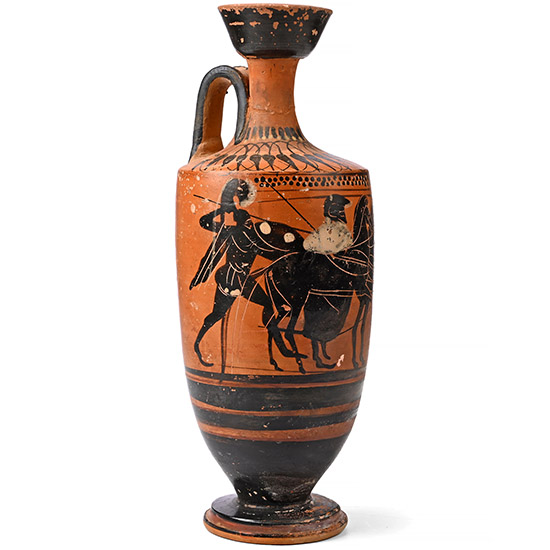
Greek Black-Figure Lekythos with Horses and Fighting Warriors
Athens, 550-500 B.C.Sold for (Inc. bp): £3,900
Cylindrical with echinus mouth and stepped torus foot, on the body a dynamic scene consisting of four rearing horses, side-by-side and wearing harnesses, nestled between the horses a standing warrior wearing a crested helmet, behind the horses an advancing warrior wearing a plumed helmet, holding a long spear in his raised hand a round shield in the other; before the horses a fleeing opponent in a running pose, facing back and holding a spear in one hand while protecting himself with a shield held in the other; long tongue motifs on the shoulder; restored. 472 grams, 23.5 cm
Ex Bonhams, Knightsbridge, London, 1990s. Private collection, Suffolk.
The scene depicts a battle between hoplites, possibly an episode from the Iliad. Originally, one or two of the combatants were positioned on a chariot; four horses from it remain visible. The scene may represent the wounding of Ares, the god of war, as he is pursued by Diomedes and accompanied by the goddess Pallas, whose helmet is emerging from behind the horses.

