-
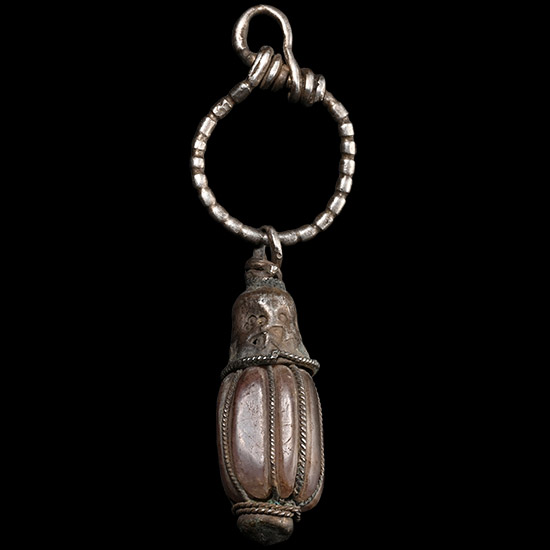
Scandinavian Viking Silver Pendant with Magical Amethyst Gem
9th-11th century A.D.Sold for (Inc. bp): £910
Comprising a beaded wire hoop with a returned fastening, a pendant with a bell-shaped cap and a filigree cage enclosing a square-section amethyst bead grooved to accept the filigree wires. 10.29 grams, 63 mm
Private collection formed in Europe in the 1980s. Westminster collection, central London, UK. -
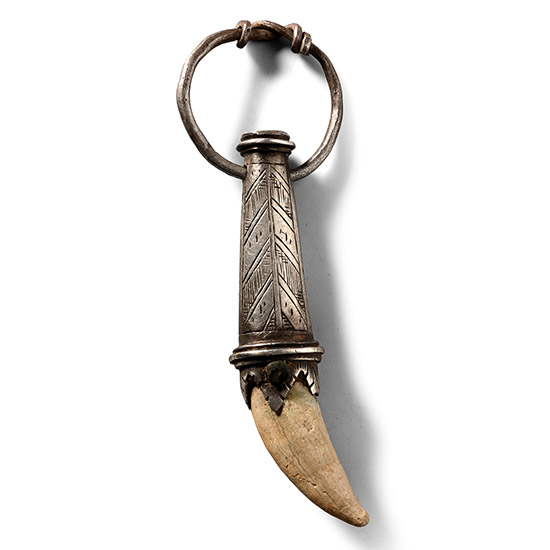
Viking Age Silver Pendant with Wolf's Tooth
10th-11th century A.D.Sold for (Inc. bp): £3,120
Comprising a tubular sleeve with raised collar above and below, the body with chevrons and hatched panels, ring loop above, set with a canine tooth secured with a rivet. 16.2 grams, 85 mm
From the private collection of a London gentleman, from his grandfather's collection formed before the early 1970s. -
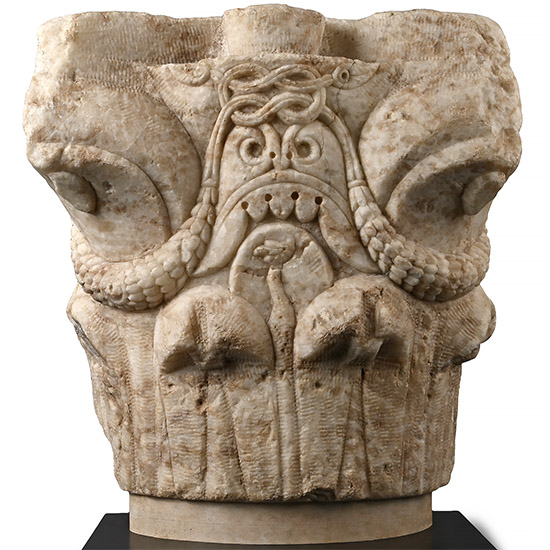
Romanesque Limestone Capital with Reef Knot
Visigothic Style, 12th century A.D.Sold for (Inc. bp): £7,670
Pillar capital for an architectural column or pier decorated with dense vegetation motifs, tapering swags or garlands; reef-knot motif and leaves above; unworked to the reverse. 74 kg total, 51.5 cm high including stand
Ex French collection. Holz Artles, 25 April 2015, no.83. Private collection, Kensington, London. Private collection, UK. This lot has been checked against the Interpol Database of stolen works of art and is accompanied by search certificate number no.13383-259007.
This finely carved capital belongs to a group of Romanesque capitals known as knotwork capitals, widespread in the South of France and North of Spain, where the influence of the architecture of the old Visigothic Kingdom was still strong. These capitals probably originate in one of the most famous sculpture workshops of Romanesque France. The base of the capital is topped by a row of abstractly sculpted acanthus leaves. The dominant section of the capital is decorated with stylised knotwork, composed of ornament that entwine and end in folded acanthus leaves. In between the entwined branches, there is more foliage forming the ‘head of a monster’ which playfully animates the sculpture. -
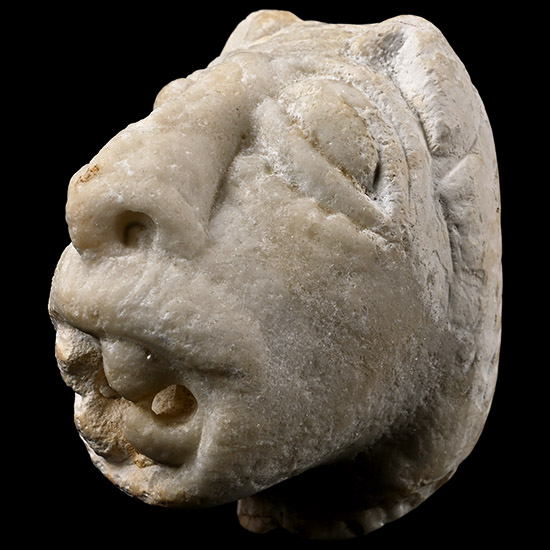
Medieval Marble Head of a Demonic Lion
Spain, 11th-13th century A.D.Sold for (Inc. bp): £936
Carved in the round with low pricked ears and hatched mane to the rear of the head, broad nose developing between domed lentoid eyes, broad upper lip, open mouth displaying teeth; repaired. 610 grams, 94 mm
with a London, UK gallery 1971-early 2000s. Private collection, London, UK. -
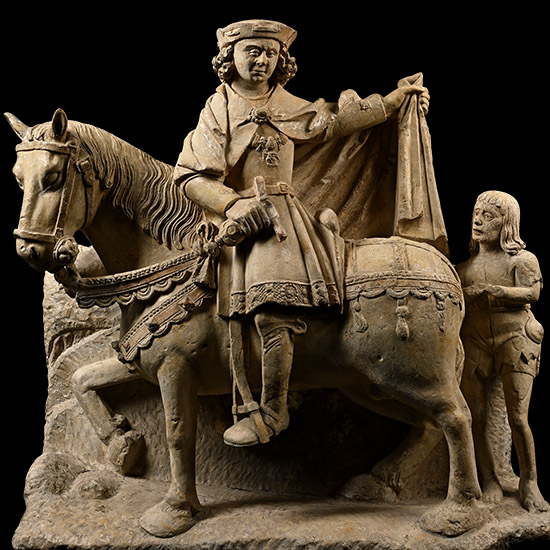
Large Medieval Carved Limestone of St Martin on Horseback with Cloak and Beggar
Flemish, 15th century A.D.Sold for (Inc. bp): £31,200
Carved in high relief, limestone scene depicting Saint Martin of Tours on horseback with his sword raised to cut off a portion of his military cloak to share it with a beggar; the saint wearing articulated armour buckled at his forearms and on his lower leg, with a billowing cloak draped across his shoulders; the horse shown in a contrapposto stance with one foreleg raised, with ornamental caparison and harness pendants; the beggar depicted with emaciated form wearing only underclothes, hands pressed together in supplication; to the reverse, traces of original fixing to a wall or architectural setting; restored. 108 kg, 78.5 cm high
Ex Richard Chester Master, Cirencester, UK. Kate Thurlow & Robin Thompson Collection, 21 October 1998. This lot has been checked against the Interpol Database of stolen works of art and is accompanied by search certificate number no.13384-259005.
The subject derives from the episode recorded by Sulpicius Severus in his Vita Sancti Martini (c. 397 A.D.), in which the young Roman soldier Martin, stationed at Amiens, divided his cloak to share it with a freezing beggar; that same night, he dreamt that Christ appeared to him wearing the half of the garment which he had given away. Martin subsequently converted to Christianity and eventually became Bishop of Tours, where he was venerated as one of the most important saints of early medieval Western Europe; his feast day is celebrated on 11th November. The present relief belongs to a tradition of Flemish devotional sculpture that flourished in the 15th century, when the prosperous towns of the Low Countries — Bruges, Ghent, Brussels, and Mechelen — became pre-eminent centres of religious carving exported across Northern Europe. Comparable examples to this piece are held in the collections of the Musée de Cluny, Paris, and the Rijksmuseum, Amsterdam. -
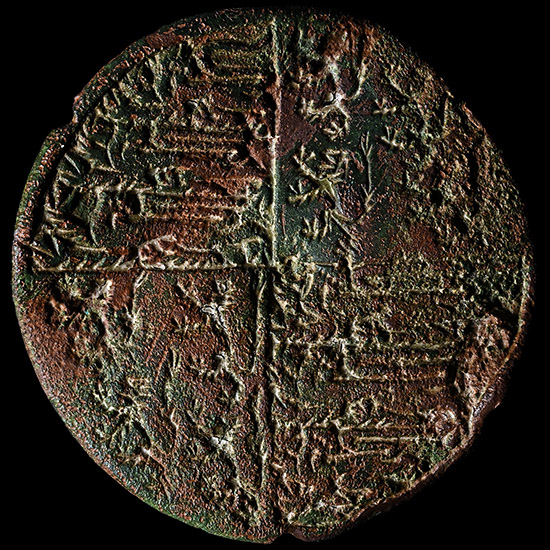
Royal Medieval Bronze Carriage Plate of Edward III and his Wife Queen Philippa of Hainault
England, 1327-1377 A.D.Sold for (Inc. bp): £546
Discoid appliqué, flat in section and slightly distorted; incuse heraldic detailing to obverse blazoned 'Quarterly 1st and 4th Gules three lions passant guardant [Or] 2nd and 3rd [Or] four lions rampant [in a quadrangle] the 1st and 4th Sable the 2nd and 3rd [Gules]'. 37.2 grams, 59 mm
Found Lowick, East Northamptonshire, UK. Accompanied by a copy of the British Museum's Portable Antiquities Scheme (PAS) report no.BH-7A9E2F.
The Royal College of Arms has identified these arms as belonging to King Edward III and his wife, Philippa of Hainault (r. 1327 - 1369). The terminus post quem for this piece is therefore 1327, the date of the marriage, and the likely terminus ante quem is Edward's death in 1377. A circular mount with the same fixing method, which bore the arms of the Bishopric of Ely, was found in Norfolk and is illustrated and described by Steven Ashley (2002: Fig. 20, p. 45, no. 196). The presence of the royal arms on this piece is likely to be a public display of allegiance to the throne rather than an indication of ownership on the part of the crown. -
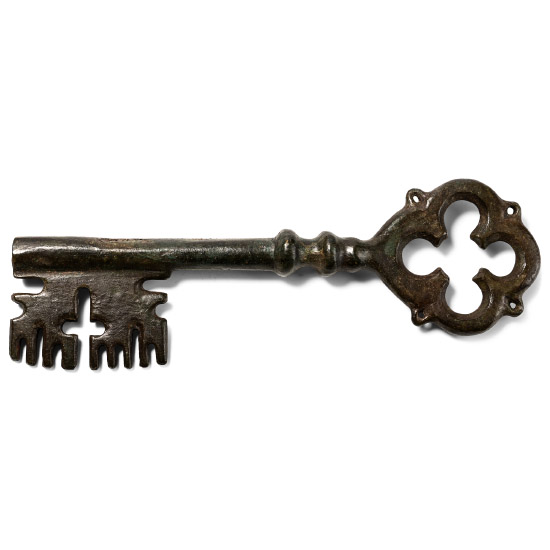
Very Large Medieval Bronze Key
14th-15th century A.D.Sold for (Inc. bp): £910
With voided lozenge bow and pierced lugs to the edges, tubular shaft with rounded forward end, split ward with bits. 142 grams, 15.6 cm
Ex German art market, 2000s. Acquired from an EU collector living in London. From the collection of a Surrey, UK, gentleman. -
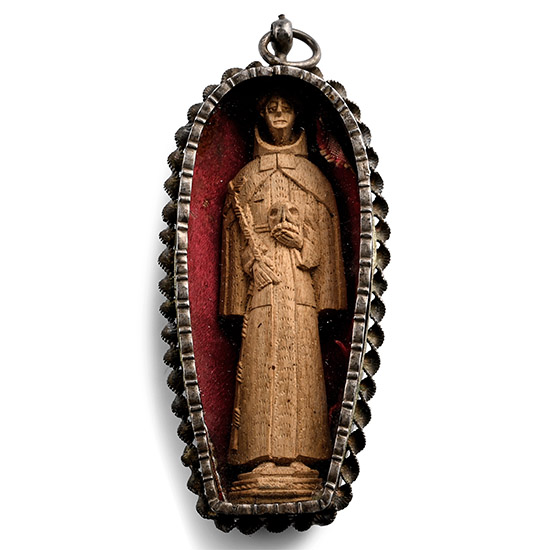
Wooden Sculpture of Saint Francis of Assisi in Silver Pendant
Spanish Colonies, 17th-18th century A.D.Sold for (Inc. bp): £390
A carved wooden figure of Saint Francis of Assisi holding a skull in his left hand and a cross in his right hand, set on a red fabric inside a silver tongue-shaped case with applied twisted wire decoration to the outer rim; attachment loop with ring to the top. 48.1 grams, 11 cm
Private collection, Europe. Acquired on the French art market. -
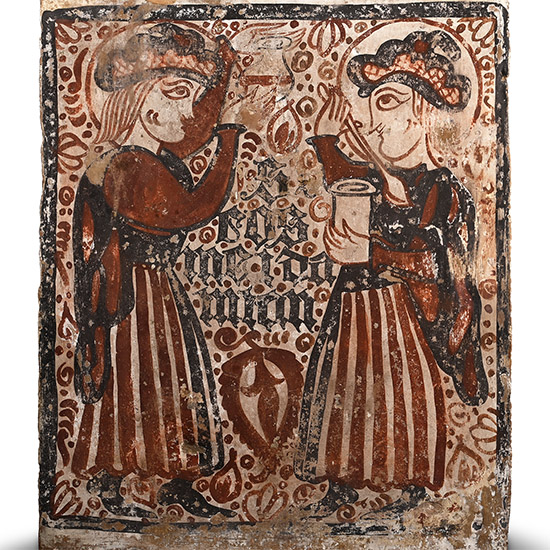
Spanish Medieval Socarrat Wall Tile Showing Saints Cosmas and Damian
Late 15th century A.D. or laterSold for (Inc. bp): £4,420
Showing two opposing surgeon saints, Cosmas and Damian, holding their medical attributes and shown nimbate, dressed in contemporary garments, with an inscription naming them at the centre, the background with densely arranged decorative motifs. 8.25 kg, 43 cm
Private collection, Spain. Private collection, London, UK.
Cosmas and Damian were two Arab physicians who were martyred in Syria during the persecutions under Emperor Diocletian. -
.jpg)
Large Medieval Stone Church Gargoyles
England, 15th century A.D.Sold for (Inc. bp): £4,940
Matched pair of carved stone corbels, each a mythical beast with a rounded body, bat-like wings folded behind the back, long arched neck and reptilian head with gaping mouth; mounted on an integral square-section base with stepped rear face; socket to forward face with bronze insert; some surface accretions. 400 kg total, 118 -121.5 cm
Private collection, UK. This lot has been checked against the Interpol Database of stolen works of art and is accompanied by search certificate number no.13385-259013.
From the Romanesque era onwards, images of demons, often carved on the external sides of cathedrals and churches, were strongly linked to the fantastical and monstrous creatures of ancient myth and legend. For theologians, supernatural creatures which could not otherwise be explained were not of God and therefore had to be demonic: their incorporation in the ecclesiastic structures showed that their malevolent powers could be kept under control only through the protection of the church. This origin of Christian demons is likely to have influenced the visual representation in medieval culture as hybrid and monstrous, especially given the increased interest in Greek works from the twelfth century onwards in the West. -
.jpg)
Medieval de Blanchfort or de Molay Family Personal Silver Heraldic Seal Matrix
Circa 1400-1540 A.D.Sold for (Inc. bp): £1,495
With a hexagonal-section facetted handle tapering to a collar of three ridges and openwork trefoil terminal; the face of the matrix with incised heater shield and heraldic arms: a bend and crescent top right; within a trefoil arched tressure a Latin inscription: ' * AVE MARIA GRACIA PLENA' meaning: 'Hail Mary, full of grace'; possibly the arms of the de Blanchfort or de Molay family. 12.41 grams, 27 mm high
Found whilst searching with a metal detector near Charlton Marshall, North Dorset, on 16 February 2022 by John Earley; recorded as Treasure with Treasure case tracking no.2022T500, and subsequently disclaimed by the Crown. Accompanied by a copy of the British Museum's Portable Antiquities Scheme (PAS) report no.DOR-771829. Accompanied by a copy of the report on a find of potential Treasure for H M Coroner from Charlton Marshall, Dorset. Accompanied by a copy of a letter from the British Museum informing the finder that the Crown's interest in the find has been disclaimed.
The basic heraldic design (the arms) comprises just a bend (diagonal stripe). The crescent is a mark of cadency, denoting the second son i.e. the younger brother of the heir apparent. The basic 'bend' motif appears in many heraldic designs, such as the arms of the de Blanchfort or de Molay families, amongst others. The heraldry of the town of Chaussin (Jura, France) is similar (bend and crescent) but these arms are not known to have been borne by a family. -
.jpg)
Medieval Silver '+OF CANFILD' Hawking Ring or Vervel
Circa 16th century A.D.Sold for (Inc. bp): £338
Plain hoop inscribed in large seriffed capitals '+ OF CANFILD' for Canfield in Essex. 1.35 grams, 10.92 mm overall, 7.69 mm internal diameter
From the private collection of a European gentleman (1942-2024), formed since the 1970s.
The lost pair of this vervel would have borne the name of the bird’s owner.

