-
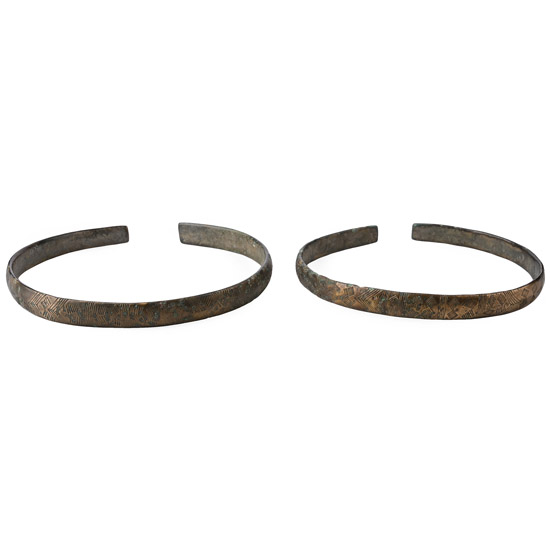
Viking Decorated Bronze Arm Ring Pair
8th-9th century A.D.Sold for (Inc. bp): £546
Matched pair of penannular arm bands with hatched decoration on the upper face. 154 grams total, 11.3-11.8 cm
From a 1980s collection. Ex North West London gallery. Private collection, Suffolk. -
.jpg)
Germanic Silver Radiate-Headed Bow Brooch
6th-8th century A.D.Sold for (Inc. bp): £585
Comprising a D-shaped headplate with scrolled tendril fill and seven radiating knops; flattened bow above triangular foot plate with similar tendril motifs, profile bird-heads to each edge, lobe finial with facing mask; ferrous pin to reverse. 67 grams, 10 cm
From the private collection of a London gentleman, from his grandfather's collection formed before the early 1970s. -
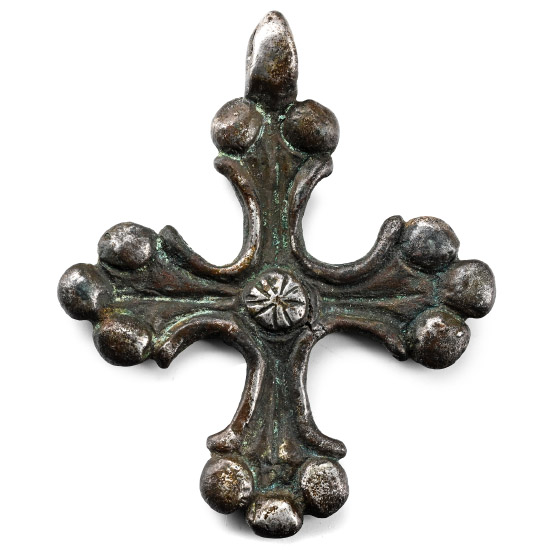
Viking Age Silver Cross Pendant
Circa 10th century A.D.Sold for (Inc. bp): £442
Equal-arm type with raised borders to the arms, trilobe finial, central domed roundel and pierced lug. 18.5 grams, 52 mm
From the private collection of a London gentleman, from his grandfather's collection formed before the early 1970s. -
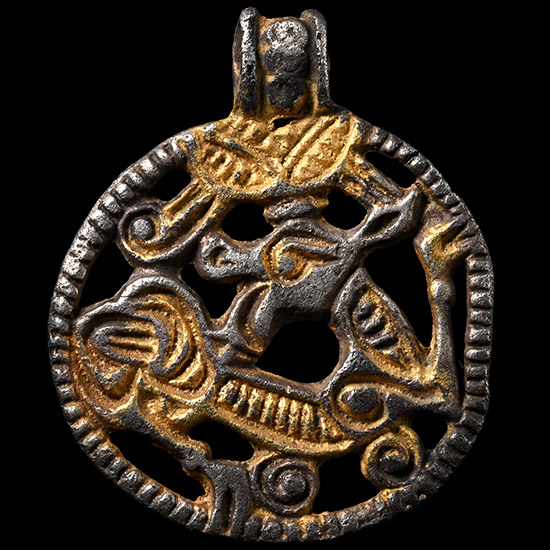
Scandinavian Viking Silver Pendant with Beast Facing Back
9th-11th century A.D.Sold for (Inc. bp): £1,300
Openwork pendant with integral loop, pelleted rim, profile beast with head turned to the rear, parcel gilt detailing. 5.62 grams, 33 mm
Private collection formed in Europe in the 1980s. Westminster collection, central London, UK. -
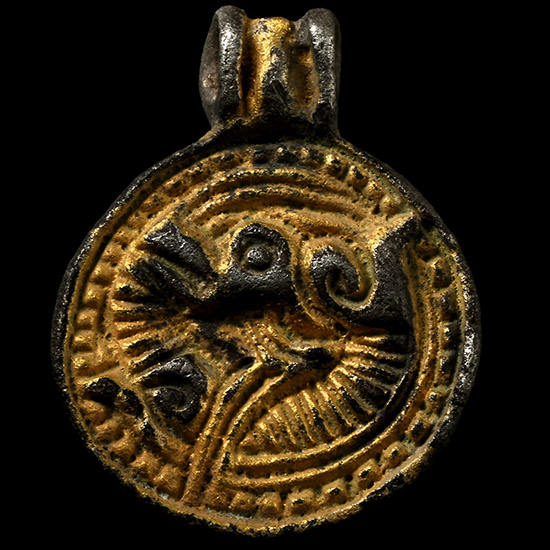
Scandinavian Viking Silver Pendant with Beast
9th-11th century A.D.Sold for (Inc. bp): £520
Discoid type with suspension loops, pellets to the border enclosing a bird-head in profile; Baltic type. 3.53 grams, 24 mm
Private collection formed in Europe in the 1980s. Westminster collection, central London, UK. -
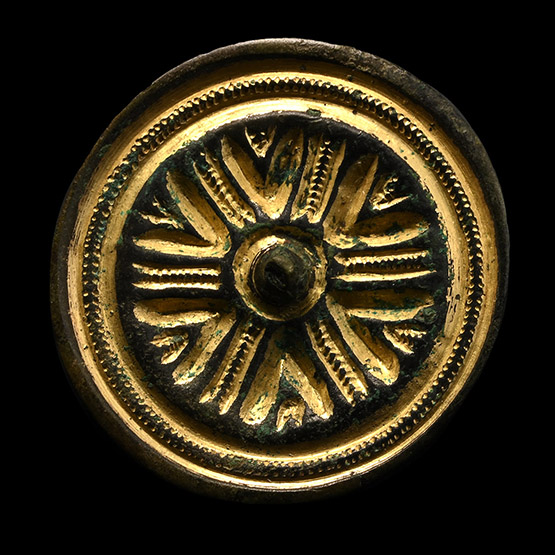
Large Anglo-Saxon Gilt Bronze Saucer Brooch
Late 5th-6th century A.D.Sold for (Inc. bp): £754
Discoid in plan with raised rim and inner ridge decorated with notches, six radiating arms with notch detailing and interstitial chevrons; central knop rivetted from reverse; remains of catch to reverse. 20.4 grams, 37 mm
Found Seaham, Co Durham, UK. Property of a Durham private collector.
The saucer brooch was one of the commonest types of brooches used by Anglo-Saxon women, usually occurring in matched pairs on the chest. This typology extends in time from the 5th to the late 6th century, especially diffused south of the Humber and East of the Severn, with a concentration in the south Midlands and Upper Thames Valley. -
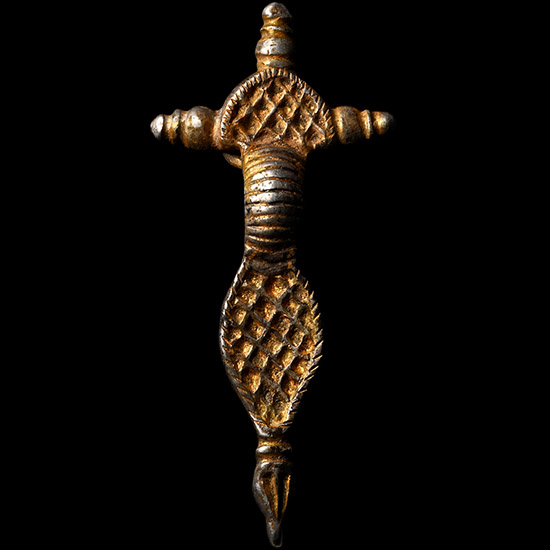
Frankish Silver-Gilt Radiate-Headed Bow Brooch
Circa 6th century A.D.Sold for (Inc. bp): £468
Comprising a D-shaped headplate with notched border and reserved lattice ornament; three collared knops to the outer edge; shallow segmented bow; lozengiform footplate with notched border, reserved lattice ornament and collared knop finial; spring, pin and catchplate to the reverse. 23.8 grams, 76 mm
Ex German art market, 2000s. Acquired from an EU collector living in London. From the collection of a Surrey, UK, gentleman. -
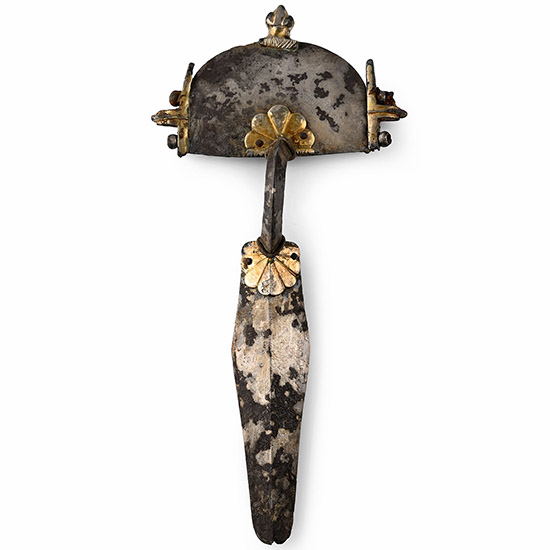
Large Gothic Silver-Gilt Fibula
Bosphorean Culture, 5th century A.D.Sold for (Inc. bp): £3,380
Comprising: a semi-circular headplate with a ram-head knop at the apex and applied gilt projections at the sides forming part of the spring mechanism; deep keeled bow with a petalled finials; keeled subrectangular footplate with a rounded finial and a tapering catchplate below. 67 grams, 20.7 cm
L. De Clercq collection, Belgium, 1980s. Ex private European collection. Accompanied by an academic report by Dr Raffaele D’Amato. This lot has been checked against the Interpol Database of stolen works of art and is accompanied by search certificate number no. 13013-246783.
Fibulae of this type were mainly found in female burials and were placed on the right side of the chest and on the left shoulder. It was from this period that the custom of wearing wide belts with buckles and a pair of brooches on the shoulders spread along the south-western Black Sea coast, having originated among the Germanic tribes of the western Roman provinces. -
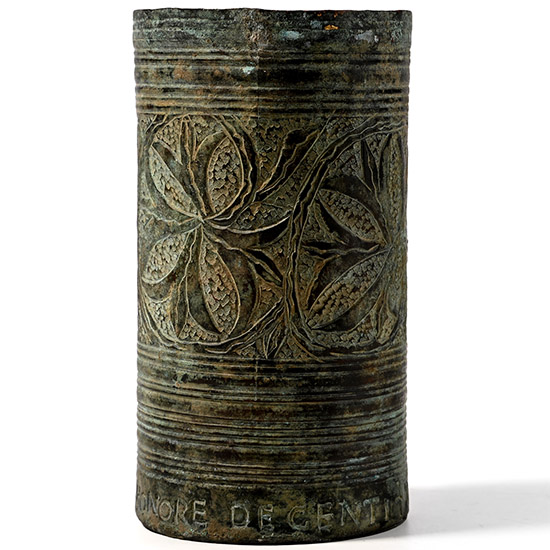
Dark Age Bronze Decorated Pyxis
Circa 5th-6th century A.D. or laterSold for (Inc. bp): £572
Tubular in section with planar base; circumferential ribbing to the sidewall and pounced field with reserved tendrils and leaves; with later Lombardic script legend above base '+ XTVS EVANGELII REDIMITVS HONORE DECENTI' (Christ ... of the Gospel submitted with noble honour). 56.9 grams, 77 mm
Ex German art market, 2000s. Acquired from an EU collector living in London. From the collection of a Surrey, UK, gentleman.
A similar dedicatory inscription appears on the Farfa Casket. -
.jpg)
Viking Age Inlaid Iron Horse Bit Cheek Piece Pair with Opposing Beasts
Northern Europe, 11th-12th century A.D.Sold for (Inc. bp): £2,210
Matched pair of bridle fittings formed as two opposing fantastical creatures with their heads turned back and front legs resting on a globe forming a passage for a strap, the bodies decorated with bands of herringbone decoration. 79.2 grams total, 79 mm each
From a European collection, 1990s. This lot has been checked against the Interpol Database of stolen works of art and is accompanied by search certificate number no.13379-257911.
On these types of horse-bits, two heads or a head/tail normally face each other. But an unusual piece from Edsvära in Västergötland, Sweden, depicts two heads turned outwards, like in the current example. The mount from Edsvära, with its attached iron bit, was found in 1906 next to a horse's skeleton. -
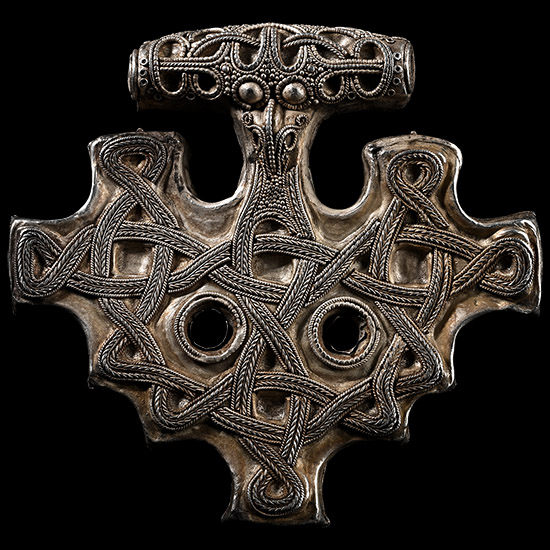
Very Large Scandinavian Viking Silver Tau Cross Pendant
10th-12th century A.D.Sold for (Inc. bp): £9,100
Hollow-formed type with barrel-shaped suspension bar, narrow neck, trefoil plaque with two lateral piercings; applied filigree knotwork to the plaque and suspension bar, domed 'eyes' and nose at the junction with the plaque; plain reverse. 23.1 grams, 71 mm
Private collection formed in Europe in the 1980s. Westminster collection, central London, UK. This lot has been checked against the Interpol Database of stolen works of art and is accompanied by a search certificate number no.13299-256161.
Although the ornament is decorated with a traditional double-braid band, it no longer features animal ornamentation, but intertwined rings made of multi-row filigree wire. The shape of the Tau cross also finds parallels with the patrices of the Busdorf hoard (Schleswig-Holstein). -
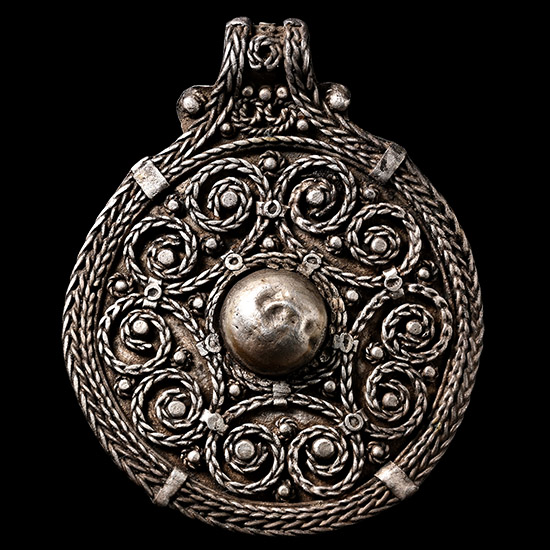
Scandinavian Viking Silver Filigree Pendant with Scrolls
9th-11th century A.D.Sold for (Inc. bp): £715
Discoid type with hollow boss to centre, ropework border enclosing scrolled filigree and granulation ornament. 4.05 grams, 35 mm
Private collection formed in Europe in the 1980s. Westminster collection, central London, UK.

