
-
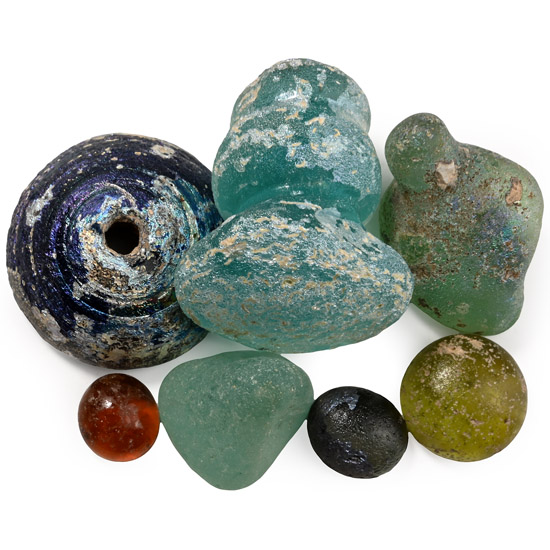
Roman Glass Artefact Collection
1st-4th century A.D.Sold for (Inc. bp): £33
Including aqua glass stopper with knop handle, plano-convex spindle whorl with iridescent surface and other items; probably used as counters in boardgames. 32 grams total, 9-27 mm
From the private collection of Mr Brian Edwards, New Malden, Surrey, UK, formed from the late 1970s-early 1980s; thence by descent. Accompanied by the original collector's data sheet(s) with reference nos.A70, A99, & A118. -
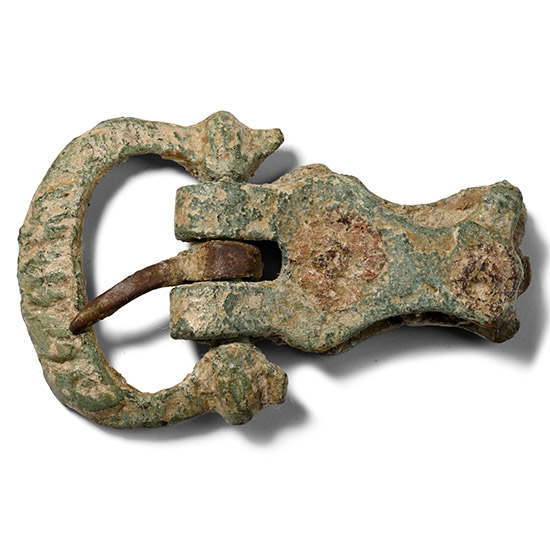
Roman Bronze Military Buckle with Plate
3rd-4th century A.D.Sold for (Inc. bp): £78
Comprising a flat, D-shaped loop with ribbed detailing to the forward edge, small curved tongue, folded buckle-plate with scooped edges and attachment rivets in situ. 11.1 grams, 43 mm
From the private collection of the late collection of Mr M., Waterlooville, Hampshire, UK, formed from the late 1980s to early 1990s. -
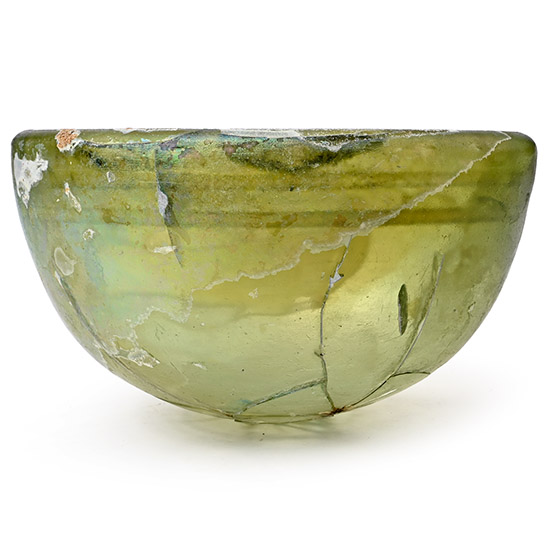
Roman Green Glass Bowl
150-50 B.C.Sold for (Inc. bp): £468
Hemispherical body with a wheel-cut decoration on the inside rim. 280 grams, 12.8 cm wide
From an important London, UK, collection 1980-2020.
Such bowls were mainly produced in the Eastern Mediterranean and diffused in Rome since the 2nd century B.C., when the sea was becoming a Mare Nostrum for the Res Publica. They were characterised by a hemispherical body with a round and convex bottom, but especially by concentric circular grooves. -
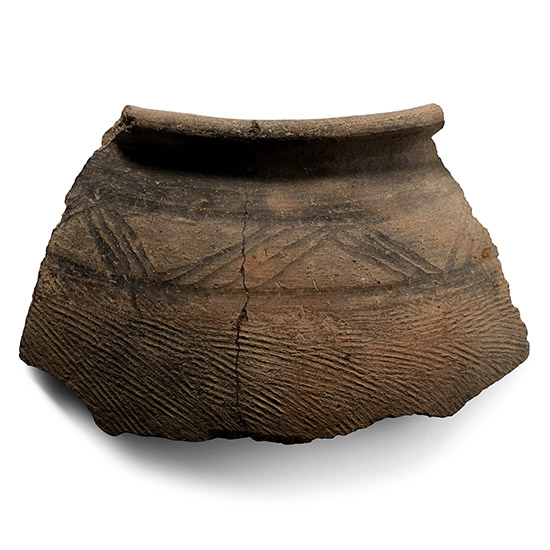
Large Romano-British Decorated Black-Burnished Ware Pot Sherd
Circa 2nd century A.D.Sold for (Inc. bp): £39
Substantial fragment from a bulbous vessel with an everted rim, a band of linear decoration below the rim, and the body decorated with a combing technique; the reverse with an old inked collection note 'opp. railstation Braughing'. 487 grams, 23 cm
Found near the village of Braughing in Hertfordshire, UK, in the early 1960s. By descent to the son of a late Hertfordshire gentleman collector, whose collection was formed from the 1960s. -
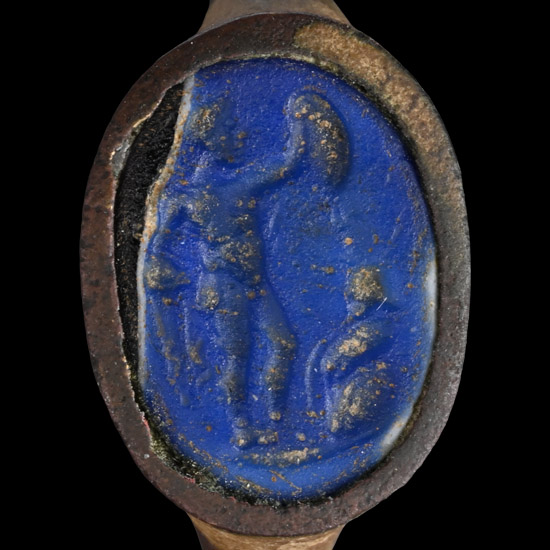
Roman Bronze Ring with Naked Male Gemstone
2nd-3rd century A.D.Sold for (Inc. bp): £156
D-section hoop widening at the shoulders, tall oval bezel set with blue glass intaglio with a standing nude male, bow behind back, holding a wine skin in upraised hand. 4.33 grams, 21.61 mm overall, 16.10 mm internal diameter (approximate size British K, USA 5 1/4, Europe 9.95, Japan 9)
Ex property of a gentleman; from a Mayfair, London, UK, gallery. Private collection, Suffolk, UK. -
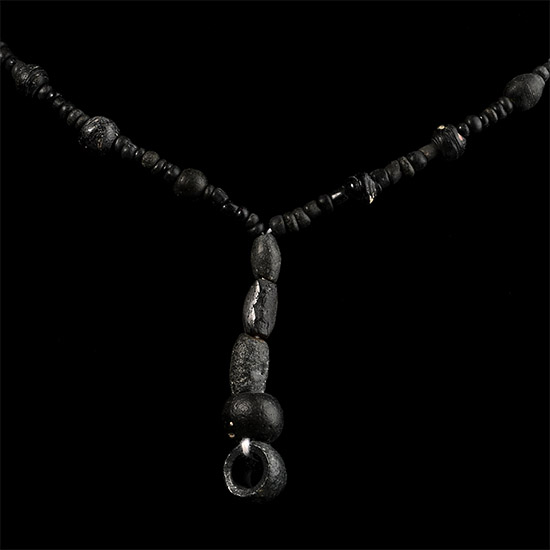
Roman Black Glass and Other Bead Necklace String
1st-4th century A.D. and laterSold for (Inc. bp): £39
Composed of small oblate beads interspersed with larger beads, the central drop composed of five larger beads; restrung. 11.8 grams, 31 cm
Acquired in the 1990s. Ex London, UK, collection. -
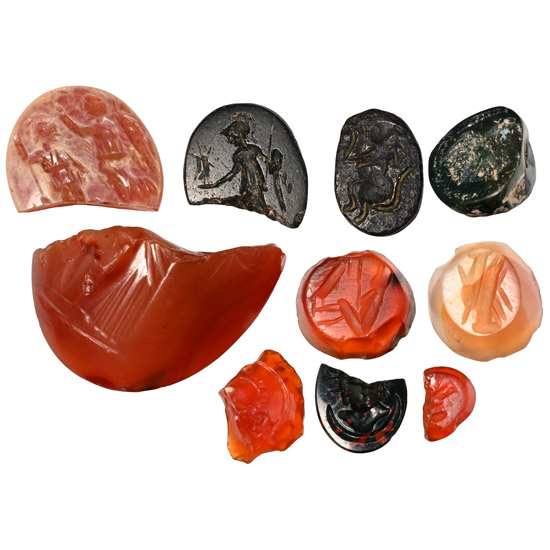
Roman Gemstone Group
2nd-3rd century A.D.Sold for (Inc. bp): £117
Including standing female with amphora, Mars with winged Victory, leaping lion, facing bust of Sol and other types; each supplied with a museum-quality impression. 5.9 grams total, 6-21 mm
From the private collection of a European gentleman (1942-2024), formed since the 1970s. -
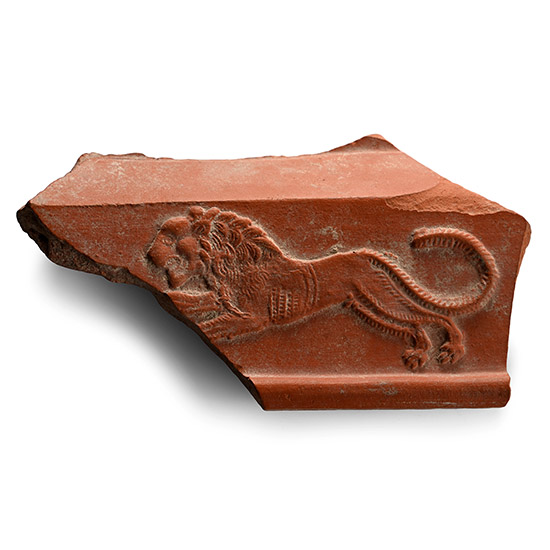
Roman Red Ware Fragment with Gladiatorial Lion
Circa 4th century A.D.Sold for (Inc. bp): £195
An irregular fragment from a large vessel with an angled shoulder and thickened rim, showing a low-relief leaping lion with its forelegs extended, jaws gaping, and its ears pulled back. 84 grams, 11.7 cm
Found near the village of Braughing in Hertfordshire, UK, in the early 1960s. By descent to the son of a late Hertfordshire gentleman collector, whose collection was formed from the 1960s. -
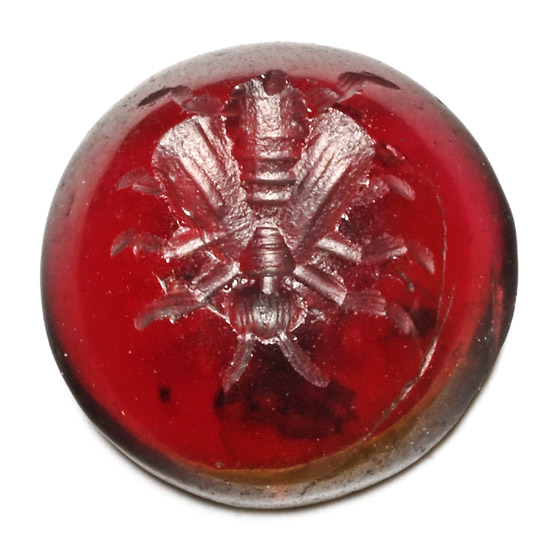
Roman Garnet Gemstone with Fly
2nd-3rd century A.D.Sold for (Inc. bp): £195
Dark purplish-red round cabochon with a fly or another flying insect, striated body and four pairs of legs. 0.56 grams, 9 mm
From the private collection of a European gentleman (1942-2024), formed since the 1970s. -
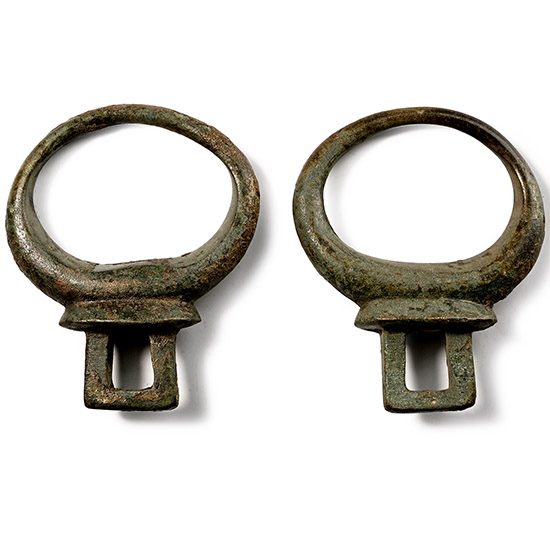
Romano-British Bronze Chariot Rein Guide Pair
England, 1st-2nd century A.D.Estimate: £200 - 300 (+bp*)
Matched pair of rein guides, each an oval loop with a collar and a rectangular loop below. 210 grams total, 74 mm each
Found UK. From a UK collection formed in the 1980s. Property of an Essex, UK, gentleman. -
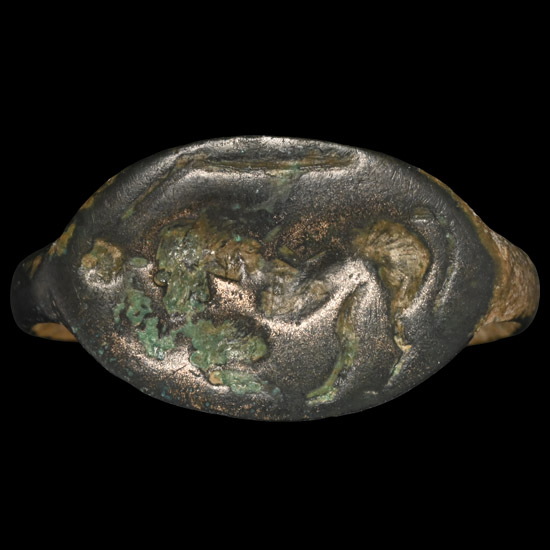
Roman Bronze Ring with Lion
1st-2nd century A.D.Sold for (Inc. bp): £59
Featuring a D-section hoop and a lentoid bezel with a standing lion, possibly with a small prey animal in its jaws. 4.57 grams, 23.72 mm overall, 19.59 x 17.86 mm internal diameter (approximate size British R, USA 8 1/2, Europe 18 3/4, Japan 18)
From the private collection of a European gentleman (1942-2024), formed since the 1970s. -
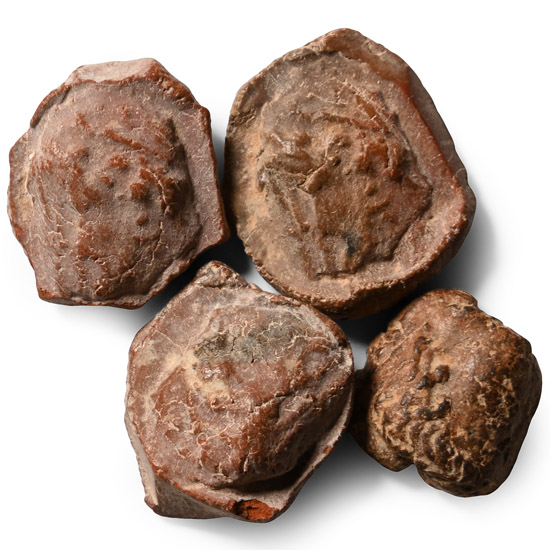
Jewish Terracotta Bullae, Tesserae or Token Group
3rd century B.C.-1st century A.D.Sold for (Inc. bp): £195
A mixed group of ceramic bullae, tesserae or theatre tokens bearing low-relief motifs of profile busts, three with Hebrew text to the reverse. 3.97 grams total, 12-17 mm
From the private collection of a European gentleman (1942-2024), formed since the 1970s.
The term 'tessera' was used in Roman times to convey the Greek term σύμβολον (token). Small tiles are known as tokens, often shaped like coins, made of metal (copper, lead, iron), clay, bone, wood, or glass, stamped as well as engraved. The tokens, however, are not exclusively coin-shaped, as the Latin term 'tessera' refers to a four-sided shape. Tokens and tesserae seem to have been used both in Athens and Rome for the distribution of goods. According to written sources, the term ‘token’ is identified with credentials of the official authorities. They have also been interpreted as tokens of identity, as entrance tickets to theatre performances, tribunals or assemblies of citizens, archival material of seal engraving, as pawns in games, Charon’s obols and even as amulets.

