-
.jpg)
Massive North American Stone Age Knapped Grey Chert Ceremonial Adena Spear Point
Early Woodland Period, circa 2500-1900 B.P.Sold for (Inc. bp): £1,105
With yellow patina and some polished areas, a ceremonial blade of exceptional length, fashioned from high-quality chert with controlled percussion flaking and well-balanced symmetry. 193 grams, 26.3 cm
Acquired in 1977 by the archaeologist owner from a private collection in Ohio, USA.
Blades of this size exceed functional hunting requirements and belong to the class of oversized ritual pieces placed in high-status Adena mound burials. This spearpoint is a rare and impressive example of Early Woodland craftsmanship. -
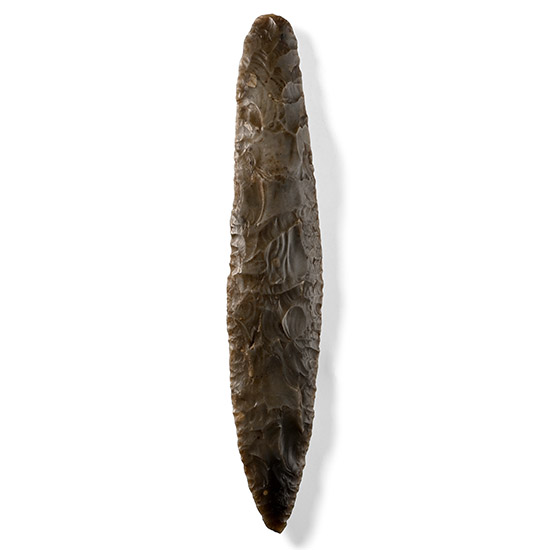
Danish 'Type-1B' Knapped Flint Dagger
Neolithic Early Dagger Period, circa 4400-3800 B.P.Sold for (Inc. bp): £910
A finely made and complete early fine Senonian or Danian flint dagger belonging to the Danish Single Grave Culture (Dolktid), a slender lanceolate outline with near-parallel sides, a discreetly indicated hafting zone, and the maximum width placed at or just ahead of the midsection. 66 grams, 18.3 cm
Found Ordrup, Sjaelland Island, Denmark, 1970. From the private collection of amateur archaeologist Jorgen Faxholm, UK. Accompanied by a copy of a previous catalogue sheet with reference.
This dagger shows the characteristic manufacturing traits of the earliest dagger horizon. There is no polishing or parallel-struck flaking of the later, more elaborate types. The maker relied on careful, even marginal retouch to create a sharp and functional cutting edge. The dagger appears to retain its original proportions with no evidence of later reworking or reduction. By the time Lomborg formalised the typology, approximately 540 examples of Type 1B were recorded from graves or intentional depositions, with a further circa 150 from unprovenanced contexts. This example sits squarely within that early corpus and represents the form at its best. -
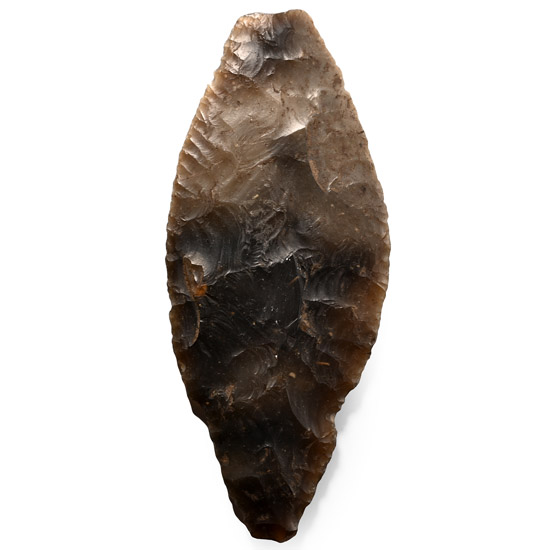
British Stone Age Knapped Flint Beaker Dagger
Beaker Period, 4700-3700 B.P.Sold for (Inc. bp): £546
Lentoid body with finely knapped edges, inked collector's note 'Suffolk. 86' to one side; very rare. 67 grams, 13.7 cm
Found Suffolk, UK, 1986(?). From the collection of Martin Doyle, Leverstock, UK, 1980s-2000s. -
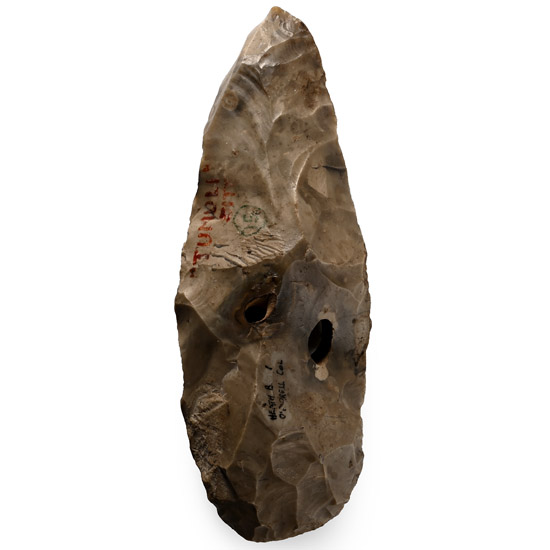
Very Large Farnham Stone Age Knapped Flint Axe
Neolithic Period, circa 6,000 B.P.Sold for (Inc. bp): £845
Piriform in plan and lentoid in section with narrow point; two natural cavities with cortex, one passing through the depth of the stone; old inked legends 'Tumuli Pit', '15', Heath B 1 / O'Morell Col' and to reverse '1807'. 540 grams, 19.6 cm
Found during the original official excavations in the Farnham area, Surrey, UK, which were conducted by Harold Faulker (1875-1963), and William Francis Rankine (c.1877-1962), who were instrumental with the excavation works and pit dwellings at sites including Six Bells, Frensham, Tilford, Thursley and Bagshot, and Waverley, amongst others at and near Farnham in the 1930s and 1940s. Much of the material is now in the prestigious Farnham museum. The present part of the collection having been gifted to their good friend and Haselmere Parish Priest, Charles Borelli (c.1914-2000) of Farnham; who was part of the Borelli family from Italy who emigrated from Lake Como in 1828 to set up the Borelli family watch and jewellery business; thence by family descent to his nephew.
Farnham district is one of the most interesting prehistoric regions in England, and has been visited by a succession of prehistoric peoples from Palaeolithic times onwards. Along the southern slope of the Farnham valley are three gravel terraces, which are famous prehistorically and have yielded large quantities of flint implements and bones of prehistoric animals, notably the mammoth. In prehistoric times, the chalk deposits played an important role in attracting settlers, as they contained rich layers of flint nodules used to make implements. The Farnham Gravels have been an abundant source of Palaeolithic finds, most prominent being hand axes. The axes differ in type, and each type is associated with a cultural phase of the Palaeolithic period. Types similar to these are found in similar deposits in the Somme valley and in many English valley gravels. Flint mining was also carried out by the Neolithic folk. Polished axes and leaf forms, arrowheads and knives, or possibly lance heads, are characteristic of the Neolithic flint work. -
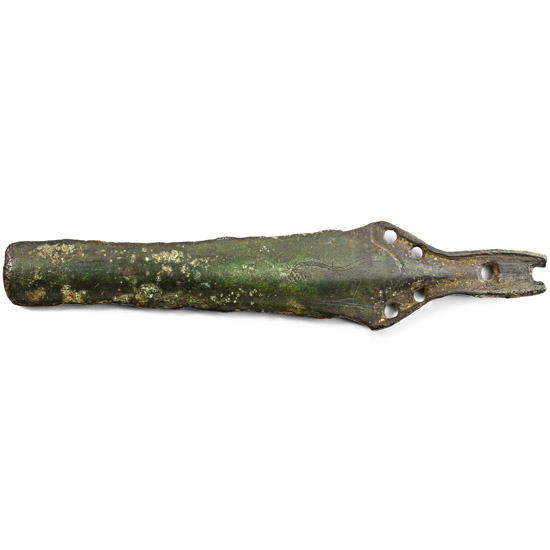
Bronze Age Votive Sword Hilt and Upper Blade Section with 'Shooting Star' Decoration
1150-950 B.C.Sold for (Inc. bp): £702
With a broad median rib and flared shoulder, grip with flange to each edge, five perforations for attachment of the organic components, engraved with a motif resembling a shooting star or comet. 358 grams, 23.8 cm
Possibly from the collection of relative Scott Langshaw Burdett (1896-1961), who served in the Great War as a Lieutenant in the Royal Sussex Regiment, was awarded the Military Cross, and later became Consul-General in Hong Kong. From an old Sussex family collection since at least 1946, thence by descent 2011. -
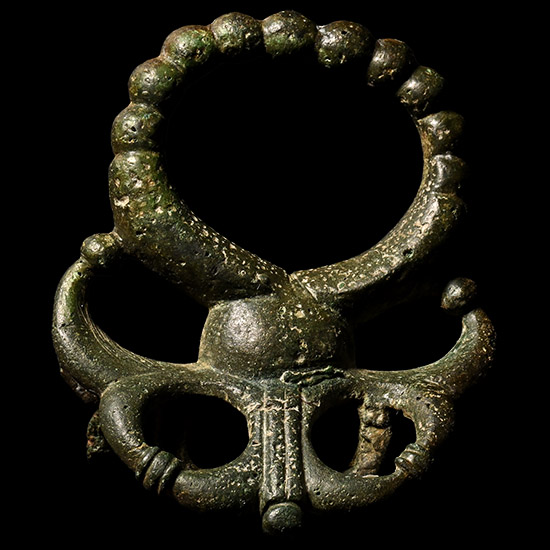
Celtic Bronze Openwork Chariot Teret Ring
Iron Age, 1st century B.C.-1st century A.D.Sold for (Inc. bp): £234
Comprising: a substantial ring, the upper section formed as a series of conjoined bulbs, the lower portion lentoid in section springing from a bulb; the bulb mounted on a base, C-shaped in section, carinated and recurved at each end to terminate in a knop attached to the underside of the ring; the base developing to a vertical strap with flanking crescent horns meeting at a ribbed collar; beneath the bulb, a rectangular loop to accept a bridle strap; one side of base absent. 64.6 grams, 63 mm
Acquired on the UK art market. Property of a Lancashire, UK, collector.
The design features of the terret are consistent with Insular La Tène art of the last centuries B.C., such as the returned horns with knop finials and the crescent motifs. -
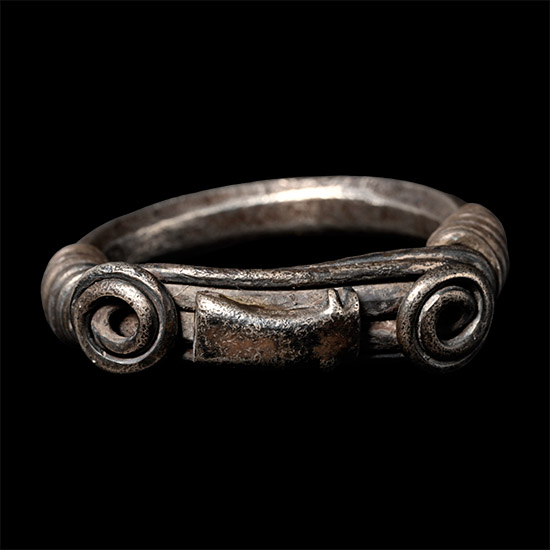
Central Balkans Silver Ring with Spiralled Terminals and Axe Motif Ornament
Iron Age, 1st-2nd century A.D.Sold for (Inc. bp): £845
Robust ring of octagonal section, fashioned from drawn and hammered wire, the hoop terminating in tightly coiled spirals, which flank a rectangular ornament soldered across the bezel, recalling a miniature axe-head; the coils further reinforced with wrapped silver wire, securing the decorative composition. 8.30 grams, 28.40 mm overall, 21.70 x 19.32 mm internal diameter (approximate size British T 1/2, USA 9 3/4, Europe 21.89, Japan 21)
Bonhams, Fine Antiquities, 4 July 1998, no.19. Private collection, UK, 1990s. with Rupert Wace Ancient Art Ltd, London. with Ariadne Galleries, New York and London, acquired from the above at TEFAF 2014, New York. Private American collection, acquired from the above, 23 January 2017.
This ring belongs to the repertoire of autochthonous Balkan silverwork that flourished from the Roman conquest through the mid-3rd century. The type is closely related to ornaments documented in the Tekija and Bare hoards, where bracelets and rings with spiral-wrapped ends and miniature axes appear as apotropaic symbols. While the axe motif was deeply embedded in Dacian and Balkan visual culture, its execution here in silver, combined with wire wrapping and spiralled terminals, reflects the enduring influence of Hellenistic toreutics upon local craftsmanship. Rather than a Viking jewel, the ring finds its most convincing parallels among the Balkan-Danubian silver hoards of the early Roman Empire. -
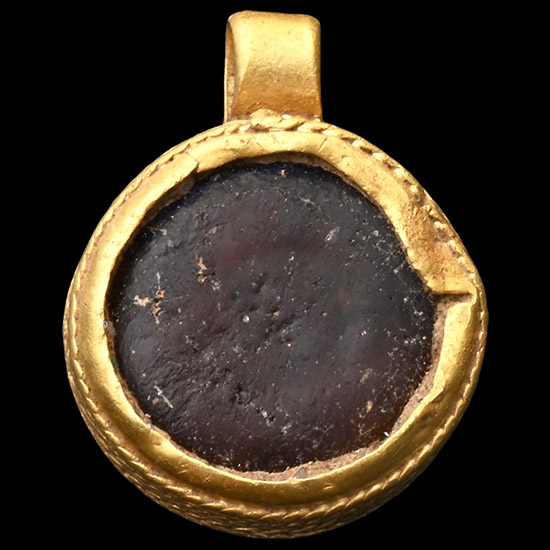
Anglo-Saxon Gold Necklace Pendant with Amber Cabochon
Circa 600-700 A.D.Sold for (Inc. bp): £1,820
Circular in plan and comprising a thin sheet backing plate with applied tall sides set perpendicular to create a mount for the stone; the sides formed from six bands of twisted wire that are set at alternating directions to create a chevron pattern; the aperture of the mount made from flat and undecorated sheet metal that folded inwards to hold the stone in place, the setting a cabochon-cut red stone, believed to be amber. 1.51 grams, 14 mm
Found whilst searching with a metal detector near Twyning, Tewkesbury, Gloucestershire, UK, on Sunday 17th August 2025 by Ben Williams; recorded as Treasure and disclaimed by the Crown with Treasure case tracking no.2025 T1597. Accompanied by a copy of the British Museum's Portable Antiquities Scheme (PAS) report no.GLO-D25ABA. -
.jpg)
Migration Period Gold Double Axehead Pendant
Circa 6th-8th century A.D.Sold for (Inc. bp): £715
Formed as a miniature twibil with loop handle and granule to each corner. 0.64 grams, 13 mm
Ex German art market, 2000s. Acquired from an EU collector living in London. From the collection of a Surrey, UK, gentleman. -
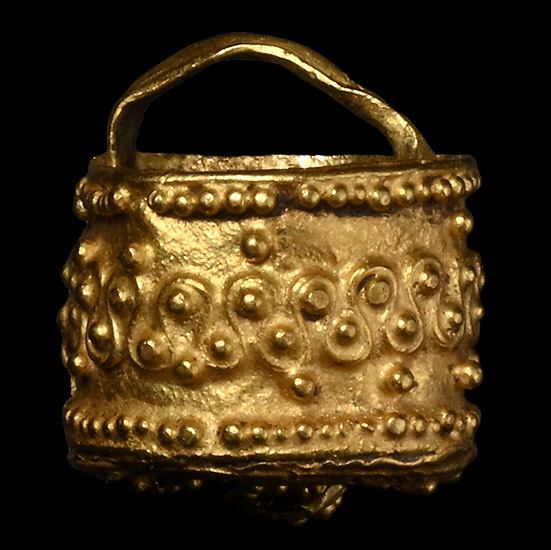
Pre-Viking Gold Aroma Bucket Pendant
Circa 4th-7th century A.D.Sold for (Inc. bp): £234
Miniature drum-shaped vessel covered in a filigree meander pattern with granules and a strap handle. 1.60 grams, 12 mm
Private collection formed in Europe in the 1980s. Westminster collection, central London, UK.
Pendants in the form of miniature buckets have been found in a number of pagan Anglo-Saxon and Viking contexts and are generally made of bronze or iron, with gold examples being rare; three gold examples were found with the hoard from Hoen, Norway. Bronze bucket amulets have been found at Driffield in Yorkshire, and Vimose bog in Denmark, among other places. In form they represent wooden buckets bound with bronze or iron bands which have been found in Anglo-Saxon and Viking graves and are believed to have held mead or ale and were used to replenish the cups from which warriors drank. As amulets they probably represent the ecstatic power of alcoholic drink and the role of women as the dispensers of these precious beverages. -
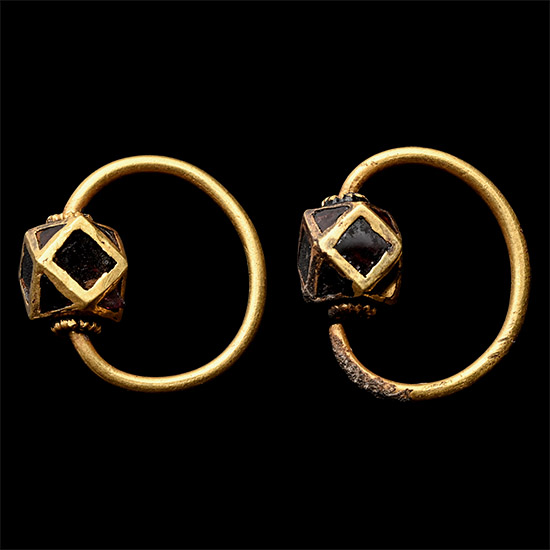
Merovingian Gold Earrings with Garnets
6th century A.D.Sold for (Inc. bp): £2,600
Of circular form, each composed of a plain gold hoop terminating in a cube-shaped setting displayed upon panels of almandine garnet, carefully cut and backed with gold foil to enhance their translucency and depth of colour; the polygonal settings formed of intersecting gold struts. 21.44 grams total, 30-32mm
New York art market. Christie's, New York, 18 December 1998, no.316. with Ariadne Galleries, New York, acquired at the above sale. Private American collection, acquired from the above, 27 April 2016. This lot has been checked against the Interpol Database of stolen works of art and is accompanied by search certificate number no.13449-257970.
Collectively, these objects demonstrate the wide diffusion of this Ostrogothic type across the Mediterranean, highlighting both the technical mastery of cloisonné work and its symbolic value within elite Gothic adornment. Their integrity is exceptional for jewels of this period, and they would be suitable, if desired, for sympathetic adaptation with discreet loops for modern wear. The use of garnet inlaid into gold cells reflects the continuation of Late Roman cloisonné techniques, adapted and developed within the Ostrogothic world. Such earrings, with their bold cubic settings and luminous stones, would have projected wealth and status, while also embodying the cultural synthesis of Roman and Gothic traditions in Italy and the wider Mediterranean during the 6th century. Displayed upon a modern bespoke bronze stand, included with the earrings. -
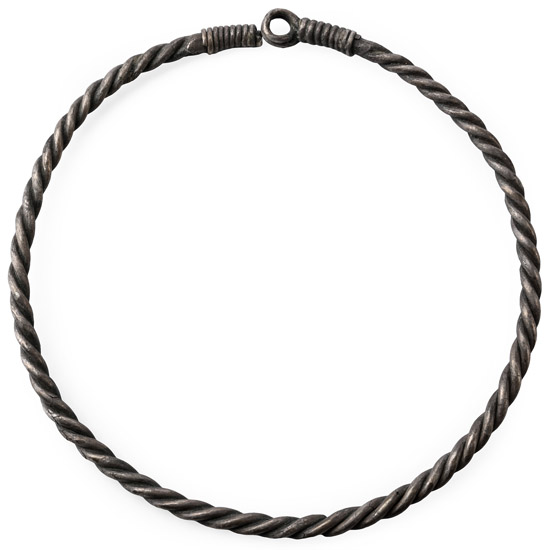
Viking Age Silver Twisted Torc
8th-9th century A.D.Sold for (Inc. bp): £624
Penannular torc formed of two round-section rods with a looped terminal. 54 grams, 14 cm
Acquired on the UK art market. Private collection, Suffolk.

