-
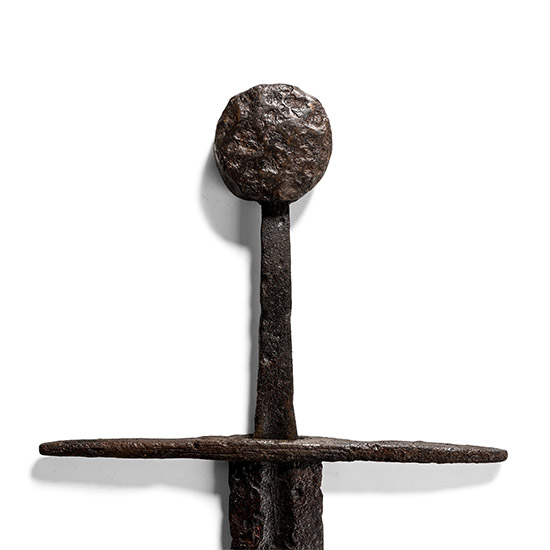
Medieval Iron Single-Handed Sword
12th-13th century A.D.Sold for (Inc. bp): £10,725
Comprising: two-edged lenticular-section piled blade (Oakshott's Type XI) with gentle taper overall to a rounded point and fuller to both faces; quillons round in section with taper to ends; flat-section tang tapering to the upper end; disc pommel of Oakshott's Type G with slightly domed faces. 1.01 kg, 95 cm
From the private collection of a London gentleman, from his grandfather's collection formed before the early 1970s. Accompanied by an academic report by Dr Raffaele D’Amato. This lot has been checked against the Interpol Database of stolen works of art and is accompanied by search certificate number no.13303-257653. -
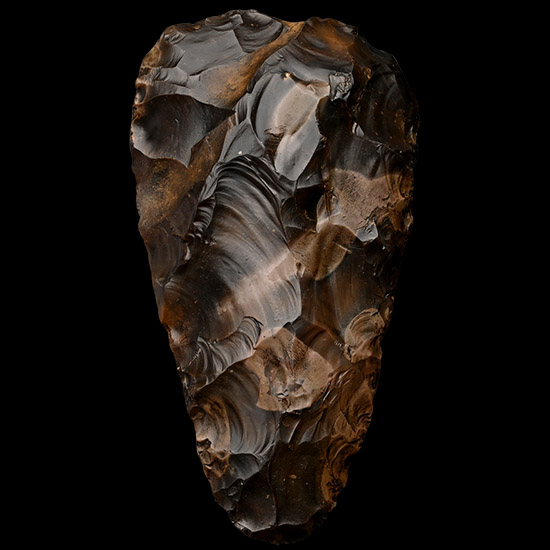
Large and Impressive Nordic Stone Age Flaked Flint Preform for a Handaxe
Neolithic Period, circa 5000-3500 B.P.Sold for (Inc. bp): £845
Large ovate handaxe 'blank' with initial knapping work already undertaken, preparatory to finishing and dressing. 790 grams, 19 cm
Formerly in the collection of Swedish Industrialist Nils Thorwaldsen (1918-2019). Ex private collection; acquired during the 1970s-1980s.
These flint axe 'blanks' were widely traded during Neolithic times. -
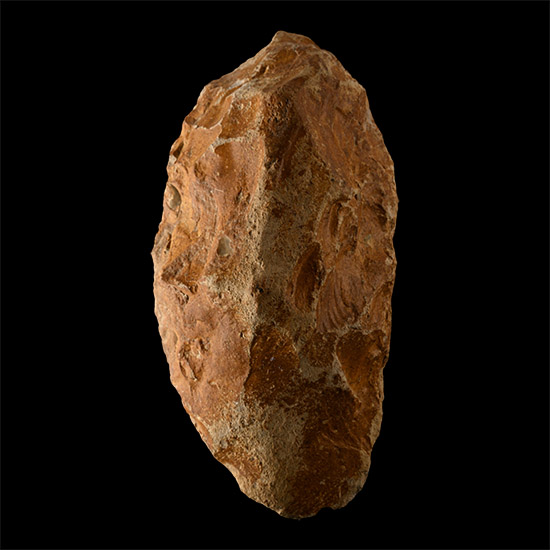
Huge Stone Age Acheulean Ovate Flint Handaxe
Lower Palaeolithic Period, circa 600,000-350,000 B.P.Sold for (Inc. bp): £676
Extremely large example of a chopping tool, likely made by Homo heidelbergensis; mounted on a custom-made display stand. 1.54 kg, 21.1 cm
From the well-regarded, long-closed quarry site of St Meme, Charente, France. From an old, large French collection. Acquired on the European art market. From a UK private collection.
Smaller handaxes continued as components of Middle Palaeolithic industries (Acheulian and Mousterian) associated with the Neanderthal and Homo sapiens. These rather crude handaxes probably reflect the coarser nature of the stone. -
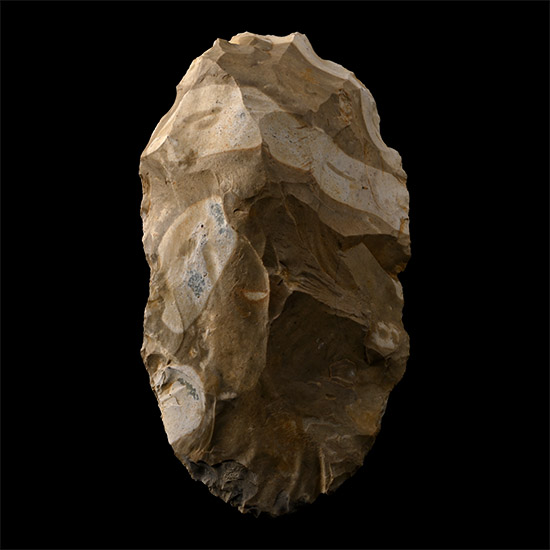
Large Stone Age Acheulean Ovate Flint Handaxe
Lower Palaeolithic Period, circa 600,000-350,000 B.P.Sold for (Inc. bp): £572
Substantial and well-made handaxe with thick butt and rounded cutting edge; marked 'St Même FR'; likely made by Homo heidelbergensis; mounted on a custom-made display stand. 719 grams, 17.5 cm without stand
From the well-regarded, long-closed quarry site of St Meme, Charente, France. From an old large French collection. Acquired on the European art market. From a UK private collection.
Smaller handaxes continued as components of Middle Palaeolithic industries (Acheulian and Mousterian) associated with Neanderthal and Homo sapiens. -
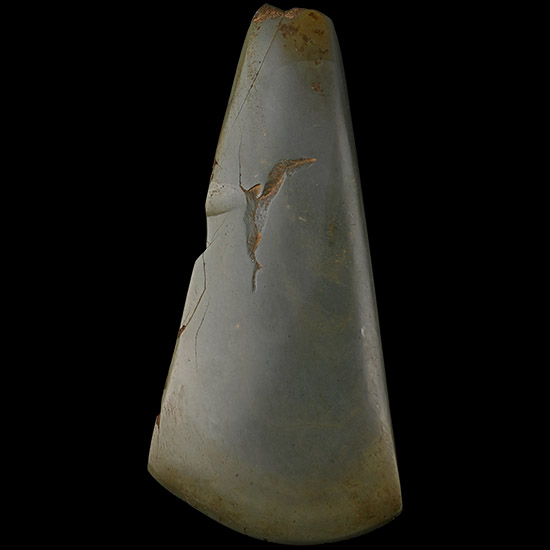
Large Greenstone Polished Axehead
Neolithic Period, circa 6th millennium B.P.Sold for (Inc. bp): £1,300
Trapezoidal in form with thick butt and curved cutting edge; cracked. 1.8 kg, 29.2 cm
Private collection, United Kingdom; reportedly found whilst fieldwalking, 1980s. Thence by descent. -
.jpg)
Very Large Farnham Stone Age Polished Axehead
Neolithic Period, circa 6,000 B.P.Sold for (Inc. bp): £1,170
Lentoid in section with broad rounded butt; edge chipped; effaced inked text to one face. 986 grams, 21 cm
Found during the original official excavations in the Farnham area, Surrey, UK, which were conducted by Harold Faulker (1875-1963), and William Francis Rankine (c.1877-1962), who were instrumental with the excavation works and pit dwellings at sites including Six Bells, Frensham, Tilford, Thursley and Bagshot, and Waverley, amongst others at and near Farnham in the 1930s and 1940s. Much of the material is now in the prestigious Farnham museum. The present part of the collection having been gifted to their good friend and Haselmere Parish Priest, Charles Borelli (c.1914-2000) of Farnham, who was part of the Borelli family from Italy who emigrated from Lake Como in 1828 to set up the Borelli family watch and jewellery business; thence by family descent to his nephew.
Farnham district is one of the most interesting prehistoric regions in England, and has been visited by a succession of prehistoric peoples from Palaeolithic times onwards. Along the southern slope of the Farnham valley are three gravel terraces, which are famous prehistorically and have yielded large quantities of flint implements and bones of prehistoric animals, notably the mammoth. In prehistoric times, the chalk deposits played an important role in attracting settlers, as they contained rich layers of flint nodules used to make implements. The Farnham Gravels have been an abundant source of Palaeolithic finds, most prominent being hand axes. The axes differ in type, and each type is associated with a cultural phase of the Palaeolithic period. Types similar to these are found in similar deposits in the Somme valley and in many English valley gravels. Flint mining was also carried out by the Neolithic folk. Polished axes and leaf forms, arrowheads and knives, or possibly lance heads, are characteristic of the Neolithic flint work. -
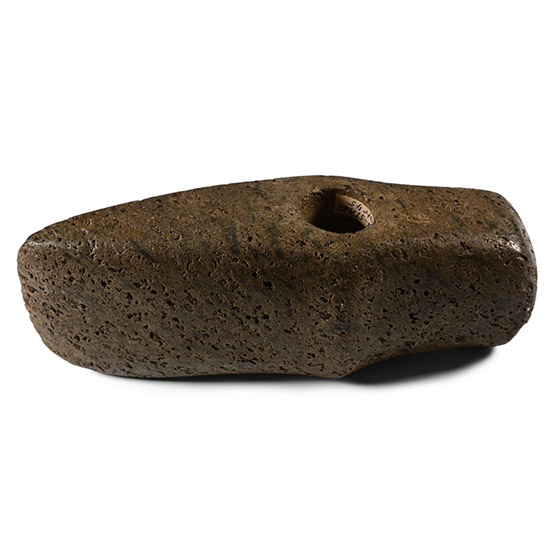
Stone Age Pierced Boat-Shaped Axehead
Neolithic Period, 4th millennium B.P.Sold for (Inc. bp): £520
Boat-shaped in plan with central drilling; domed hammer-face to butt, carination to each broad face. 656 grams, 14.8 cm
Acquired in the 1996. Private collection, Switzerland, thence by descent. Private collection, since the late 1990s. -
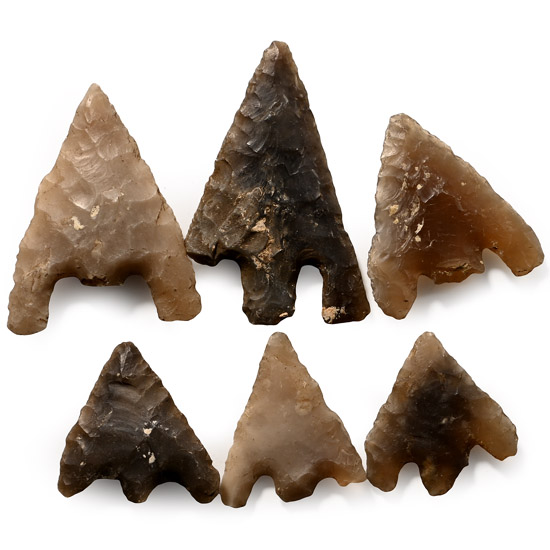
Farnham Stone Age Knapped Flint Arrowhead Collection
Neolithic Period, circa 6,000 B.P.Sold for (Inc. bp): £442
Barbed and tanged types, lentoid in section. 13.2 grams total, 21-34 mm
Found during the original official excavations in the Farnham area, Surrey, UK, which were conducted by Harold Faulker (1875-1963), and William Francis Rankine (c.1877-1962), who were instrumental with the excavation works and pit dwellings at sites including Six Bells, Frensham, Tilford, Thursley and Bagshot, and Waverley, amongst others at and near Farnham in the 1930s and 1940s. Much of the material is now in the prestigious Farnham museum. The present part of the collection having been gifted to their good friend and Haselmere Parish Priest, Charles Borelli (c.1914-2000) of Farnham; who was part of the Borelli family from Italy who emigrated from Lake Como in 1828 to set up the Borelli family watch and jewellery business; thence by family descent to his nephew.
Farnham district is one of the most interesting prehistoric regions in England, and has been visited by a succession of prehistoric peoples from Palaeolithic times onwards. Along the southern slope of the Farnham valley are three gravel terraces, which are famous prehistorically and have yielded large quantities of flint implements and bones of prehistoric animals, notably the mammoth. In prehistoric times, the chalk deposits played an important role in attracting settlers, as they contained rich layers of flint nodules used to make implements. The Farnham Gravels have been an abundant source of Palaeolithic finds, most prominent being hand axes. The axes differ in type, and each type is associated with a cultural phase of the Palaeolithic period. Types similar to these are found in similar deposits in the Somme valley and in many English valley gravels. Flint mining was also carried out by the Neolithic folk. Polished axes and leaf forms, arrowheads and knives, or possibly lance heads, are characteristic of the Neolithic flint work. -
.jpg)
Giant French Stone Age 12 Inch Acheulean Knapped Handaxe
Lower Palaeolithic Period, circa 650,000-350,000 B.P.Sold for (Inc. bp): £975
Made from a tabular nodule utilising its cortex as the grip, long cutting edges with a dual patina; attributed to Homo heidelbergensis. 2.1 kg, 30.5 cm
From Car Bouresches, Haut-de-France. Acquired in the 1970s-1990s. From the collections of the famous UK musician and amateur archaeologist, Victor Brox (1941-2023). Acquired on the UK art market. From a private collection. -
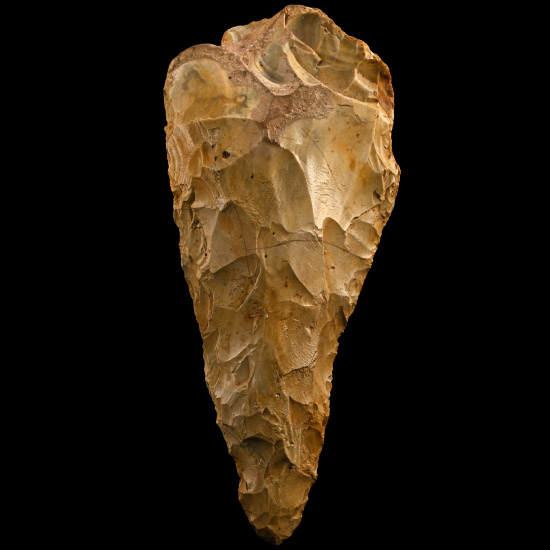
British Stone Age Knapped Flint Axe
Middle Palaeolithic Period, circa 150,000-60,000 B.P.Sold for (Inc. bp): £1,300
Piriform body in cream-coloured flint, with remains of an old handwritten label on one side. 572 grams,19 cm
Found Test Road, Huzbourough Copse, Hampshire, UK, August 1965. From the collection of Martin Doyle, Leverstock, UK, 1980s-2000s. -
.jpg)
African Stone Age Homo Erectus Knapped Handaxe
Lower Palaeolithic Period, circa 1,000,000-500,000 B.P.Sold for (Inc. bp): £312
Piriform axe with narrow point, the surfaces weathered smooth, inked collector's note 'Seguedine 71'. 515 grams, 20 cm
From Seguedine, Africa. Ex old German collection formed in the 1970s by Dr J Fehkhaber. Acquired on the European art market. -
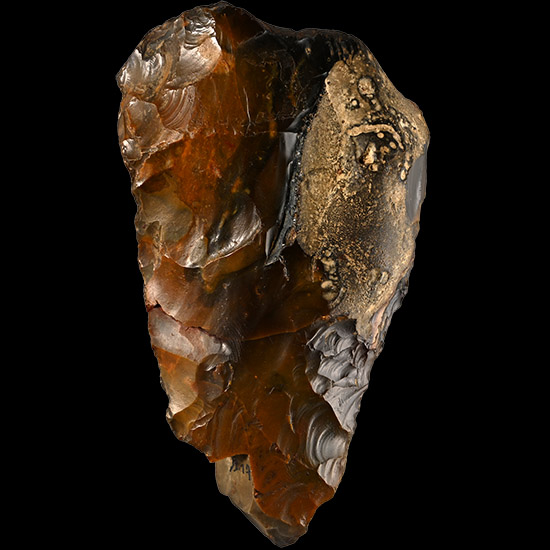
Stone Age Acheulean Handaxe
Lower Palaeolithic, circa 700,000-300,000 B.P.Sold for (Inc. bp): £520
Ovate axe in dark brown stone with some cortex visible, old collector's note ' 2 P. Abbevillier alluvions de la Somme.' 617 grams, 15.3 cm
From Abbeville, France (according to inscription). Collection of Michel C. Vaes (1934-2024), Belgium, formed 1960s-90s. Accompanied by a copy of the EU Licence no.2026 DMF 0436.

