-
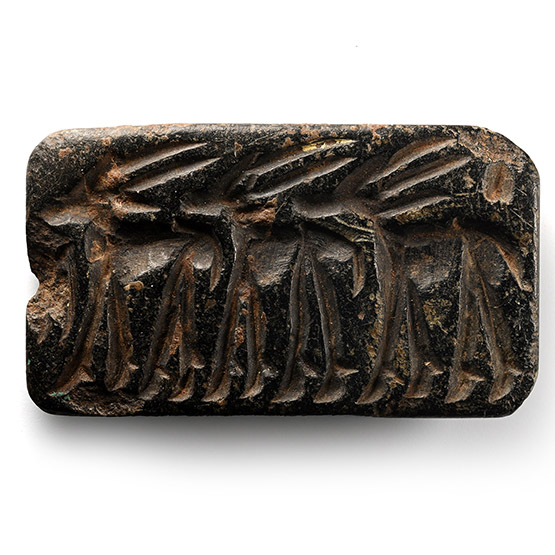
Western Asiatic Steatite Seal with Animals
3300-2900 B.C.Sold for (Inc. bp): £780
Rectangular in plan and triangular in section with a median hole, flat face with incuse frieze of ibexes. 38.9 grams, 61 mm
Acquired in the mid 1980s-1990s. Private collection, Switzerland, thence by descent. Private collection, since the late 1990s.
Some stamp seals from the period of transition between Jemdat Nasr and the Early Dynastic Period of Ur represent animals, and some scholars suggest that they were probably used as pendants or amulets. The animals are somewhat simplified and often reduced to mere lines: a file of animals usually forms the basis of such a pattern. -
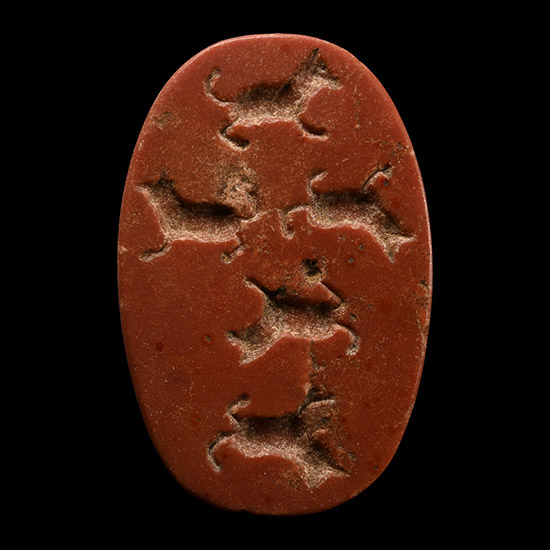
Large Akkadian Red Jasper Seal
Circa 2200 B.C.Sold for (Inc. bp): £780
Plano-convex in section with incuse animal forms to the underside. 82.8 grams, 66 mm
Private collection. Acquired from a Swiss collection, 2002.
The seal shows stylistic affinity with Akkadian seals representing animals. A few scenes of daily life occur on Akkadian seals, chiefly on the small number illustrating the history of Etana and the eagle. If Akkadian, our seal can be considered very rare. -
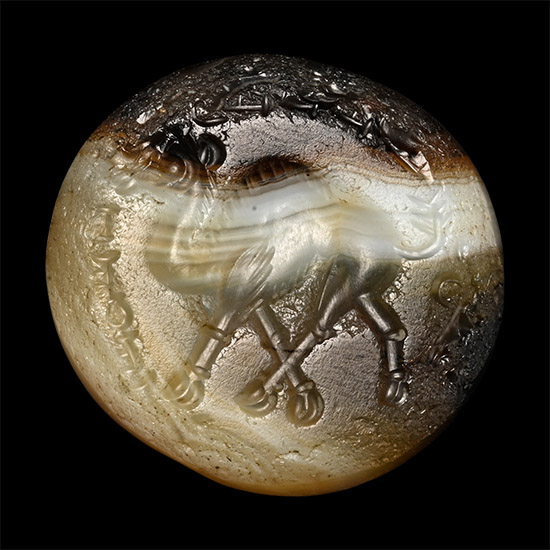
Sasanian Banded Agate Stamp Seal with a Dromedary Camel and Inscription
5th-7th century A.D.Sold for (Inc. bp): £1,170
Plano-convex in section with transverse piercing; incuse image on the underside of a charging dromedary camel inside a circular Sasanian inscription; supplied with a museum-quality impression; very rare type. 8.9 grams, 20 mm
From a privately held London, UK, collection from the 1990s. -
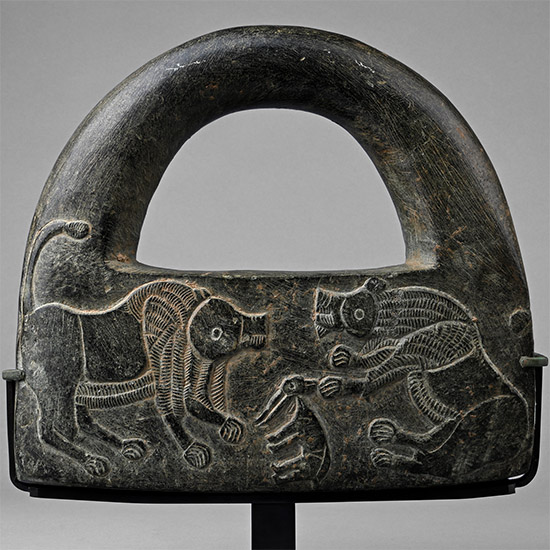
Large Bactrian Black Chlorite 'Hand Bag' Ceremonial Weight
3rd millennium B.C.Sold for (Inc. bp): £13,000
D-shaped in profile with a round-section loop; obverse with a reserved scene of two lions with hatched detailing to the fur advancing towards a small quadruped placed perpendicular to them; reverse with a median eagle with wings extended and feather detailing, flanked by rearing serpents and a scorpion; mounted on a custom-made stand. 6.25 kg total, 28.3 cm high including stand
with Gallery Rosen Ancient Art, Tel Aviv, 10 November 1969. Ex London, UK, gallery, 1971-early 2000s. London, UK, collection. Accompanied by a copy of an original invoice from Gallery Rosen Ancient Art, 10 November 1969. Accompanied by an academic report by Dr Raffaele D’Amato. This lot has been checked against the Interpol Database of stolen works of art and is accompanied by search certificate number no.13246-252973.
Among the most iconic intercultural style objects are the so-called 'lock' or 'handbag' weights. They have been found in a variety of different colourful stones, such as breccia, chlorite, fossiliferous limestone, calcite and onyx. At the beginning, these objects were probably not weights at all, but were likely badges of high office, carried to indicate authority. Similar objects have been found throughout Mesopotamia, the islands of the Persian Gulf, on the Iranian steppe, and in the Indus Valley. -
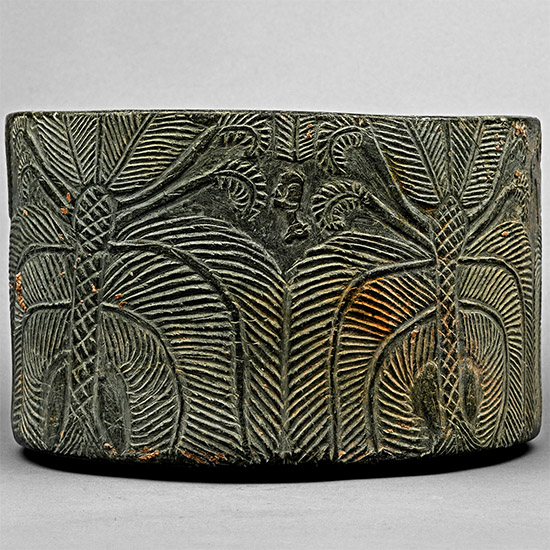
Mesopotamian Steatite Bowl with Animals and Palm Trees
3rd millennium B.C.Sold for (Inc. bp): £10,400
Drum-shaped steatite vessel with broad flat rim; low-relief frieze to the outer face: dense vegetation panels with hatched treetrunks and fronds, resting quadrupeds, each with the legs folded beneath the body. 5.3 kg, 24.5 cm wide
Acquired by a Swiss family in the mid-1980s to late 1990s, thence by descent. Private collection, Switzerland, since the late 1990s. Accompanied by an academic report by Dr Raffaele D’Amato. This lot has been checked against the Interpol Database of stolen works of art and is accompanied by search certificate number no.13026-246787.
In Mesopotamia ancient stone-carvers produced a variety of vessels from soft soapstone (steatite) and pale yellow alabaster, along with jewellery. They include cylindrical boxes, cups, high open-rim vases and a few globular jars. Among it the most prominent products were the cups with tall, slender stalks, apparently intended for religious purposes. The repertoire of motifs of the ‘Intercultural Style’ includes vegetal, architectural, and abstract or naturalistic representations of people and animals, depicted in a carved and inlaid technique. -
.jpg)
Sasanian Blue Chalcedony Gemstone with Animal in Gold Ring
5th-7th century A.D.Sold for (Inc. bp): £845
An oval grey-blue intaglio featuring a reclining antelope, set in a later hollow-form gold ring; supplied with a museum-quality impression. 5.95 grams, 25.63 mm overall, 18.29 x 18.82 mm internal diameter (approximate size British Q 1/2, USA 8 1/4, Europe 18.12, Japan 17)
Acquired on the European art market. -
.jpg)
Sasanian Gold Pendant with Three Registers
6th-7th century A.D.Sold for (Inc. bp): £975
Ovoid in plan with a loop to the narrow end, repoussé pellets to the rim, star-and-crescent motifs, and ropework borders. 3.47 grams, 45 mm
Acquired by a Swiss family in the mid-1980s to late 1990s, thence by descent. Private collection, Switzerland, since the late 1990s.
The crescent is often illustrated in the clan symbols (neshan) of aristocratic Sasanian families. On the reliefs of Naghsh-e-Rustam, the crescent moon is linked to aristocratic clans, and on various monuments, it is linked with military units. -
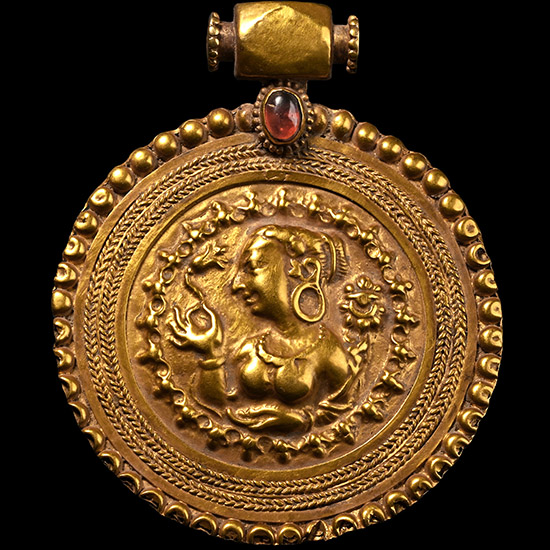
Large Kushan Gold Pendant with Bust of a Goddess
Circa 4th century A.D.Sold for (Inc. bp): £15,600
A late Kushan or Hephthalites Dynasty discoid pendant with a female deity, possibly Nana, at the centre holding a lotus flower in her right hand, hair elaborately dressed and wearing large earrings, necklace and bracelets; enclosed by a border of stylised bull heads and a double-plaited border, the outer edge with raised bosses; later applied polygonal suspension loop with granulated collars and an oval garnet cabochon. 22.11 grams, 71 mm
Acquired by a Swiss family in the mid-1980s to late 1990s, thence by descent. Private collection, Switzerland, since the late 1990s. Accompanied by an academic report by Dr Raffaele D’Amato. This lot has been checked against the Interpol Database of stolen works of art and is accompanied by search certificate number no.13021-246776.
Nana (Kushan Greek: Νανα, Ναναια, Ναναϸαο, Sogdian Nni) was a Bactrian female deity, a variation of the pan-Asian Nana, a fusion of the Sumero-Babylonian Inanna-Ishtar with a local deity, in her Kushan form with the local (Zoroastrian) Harakhvati Aredvi Sura Anahita. Such syncretism was common among Kušan deities. She was an important patron deity in the Kushan Empire and the most important deity worshipped by Emperor Kaniška (c. 127-150 A.D.). -
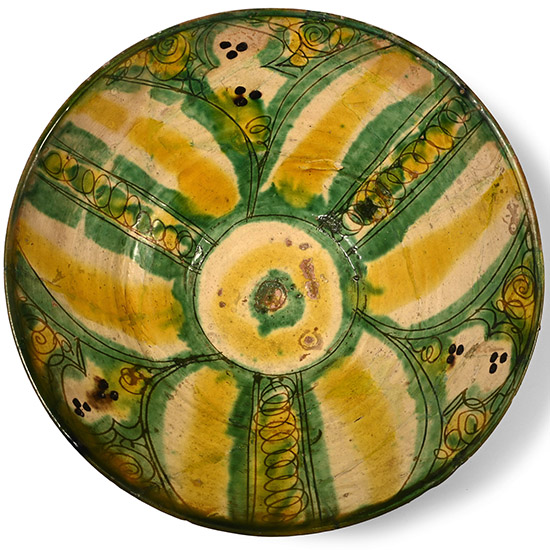
Nishapur Terracotta Glazed Bowl
10th century A.D.Sold for (Inc. bp): £585
Hemispherical in profile with basal ring, painted rim and trefoil motif on a textured field. 651 grams, 25 cm wide
Acquired before 1978. Private collection, UK. -
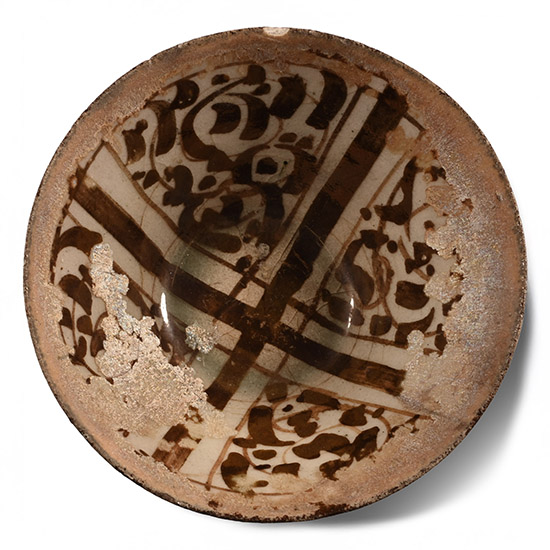
Syrian Lustre Pottery Bowl
13th century A.D.Sold for (Inc. bp): £546
Conical in profile with ring foot; glazed inner face with reserved cross and panels of calligraphic text; text to underside inside foot; old collectors' labels to sidewall. 142 grams, 13.8 cm
with Christie's, London, Islamic Manuscripts, Miniatures, and Works of Art, 10 October 1989, no.485. Private collection, London. -
.jpg)
Large Western Asiatic Facetted Glass Vessel
9th-11th century A.D.Sold for (Inc. bp): £5,720
With drum-shaped body and broad shoulder, tapering neck and flared mouth, recessed underside, segmented facets to the neck and edge of the shoulder, iridescent surface; repaired. 412 grams, 20.6 cm
Acquired on the UK art market, 1990s. Private collection, New York, USA. This lot has been checked against the Interpol Database of stolen works of art and is accompanied by search certificate number no.13374-255459.
This object was probably produced in Nishapur, a vital city in the early and middle Islamic period, located on the Silk Road. The people of high and low-level classes of Nishapur, land-owning aristocracy and literates or simple farmers and miners, were able to adapt the cultural trends arriving from the Silk Road, creating a material culture with a distinctive visual language. -
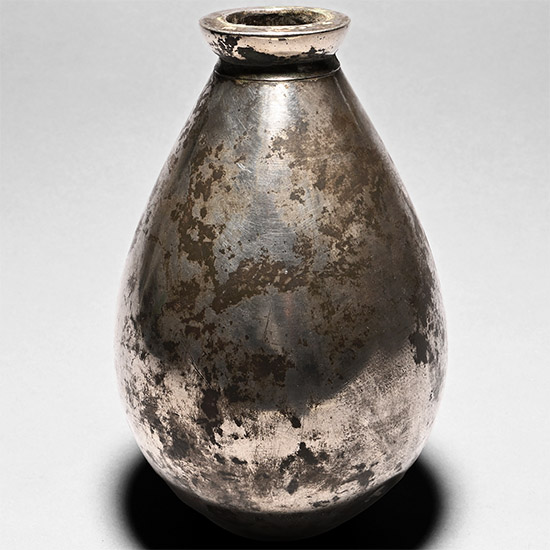
Large Sasanian Silver Bulb-Shaped Vessel
5th-6th century A.D.Sold for (Inc. bp): £2,340
Ovoid in profile with a short neck and a flat rim, pierced at the bottom; minor dents to the surface. 485 grams, 17 cm
London, UK gallery, 1971-early 2000s. Private collection, London, UK. This lot has been checked against the Interpol Database of stolen works of art and is accompanied by search certificate number no.13139-248448.

