-
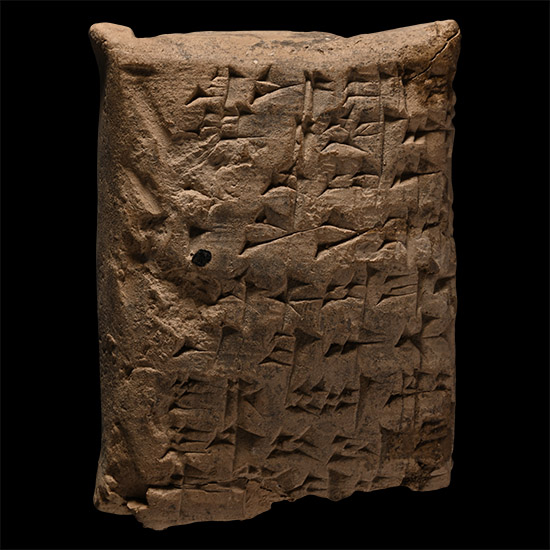
Old Babylonian Cuneiform Tablet with Legal Text
Circa 2000-1900 B.C.Sold for (Inc. bp): £2,210
The majority of a pillow-shaped tablet with impressed cuneiform text on three sides and a cylinder seal impression on the short face. 214 grams, 76 mm
Private collection, 1980s. UK private collection before 2000. Acquired on the UK art market. Private collection, London, UK. Academically researched and catalogued by the late Professor Lambert. Accompanied by an original handwritten slip written by Professor Wilfrid George Lambert. -
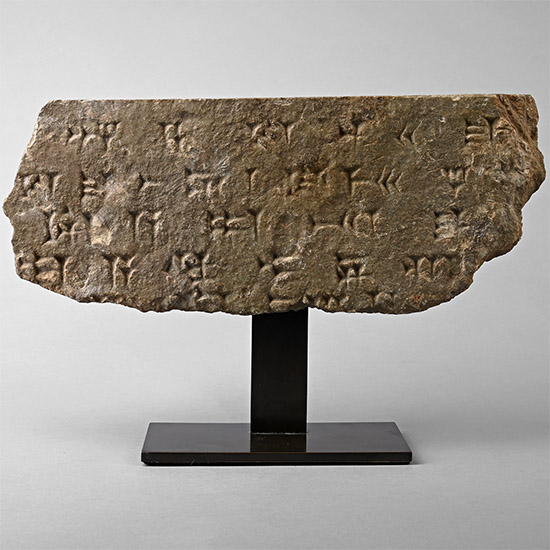
Large Neo-Assyrian Cuneiform Frieze Section with Annals for King Ashurnasirpal II
883-859 B.C.Sold for (Inc. bp): £12,350
A stone frieze with four lines of large cuneiform text accompanied by documentation to support that this a section from the annals of King Ashurnasirpal II: 'Ashurnasirpal (II), great king, mighty king, king of the universe, king of Assyria, son of Tukulti-Ninurta (II), great king, mighty king, king of the universe, king of Assyria, son of Adad-nirari (II), great king, mighty king, king of the universe, king of Assyria, valiant man, who acts with the support of the weapons of Assur, his lord, who has no equal among the princes of the four regions, king who has subdued (the territories extending) from the opposite bank of the Tigris to Mount Lebanon and the Great Sea, the entire land of Laqû, the land of Suhu as far as the city of Rapiqu. He conquered the sources of the Subnat river as far as the land of Nirbu…'; mounted on a custom-made display stand. 2.85 kg total, 36.5 cm wide including stand
Belgian private collection, acquired before 1960, and thence by descent to the collector's widow. with Mrs Drees (?), Brussels, acquired from the widow of the above, 2004. with Pierre Bergé & Associés, Paris, 28 October 2006, lot 219. with Gorny & Mosch, Munich, 12 December 2023, lot 416. This lot has been checked against the Interpol Database of stolen works of art and is accompanied by search certificate number no.13369-258955.
Most of the reliefs and inscriptions of this king are in the British Museum and Louvre. Further holdings are in the New York Historical Society, the Metropolitan Museum of Art and Yale University. They celebrated the glory of the Assyrians at the apogee of their Empire. -
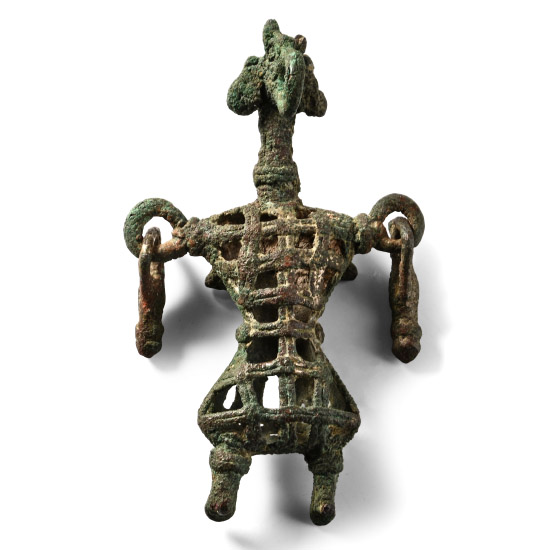
Amlash Bronze Fertility Figure with Baby
13th-12th century B.C.Sold for (Inc. bp): £819
Formed as a standing figure cradling an infant; stylised facial and anatomical detailing; openwork cage structure and suspension loop to the reverse of the head. 58.6 grams, 91 mm
Ex Samuel Dubiner (1914-1993), Canada, a prominent businessman, arts patron, and one of the world's most distinguished collectors of Bronze Age and Iron Age Iranian art, including Amlash material. Acquired by the current owner from the above, circa 1985-1995. -
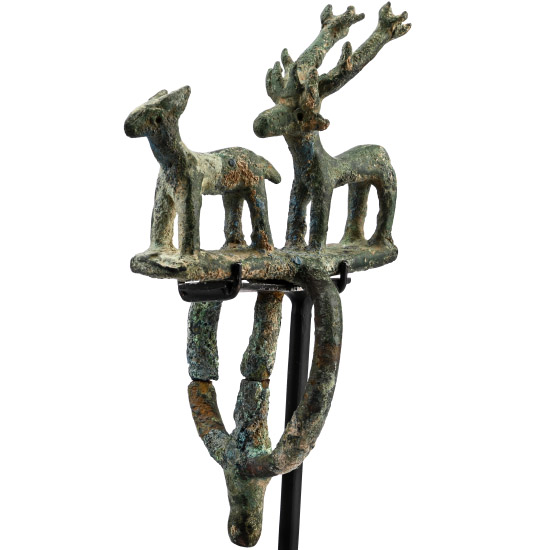
Hittite Bronze Standard Finial with Animal
Circa 13th-10th century B.C.Sold for (Inc. bp): £1,690
With a central bar with a semi-circle on either side, surmounted by a flat platform with a stag with large, elaborate horns, standing behind a doe; accompanied by a custom-made display stand. 405 grams, 17 cm (922 grams total, 31 cm including stand)
From a private collection, since 1989. Ex West London, UK collection. -
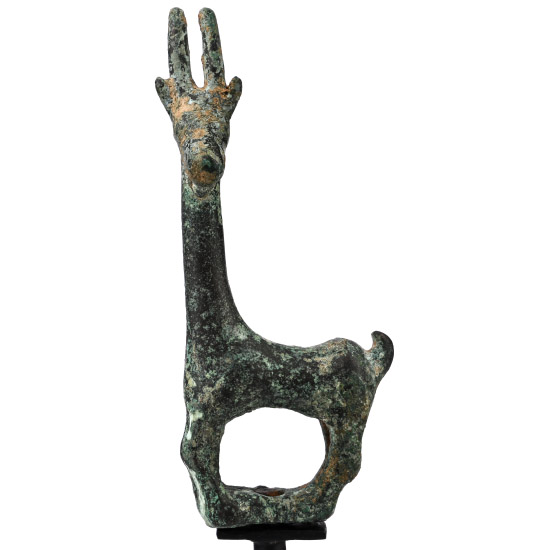
Luristan Bronze Antelope Statuette
13th-7th cenury B.C.Sold for (Inc. bp): £468
Depicted standing with head erect and prominent curving horns; mounted on a custom-made display stand. 98 grams, 96 mm (279 grams, 22.6 cm including stand)
From a private collection, since 1989. Ex West London, UK collection. -
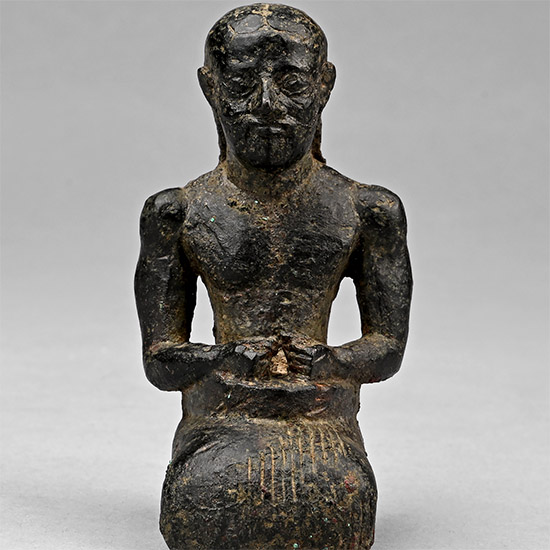
Western Asiatic Bronze Statuette of a Kneeling Priest
Late 3rd millennium B.C.Sold for (Inc. bp): £5,720
Modelled as a kneeling priest wearing a knee-length kilt, the long hair combed back from the face and extending down the back, arms bent, and fists clenched, resting on the belt, recessed to the underside. 359 grams, 83 mm
Ex London family collection, since the 1970s. Accompanied by a report of metallurgical analytical results, written by Metallurgist Dr Brian Gilmour of the Research Laboratory for Archaeology and the History of Art, University of Oxford. This lot has been checked against the Interpol Database of stolen works of art and is accompanied by search certificate number no.13313-258236.
This powerful figure was probably lost-wax cast in arsenical copper, as were many Near Eastern bronzes of the 3rd millennium. He is muscular with broad shoulders, a strong chest and a well-toned, rippling abdomen. The pleated long garment is typical of the Mesopotamian men. Very interesting is his praying gesture, which is typical of the statuette of Ur culture. -
.jpg)
Sumerian Head with Inlaid Eyes
Circa 3000 B.C.Sold for (Inc. bp): £1,521
D-section carved mask with lateral spurs to the brow, exaggerated aquiline nose and broad mouth with raised lips; applied shell and glass inlay to each eye; pierced at the cheeks for attachment; mounted on a custom-made stand. 28.7 grams total, head: 28 mm wide, 83 mm including stand
From the private collection of the late Mr S.M., London, UK, 1970s-1990s; and a North American collection. -
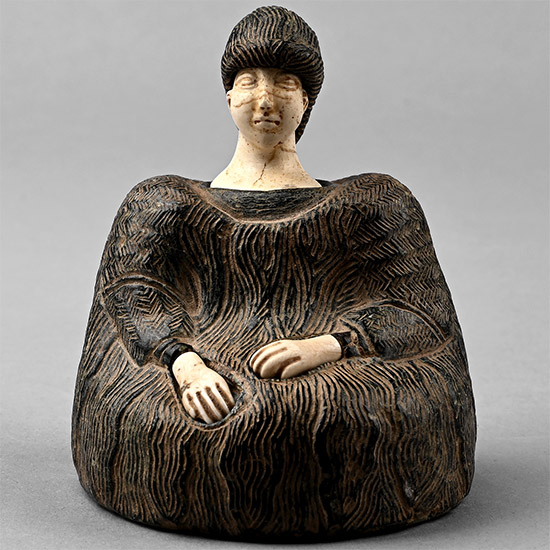
Bactrian Stone Female 'Princess' Idol
Bactria-Margiana, late 3rd-2nd millennium B.C.Sold for (Inc. bp): £11,700
Carved as a seated human figure, body with rows of overlapping tufts of fur, set with a bald head carved from cream stone with semi-naturalistic detailing to the face; a separate wig with wavy hair, and separately modelled hands. 540 grams total, 95 mm high
Palace Galleries, New York, early 2000s. Acquired by the current owner from the above. Private collection of a North American lady. This lot has been checked against the Interpol Database of stolen works of art and is accompanied by search certificate number no.13372-256950.
This wonderful composite stone sculpture of a seated female figure with finely carved features is typical of the area of Bactria-Margiana, from the late 3rd to early 2nd millennium B.C. Among the few three-dimensional images assigned to this period in Central Asia are a group of stone female figures seated or squatting on a platform and wearing a pattern-decorated robe, perhaps imitating sheep's fleece. -
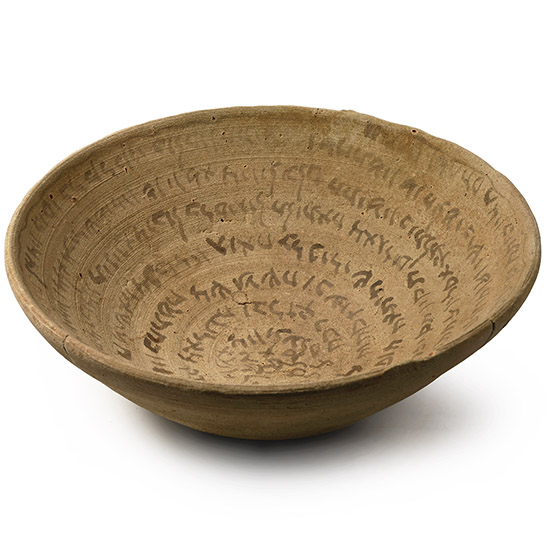
Aramaic Terracotta Magical Incantation Bowl
Circa 4th-8th century A.D.Sold for (Inc. bp): £975
Flat-based bowl, inscribed in spiral from the bottom inner wall to the rim with Aramaic text. 360 grams, 17.6 cm
Private collection, 1980s. UK private collection before 2000. Acquired on the UK art market. Private collection, London, UK
Aramaic incantation bowls are particular to the Sasanian period and have been found in the regions of modern Iraq. These simple ceramic bowls, also known as magic bowls, each contain an Aramaic inscription, written in ink, which spirals from the centre. The bowls seem to have played an important part in domestic life. For example, during excavation in Nippur in 1889, one or more incantation bowls were found in each house together with domestic artefacts, most often in doorways or under floorboards in the corner of rooms. The bowls are predominantly apotropaic, and the inscriptions tend to protect their owners from misfortunes such as childbirth, illness and evil spirits. -
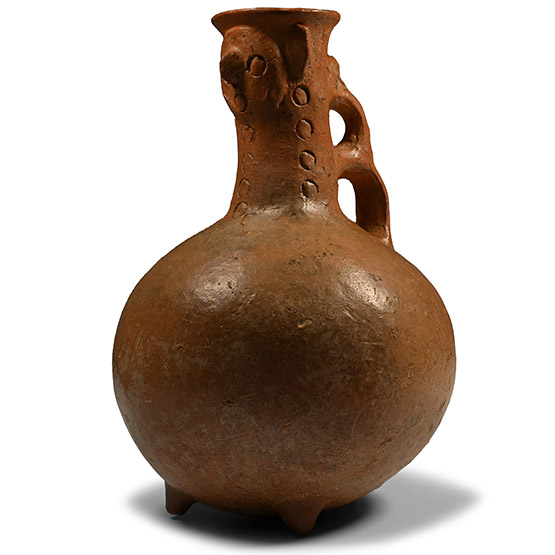
Amlash Terracotta Single-Handled Jug with Head Attachment
Circa 1000-800 B.C.Sold for (Inc. bp): £975
Comprising a rounded body resting on three stub legs; funicular mouth and short neck; beneath the rim a mask with pinched nose and two pointed ears, impressed circular eyes and mouth; three vertical decorative strips impressed with the same tool as formed the eyes and mouth; tiered strap handle with two finger-grips to the outer face and impressed detailing running from the neck to the shoulder; rim and one foot partly restored. 723 grams, 20.6 cm
Ex Zackary, Los Angeles, 1960s. Thereafter London art market, 1992. Accompanied by a copy of an Art Loss Register certificate no.S00079639.
Several tripod vessels were found at Marlik and Amlash. Examples of tripod vessels from other sites include a comparable example with a tripod stand from Agha Evlar. Jars with tripod knob stands and long necks, particularly similar to the Marlik specimen from Zeinab Bejar, were found in the upper level of Tombs C L and B III of Ghalekuti in the Dailaman region of Gilan. Vessels with tripod legs from Kalardasht are dated by Vanden Berghe to 1000-800 B.C. -
.jpg)
Sabean Yemeni Dedicatory Plaque from the Kingdom of Qataban
1st century A.D.Sold for (Inc. bp): £1,820
With eight lines of qatabanic Sabaean text regarding an unknown temple of the kingdom of Qatabān, dedicated to the gods Amm dhu-Raymatum and Warafum: '1 Dlwn -b-Gbln ʿbd (s¹q)ny[ ʿm] 2 ḏ-Rymtm w-Wrfm (s¹)qnyt-ḏ= 3 hbm ḥg tkrb-s¹mn gwm/ 4 bʿw mhrt Nbṭ m w-(ytʿs¹) 5 w-ʾbl-s¹ ḥg t(k)rb-s¹mn l-m= 6 tʿn-s¹ b-s¹wt brṯ n rṯd D..= 7 wn ʿm w-Wrfm ʾḏn-s¹ w-(mqm)-s¹ 8 w-qny-s¹ b-ḥg ʿm w-ʾnby' 'Dalwān ... offered [to ʿAmm] (2) dhu-Raymatum and Warafum the offering of (3) bronze according to the promise he made to them ... (4) ... mares of Nabaṭ um ... (5) his camel in accordance with the promise he had made to them to be (6) protected in this expedition. Dalwān has confided (7) to ʿAmm and Warafum his faculties, his abilities (8) and his possessions, with the approval of Amm and Anbī'; mounted on a custom-made stand. 1.01 kg total, 23.7 cm high including stand
Ex London W1 collector; acquired between 1970 and the late 1990s. -
.jpg)
Western Asiatic Banded Agate Cylinder Seal with Winged Figure
2nd-1st millennium B.C.Sold for (Inc. bp): £286
Frieze depicting a standing winged figure in profile facing a column with disc above and radiating beams; supplied with a museum-quality impression. 8.37 grams, 30 mm
From the private collection of a European gentleman (1942-2024), formed since the 1970s.

