-
.jpg)
Byzantine Gold Marriage Ring
Circa 6th-7th century A.D.Sold for (Inc. bp): £9,100
D-section hoop with expanding shoulders, trumpet-shaped bezel with two facing busts and a cross between and a nimbate bearded bust above, legend 'OMONOIA' (harmony) below. 9.62 grams, 23.93 mm overall, 18.92 mm internal diameter (approximate size British R 1/2, USA 8 3/4, Europe 19.38, Japan 18)
From an important Byzantine collection, formed in the 1970s, Surrey, UK. This lot has been checked against the Interpol Database of stolen works of art and is accompanied by search certificate number no.13347-258734.
The marriage ring is one of the typologies in which figural decorations are frequently found. Generally speaking, marriage rings are engraved with a representation of a husband and wife, sometimes accompanied by Christ, and usually engraved with wishes for 'harmony, health and the grace of God'. Rings of this type had been used since the late 4th century A.D. and remained extremely popular in Byzantium in the 6th and 7th centuries. -
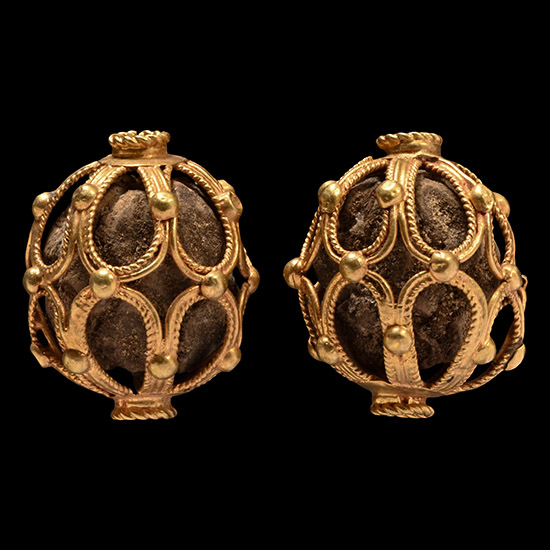
Byzantine Gold Openwork Beads from Earrings
10th-11th century A.D.Sold for (Inc. bp): £644
Each a spherical cage with ropework texturing, a granule at each node; oval glass bead within. 13.8 grams, 22 mm each
Acquired on the Swiss art market, 1998. Private collection, Europe.
The openwork beads were prepared to be inserted in an earring of ‘Grapevine’ typology, III type of earring in the Niederle classification. Similar specimens, imported from Byzantium, were found in Tokaj (Hungary) and dated to the time of the Emperor Romanus Lekapenos (920-944 A.D.). -
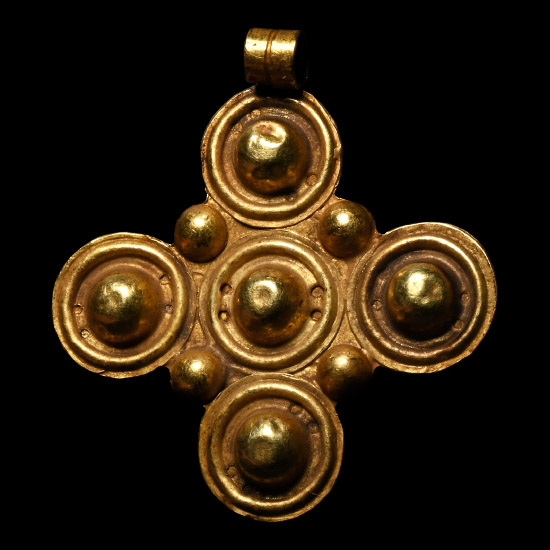
Byzantine Gold Cross Pendant with Bosses
Circa 6th-8th century A.D.Sold for (Inc. bp): £910
Formed of five hemispherical bosses, likely representing the five wounds of Christ, with a small raised boss at each junction; applied suspension loop. 3.41 grams, 35 mm
UK private collection before 2000. London collection, acquired on the UK art market. -
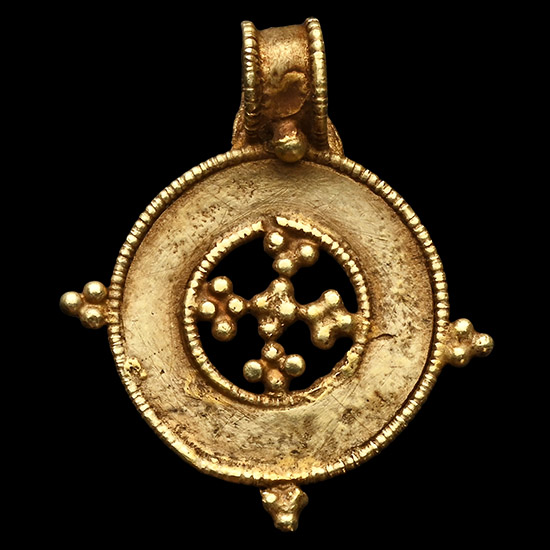
Byzantine Gold Cross Pendant
Circa 6th-8th century A.D.Sold for (Inc. bp): £650
Comprising an annular plaque with beaded wire frame to inner and outer edges, granule clusters to three cardinal points and a cruciform cluster to the centre; a suspension loop with cluster at the junction and beaded wire edges. 1.88 grams, 24 mm
From a North American gentleman's collection, 1990s. -
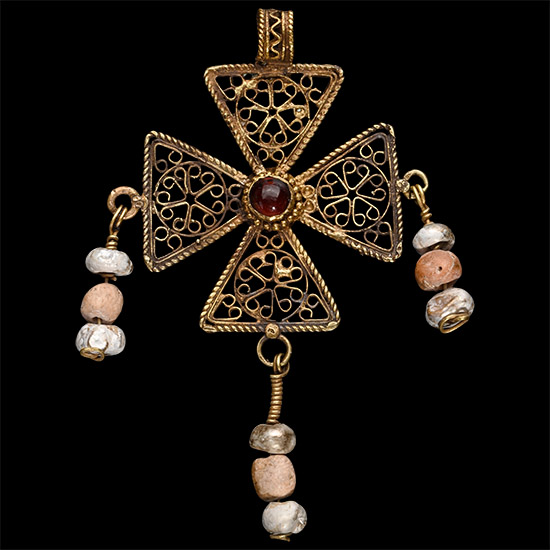
Byzantine Filigree Gold Cross Pendant with Bead Drops
Circa 6th-8th century A.D.Sold for (Inc. bp): £1,560
Formed as a Maltese cross, each arm with twisted filigree frame and filigree coils, dangle to the outer end with pearl and other beads (pearls ancient but possibly not original), central stepped cell with beaded collar and inset garnet cabochon, loop with filigree detailing. 3.68 grams, 50 mm
From a North American gentleman's collection, 1990s. -
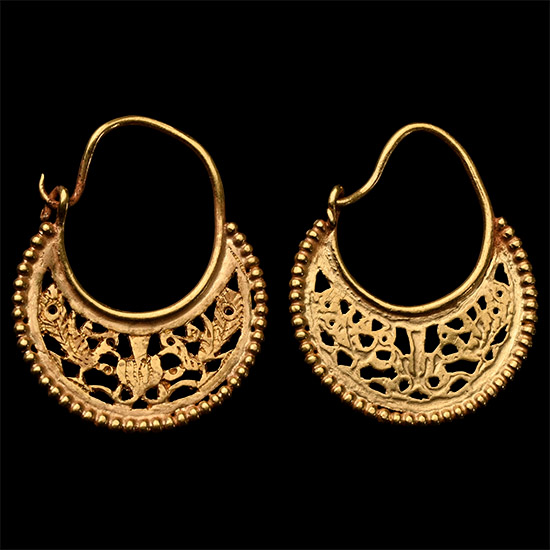
Byzantine Gold Openwork Earring Pair
6th-8th century A.D.Sold for (Inc. bp): £1,430
Each a crescent plaque with beaded borders, sprung hook and catch; openwork foliage motif with two opposing birds. 5.75 grams total, 28-29 mm
Private collection, 1990s-early 2000s. -
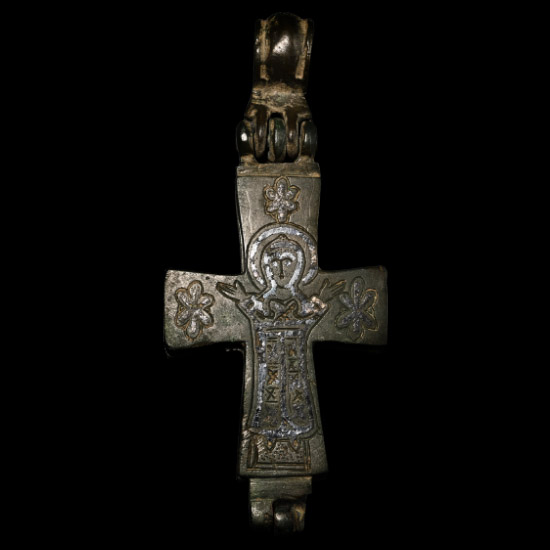
Large Byzantine Bronze Reliquary Cross Pendant with Christ
Circa 10th-12th century A.D.Sold for (Inc. bp): £1,430
Enkolpion with hinged loop; obverse with low-relief nimbate Corpus Christi with arms extended laterally, inlaid silver detailing; reverse with robed figure in orans pose with silver detailing to nimbus and robe. 123 grams, 11.2 cm
From the private coin collection of a West London, UK, gentleman, formed since the mid 1980s. -
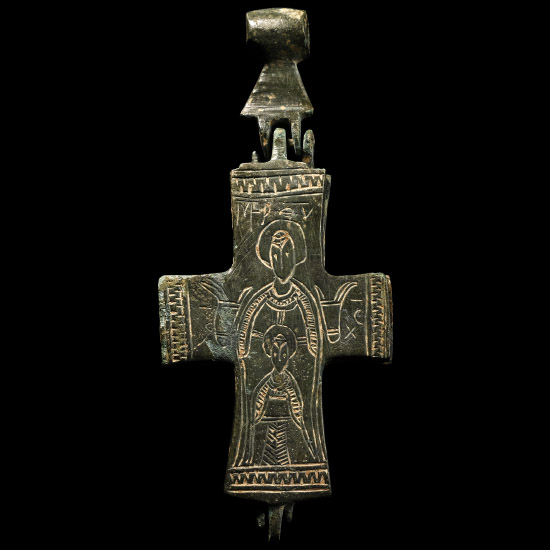
Large Byzantine Bronze Reliquary Cross Pendant with Saint George and Mary
Circa 10th-12th century A.D.Sold for (Inc. bp): £780
With separate hinge and suspension loop; obverse with nimbate robed figure in a tondo with legend 'ΓΕΟΡΓ[Η]' (St George); reverse with robed and nimbate figure in orans pose with 'ICX' beneath each wrist, smaller nimbate figure before, legend 'MHP ΘV' (Mother of God). 82 grams, 10.8 cm
From the private collection of a West London, UK, gentleman, formed since the mid 1980s. -
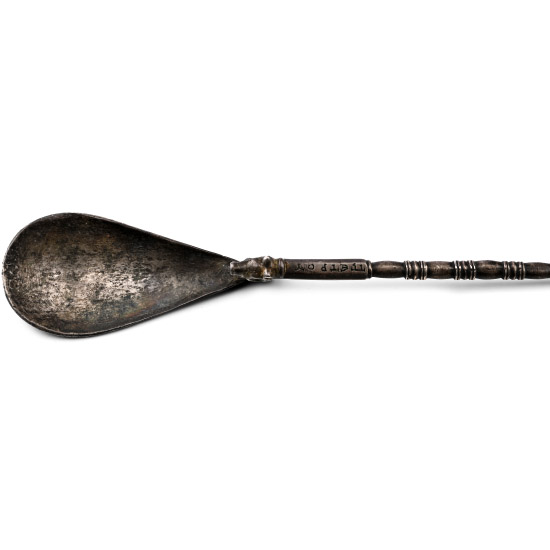
Late Byzantine Silver Spoon with 'St Peter' Inscription on the Handle
Late 6th-8th century A.D.Sold for (Inc. bp): £910
Featuring a large, shallow piriform bowl, stepped junction with a boar's head above, a hexagonal-section stem extending from behind the boar's neck bearing a Greek inscription 'TTETPOY' (of Peter); a balustered handle with a cuboid, striated finial. 60.77 grams, 21.5 cm
Acquired on the UK art market. Private collection, Surrey, UK.
The inscription suggests that the spoon may have had a liturgical purpose, associated with the Holy Communion. Still today in the Orthodox Church, the Body and Blood of Christ are dispensed with similar liturgical objects. The name Peter can be associated with the church, or simply with the owner of the liturgical artefact. -
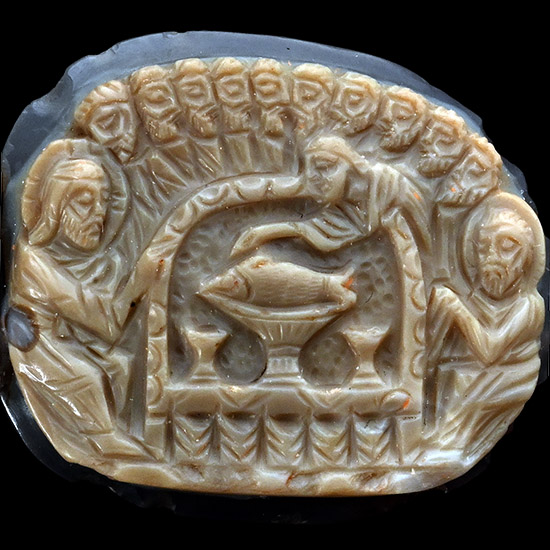
Byzantine Carved Agate Cameo of The Holy Banquet
6th-8th century A.D.Sold for (Inc. bp): £4,420
Plano-convex in section with low-relief carving: scene with a meal at a so-called sigma table surrounded by Christ, Peter, John and the other disciples; Christ and Peter attending and beardless Saint John the Evangelist preparing the fish. 9.95 grams, 32 mm
From a North American gentleman's collection, 1990s. This lot has been checked against the Interpol Database of stolen works of art and is accompanied by search certificate number no.13368-259040.
In early Byzantine art, Saint Peter is often depicted as the only figure apart from Christ to be shown with a nimbus, to emphasise his pre-eminent position as a church father and the 'rock' of the church. -
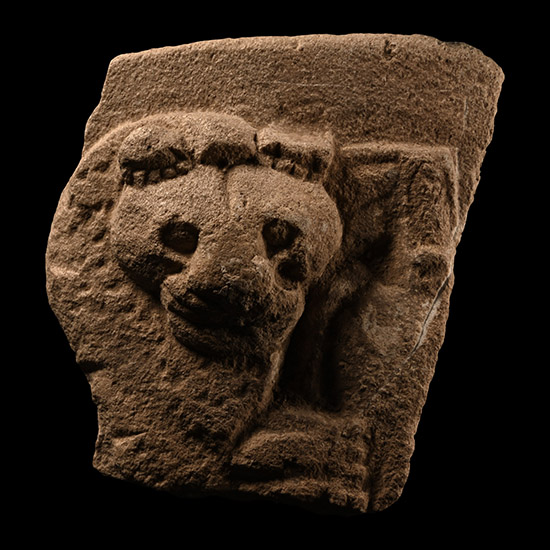
Sumerian Limestone Plaque with Lion
3rd millennium B.C.Sold for (Inc. bp): £650
Fragment from a plaque or large bowl with high-relief head and foreparts of a lion with broad piriform face and sunken eyes; rounded rim above. 246 grams, 96 mm
Ex Mr J.K. Maryland, USA. Private collection. Acquired in 1999.
From a technical point of view, the sculpture, in low relief, belonged to a ritual element with profile figures highlighted by an extremely delicate internal modelling, with space between the various decorative bands that admirably preserves the figure of the lion, giving it full value, according to an artistic principle also found in the seals of the Jemdet Nasr period (2800-2600 BC). -
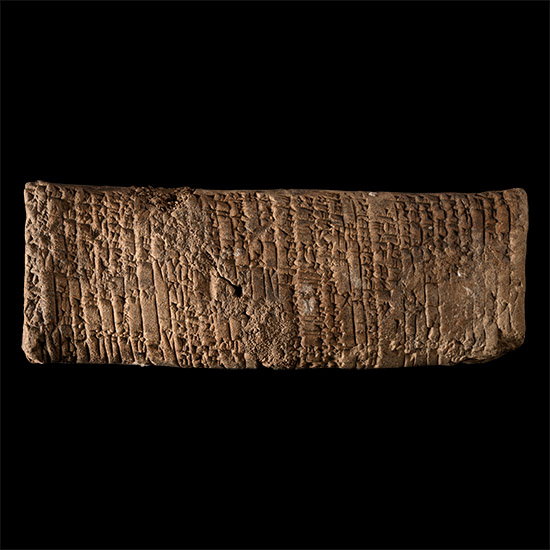
Large Old Babylonian Cuneiform Tablet with Administrative Text
Circa 2000-1900 B.C.Sold for (Inc. bp): £1,560
Long tablet with rows of densely arranged impressed cuneiform text on one side. 363 grams, 15.5 cm
Private collection, 1980s. UK private collection before 2000. Acquired on the UK art market. Private collection, London, UK. Academically researched and catalogued by the late Professor Lambert. Accompanied by an original handwritten slip written by Professor Wilfrid George Lambert.

