-
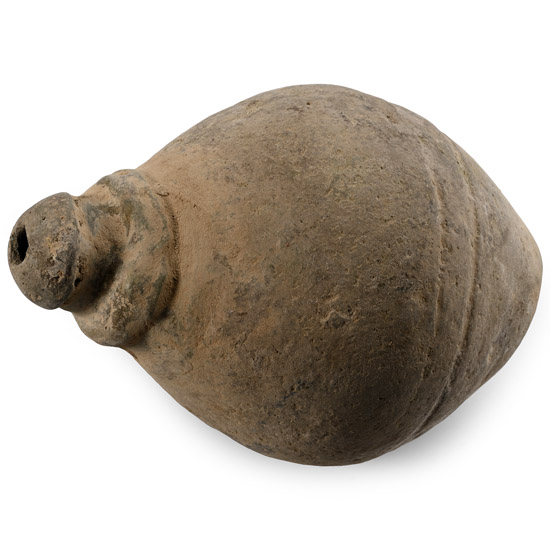
Byzantine 'Greek Fire' Ceramic Fire Bomb or Hand Grenade
9th-11th century A.D.Sold for (Inc. bp): £130
Piriform body with tiered neck and domed filler-hole; intended to be filled with explosive liquid and a wick, and used as a hand grenade. 788 grams, 15.1 cm
From an important specialist collection, London, UK, 1990s. Accompanied by an academic paper by military specialist Dr Raffaele D'Amato, dated 15 July 2019 and titled 'Eastern Roman Empire - Greek Fire Bomb or Hand Grenade (μεσαίον kακάβιον) 9th-11th century AD'.
Apart from the use of siphons or manual flame-throwers called cheirosiphona, special corps of Roman soldiers employed terracotta grenades, in the form of small jars, abundantly evidenced in archaeological excavations. They were called μεσαία kακαβιά or κυτροκακάβια, where the former had a bulbous shape and the latter a more cylindrical form. -
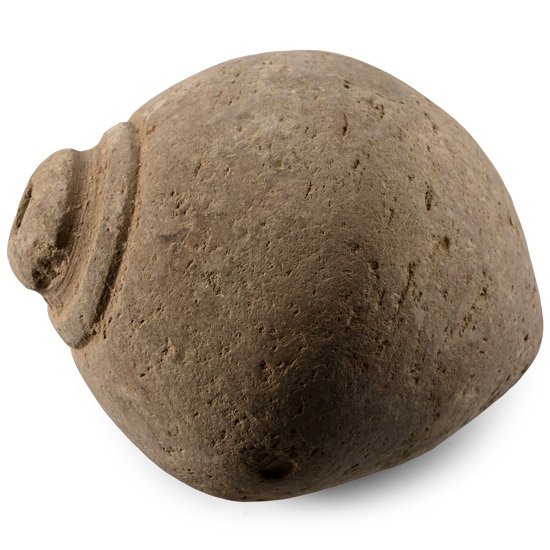
Byzantine 'Greek Fire' Ceramic Fire Bomb or Hand Grenade
9th-11th century A.D.Sold for (Inc. bp): £124
Ovoid body with pointed base and domed filler-hole; intended to be filled with explosive liquid and a wick, and used as a hand grenade. 510 grams, 11.9 cm
From an important specialist collection, London, UK, 1990s. Accompanied by an academic paper by military specialist Dr Raffaele D'Amato, dated 15 July 2019 and titled 'Eastern Roman Empire - Greek Fire Bomb or Hand Grenade (μεσαίον kακάβιον) 9th-11th century AD'.
Apart from the use of siphons or manual flame-throwers called cheirosiphona, special corps of Roman soldiers employed terracotta grenades, in the form of small jars, abundantly evidenced in archaeological excavations. They were called μεσαία kακαβιά or κυτροκακάβια, where the former had a bulbous shape and the latter a more cylindrical form. -

Turkish Iron Dagger with Brass Hilt and Scabbard
Mid 20th century A.D.Sold for (Inc. bp): £169
Two-edged jambiya with narrow curved blade, two deep fullers and punched detailing with inset turquoise-coloured pellet; brass bolster and applied bone panels to the grip, silver facing to pommel; brass sheath with low-relief foliage and figural ornament, suspension rings. 211 grams, 23.2 cm
Previously acquired on the UK art market in the early 2000s. This item is for collection from our premises only. -
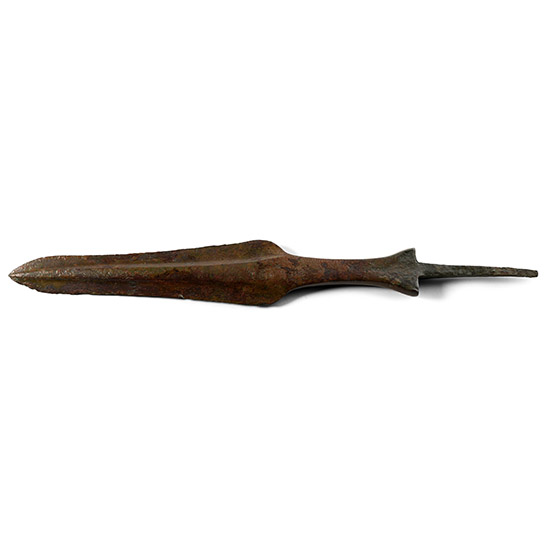
Large Western Asiatic Bronze Spearhead
Early 1st millennium B.C.Sold for (Inc. bp): £286
The blade with rounded shoulders, the raised midrib extending to the shaft, a rectangular-section tang below. 400 grams, 33.8 cm
Ex Abelita family collection, 1990s. -
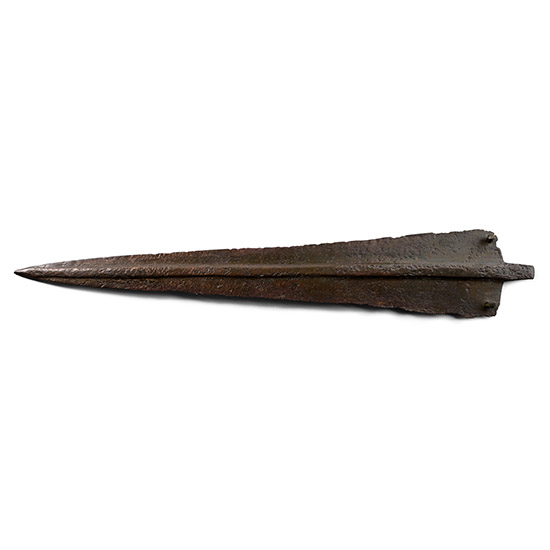
Large Western Asiatic Bronze Dagger
2nd-1st millennium B.C.Sold for (Inc. bp): £234
Triangular blade with raised midrib and a short tang. 134 grams, 28.4 cm
Ex Abelita family collection, 1990s. -
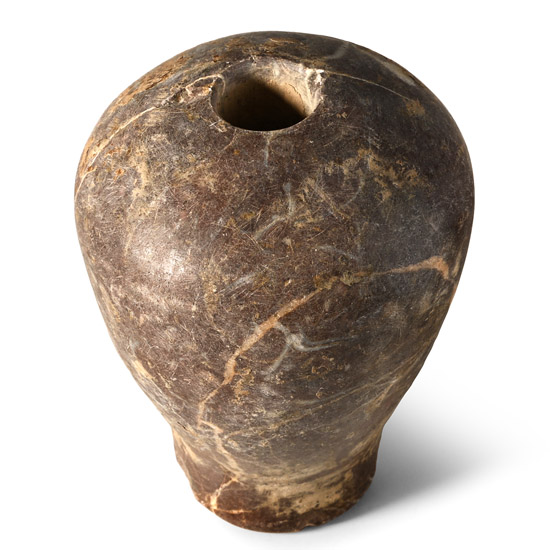
Western Asiatic Polished Stone Macehead
3rd-2nd millennium B.C.Sold for (Inc. bp): £111
With a globular body and a short cylindrical socket. 335 grams, 78 mm
From the collection of a London, UK, gentleman, 1990s. -
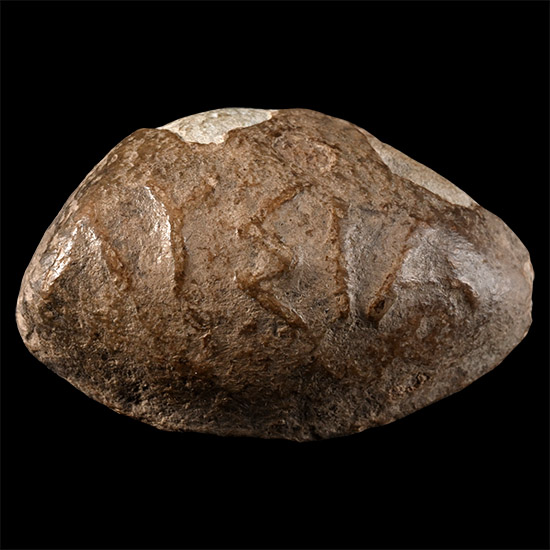
Greek Lead Slingshot with Inscription
3rd-1st century B.C.Sold for (Inc. bp): £59
Lenticular type with casting seam to the rim, raised legend 'ΛΥΣΙΑ' (commander's name, Lisia) on one side. 39.1 grams, 29 mm
Ex German art market, 2000s. Acquired from an EU collector living in London. From the collection of a Surrey, UK, gentleman. -
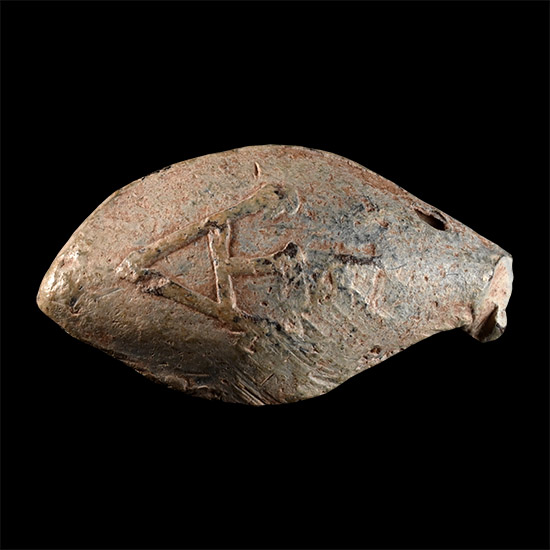
Greek Lead Slingshot with Alpha
1st century B.C.Sold for (Inc. bp): £117
Lenticular type with casting seam to the rim, raised iconic Greek letter A (alpha) on one side, and the other with raised pellets. 30.9 grams, 33 mm
Ex German art market, 2000s. Acquired from an EU collector living in London. From the collection of a Surrey, UK, gentleman. -
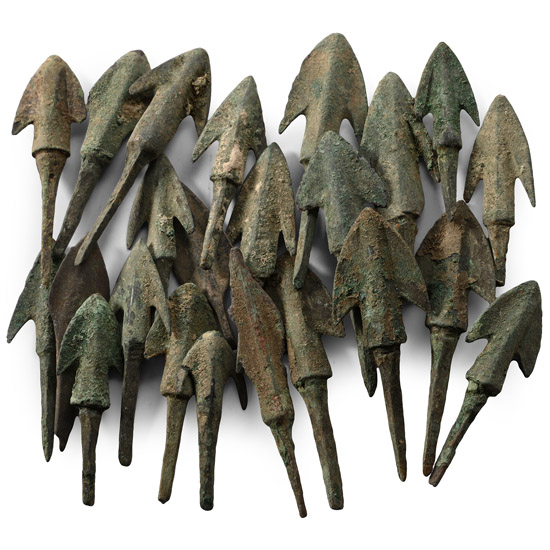
Western Asiatic Bronze Arrowhead Collection
2nd-1st millennium B.C.Sold for (Inc. bp): £195
Comprising tanged arrowheads, most with barbs. 114 grams total, 36-53 mm
Ex London, UK, collection, 1990s. -
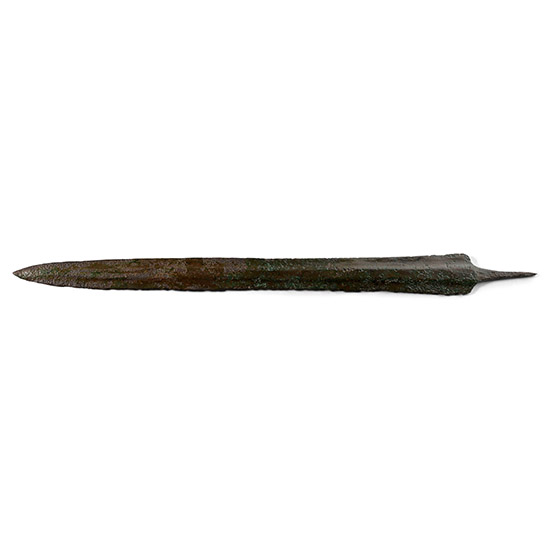
Large North-West Persian Bronze Dirk
Early 1st millennium B.C.Sold for (Inc. bp): £221
Slender blade with raised midrib and a short tang. 217 grams, 39.7 cm
Ex Abelita family collection, 1990s. -
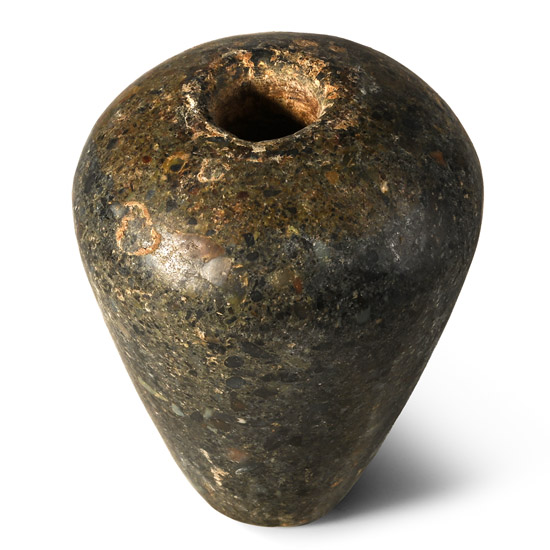
Western Asiatic Polished Stone Macehead
3rd-2nd millennium B.C.Sold for (Inc. bp): £104
Ovoid body with circular socket. 435 grams, 86 mm
From the collection of a London, UK, gentleman, 1990s. -
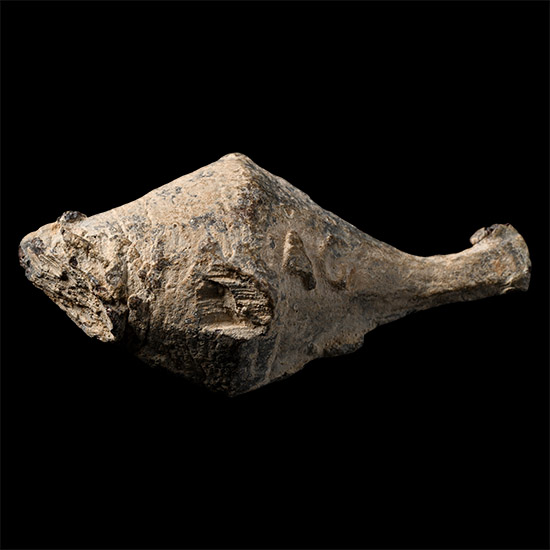
Roman Lead Cnaeus Pompey Battle of Munda Slingshot
Circa 46 B.C.Sold for (Inc. bp): £169
Facetted lentoid-section sling shot (glans) with inscription in Latin letters 'CN' (Cneius) 'MAG' (Magnus) on one side, and 'IMP' for 'IMPERATOR' (victorious general) to the other side, i.e., Gnaeus Pompeius Magnus Imperator (Pompey the Great the victorious general). 71.2 grams, 51 mm
Previously from a private Spanish collection. Ex London, UK, gentleman. Accompanied by a copy of a Spanish export licence.
The shot (Völling type 1C) is marked with the abbreviated name of Gnaeus Pompey; it was used in quantity at the Battle of Monda (or Munda) against Julius Caesar, 17th March 45 BC. The projectiles could be of different material: in lead (glandes) or in pottery or stone (lapides missiles). Sometimes they were signed with the name of the general, as is our specimen.

