-
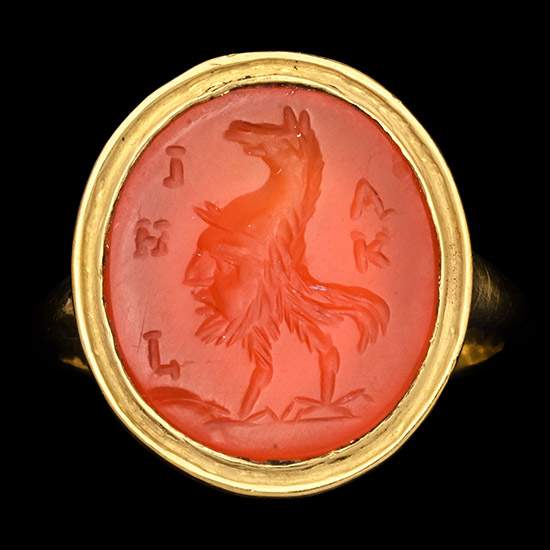
Roman Carnelian Gemstone with Gryllus in Gold Ring
2nd century A.D.Sold for (Inc. bp): £2,860
Translucent oval intaglio featuring a standing gryllus wearing a gryphon-headed helmet, flanked by the inscription 'KAΛHI' meaning 'to the beautiful one'; set in a later gold ring with a D-section hoop; supplied with a museum-quality impression. 9.29 grams, 23.83 mm overall, 20.32 x 17.88 mm internal diameter (approximate size British R 1/2, USA 8 3/4, Europe 19.38, Japan 18)
Acquired on the European art market. This lot has been checked against the Interpol Database of stolen works of art and is accompanied by search certificate number no.13322-257896.
Fanciful combinations of various human and animal heads, sometimes with the addition of other elements, are generally called grylloi. These fantastic devices were more than mere artists' fancies and were worn by the ancient Romans and others for their supposed efficacy in averting the evil eye. -
.jpg)
Roman Carnelian Gemstone with Eros Before an Altar in Gold Ring
1st century A.D.Sold for (Inc. bp): £2,860
Finely engraved Roman carnelian intaglio showing nude winged Amor in front of a pillar with his weapons, helmet, shield, and spear, putting on a shin guard, standing before an altar, set in a later gold ring; supplied with a museum-quality impression. 3.55 grams, 21.09 mm overall, 18.46 mm internal diameter (approximate size British Q, USA 8, Europe 17.49, Japan 16)
Acquired on the European art market. This lot has been checked against the Interpol Database of stolen works of art and is accompanied by search certificate number no.13323-258009.
This particular iconography shows the god of love arming himself, standing in front of an altar surmounted by a helmet, and with a hoplon shield at its bottom. He is putting a greave on his right leg, and a spear occupies the central part of the scene. Figuratively, Amor is maybe represented arming himself for a 'love deed'. But the scene can be referred to the battle against the Titans, to which all the Olympian gods took part. -
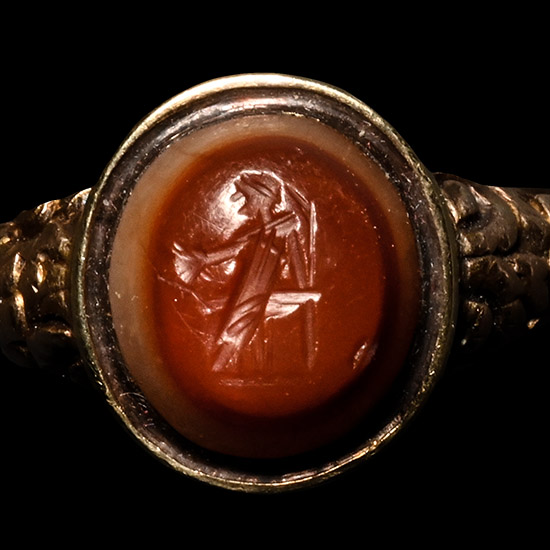
Roman Carnelian Onyx Gemstone of a Seated Muse Set into a Gold Georgian Ring
2nd-3rd century A.D.Sold for (Inc. bp): £572
Cabochon with incuse enthroned Muse with a mask and one hand extended; set into an antique gold ring; supplied with a museum-quality impression. 3.44 grams, 25.11 mm overall, 17.50 mm internal diameter (approximate size British N, USA 6 1/2, Europe 13.72, Japan 13)
Private collection, Europe. Acquired on the English art market. -
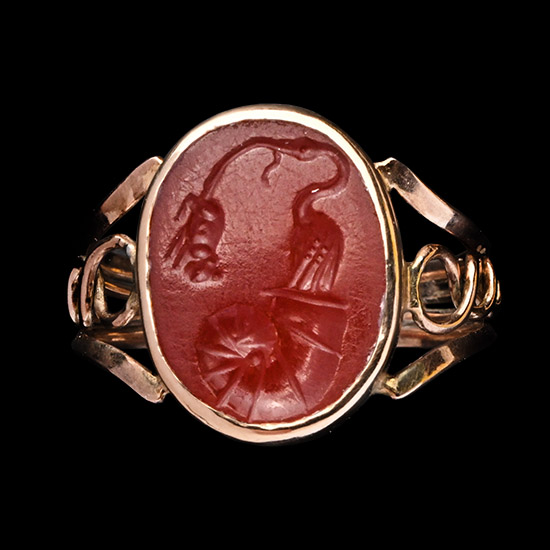
Roman Carnelian Gemstone with Stork Emerging from a Seashell in Gold Ring
1st century B.C.Sold for (Inc. bp): £3,510
The oval intaglio engraved with a whimsical image of a stork emerging from the mouth of a large seashell, its neck arched forward to seize a small mouse by the tail; set in a finely made 19th-century ring with openwork shoulders; supplied with a museum-quality impression. 4.25 grams, 24.31 mm overall, 19.30 mm internal diameter (approximate size British T, USA 9 1/2, Europe 21.26, Japan 20)
Acquired on the European art market. This lot has been checked against the Interpol Database of stolen works of art and is accompanied by search certificate number no.13365-257944.
The stork, a bird symbolic in antiquity of vigilance, filial piety, and longevity, here appears in an imaginative fusion with a marine shell—an element often associated with Venus and the sea. The capture of the mouse adds an element of humour and narrative intrigue, perhaps evoking themes of cunning, the triumph of wit, or the unexpected in nature. Such unusual compositions are occasionally found in Roman glyptics of the late Republican period, appealing both for their novelty and symbolic richness. -
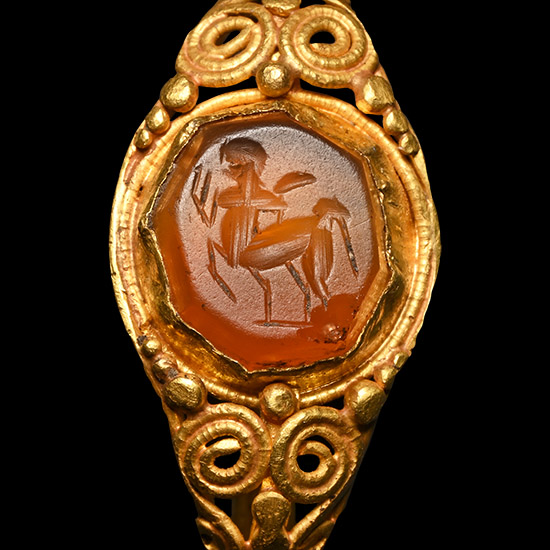
Roman Gold Ring with Carnelian Gemstone with Centaur
Late 2nd-3rd century A.D.Sold for (Inc. bp): £3,640
With broad openwork shoulders and applied filigree scrolls, granulations flanking the cell with an inset facetted octagonal carnelian intaglio with an advancing centaur with a syrinx; supplied with a museum-quality impression. 4.51 grams, 26.50 mm overall, 23.05 x 12.76 mm internal diameter (approximate size British J, USA 4 3/4, Europe 8.69, Japan 8)
Ex German art market, 2000s. Acquired from an EU collector living in London. From the collection of a Surrey, UK, gentleman. -
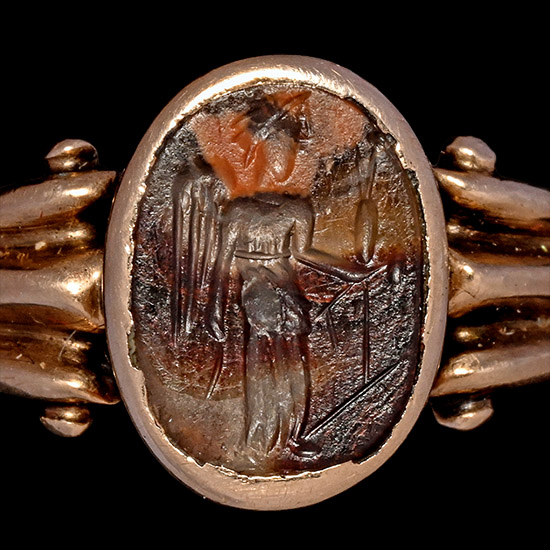
Roman Agate Gemstone of Syncretistic Fortuna in Gold Ring
2nd-3rd century A.D.Sold for (Inc. bp): £819
Intaglio of syncretistic Fortuna, winged like Victory and helmeted like Minerva in a long robe holding a rudder with an ear of corn and poppy; set into an antique gold ring; supplied with a museum-quality impression. 3.22 grams, 23.31 mm overall, 19.46 x 19.15 mm internal diameter (approximate size British R, USA 8 1/2, Europe 18 3/4, Japan 18)
Private collection, Europe. Acquired on the English art market. -
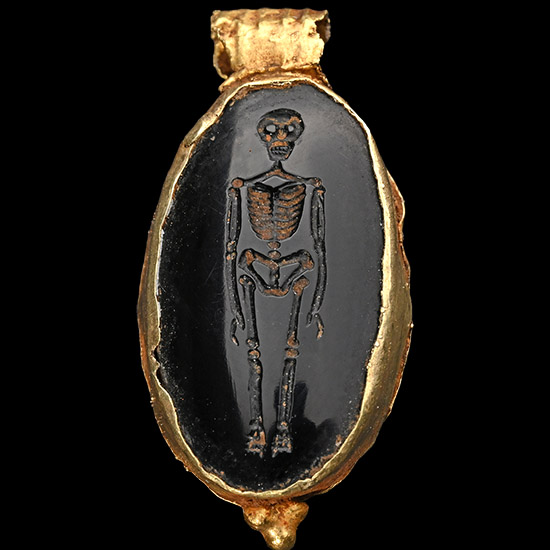
Roman Gold Pendant with Skeleton Gemstone
Circa 2nd-3rd century A.D. or laterSold for (Inc. bp): £3,120
Ellipsoid onyx gemstone with an incuse skeleton motif, set in a gold-sheet cell with granule cluster below and ribbed loop above, reverse with border of pellets enclosing three rosettes. 2.7 grams, 26 mm
From a North American gentleman's collection, 1990s. -
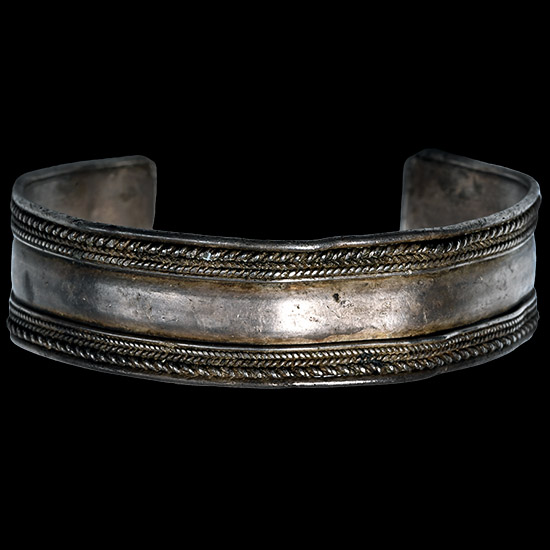
Roman Silver Bracelet with Filigree Wires and Bosses
1st-4th century A.D.Sold for (Inc. bp): £715
Penannular in plan and rectangular in form with applied bands of filigree ropework to the outer edges, granule to each corner. 24.8 grams, 62 mm
From the old family collection of a West Country, UK, lady; acquired by descent from her grandfather circa 2001. -
.jpg)
Roman Silver Pin with God Sol
1st-4th century A.D.Sold for (Inc. bp): £364
Comprising a tapering pin with the finial formed as the draped bust of Sol wearing a radiate crown. 9.39 grams, 10.9 cm
Ex German art market, 2000s. Acquired from an EU collector living in London. From the collection of a Surrey, UK, gentleman. -
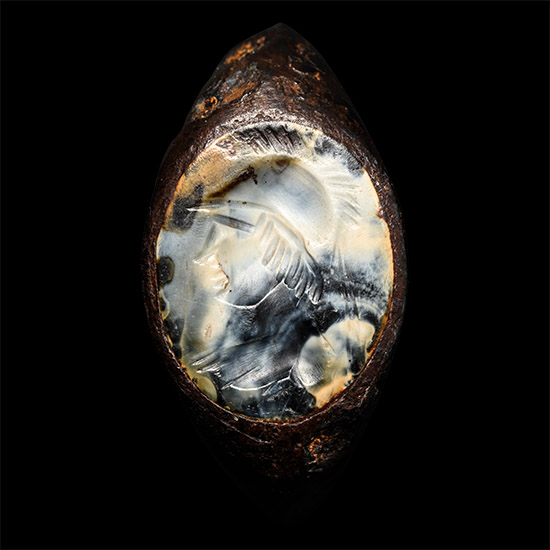
Roman Imperial Military Iron Ring with Burnt Agate Gemstone with a Helmetted Warrior
1st century A.D.Sold for (Inc. bp): £572
Comprising a slender D-section hoop expanding at the shoulders, oval bezel set with an intaglio of a young soldier wearing a crested helmet, either Minerva or Roma. 6.30 grams, 25.14 mm overall, 19.63 x 16.97 mm internal diameter (approximate size British P, USA 7 1/2, Europe 16.23, Japan 15)
UK private collection, acquired on the English market in the 2000s. -
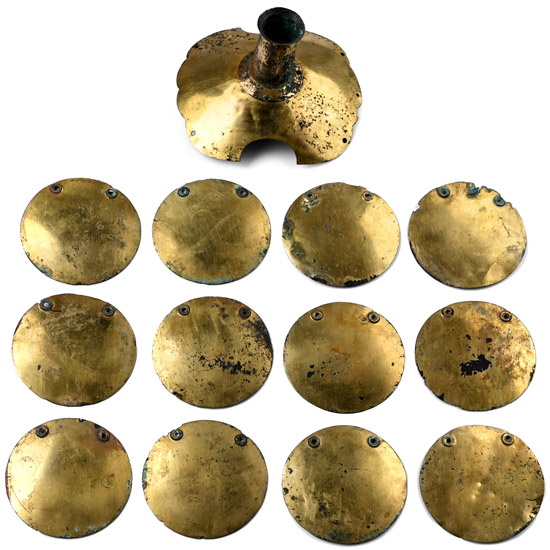
Byzantine Age Gilt Bronze Horse Bridle Decoration Group
9th-10th century A.D.Sold for (Inc. bp): £650
Comprising: a domed cap with lateral scoops and attachment holes to the edges, a central applied tapering tube with flared rim; twelve gently domed disc-scales with two attachment points. 357 grams total, 8.2-13.3 cm
From the private collection of a London gentleman, from his grandfather's collection formed before the early 1970s.
The cap is provided with a plume-holder and two lateral slots for the ears; the scales decorate the rest of the bridle or harness. -
.jpg)
Byzantine Gilt Bronze Horse Harness Decoration Set
8th-10th century A.D.Sold for (Inc. bp): £1,430
Comprising: a large octofoil harness frontal plate with beaded rim and granulation; studs with quatrefoil plates; bell-shaped dangles. 556 grams total, 11-92 mm
From the private collection of a London gentleman, from his grandfather's collection formed before the early 1970s. This lot has been checked against the Interpol Database of stolen works of art and is accompanied by a search certificate number no.12687-234699.
The military technology of Byzantium and Khazar Kingdom were interconnected in the 8th-10th centuries A.D. Many military items, like horse harnesses, were produced in both countries and object of interchange between the two military cultures.

