
Ancient Art, Antiquities, Books, Natural History, Stamps & Coins
Days 1-5
Open For Bidding
Open For Bidding

-
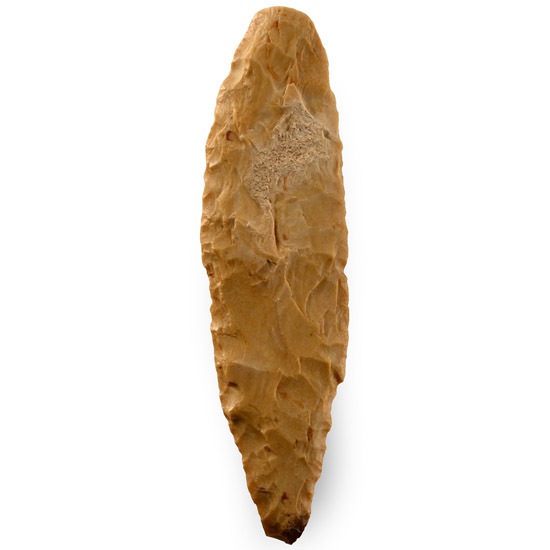
African Stone Age Knapped Knife
Neolithic Period, circa 6000 B.P.Estimate: £70 - 90 (+bp*)
Opening Bid: £5
Parallel-sided lanceolate blade with sharply tapering point. 25.5 grams, 10.7 cm
From El Golea, Africa. Ex old German collection formed in the 1970s by Dr J Fehkhaber. Acquired on the European art market. -
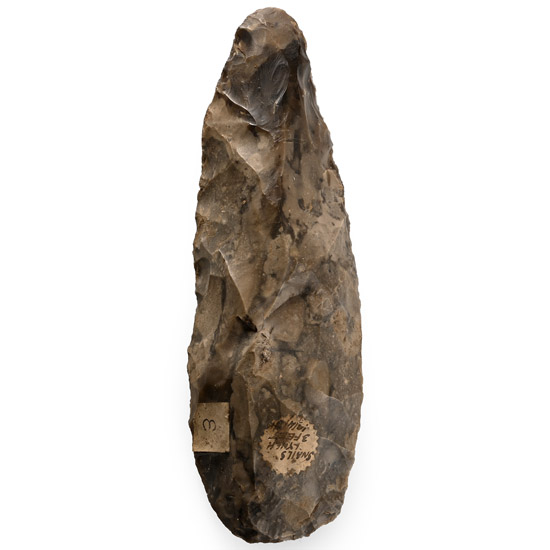
Farnham Large Stone Age Knapped Flint Axe
Neolithic Period, circa 6,000 B.P.Estimate: £150 - 200 (+bp*)
Opening Bid: £5
Leaf-shaped in profile with broad butt and sturdy point; cortex to flat underside; old collector' labels 'Snails Lynch / 3 feet / 19/4/[..]', '3 [..]/38'. 370 grams, 18.5 cm
Found during the original official excavations in the Farnham area, Surrey, UK, which were conducted by Harold Faulker (1875-1963), and William Francis Rankine (c.1877-1962), who were instrumental with the excavation works and pit dwellings at sites including Six Bells, Frensham, Tilford, Thursley and Bagshot, and Waverley, amongst others at and near Farnham in the 1930s and 1940s. Much of the material is now in the prestigious Farnham museum. The present part of the collection having been gifted to their good friend and Haselmere Parish Priest, Charles Borelli (c.1914-2000) of Farnham; who was part of the Borelli family from Italy who emigrated from Lake Como in 1828 to set up the Borelli family watch and jewellery business; thence by family descent to his nephew.
Farnham district is one of the most interesting prehistoric regions in England, and has been visited by a succession of prehistoric peoples from Palaeolithic times onwards. Along the southern slope of the Farnham valley are three gravel terraces, which are famous prehistorically and have yielded large quantities of flint implements and bones of prehistoric animals, notably the mammoth. In prehistoric times, the chalk deposits played an important role in attracting settlers, as they contained rich layers of flint nodules used to make implements. The Farnham Gravels have been an abundant source of Palaeolithic finds, most prominent being hand axes. The axes differ in type, and each type is associated with a cultural phase of the Palaeolithic period. Types similar to these are found in similar deposits in the Somme valley and in many English valley gravels. Flint mining was also carried out by the Neolithic folk. Polished axes and leaf forms, arrowheads and knives, or possibly lance heads, are characteristic of the Neolithic flint work. -
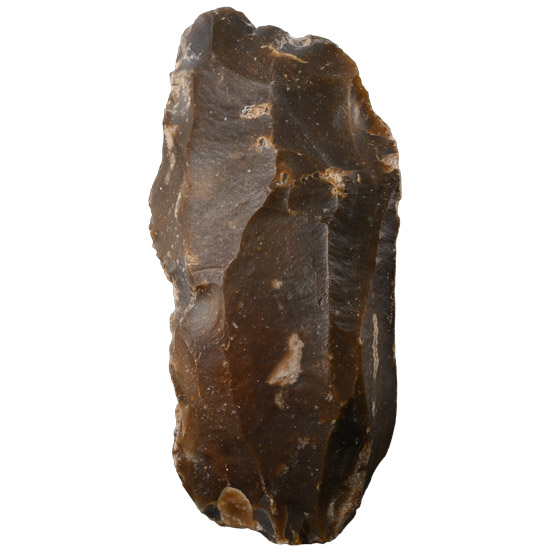
Massive Stone Age 'Livre de Beurre' from Le Grand Pressigny
Neolithic Period, 5500-2400 B.P.Estimate: £150 - 200 (+bp*)
Opening Bid: £5
A substantial flint core or so-called 'Livre de Beurre' with vertical traces of blows on the work side, remains of cortex on one side, slightly rounded blade. 4.8 kg, 29 cm
From the private collection of Kenneth Machin (1936-2020), Buckinghamshire, UK; his collection of antiquities and natural history was formed since 1948; thence by descent. -
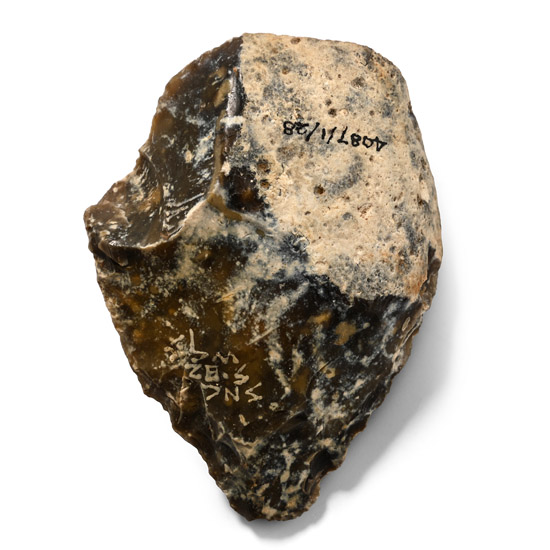
Possible Stone Age Clactonian Flint Scraper
Lower Palaeolithic Period, circa 700,000-300,000 B.P. or laterEstimate: £30 - 40 (+bp*)
Opening Bid: £5
Piriform in plan with a rounded butt, possibly natural, two old inked collection notes 'SNC S.82 WGS' and 4087/1/28', and a pencilled note '74.7' to the other side. 74.9 grams, 72 mm
Previously in several old collections, having been annotated with three different accession numbers. Acquired from an Oxfordshire, UK, auction house. From the private collection of a West Midlands lady collector. -
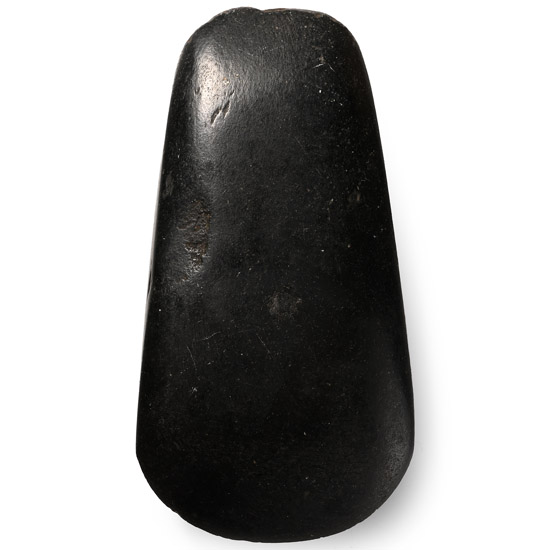
Farnham Stone Age Polished Axehead
Neolithic Period, circa 6,000 B.P.Estimate: £150 - 200 (+bp*)
Opening Bid: £5
Trapezoidal in plan with asymmetrical curved cutting edge, polished surface. 303 grams, 12 cm
Found during the original official excavations in the Farnham area, Surrey, UK, which were conducted by Harold Faulker (1875-1963), and William Francis Rankine (c.1877-1962), who were instrumental with the excavation works and pit dwellings at sites including Six Bells, Frensham, Tilford, Thursley and Bagshot, and Waverley, amongst others at and near Farnham in the 1930s and 1940s. Much of the material is now in the prestigious Farnham museum. The present part of the collection having been gifted to their good friend and Haselmere Parish Priest, Charles Borelli (c.1914-2000) of Farnham; who was part of the Borelli family from Italy who emigrated from Lake Como in 1828 to set up the Borelli family watch and jewellery business; thence by family descent to his nephew.
Farnham district is one of the most interesting prehistoric regions in England, and has been visited by a succession of prehistoric peoples from Palaeolithic times onwards. Along the southern slope of the Farnham valley are three gravel terraces, which are famous prehistorically and have yielded large quantities of flint implements and bones of prehistoric animals, notably the mammoth. In prehistoric times, the chalk deposits played an important role in attracting settlers, as they contained rich layers of flint nodules used to make implements. The Farnham Gravels have been an abundant source of Palaeolithic finds, most prominent being hand axes. The axes differ in type, and each type is associated with a cultural phase of the Palaeolithic period. Types similar to these are found in similar deposits in the Somme valley and in many English valley gravels. Flint mining was also carried out by the Neolithic folk. Polished axes and leaf forms, arrowheads and knives, or possibly lance heads, are characteristic of the Neolithic flint work. -
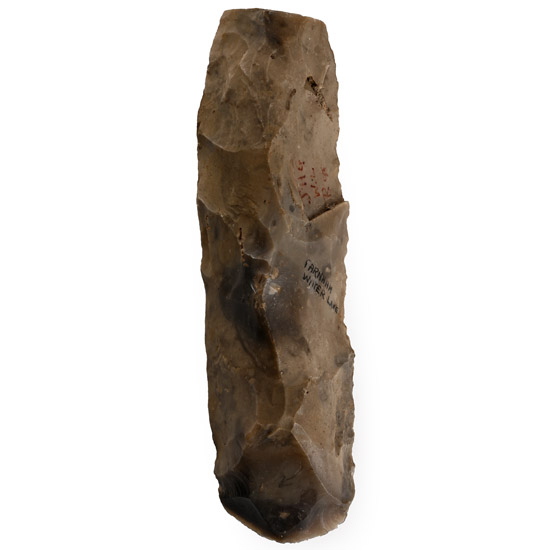
Farnham Stone Age Knapped Flint Axe
Neolithic Period, circa 6,000 B.P.Estimate: £100 - 140 (+bp*)
Bids: 1 | Current Bid: £5
Triangular in section with old inked legends 'Farnham Water Lane', 'JHG/W.L/R93', 'W.L. surface by gra[v]es' and other partly effaced. 253 grams, 14.9 cm
Found during the original official excavations in the Farnham area, Surrey, UK, which were conducted by Harold Faulker (1875-1963), and William Francis Rankine (c.1877-1962), who were instrumental with the excavation works and pit dwellings at sites including Six Bells, Frensham, Tilford, Thursley and Bagshot, and Waverley, amongst others at and near Farnham in the 1930s and 1940s. Much of the material is now in the prestigious Farnham museum. The present part of the collection having been gifted to their good friend and Haselmere Parish Priest, Charles Borelli (c.1914-2000) of Farnham; who was part of the Borelli family from Italy who emigrated from Lake Como in 1828 to set up the Borelli family watch and jewellery business; thence by family descent to his nephew.
Farnham district is one of the most interesting prehistoric regions in England, and has been visited by a succession of prehistoric peoples from Palaeolithic times onwards. Along the southern slope of the Farnham valley are three gravel terraces, which are famous prehistorically and have yielded large quantities of flint implements and bones of prehistoric animals, notably the mammoth. In prehistoric times, the chalk deposits played an important role in attracting settlers, as they contained rich layers of flint nodules used to make implements. The Farnham Gravels have been an abundant source of Palaeolithic finds, most prominent being hand axes. The axes differ in type, and each type is associated with a cultural phase of the Palaeolithic period. Types similar to these are found in similar deposits in the Somme valley and in many English valley gravels. Flint mining was also carried out by the Neolithic folk. Polished axes and leaf forms, arrowheads and knives, or possibly lance heads, are characteristic of the Neolithic flint work. -
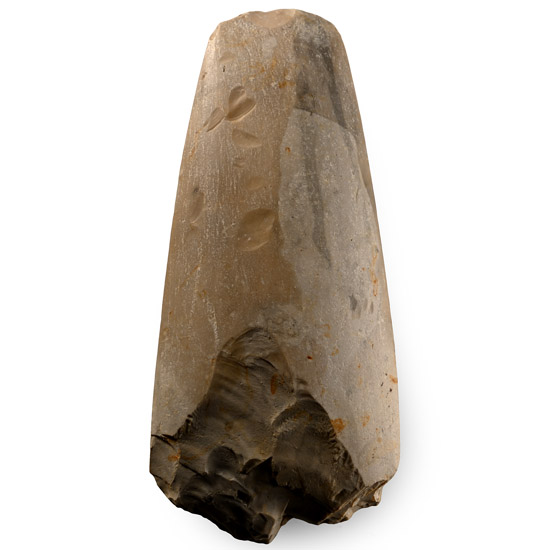
Horsham Large Stone Age Polished Axehead
Neolithic Period, circa 6,000 B.P.Estimate: £60 - 80 (+bp*)
Opening Bid: £5
Trapezoidal in plan with narrow butt and broad cutting edge; chipped. 414 grams, 14.6 cm
Found Horsham, West Sussex, UK. From the private collection of a Sussex, UK, gentleman. -
.jpg)
French Stone Age Solutrean Knapped Flint Leaf Point - Ex Sir Arthur Evans
Upper Palaeolithic Period, 22,000-17,000 B.P.Estimate: £100 - 140 (+bp*)
Opening Bid: £5
Triangular, flat point of grey-brown flint, one blade is slightly excurvate, and the other excurvated at the terminal end, the base broken straight across. 15.5 grams, 56 mm
Found in Les Eyries Cave, Dordogne, France. Received in a Museum exchange in 1900. Ex Sir Arthur John Evans (1851–1941), British archaeologist and son of Sir John Evans (1823-1908). Ex Henry Dewey (1876–1965), a prominent British geologist and archaeologist who made seminal contributions to the study of the Palaeolithic period. Ex R Richard Widdowson, a well-known UK-based antiquities specialist who owned the gallery 'Ancient Times' in Scarborough in Southern England. Ex J Weston Smith. Accompanied by an illustrated envelope and two collector's information cards. -
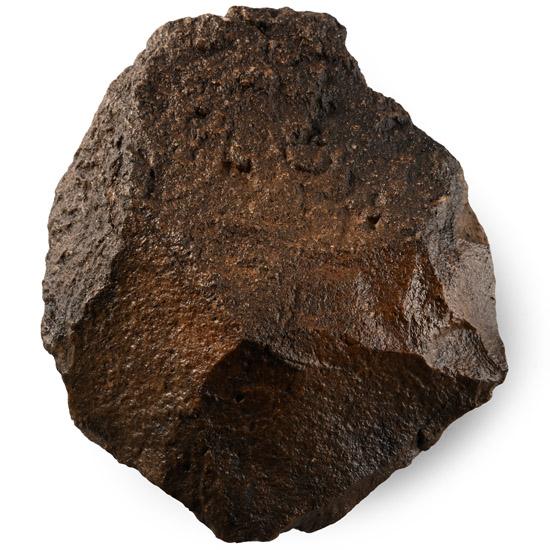
African Stone Age Homo Erectus Knapped Cleaver Type Handaxe
Lower Palaeolithic Period, circa 1,000,000-500,000 B.P.Estimate: £60 - 80 (+bp*)
Opening Bid: £5
Cordate type in dark red quartzite with broad edge. 674 grams, 12.3 cm
From the Northern Sahara, North Africa. From a collection formed during the 1970s and 1980s, having been acquired on the British art market; thence by descent to the current owner in 1998. -
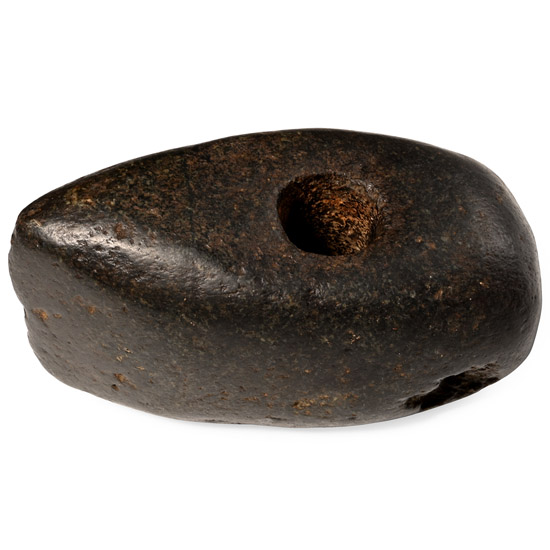
Stone Age Pecked and Polished Black Stone Pierced Boat-Shaped Axehead
Neolithic Period, circa 6,000 B.P.Estimate: £200 - 300 (+bp*)
Opening Bid: £100
Featuring a rounded butt and a round socket. 743 grams, 12.1 cm
From an old English, UK, collection. Acquired on the UK art market. Property of a London, UK, antiquarian. -
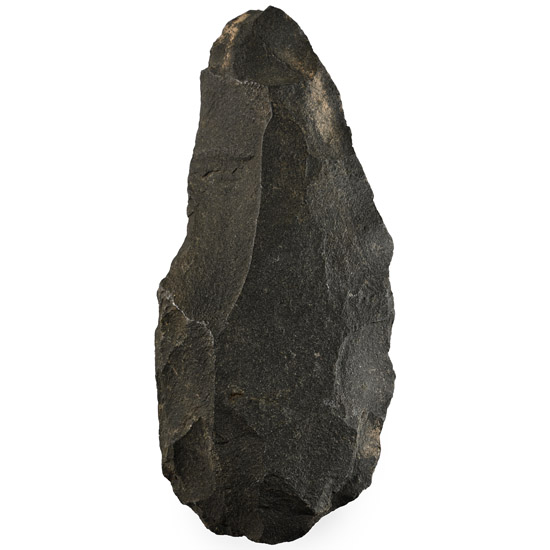
African Stone Age Homo Erectus Knapped Handaxe
Lower Palaeolithic Period, circa 1,000,000-500,000 B.P.Estimate: £80 - 100 (+bp*)
Opening Bid: £5
Ovate in plan with a curving blade and a narrow butt. 370 grams, 14.5 cm
From Central Sahara, Africa. Ex old German collection formed in the 1970s by Dr J Fehkhaber. Acquired on the European art market. -
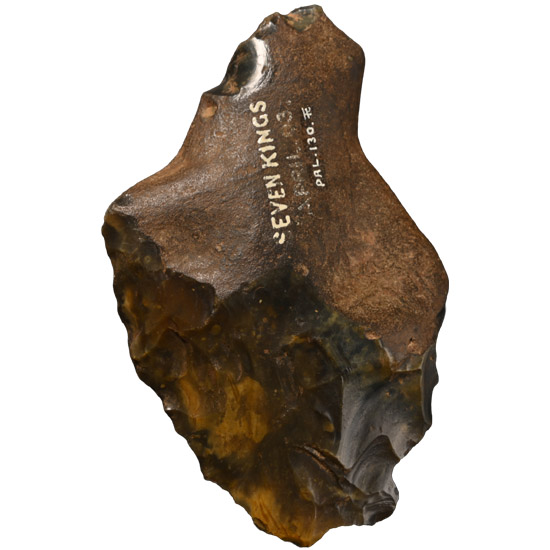
British Stone Age Knapped Flint Axe
Middle Palaeolithic Period, circa 150,000-60,000 B.P.Estimate: £150 - 200 (+bp*)
Bids: 1 | Current Bid: £5
In dark brown flint, an old inked collector's note 'Seven Kings, April [?]3, PAL.130. (monogram)' on one side. 167 grams, 11.5 cm
Found in Seven Kings, East London, UK. From the collection of Martin Doyle, Leverstock, UK, 1980s-2000s.
