-

Egyptian Steatite Heart Scarab
Late Period, 664-332 B.C.Sold for (Inc. bp): £221
With ribbed carapace and suspension loop to underside. 2.89 grams, 22 mm
Acquired on the European art market in the early 2000s. with Galerie Rhéa, Zurich, Switzerland. -
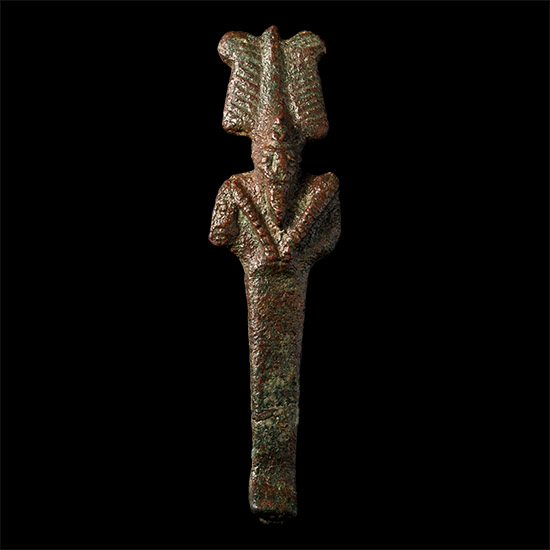
Egyptian Bronze Osiris Figure
Late-Ptolemaic Period, circa 664-30 B.C.Sold for (Inc. bp): £156
Standing pose wearing the atef crown with flanking ostrich plumes and frontal uraeus; holding the crook (heka) and flail (nekhakha) regalia in his crossed hands; peg to underside of feet; repaired. 16.17 grams, 68 mm
From the private collection of a Canadian gentleman living in Essex, UK, formed since the 1920s-circa 1990. Property of an Essex lady until the late 1990s; thence by descent. From the private collection of an Essex gentleman since the late 1990s. -
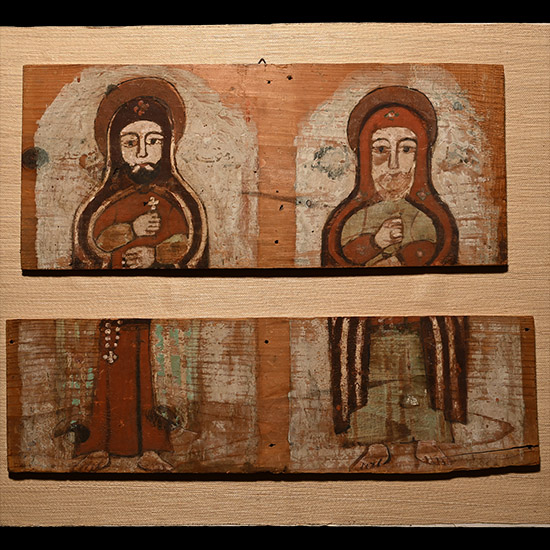
Late Coptic Panels Decorated with Two Standing Saints
17th-18th century A.D.Sold for (Inc. bp): £3,900
Two wooden panels showing two standing nimbate figures, probably Saint Daloucham on the right, wearing a red veil, and a bearded figure on the left, probably Saint Pachomius, holding a small cross and prayer beads; mounted on a fabric-covered backing board. 1.05 kg total, 65.2 x 50 cm
Leclere, Marseille, 20 April 2013, no.99. Private collection, UK. Accompanied by an academic report by Dr Raffaele D’Amato. This lot has been checked against the Interpol Database of stolen works of art and is accompanied by search certificate number no.12184-221677.
Stylistically, the icon can be compared to the paintings in the Church of St. Thomas in Achmim, which could also help identify one of the two saints. Especially important in this regard are the parallels between the robes of the saints and those of Saint Thomas in the church’s Doom, with long folds coloured with identical colours; the floral decoration of the sleeves of the inner tunic, and the faces of the Saints, with oval and widened eyes. The influence of Ethiopian paintings of the same period is evident in the Church of Achmim, like in this icon. The painting preserves the distant memory of medieval paintings, through a Coptic cultural humus whose vestiges are still today in Egypt, Nubia and Ethiopia. In the Church of Achmim are represented the martyrs of Achmim, i.e. Saint Pachomius and his sister Saint Daloucham. It is not impossible that one of the represented ascetic monks could be Pachomius. It is also probable that the icon was part of a wider group, representing also other important characters of the Coptic Church. -
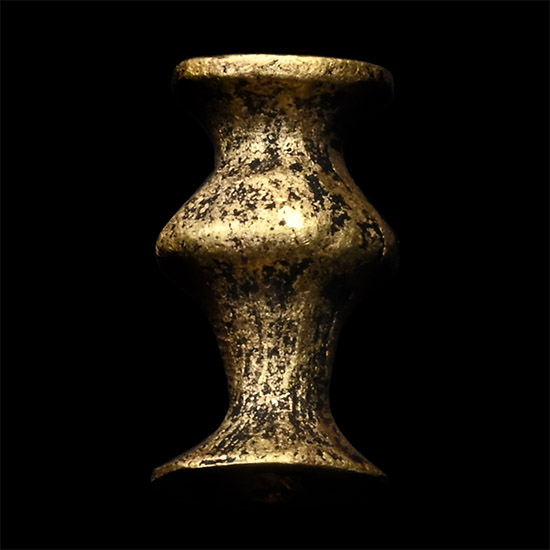
Egyptian Gold Bead Amulet
Late New Kingdom-Third Intermediate Period, circa 1069-900 B.C.Sold for (Inc. bp): £169
Formed as a poppy seed with flaring terminals. 0.91 grams, 9 mm
Ex French art market, 1920s. -
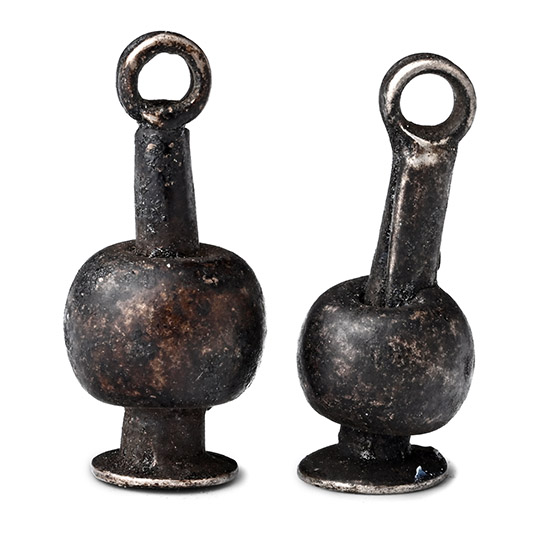
Egyptian Silver Poppy Amulets
New Kingdom-Late Period, 1550-332 B.C.Sold for (Inc. bp): £117
Matched pair of amulets with a long cylindrical neck and a spherical body, with a ribbed suspension loop above. 2.12 grams total, 15-16 mm
Ex London, UK, collection, 1920s-1940s. Accompanied by a previously illustrated catalogue card with provenance.
Amulets in the form of poppies were used to heal and alleviate pain. These types of amulets were also linked to Osiris, the Egyptian deity of agriculture, death, and the afterlife. -
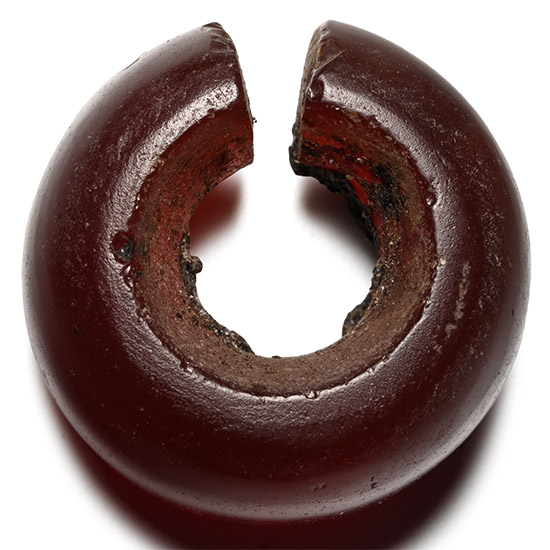
Egyptian Hardstone Hair Ring
New Kingdom, 1550-1070 B.C.Sold for (Inc. bp): £117
Circular with a semi-circular profile and an opening on one side. 3.57 grams, 17 mm
From a 20th century UK collection. Accompanied by a previously illustrated catalogue card with provenance. -
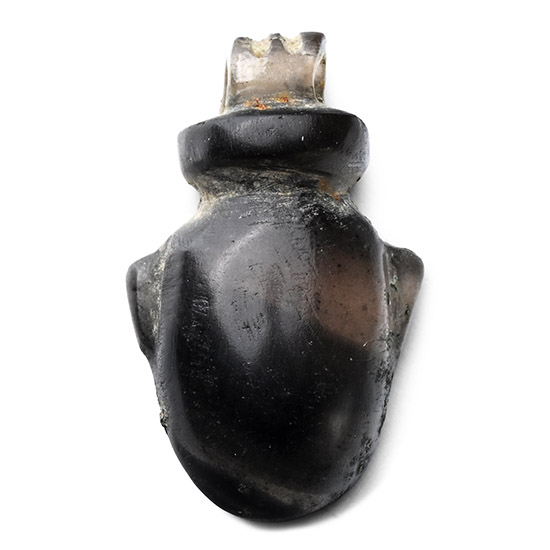
Egyptian Smoky Quartz Heart Amulet
Late Period, 664-332 B.C.Sold for (Inc. bp): £156
Carved with lateral triangular lugs, a pronounced rim surmounted by a ribbed suspension loop. 0.76 grams, 16 mm
From a 20th century UK collection. -
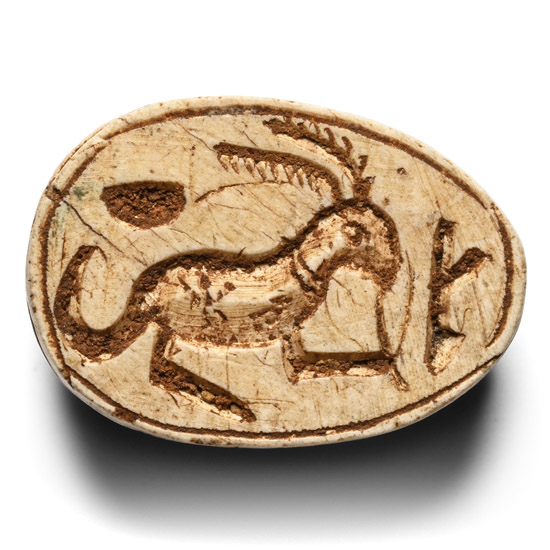
Egyptian Steatite Scarab with Hare
Late Period-Ptolemaic Period, 664-30 B.C.Sold for (Inc. bp): £182
Anatomical detailing on the carapace and pierced longitudinally; underside with a reclining hare and two hieroglyphs. 3.07 grams, 19 mm
From the private collection of a European gentleman (1942-2024), formed since the 1970s.
The Egyptian hare, Cape Hare, was associated with the goddess Wenut, whose name means the 'swift one'. -
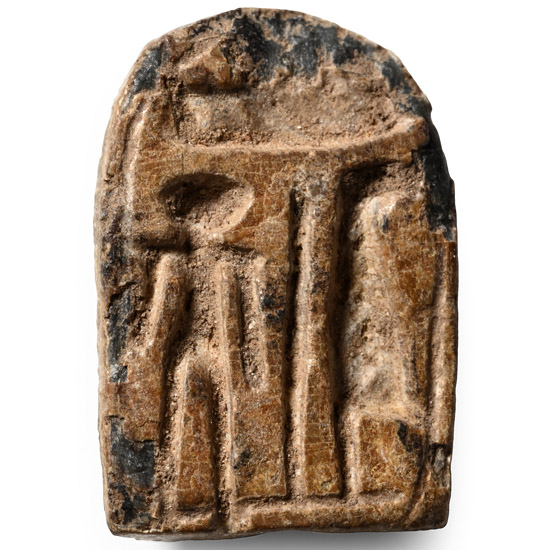
Egyptian Steatite Tilapia Fish Plaque Amulet
Late Period, 664-332 B.C.Sold for (Inc. bp): £117
The domed upper face shaped as a fish with scale detailing, the underside has three hieroglyphs consisting of a men (draughtboard) sign, with a figure of a standing deity wearing a sun-disc crown next to a large Maat feather to the right, pierced longitudinally. 1.72 grams, 16 mm
Ex Mustaki collection, early 20th century, UK. Accompanied by a previously illustrated catalogue card with provenance.
Fish amulets symbolised regeneration. -
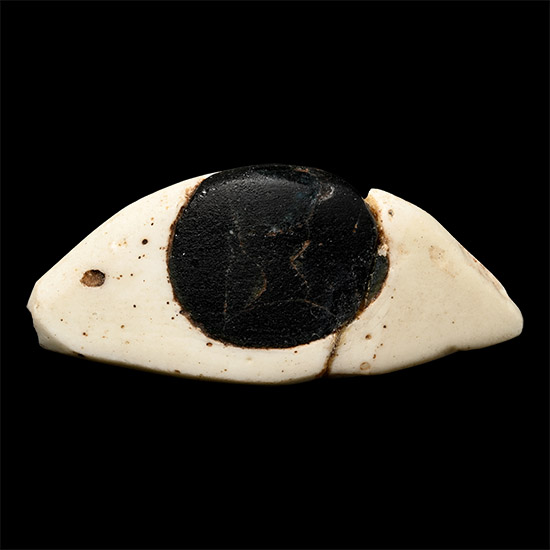
Egyptian Glass Mummy Eye
Ptolemaic Period, circa 332-30 B.C.Sold for (Inc. bp): £234
White sclera with inset black glass iris; old dealer's ticket with legend; repaired. 5 grams, 36 mm
Ex John Cummings Ltd., Lincolnshire, UK. From the private collection of a Canadian gentleman living in Essex, UK, formed since the 1920s-circa 1990. Property of an Essex lady until the late 1990s; thence by descent. From the private collection of an Essex gentleman since the late 1990s. Accompanied by an old information card. -
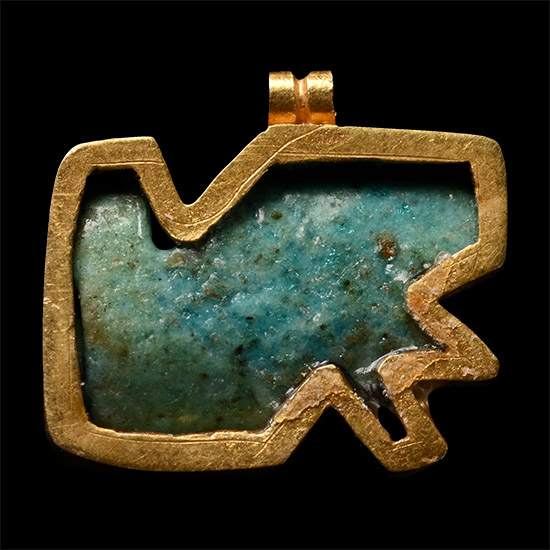
Egyptian Faience Eye of Horus in Gold Pendant
Late Period, 664-332 B.C. and laterSold for (Inc. bp): £124
Comprising a turquoise-glazed wedjat amulet set in a 14-carat gold pendant mount. 1.09 grams, 14 mm
Ex important German collection, 1960-1990.
The wedjat-eye amulet (also called the Eye of Horus) became one of the most recognisable symbols in ancient Egyptian culture. It signifies protection, healing, and restoration. In myth, Horus lost his eye during his battle with Seth, and it was later magically restored, symbolising healing and the return to wholeness. The Eye of Horus came to embody divine power and protection, and was often used in amulets to safeguard and promote well-being. -
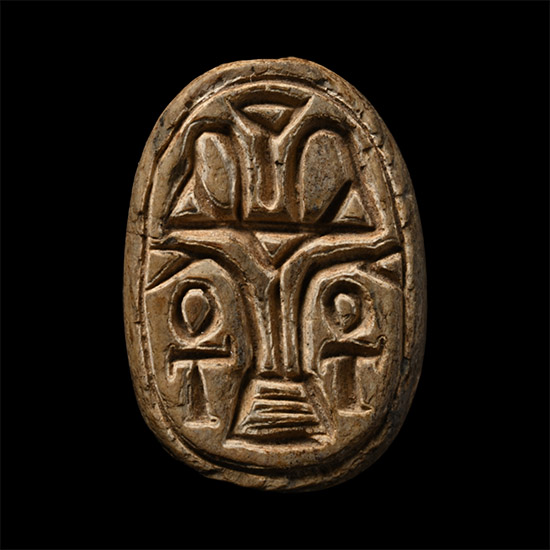
Egyptian Steatite Scarab
Middle Kingdom-Second Intermediate Period, circa 1900-1560 B.C.Sold for (Inc. bp): £182
Plano-convex in section with segmented carapace and mouth parts; to the underside, the 'Sema-Tawy' central motif and two flanking ankh glyphs. 5.2 grams, 22 mm
From the collection of David Donlan (1947-2025), a dedicated and lifelong collector with a passion for the ancient world and the natural sciences, forming his collection from the 1960s onwards, using many reputable dealers across the United Kingdom, including the well-regarded Coincraft and The Parthenon Gallery.
The 'sema- tawy' is a powerful symbol representing the unification of Upper and Lower Egypt. It traditionally consists of a windpipe entwined with lotus and papyrus plants. The ankh signs are the Egyptian hieroglyphs for 'life'.

