-
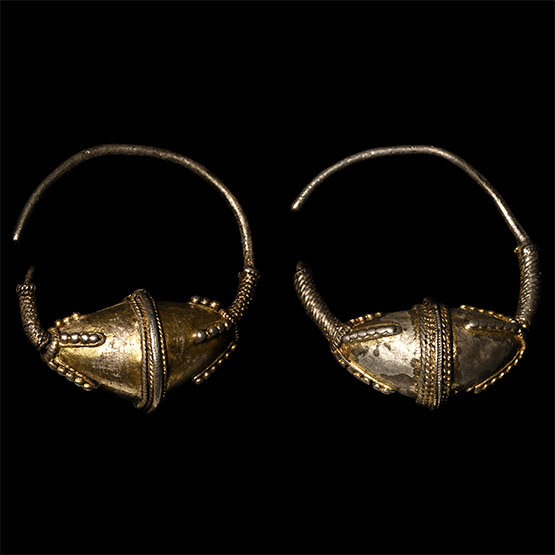
Byzantine Silver-Gilt Earring Pair
6th-10th century A.D.Sold for (Inc. bp): £187
A matched pair with round-section hoops and decorative 'bulbs' featuring medial ropework collars, with applied beads and collars of 'ropework' to both ends. 9.54 grams total, 35-36 mm
Ex German art market, 2000s. Acquired from an EU collector living in London. From the collection of a Surrey, UK, gentleman. -
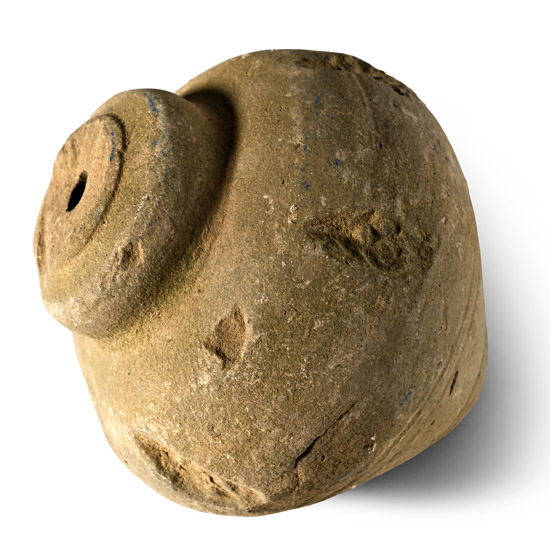
Byzantine 'Greek Fire' Ceramic Fire Bomb or Hand Grenade
9th-11th century A.D.Sold for (Inc. bp): £59
Piriform body with circumferential bands and impressed motifs on the shoulder and wide neck; intended to be filled with explosive liquid and a wick, and used as a hand grenade. 562 grams, 10.3 cm
From an important specialist collection, London, UK, 1990s. Accompanied by an academic paper by military specialist Dr Raffaele D'Amato, dated 15 July 2019 and titled 'Eastern Roman Empire - Greek Fire Bomb or Hand Grenade (μεσαίον kακάβιον) 9th-11th century AD'.
Apart from the use of siphons or manual flame-throwers called cheirosiphona, special corps of Roman soldiers employed terracotta grenades, in the form of small jars, abundantly evidenced in archaeological excavations. They were called μεσαία kακαβιά or κυτροκακάβια where the former had a bulbous shape and the latter a more cylindrical form. -
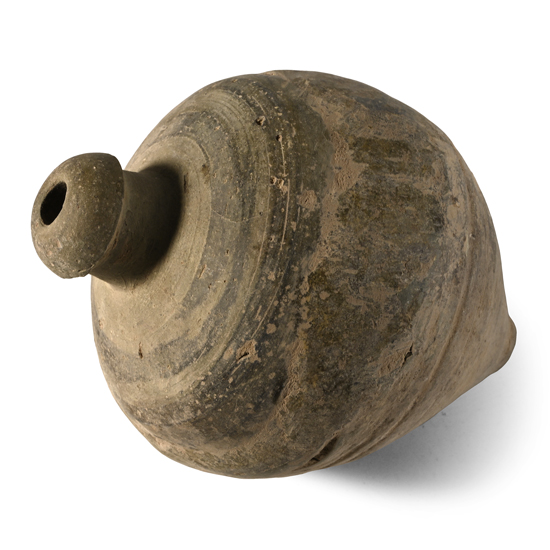
Byzantine 'Greek Fire' Ceramic Fire Bomb or Hand Grenade
9th-11th century A.D.Sold for (Inc. bp): £78
Piriform in profile with a domed filler hole, linear decoration; intended to be filled with explosive liquid and a wick, and used as a hand grenade. 513 grams, 12.2 cm
From an important specialist collection, London, UK, 1990s. Accompanied by an academic paper by military specialist Dr Raffaele D'Amato, dated 15 July 2019 and titled 'Eastern Roman Empire - Greek Fire Bomb or Hand Grenade (μεσαίον kακάβιον) 9th-11th century AD'.
Apart from the use of siphons or manual flame-throwers called cheirosiphona, special corps of Roman soldiers employed terracotta grenades, in the form of small jars, abundantly evidenced in archaeological excavations. They were called μεσαία kακαβιά or κυτροκακάβια, where the former had a bulbous shape and the latter a more cylindrical form. -
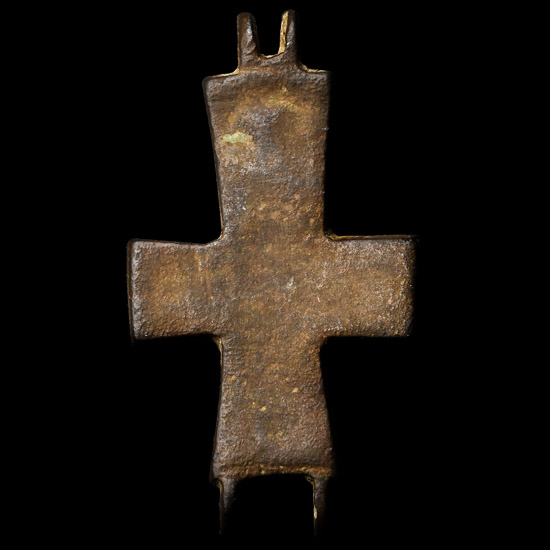
Byzantine Bronze Reliquary Cross Pendant Plate
Circa 10th-12th century A.D.Sold for (Inc. bp): £26
A plain plate from an enkolpion with hinge-loops at each end. 7.36 grams, 48 mm
Acquired on the UK art market from the 1990s. From the private collection of a Lincolnshire, UK, gentleman. -
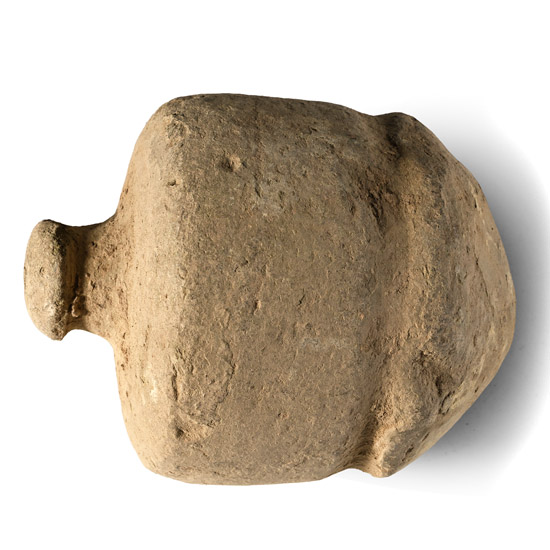
Byzantine 'Greek Fire' Ceramic Fire Bomb or Hand Grenade
9th-11th century A.D.Sold for (Inc. bp): £39
Cylindrical body with thickened base and angled shoulder; intended to be filled with explosive liquid and a wick, and used as a hand grenade. 365 grams, 10.1 cm
From an important specialist collection, London, UK, 1990s. Accompanied by an academic paper by military specialist Dr Raffaele D'Amato, dated 15 July 2019 and titled 'Eastern Roman Empire - Greek Fire Bomb or Hand Grenade (μεσαίον kακάβιον) 9th-11th century AD'.
Apart from the use of siphons or manual flame-throwers called cheirosiphona, special corps of Roman soldiers employed terracotta grenades, in the form of small jars, abundantly evidenced in archaeological excavations. They were called μεσαία kακαβιά or κυτροκακάβια where the former had a bulbous shape and the latter a more cylindrical form. -
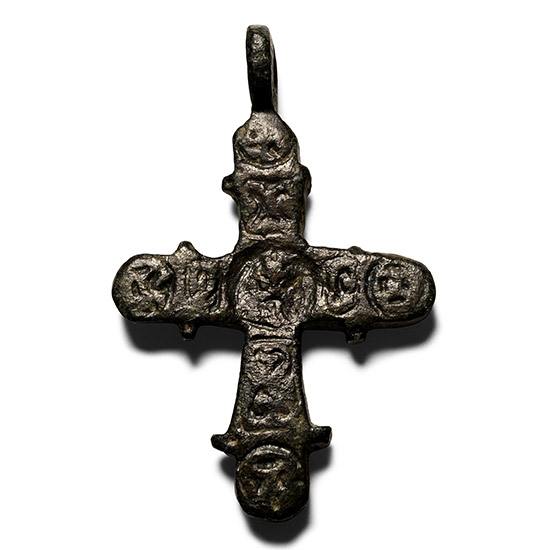
Byzantine Bronze Cross Pendant
12th-14th century A.D.Sold for (Inc. bp): £98
Bifacial pendant with remains of inscription(?) on one side and the other with decorated arms and a bust in a circlet at the centre. 4.55 grams, 36 mm
Ex German art market, 2000s. Acquired from an EU collector living in London. From the collection of a Surrey, UK, gentleman. -
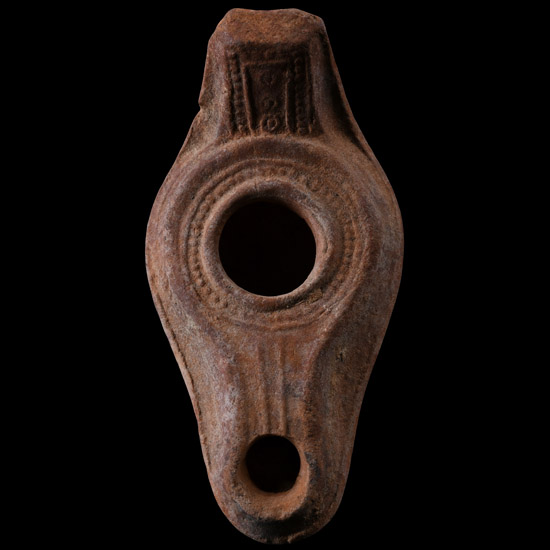
Byzantine Period Terracotta Oil Lamp
Circa 5th-7th century A.D.Sold for (Inc. bp): £46
Slipper type with a wide nozzle and a raised handle with pellet and ring-and-dot decoration to the rear, three vertical bands behind the handle, a band of pellets surrounding the filler-hole. 104 grams, 10.6 cm
From the collection of a Yorkshire, UK gentleman, items collected in the Holy Land in the 1960s. -
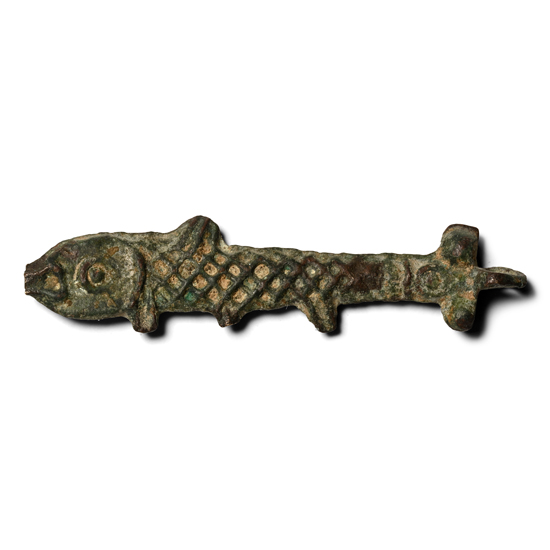
Byzantine Bronze Fish Pendant
6th-10th century A.D.Sold for (Inc. bp): £98
Bifacial pendant with crosshatching on the body, large ring-and-dot eyes and small raised fins, integral suspension loop above. 6.11 grams, 52 mm
Ex German art market, 2000s. Acquired from an EU collector living in London. From the collection of a Surrey, UK, gentleman. -
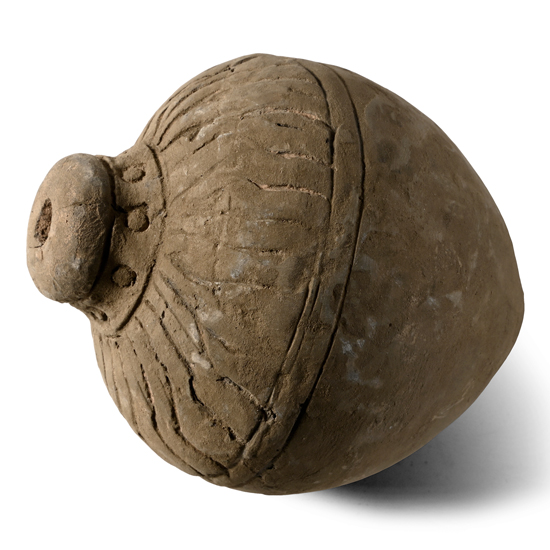
Byzantine 'Greek Fire' Ceramic Fire Bomb or Hand Grenade
9th-11th century A.D.Sold for (Inc. bp): £104
Ovoid in profile with domed filler hole, linear decoration with a band of annulets below the neck; intended to be filled with explosive liquid and a wick, and used as a hand grenade. 408 grams, 10.9 cm
From an important specialist collection, London, UK, 1990s. Accompanied by an academic paper by military specialist Dr Raffaele D'Amato, dated 15 July 2019 and titled 'Eastern Roman Empire - Greek Fire Bomb or Hand Grenade (μεσαίον kακάβιον) 9th-11th century AD'.
Apart from the use of siphons or manual flame-throwers called cheirosiphona, special corps of Roman soldiers employed terracotta grenades, in the form of small jars, abundantly evidenced in archaeological excavations. They were called μεσαία kακαβιά or κυτροκακάβια, where the former had a bulbous shape and the latter a more cylindrical form. -
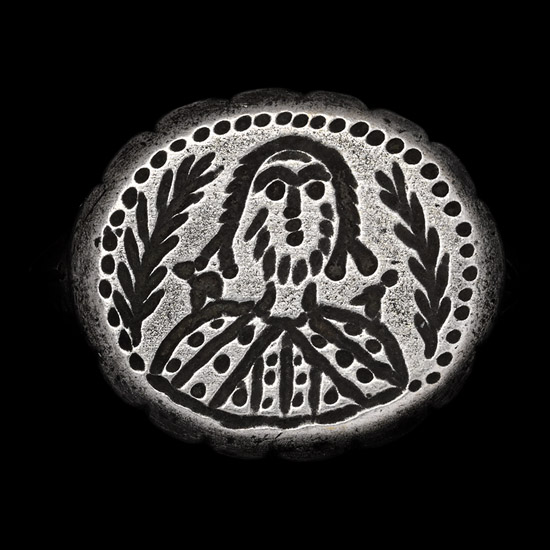
Byzantine Silver Ring with Bust
12th-15th century A.D.Sold for (Inc. bp): £234
Featuring a D-section hoop with a palm frond on both shoulders, oval bezel with a piecrust edge and pelletted border, central profile bust of a robed and bearded man flanked by palm fronds. 7.45 grams, 22.59 mm overall, 18.57 mm internal diameter (approximate size British Q, USA 8, Europe 17.49, Japan 16)
From the collection of a gentleman, acquired on the London art market in the 1990s. -
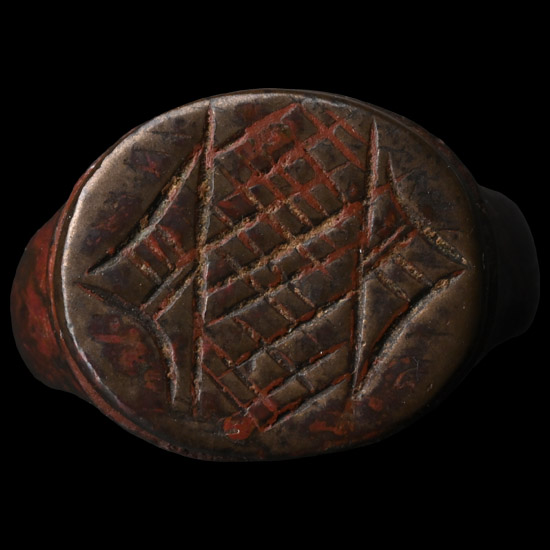
Byzantine Bronze Ring with Hatched Design
12th-15th century A.D.Sold for (Inc. bp): £52
D-section hoop with a raised boss at the base, large oval bezel with hatched decoration. 10.88 grams, 23.12 mm overall, 19.20 mm internal diameter (approximate size British Q, USA 8, Europe 17.49, Japan 16)
Acquired Town Hall Antiques, Market Place, Woburn, Bedfordshire, UK, on 5th June 1998. Property of a West Northamptonshire, UK, gentleman. Accompanied by the original Town Hall Antiques invoice. -
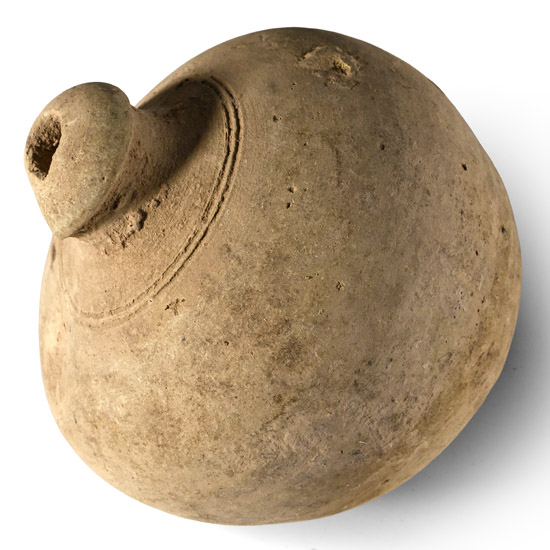
Byzantine 'Greek Fire' Ceramic Fire Bomb or Hand Grenade
9th-11th century A.D.Sold for (Inc. bp): £59
Bulbous body with domed filler hole, two circumferential bands below the neck; intended to be filled with explosive liquid and a wick, and used as a hand grenade. 407 grams, 89 mm
From an important specialist collection, London, UK, 1990s. Accompanied by an academic paper by military specialist Dr Raffaele D'Amato, dated 15 July 2019 and titled 'Eastern Roman Empire - Greek Fire Bomb or Hand Grenade (μεσαίον kακάβιον) 9th-11th century AD'.
Apart from the use of siphons or manual flame-throwers called cheirosiphona, special corps of Roman soldiers employed terracotta grenades, in the form of small jars, abundantly evidenced in archaeological excavations. They were called μεσαία kακαβιά or κυτροκακάβια where the former had a bulbous shape and the latter a more cylindrical form.

