-
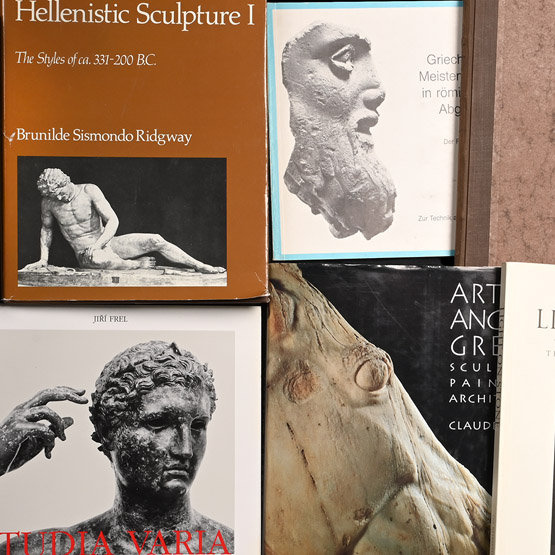
Books on Ancient Greek and Hellenistic Marble Sculpture - 8 Titles
1904-2003 A.D.Sold for (Inc. bp): £46
J. Coscia - Light on Stone: Greek and Roman Sculpture in the Metropolitan Museum of Art - New York,2003, card covers, 100pp, monochrome; C. Laisné - Art of Ancien Greece: Sculpture, Painting, Architecture - Paris, 1995, hardback with dustwrapper, 208 pp, colour; J. Frel - Studia Varia - Rome, 1994, card covers, 209 pp, monochrome; F. Poulsen - Sculptures Antiques de Musées de Province Espagnols - Copenhagen, 1933, hardback library binding, 72 pp, 76 plates, monochrome; Skulpturhall Basel - Grieschische Meisterwerke in Romischen Abgussen - Basel, 1982, card covers, 54 pp, monochrome; Kunstsammlung Dresden - Griechische Skulpturen und Fragmente - Dresden, 1989, card covers, 43 pp, monochrome; Brunilde S. Ridgway - Hellenistic Sculprure I: The Stylesof ca. 331-200 B.C. - Madison, 1990, hardback with dustwrapper, 403 pp, 187 monochrome plates; A.H. Smith - A Catalogue of Sculpture in the Department of Greek and Roman Antiquities, British Museum Vol.III - London, 1904, hardback with cloth covers, 481 pp, 29 monochrome plates. 6.94 kg total, 23.4 x 15 - 30.8 x 25 cm
Property of a London, UK, gentleman. -
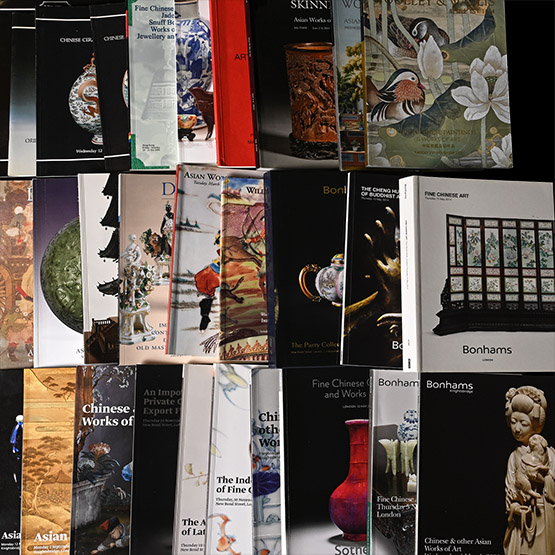
Bonhams, Doyle and Other Chinese and Asian Art Auction Catalogue Group - 29 Titles
1990-2021 A.D.Sold for (Inc. bp): £46
BONHAMS LONDON: Chinese & other Asian Works of Art, 4 March 2009; Fine Chinese Art, 5 November 2009; Fine Chinese Ceramics and Works of Art, 12 May 2010; Chinese & other Asian Works of Art, 7 September 2011; The Inder Rieden Collection of Fine Chinese Porcelain, 10 November 2011; The Anthony Evans Collection of Later Chinese Porcelain, 10 November 2011; An Important European Private Collection of Chinese Export Figures, 10 November 2011; Chinese & other Asian Works of Art, 14 May 2012; Asian Art, 2 September 2013; Asian Art, 12 May 2014; Fine Chinese Art, 15 May 2014; The Chen Huan Collection of Buddhist Art, 15 may 2014; The Parry Collection of Chinese Art, 2 November 2021; WILLIAM DOYLE GALLERIES: Important English 7 Continental Furniture 7 Decorations, 29 January 1997; Asian Works of Art, 31 March 1998; DOYLE, NEW YORK: Important English and Continental Furniture and Decorations and Old Master Paintings and Drawings, 23-24 January 2008; Asian Works of Art, 14 September 2009; Asian Works of Art, 22 March 2010; Asian Works of Art, 13 September 2010; WOOLLEY & WALLIS: Fine Chinese Paintings & Works of Art, 23 November 2021; Asian Art II, 24 November 2021; SKINNER: Asian Works of Art, 2-4 June 2011; JEAN-LOUIS PICARD: Art D'Extreme Orient, 25-26 May 1993; GIBSON AUCTIONS: Fine Asian Art, London, 18 November 2021; TREASURE AUCTION: Fine Chinese Ceramics, Jades, Snuff Bottles, Works of Art, Jewellery and Watches, Hong Kong, 20-21 October 2000; PHILLIPS, LONDON: Chinese Export Porcelain & Works of Art, 7 November 1990; Chinese Ceramics & Works of Art, 12 June 1991; Oriental and European Ceramics, Glass and Works of Art, 12 November 1993; Selected Chinese & Japanese Works of Art, 8 June 1994. 17.5 kg total, 26.5 x 21.1 - 27.4 x 21.7 cm
Property of a London, UK, gentleman. -
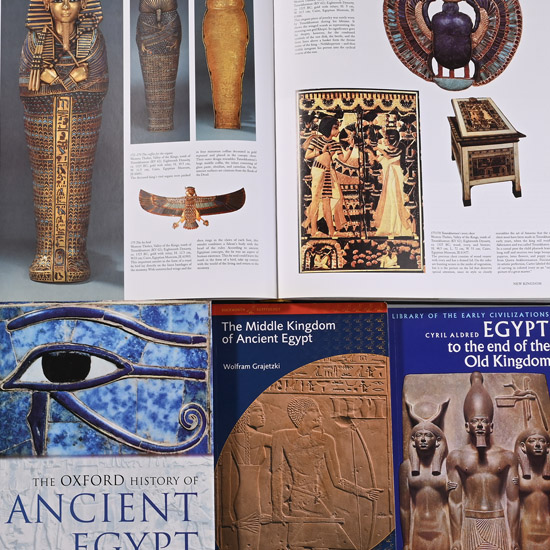
Books on Ancient Egyptian History - 4 Titles
1992-2006 A.D.Sold for (Inc. bp): £46
Aldred, C., Egypt to the end of the Old Kingdom, London, 1992, 143pp, card covers, colour and monochrome; Grajetzki, W., The Middle Kingdom of Ancient Egypt, London, 2006, 208 pp, card covers, monochrome; Schulz, R., Seidel, M. (eds), Egypt. The World of the Pharaohs, Köln, 1998, 538 pp, hardback, colour and monochrome; Shaw, I. (ed.), The Oxford History of Ancient Egypt, Oxford, 2000. (signed by Ian Shaw), 512 pp, hardback with dust jacket, colour and monochrome. 5.96 kg total, 15.5 x 23.5 - 28 x 32 cm
Ex libris a Hertfordshire gentleman. -
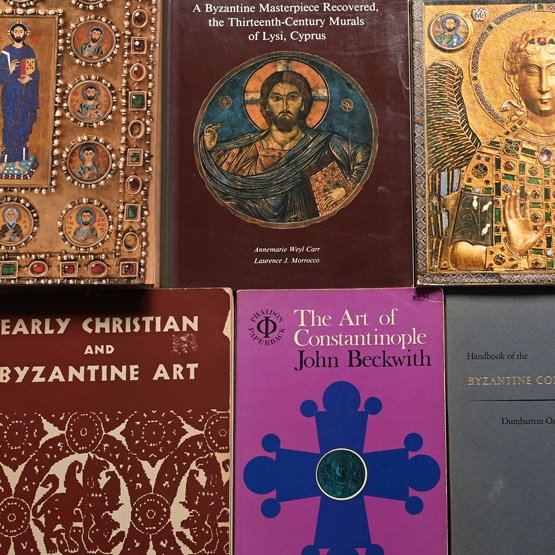
Books on Byzantine Archaeology and Art Works - 6 Titles
1944-1997 A.D.Sold for (Inc. bp): £72
H.C. Evand & W.D. Wixom - The Glory of Byzantium: Art and Culture of the Middle Byzantine era AD 843-12161 - New York, 1997, hardback with dustwrapper, 574 pp, colour; A. W. Carr& L.J. Morrocco - A Byzantine Masterpiece Recovered the Thirteenth Century Murals of Lysi, Cyprus - Austin, 1991, card covers, 159 pp, colour and monochrome; D. Buckton (ed) - Tjhe Treasury of San Marco, Venice - Milan, 1984, card coers, 337 pp, colour; Walter Art Gallery - Early Christian and Byzantine Art - Baltimore, 1947, card covers, 172 pp, 1221 monochrome plates; J. Beckwith - The Art of Constantinople - London, 1961, card covers, 184 pp, monochrome; Dumbarton Oaks - Handbook of the Byzantine Collection - Washington, 1967, card covers, 125 pp, 376 monochrome plates. 7.66 kg total, 23 x 15.1 - 31.5 x 24 cm
Property of a London, UK, gentleman. -
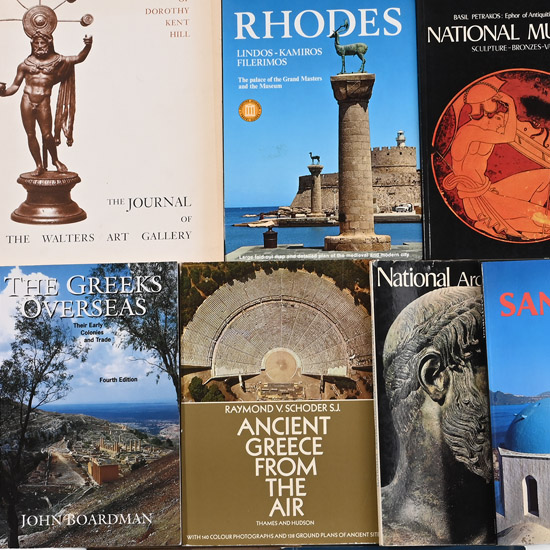
Books on Ancient Greek Antiquities, Ancient Art and Archaeology - 9 Titles
1927-2011 A.D.Sold for (Inc. bp): £7
AA.VV., Essays in honor of Dorothy Kent Hill, The Journal of the Walters Art Gallery, Baltimore, 1977, pp.136, b/w ill.; E. Langlotz, Fruehgriechische Bildhauerschulen, mit 100 Tafeln im Verlag, only Text, Nueernberg, 1927, pp.203; R.V.Schoder, S.J., Ancient Greece from the Air, London, 1974, pp.256, with 140 Colour Photographs and 138 ground plans of ancient sites; J.Ober, C.W.Hedrick, The Birth of Democracy, An Exhibition celebrating the 2500th anniversary of Democracy, at the National Archives, Washington, D.C., Athens, 1993, pp.179, b/w & col. Ill.; AA.VV., National Archaeological Museum, Athens, 1979, pp.96, col.ill.; C.Doumas, Santorini, A guide to the Island and its Archaeological Museum, Athens, 1997, pp.128, mainly col.ill. and some in b/w; A.B. Tataki, Rhodes, Lindos-Kamiros-Filermos, The Palace of the Grand Masters and the Museum, Athens, 1995, pp.128, map and col.ill.; B.Petrakos, National Museum, Sculpture-Bronzes-Vases, Athens, 1993, pp.191, col.ill.; J. Boardman, The Greeks Overseas, Their Early Colonies and Trade, London, 1999, pp.304, b/w ill. 4.55 kg total, 24 x 16 - 28 x 21.6 cm
Property of a London, UK, gentleman. -
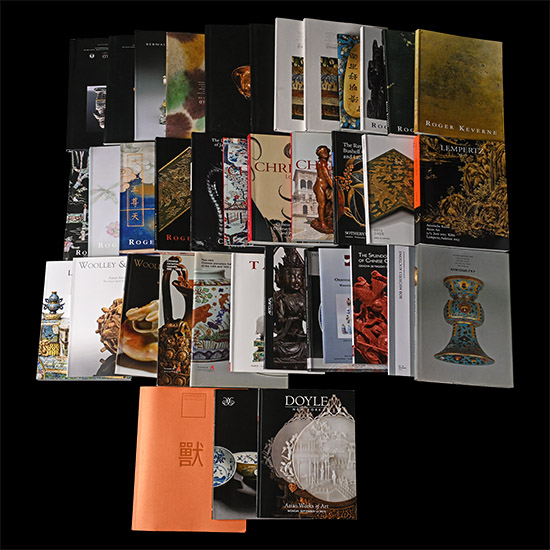
Eskenazi, Roger Keverne, Berwald, Christie's and Other Chinese and Asian Art Auction Catalogue Group - 39 Titles
1977-2008 A.D.Sold for (Inc. bp): £338
BERWALD ORIENTAL ART: Eternal Images, Chinese Ceramic Sculpture from the Han to Tang Dynasties, 8-26 November 1999; Spring 2008, New York (2 copies); Kangxi Biscuit Porcelain from Private Collections, London (no date); Facing East, Expressions in Chinese Art, London, (no date), (2copies); Shapes and Glazes of the Tang, London, (no date), (2 copies); ROGER KEVERNE: Fine and Rare Chinese Works of Art and Ceramics, Winter Exhibition 1999; Fine and Rare Chinese Works of Art and Ceramics, Summer Exhibition 2000; Winter Exhibition 2003; Winter Exhibition 2004; Summer Exhibition 2005; Summer Exhibition 2006; Summer Exhibition 2007; Winter Exhibition 2007; Summer Exhibition 2008; CHRISTIE'S: The Lundgren Collection, London, 18 November 1997; Asian Decorative Arts, South Kensington, 22 March 2001; Chinese Ceramics and Chinese Export Ceramics and Works of Art, London, 19 June 2001; Furniture and Works of Art 'Il Paradiso', London, 11 December 2001; SOTHEBY'S: The Raymond and Frances Bushell Collection of Inro and lacquer, London, 18 June 1997; Arts D'Asie, Paris, 10 June 2014; LEMPERTZ: Asian Art, Cologne, 3-5 June 2015; Asian Art, Cologne, 13-14 June 2014; WOOLLEY & WALLIS: Asian Art II, Salisbury, 22 May 2014; Asian Art I, Salisbury, 21 May 2014; ESKENAZI: Chinese Ceramic Vessels 500-1000 AD, November 2001; Two Rare Porcelain Fish Jars of the 14th and 16th Centuries, November 2002; TAJAN: Arts D'Asie, 11 June 2012; ARTCURIAL: Art D'Asie, Paris, 9 June 2014; UPPSALA AUKTIONSKAMMARE: Internationell Kvalitetsauktion, 13 June 2014; CAMBI: The Splendor of Chinese Corals, 28 May 2014; STOCKHOLMS AUKTIONSVERK: Fine Art & Antiques - Oriental Ceramics & Works of Art, 6 June 2013; DOYLE: Asian Works of Art, New York, 12 September 2011; ROB MICHIELS: Asian Arts & European Ceramics, 6-7 October 2018; VANDERVEN ORIENTAL ART: Beasts & Creatures, 2017; A & J SPEELMAN: Buddhist Works of Art, London 1998. 27.95 kg total, 26.6 x 21 - 30.5 x 22 cm
Property of a London, UK, gentleman. -
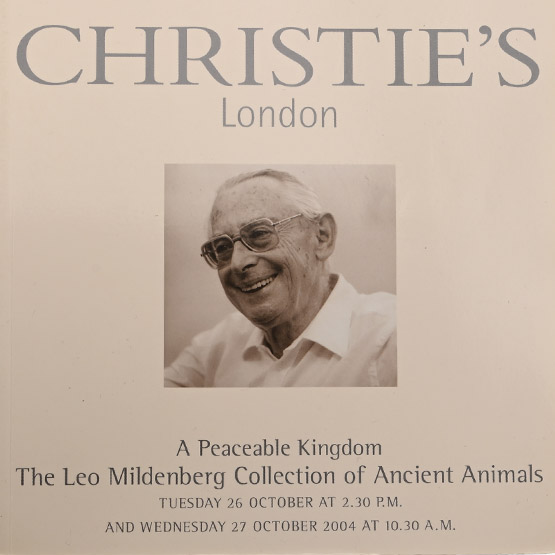
Christie's Auction Catalogue: A Peaceable Kingdom - The Leo Mildenberg Collection of Ancient Animals
26 & 27 October 2004 A.D.Sold for (Inc. bp): £20
Christie's sale 7017 catalogue, card covers, 316pp, 419 lots including figurines, jewellery and images of animals, etc. 1.24 kg, 26.7 x 21 cm
Property of a London, UK, gentleman. -
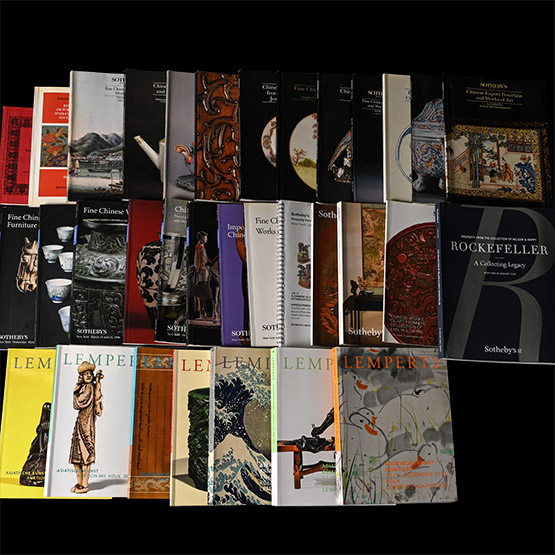
Sotheby's, Lempertz and Other Chinese and Asian Art Auction Catalogue Group - 33 Titles
1979-2019 A.D.Sold for (Inc. bp): £65
SOTHEBY’S: Oriental ivories, Shibayama and Works of Art, Thursday 15th February, 1979; Belle collection de porcelaines de Chine d’emaux cloisonnes et de sculptures en corail, dimanche 4 mars 1984 a 11th et 16th; Fine Chinese Decorative Works of Art, New York, April 7th and 8th, 1988; Chinese Decorative Arts and Export Porcelain, Friday 28th October-Tuesday 1st November 1988; Belle collection de porcelaines de Chine, dimanche 5 mars 1989; Chinese Export Porcelain and decorative works of art, Tuesday 9th and Friday 12th May 1989; Chinese Export Porcelain from the Collection of Jorge Getulio Veiga, Tuesday 31st October 1989; Fine Chinese Export Porcelain from the Collection of Angelo Castelo Branco Cerqueira Caldas, Tuesday 8th May 1990; Chinese Export Porcelain and works of art, Tuesday 29th May 1990; Fine Chinese Ceramic and Works of Art, Tuesday, May 28, 1991; Fine Chinese and Korean Ceramics and Works of Art, Tuesday 10th December 1991; Chinese Export Porcelain, Friday, October 23, 1992; Chinese Export Porcelain and Works of art, Tuesday 3rd November 1992; Fine Chinese Ceramics, Furniture and Works of Art, Wednesday March 19, 1997; Fine Chinese Ceramics, Furniture and Works of Art, Tuesday September 23, 1997; Fine Chinese Works of Art, March 23, 1998; Fine Chinese Ceramics, Furniture and Works of Art, Thursday September 17, 1998; Chinese Export, Porcelain, Paintings, Silver and Works of Art, January 20, 1999; Fine Chinese Works of Art and Snuff Bottles, March 22 and 23, 1999; Important Chinese Furniture, Tuesday March 23, 1999; Fine Chinese Works of art, September 15, 1999; Property from the Estate of Brooke Astor, 24 Sep 2012; Art d’Asie, 12 Juin 2018; Saturday at Sotheby’s Asian Art, 15 September 2018; Chinese Works of Art from the collection of Emil Hultmark; property from the collection of Nelson & Happy Rockfeller, A Collecting Legacy, 18 January 2019; LEMPERTZ: Asiatische Kunst, Auktion 860, Koln 11/12 Juni 2004; Asiatische Kunst, Auktion 865, Koln 26/27 Nov. 2004; Asiatische Kunst, Auktion 875, Koln 31 Mai/1 Juni 2005; Asian art, Chinese Jades of a private collection 10 June 2008 Auktion 926; Asiatische Kunst, Auktion 951, Koln 11/12 Dezember 2009; Asiatische Kunst-Asian Art, Auktion 964, Koln 11/12 Juni 2010; Asiatische Kunst, Auktion 973, Koln 10/11 Dezember 2010; 23 kg total, 21 x 20 - 29.6 x 23 cm
Property of a London, UK, gentleman. -
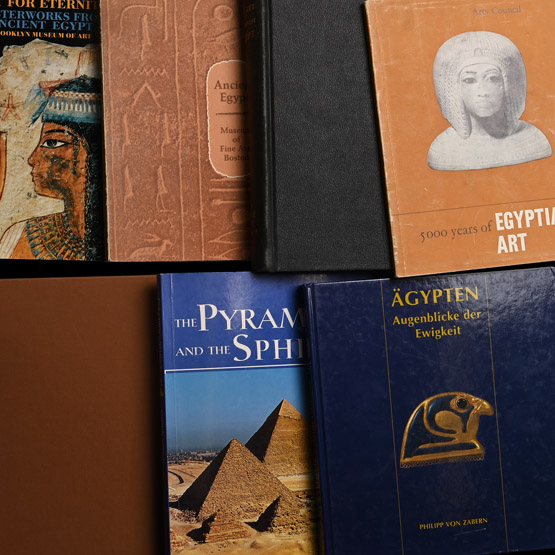
Books on Ancient Egypt and Egyptology - 7 Titles
1940-2005 A.D.Sold for (Inc. bp): £7
E.L.B. Terrace & H.G. Fischer - Treasures of Egyptian Art from the Cairo Museum - London, 1970, hardback with cloth covers, 188 pp, colour; C. Rossi - The Pyramids and the Sphinx - Cairo, 2005, card covers, 160 pp, colour; M. Page-Gasser &A.B. Wiese - Ägypten Augenblick der Ewigkeit - Mainz, 1998, hardback 340 pp, colour; The Art of Ancient Egypt - London, 1940, hardback, library binding, 22 pp, 333 colour and monochrome plates; Royal Academy of Arts - 5000 Years of Egyptian Art - London, 1962, card covers, 46 pp, 40 monochrome plates, fold-out map; R.A. Fazzinin et al - Art for Eternity: Masterworks from Ancient Egypt - Brooklyn, 1999, card covers, 160 pp, colour; W. Stenson Smith - Ancient Egypte - Boston, 1960, card covers, 215 pp, monochrome. 5.66 kg total, 23 x 15 - 27.5 x 20 cm
Property of a London, UK, gentleman. -
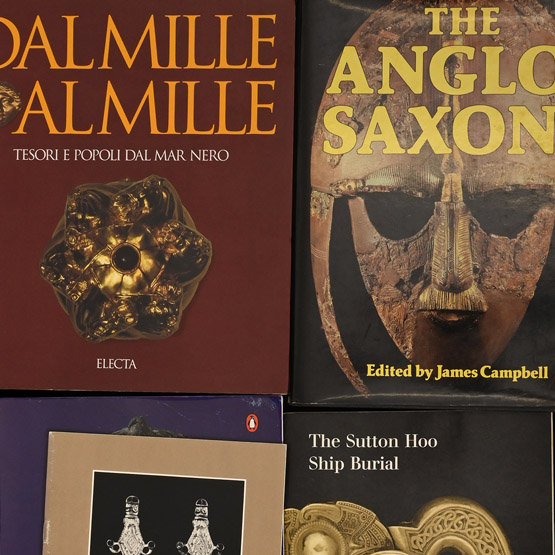
Books on Anglo-Saxon and Dark Age Art and Archaeology - 5 Titles
1972-1995 A.D.Sold for (Inc. bp): £13
Katharine Reynolds Brown - Frankish Art in American Collections, 1984, cardcovers, 31 pp, black and white images; Ruoert Bruce-Mitford - The Sutton Hoo Ship-Burial, A Handbook, second edition, 1972, cardcovers, 103 pp, 34 black and white plates; James Campbell (ed.) - The Anglo-Saxons, 1991, cardcovers, 272 pp, colour and black and white images; James Campbell (ed.) - The Anglo-Saxons, 1982, hardcover with dustwrapper, 272 pp, colour and black and white images; Dal Mille Al Mille, Tesori E Popoli Dal Mar Nero, in Italian, 1995, cardcovers, 249 pp, colour and black and white images. 4.37 kg total, 24.2 x 17.1 - 28 x 25 cm
Property of a London, UK, gentleman. -
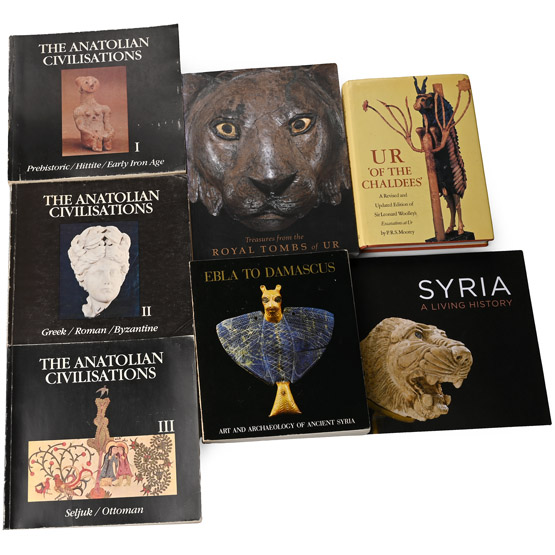
Books on Ancient Near Eastern Antiquities, Ancient Art & Archaeology - 7 Titles
1982-2017 A.D.Sold for (Inc. bp): £78
P.R.S. Moorey - Ur 'Of the Chaldees', A Revised and Updated Edition of Sir Leonard Woolley's Excavations at Ur, 1982, hardcover with dustjacket, 272 pp, black and white and colour images; The Anatolian Civilisations I, Prehistoric / Hittite / Early Iron Age, Istanbul May 22-October 30, 1983, cardcovers, 311 pp, black and white images; The Anatolian Civilisations II, Greek / Roman / Byzantine, Istanbul May 22-October 30, 1983, cardcovers, 199 pp, black and white images; The Anatolian Civilisations III, Seljuk / Ottoman, Istanbul, May 22-October 30, 1983, cardcovers, 323 pp, black and white images; Syria, A Living History, October 15, 2016-February 26, 2017, cardcovers, 48 pp, colour images; Ebla to Damascus, Art and Archaeology of Ancient Syria, 1985, cardcovers, 542 pp, colour and black and white images; Richard L. Zettler and Lee Horne (eds.) - Treasures from the Royal Tombs of Ur, 1998, cardcovers, 195 pp, black and white and colour images. 6.24 kg total, 24.2 x 17 - 28 x 21.6 cm
Property of a London, UK, gentleman. -
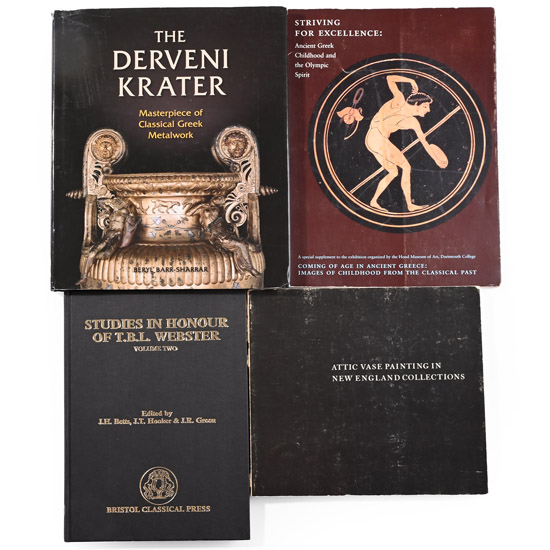
Books on Ancient Greek Pottery, Ancient Art & Archaeology - 4 Titles
1972-2008 A.D.Sold for (Inc. bp): £26
B. Barr-Sharrar, The Derveni Krater, Masterpiece of Classical Greek Metalwork, Princeton, 2008, pp.240, 32 colour plates; J.Neils, J.H.Oakley, Striving for excellence: Ancient Greek Childhood and the Olympic spirit, New York, 2004, pp.64, full colour catalogue; D.M.Buitron, Attic Vase Painting in New England Collections, Harvard, 1972, pp.152, b/n ill.; J.H. Betts, J.T. Hooker, J.R. Green, Studies in honour of T.B.L. Webster, volume II, Bristol, 1988, b/w ill. 3.31 kg total, 26 x 19 - 30 x 25 cm
Property of a London, UK, gentleman.

