-
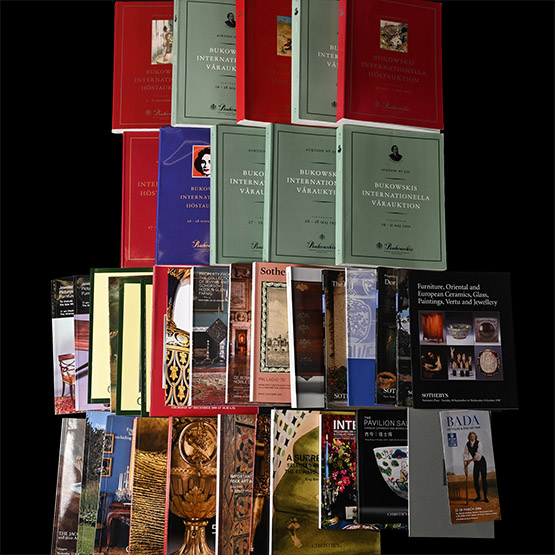
Bukowskis, Christie's, Sotheby's and Other English, European and American Antique Art Auction Catalogues - 38 Titles
1996-2017 A.D.Sold for (Inc. bp): £20
BUKOWSKIS: Internationella Höstauktionen, Stockholm, 27-29 November 1996; Internationella Höstauktionen, Stockholm, 26-28 November 1997 Internationella Vårauktion, Stockholm, 27-29 May 1998; Internationella Vårauktion, Stockholm, 26-28 May 1999; Internationella Vårauktion, Stockholm, 29-31 May 2001; Internationella Höstauktionen, Stockholm, 3-6 December 2002; Internationella Vårauktion, Stockholm, 26-28 May 2003; Internationella Höstauktionen, Stockholm, 2-5 December 2003; Internationella Vårauktion, Stockholm, 25-28 May 2004; Internationella Höstauktionen, Stockholm, 30 November-3 December 2004; CHRISTIE'S: The Jacobites and Their Adversaries, Scotland, 12 June 1996; Horsenden Manor, Princes Risborough, Buckinghamshire, 22 September 1997; The British Interior, English Furniture, ceramics, paintings, Silver and Chinese Export Porcelain, including a selection of Irish Furniture and Objects, New York, 21 January 1999; Important Mobilier, Sculpture et Objets D'Art, Ceramiques Europeennes et Orfevrerie, Paris, 24 June 2009; 500 Ans - Arts Decoratifs Europeens, Paris, 4-5 May 2011; Important American Furniture, Folk Art and Silver, New York, 22 January 2016; Collection d'un Amateur, paris, 21 June 2011; A Surreal Legacy, King Street, 15 December 2016; Interiors, London, 28 November 2017; The Pavilion Sale - Chinese Ceramics and Works of Art, Hong Kong, 4 October 2018; ROBERT YOUNG ANTIQUES: No 35, London; PHILLIPS: Jewellery, Silver, Ceramics, Pictures, Works of Art, Furniture, Carpets and Rugs- to include property from the estate of the late Mr N Blackburne, St Edmunds, 23-24 June 1999; Jewellery, Silver, Ceramics, Pictures, Works of Art, Furniture, Carpets and Rugs, Bury St Edmunds, 25-26 June 1997; LAWRENCE: Ceramics, Silver and Jewellery, Furniture, 14 and 21 November 1996; Ceramics and Paintings, 9 October 1997; Ceramics, Silver and Jewellery, 4 July 1996 (2 copies); EWBANK: Antiques & Fine Art, 14 December 2000; TAJAN: Mobilier et Objets D'Art, 19 November 2014; SOTHEBY'S: Brockhall, Weedon, Northamptonshire, 16 June 1997; Furniture, Oriental and European Ceramics, Glass, paintings, Vertu and Jewellery, Summers Place, 30 September-8 October 1997; The Roger Whittaker Collection, Herefordshire, 12 July 1999; Estate and General Sales, Sussex, 8-16 June 1999; The Collection of Dorothy Hirshon, New York, 26 September 1998; Property from the Collection of Irvin & Anita Schorsch, New York, 20-22 January 2016; Of Royal and Noble Descent, London, 19 January 2016; Palladio '70, Paris, 8 October 2015; The Collection of Roy and Ruth Nutt: Important Americana & Decorative Arts, New York, 23 January 2015. 32.9 kg total, 21.1 x 16.8 - 29 x 21.5 cm
Property of a London, UK, gentleman. -
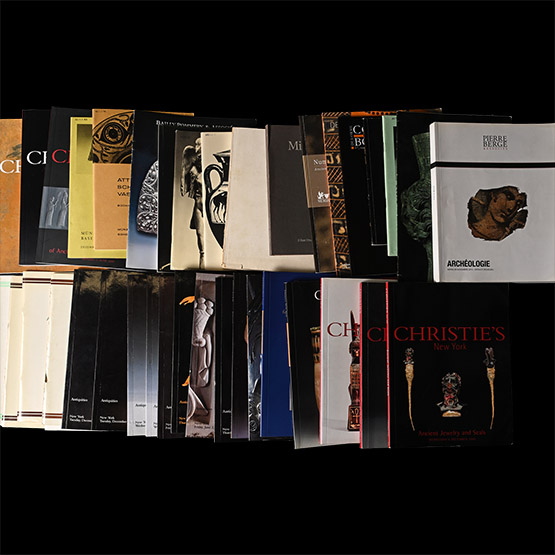
Christie's New York and Other Antiquities and Ancient Art Auction Catalogue Group - 37 Titles
1964-2013 A.D.Sold for (Inc. bp): £416
CHRISTIE'S: Important Classical, Western, Asiatic and Egyptian Antiquities, New York, 25 January 1979; Important Classical, Western, Asiatic and Egyptian Antiquities, New York, 14 June 1979; Important Classical, Western, Asiatic and Egyptian Antiquities, New York, 5 December 1979; Fine Antiquities, New York, 20 May 1980; Antiquities, New York, 15 December 1992 (2 copies); Antiquities, New York, 15 December 1993 (2 copies); Antiquities, New York, 10 June 1994; Antiquities, New York, 15 December 1994; Antiquities, New York, 2 June 1995; Antiquities, New York, 7 December 1995; Antiquities, New York, 14 June 1996; Antiquities, New York, 18 December 1996; Ancient Glass formerly in the G. Sangiorgi Collection, New York, 3 June 1999; Antiquities, New York, 4 June 1999; Antiquities, New York, 9 December 1999; Antiquities, New York, 13 June 2000; Ancient Jewelry and Seals, 6 December 2000; Antiquities, New York, 7 December 2000; Antiquities, New York, 8 June 2001; The Surena Collection of Ancient Near Eastern Cylinder Seals, New York, 11 June 2001; MUNZEN UND MEDAILLEN AG BASEL: Antike Bronze-Figuren, Antike Glasr, Archäologische Literatur, December 1985; Attische Schwarzfigurige Vasen, November 1964; Terrakotten, Antike Gemmen, Oktober 1980; Antike Vasen, December 1977; BAILLY-POMMERY & ASSOCIES: Arts D'Orient, 27 February 2003; ARTEMIS: Consolidated Audited Annual Report, 24 January 1992; GALERIE GERDA BASSENGE: Auktion 21, Teil I, Alte u Neue Kunst, Berlin, May 1973; MICHAEL WARD, INC: First Exhibition 1983; NUMISART: Ancient Art, (no date); DELORME & COLLIN DU BOCAGE: Archeologie, Asie, Islam, Livres, Paris, 29 May 2010; Archeologie, Paris, 20 June 2012; PIERRE BERGE: Archeologie, 26 November 2013; Egypt at The Merrin Gallery, 1992; Steingefasse der Antike, Antike Gläser, Geschnittene Stein, Varia et Curiosa, Bücher über Archäologie, November 1976; NFA, Art of Antiquity (no date). 14.7 kg total, 24 x 17 - 29.2 x 24.3 cm
Property of a London, UK, gentleman. -
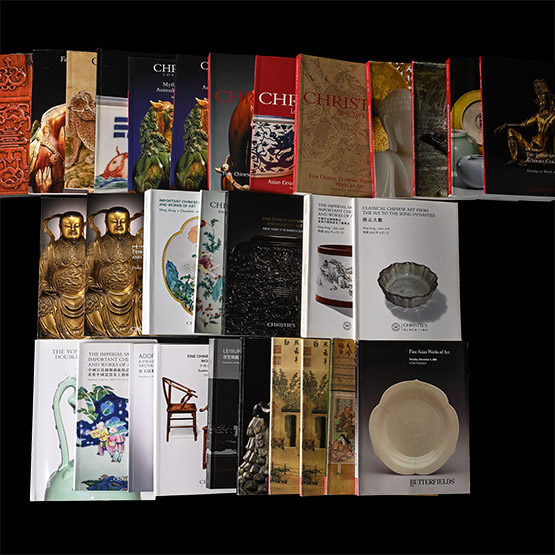
Christie's and Butterfields Chinese and Asian Art Auction Catalogue Group - 30 Titles
1996-2019 A.D.Sold for (Inc. bp): £91
CHRISTIE’S: Important Chinese Furniture, Formerly the Museum of Classical Chinese Furniture Collection, Thursday, September 19, 1996; Fine Asian Works of Art, May 14 & 15, 1997; Asian Art, Wedsneday 20 May 1998; Fine Asian Works of Art, May 26 & 27 1998; Myth and Reality: Animals in Chinese Art Friday 7 May 1999; Fine Chinese Ceramics, Paintings and Works of Art, Tuesday 21 March 2000; Asian Ceramics and Works of Art, Thursday 13 April 2000; Fine Chinese Ceramics, Paintings and Works of Art, Thursday 21 September 2000; Fine Chinese Ceramics and Works of Art, including Property from the Arthur M. Sackler Collections, Thursday 25 and Friday 26 March 2010; The Sze Yuan Tang Archaic Bronzes from the Anthony Hardy Collection, Thursday 16 September 2010; Fine Chinese Ceramics and Works of Art, Including Property from the Arthur M. Sackler Collection, Thursday 16 and Friday 17 September 2010; The James and Marilyn Alsdorf Collection, 22 March 2011; Fine Chinese Ceramics and Works of Art part II, Friday 25 March 2011 (two copies); Important Chinese Ceramics and Works of Art, 2 December 2015; Chinese Export Art including the Sowell Collection, 21 January 2016; Fine Chinese Ceramics and Works 17-18 March 2016; The Imperial Sale, important Chinese Ceramics and Works of Art, 1st June 2016; Classical Chinese art from the Sui to Song Dynasties, 1st June 2016; The Yongzheng Emperor’s Double Dragon Amphora, 31 May 2017; The Imperial Sale, important Chinese Ceramics and Works of Art, 31 May 2017; Adorning the Kings, a private collection of archaic Jade ornaments, 31 May 2017; Fine Chinese Ceramics and Works of Art, 7 November 2017; Leisure Delights, 29 May 2019; BUTTERFIELDS: Fine Asian Works of Art, October 12 & 13, 1999; Fine Asian Works of Art, June 11, 2001 (two copies); Fine Asian Works of Art, Monday October 22, 2001; Fine Asian Works of Art, November 5, 2002. 26 kg total, 26.7 x 21.2 - 29.7 x 23 cm
Property of a London, UK, gentleman. -
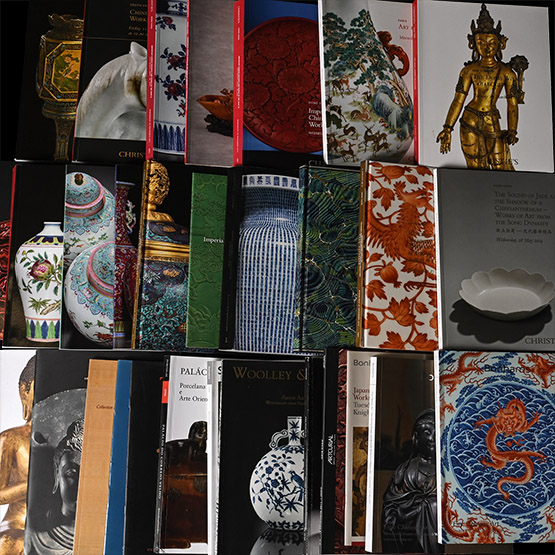
Christie's and Other Chinese and Asian Art Auction Catalogue Group - 30 Titles
1997-2018 A.D.Sold for (Inc. bp): £169
BONHAMS: Japanese and other Asian Works of Art, Tuesday 5 December 2006; Fine Chinese Art, 8 November 2018; Fine Chinese Art, Introducing Beauty and Beyond: Women in Chinese Art, 27 May 2021; ARTCURIAL: Art d’Asie, Mardi 13 Decembre 2011; SKINNER: Asian Works of Art, December 1-3, 2011; WOOLLEY & WALLIS: Asian Art I, Wednesday 16th November 2011; SOTHEBY’S: Art d’Asie, 15 Decembre 2011; PALACIO DO CORREIO VELHO: Porcelana Chinesa e Arte Oriental, 27 September-3 October, 2006; TAJAN: Art Coreen, Collection de Mr. et M.me Francois P. Mallet, Mardi 18 Mars 1997; Art d’Extreme-Orient, 18 & 19 October 1999; Art d’Asie, 18 Mai 2005; TUCKER-TOZER: Luminescence from the East, an Exhibition of Buddhist and Hindu Sculpture from India, China and Southeast Asia, 4th-26th November 2004; CHRISTIE’S: Fine Chinese Ceramics and Works of Art, Tuesday 8 November 2011; Chinese Ceramics, Works of Art and Textiles, Friday 11 November 2011; Important Chinese Ceramics and Works of Art, Part I, Wednesday 30 November 2011; Important Chinese Ceramics and Works of Art, Part II, Wednesday 30 November 2011; Exceptional Chinese works of art from an Important European Collection, Wednesday 30 November 2011; Art d’Asie, Mercredi 14 decembre 2011; The Doris Wiener Collection, Tuesday 20 March 2012; Important Chinese Lacquer from the Lee Family Collection, part III, Wednesday 28 November 2012; Fine Chinese Furniture from Private American Collections, 28 November 2012; The Yiqingge Collection of Chinese Ceramics, 29 May 2013; The Imperial Sale, Important Chinese Ceramics and Works of Art, Wednesday 29 May 2013; Reverence and Perfection Magnificent Imperial Cloisonne enamels from a private European collection, Wednesday 29 May 2013; In Pursuit of Refinement: A legacy of the YC Chen Collection, Wednesday 29 May 2013; Imperial Chinese Porcelain, Treasures from a distinguished American collection, Wednesday 27 November 2013; The R.E.A. Riesco Collection of Important Chinese Ceramics, Wednesday 27 November 2013; Important Chinese Ceramics and Works of Art, Wednesday 27 November 2013; Imperial Chinese Porcelain, Treasures from a Distinguished American Collection, Wednesday 27 November 2013; The sound of Jade and the Shadow of a Chrysantemun, Works of Art from the Song Dynasty, Wednesday 28 May 2014; The Sublime and Beautiful Asian Masterpieces of devotion, Thursday 20 March 2014. 24.5 kg total, 26.5 x 21 - 29.7 x 23.1 cm
Property of a London, UK, gentleman. -
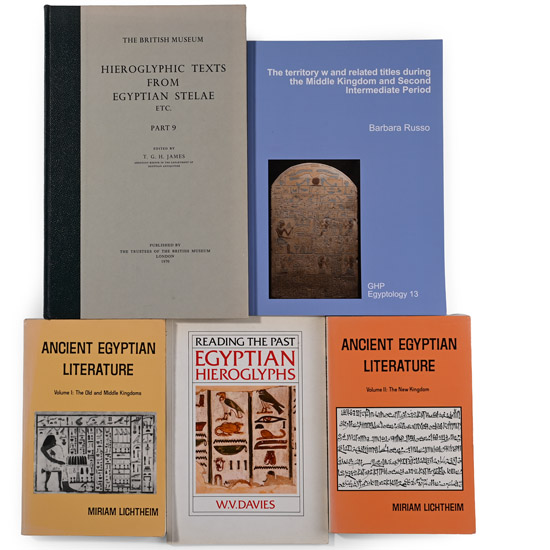
Books on Egyptian Hieroglyphs and Texts - 5 Titles
1970-2010 A.D.Sold for (Inc. bp): £7
Davies, W.V., Reading the Past: Egyptian Hieroglyphs, London, 1987, 64 pp, card covers, monochrome; James. T.G.H., The Hieroglyphic Texts from Egyptian Stelae etc. Part 9, London, 1970, 71 pp, 51 plates, hardback, monochrome; Lichtheim, M., Ancient Egyptian Literature I: The Old and Middle Kingdoms, Berkeley-London, 1975, 245 pp, card covers, monochrome; Lichtheim, M., Ancient Egyptian Literature II: The New Kingdom, Berkeley-London, 1976, 239 pp, card covers, monochrome; Russo, B., The territory w and related titles during the Middle Kingdom and Second Intermediate Period, London, 2010, 90 pp, 13 plates, card covers, monochrome. 2.56 kg total, 22.7 x 15.2 - 33.7 x 22 cm
Ex libris a Hertfordshire gentleman. -
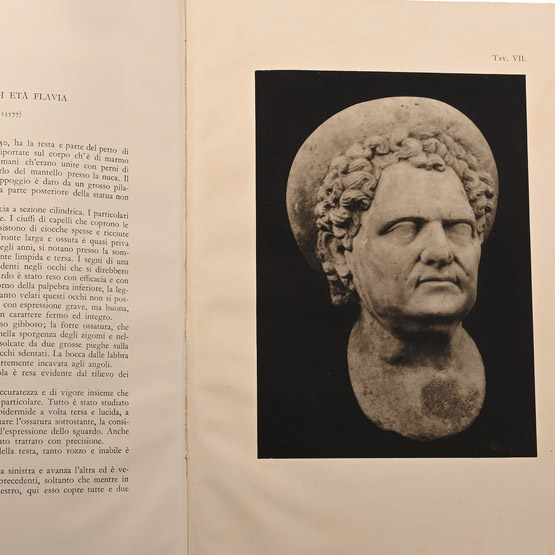
Monumenti Di Scultura Clara Rhodos no.356/500 Limited Edition - Studi E Materiali Pubblicati A Cura Dell' Istituto Storico - Archeologico Di Rodi Vol. V2
1932 A.D.Sold for (Inc. bp): £13
Bergamo, hardcover, 189 pp, 15 tables, 55 black and white images. 1.26 kg, 30.5 x 22.5 cm
Property of a London, UK, gentleman. -
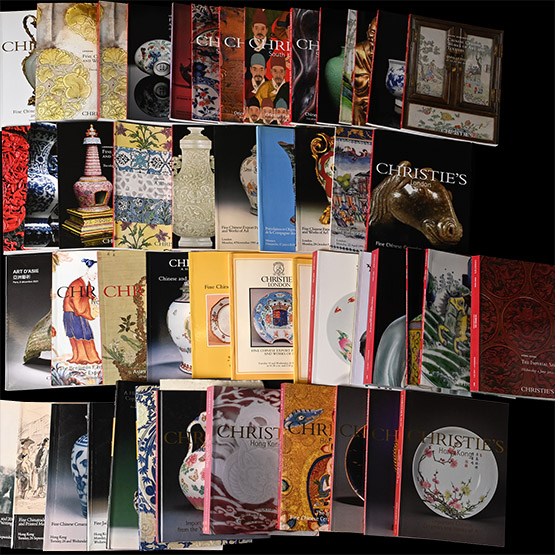
Christie's Chinese and Asian Art Auction Catalogue Group - 47 Titles
1983-2021 A.D.Sold for (Inc. bp): £390
CHRISTIE'S SWIRE, HONG KONG: Fine 19th and 20th Century Chinese Paintings, 25 September 1989; Fine Chinatrade Paintings and Printed Material, 26 September 1989; Fine Chinese Ceramics and Works of Art, 26-27 September 1989; Fine Jade Carvings and Jadeite Jewellery, 25 and 27 September 1989; CHRISTIE'S, HONG KONG: A Highly Important Early Ming Underglaze-Copper-Red Vase from a Private Collection, 5 November 1997; Important Chinese Ceramics and Jades from the Jingguangtang Collection, 5 November 1997; Important Qing Porcelain from the Yuen Family Collection, 30 April 2000; The Imperial Sale, Important Chinese Lacquer, Ceramics and Works of Art, 29-30 April 2001; The Imperial Sale, Fine Chinese Ceramics and Works of Art, 29 April 2002; One Man's Vision, Important Chinese Art from the Manno Art Museum, 28 October 2002; Imperial Devotions, Buddhist Treasures for the Qianglong Court, 28 October 2002; Important Chinese Ceramics and Works of Art, 28 October 2002; The Imperial Sale, 29 May 2007; Imperial Treasures from the Fonthill Collection, 1 December 2010; Important Chinese Ceramics and works of Art, 1 June 2011; A Magnificent Qianglong Revolving Vase, 1 June 2011; Inspired Connoisseurship: Property from a European Collection, 1 June 2011; The Imperial Sale, 1 June 2011; CHRISTIE'S, PARIS: Art d'Asie, 8 December 2021; CHRISTIE'S, NEW YORK: The Benjamin F Edwards III Collection of Chinese Export Porcelain, Part II, 22 January 2003; CHRISTIE'S, EAST: Asian Decorative Arts, 18 September 2000; CHRISTIE'S, AMSTERDAM: Chinese and Japanese Ceramics and Works of Art, 13 May 1998; CHRISTIE'S, LONDON: Fine Chinese Export Porcelain, 30-31 March 1983; Fine Chinese Export Porcelain, 19-20 March 1985; Fine Chinese Export Porcelain and Works of Art, 17 November 1986; Porcelaines et Objets d'Art de la Compagnie des Indes, 17 June 1990; Fine Chinese Export Porcelain and Works of Art, 29 October 1990; Chinese Export Porcelain and Works of Art, 22 April 1991; Fine Chinese Export Porcelain and Works of Art, 4 November 1991; Fine Chinese Ceramics and Works of Art, 6 June 2000; Fine Chinese and Export Porcelain and Works of Art, 15 November 2000; Fine Chinese Ceramics and Works of Art, 15 November 2000; Fine Chinese Export Porcelain and Works of Art, 15 May 2007; Fine Chinese Ceramics and Works of Art, Including Export Art, 12 May 2009; Fine Chinese Export Porcelain and Works of Art, 3 November 2009; Fine Chinese Export Porcelain and Works of Art, 11 May 2010; A Window on the Orient - A Distinguished Private Collection, 4 November 2010; Fine Chinese Ceramics and Works of Art, 9 November 2010; Fine Chinese Ceramics and Works of Art, 10 May 2011 (2 copies); CHRISTIE'S, SOUTH KENSINGTON: Oriental Ceramics and Works of Art, 23 November 1995; Oriental Ceramics and Works of Art, 16 March 2000; Oriental Ceramics and Works of Art, 8 June 2000; Oriental Paintings and Prints, 23 June 2000; Chinese Ceramics and Works of Art, 9 November 2000; Chinese Ceramics, Works of Art and Textiles, 10 November 2006; Chinese Ceramics and Works of Art, 10 September 2009; Chinese Ceramics, Works of Art and Textiles, 15 May 2009; Chinese Ceramics, Works of Art and Textiles, 14 May 2010; Chinese Ceramics, Works of Art and Textiles, 13 May 2011. 34.45 kg total, 26.6 x 21 - 30.4 x 21.6 cm
Property of a London, UK, gentleman. -
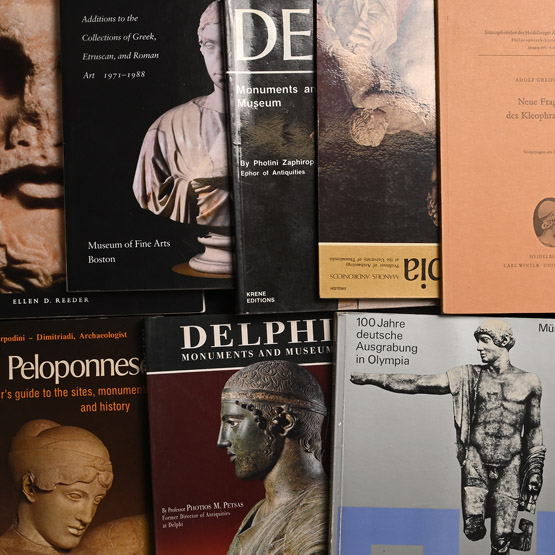
Books on Ancient Greek Antiquities, Ancient Art and Archaeology - 8 Titles
1972-2004 A.D.Sold for (Inc. bp): £33
Ellen D. Reeder - Hellenistic Art in the Walters Art Gallery - Baltimore, 1988, card covers, 260pp, monochrome; C.C Vermele - Sculpture in Stone and Bronze in the Museum of Fine Arts, Boston - Boston, 1988, card covers, 132 pp, monochrome; 100 Jahre Deutsche Ausgrabung in Olympia - München, 1972, card covers, 136 pp, monochrome; Photios M. Petsas - Delphi Monuments and Museum - Athens, 2004. card covers, 119 pp, colour, fold-out map; Photini Zaphiropolou - Delos Monuments and Museum - Athens, 1993, card covers, 96 pp, colour, fold-out map; E. Karpodini - The Peloponnese: A Traveller's Guide to the Sites, Monuments and History - Athens, 1993, card covers, 208 pp, colour, fold-out map; Manolis Andronicos - Olympia - Athens, 1976, card covers, 72 pp, colour; Adolf Greifenhagen - Neue Fragmente des Kleophradesmalers - Heidelberg, 1972, card covers, 50 pp, 32 monochrome plates, offprint. 4.08 kg total, 24.5 x 17 - 30.5 x 23 cm
Property of a London, UK, gentleman. -
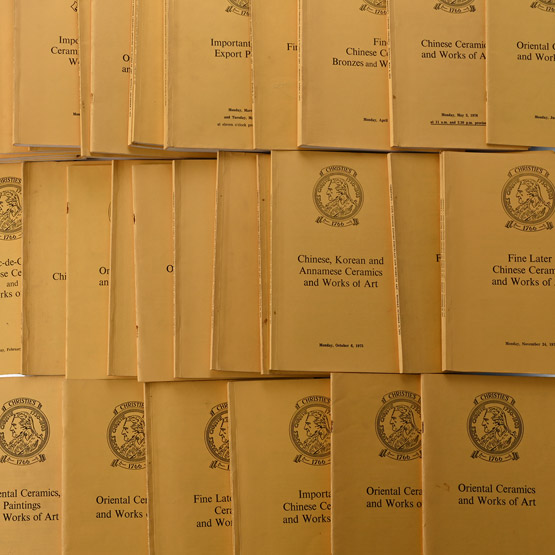
Christie's London Chinese and Asian Art Auction Catalogue Group - 34 Titles
1974-1977 A.D.Sold for (Inc. bp): £780
Oriental Ceramics, Paintings and Works of Art, 29-30 July 1974; Oriental Ceramics and Works of Art, 30 September 1974; Fine Later Chinese Ceramics and Works of Art, 7 October 1974; Important Chinese Ceramics and Works of Art, 25-26 November 1974; Oriental Ceramics and Works of Art, 16 December 1974; Oriental Ceramics and Works of Art, 3-4 February 1975; Blanc-de-Chine, Chinese Ceramics and Works of Art, 17 February 1975; Fine Chinese Export Ceramics and Works of Art, 3 March 1975; Oriental Ceramics and Works of Art, 17 March 1975; Fine and Early Chinese Ceramics and Works of Art, 12 May 1975; Oriental Ceramics, Paintings and Works of Art, 19 May 1975; Fine and Early Chinese Ceramics, Lacquer, Bronzes and Works of Art, 9 June 1975; Fine Chinese Export Ceramics and Works of Art, 23 June 1975; Fine Chinese Ceramics and Works of Art, 28 July 1975; Chinese, Korean and Annamese Ceramics and Works of Art, 6 October 1975; Fine Chinese Export Porcelain and Works of Art, 13 October 1975; Fine Later Chinese Ceramics and Works of Art, 24 November 1975; Fine Later Chinese Ceramics and Works of Art, 24 November 1975; Fine and Early Chinese Ceramics, Bronzes and Works of Art, 8 December 1975; Oriental Ceramics and Works of Art, 19 January 1976; Important Chinese Export Porcelain, 1-2 March 1976; Fine Chinese Ceramics, Enamels and Works of Art, 15 March 1976; Fine Chinese Ceramics, Bronzes and Works of Art, 5 April 1976; Chinese Ceramics and Works of Art, 3 May 1976; Oriental Ceramics and Works of Art, 7 June 1976; Fine Chinese Export Porcelain, 14 June 1976; Oriental Ceramics and Works of Art, 26 July 1976; Oriental Ceramics and Works of Art, 27 September 1976; Fine Chinese Export Porcelain, 18 October 1976; Chinese Ceramics, Bronzes and Works of Art, 1 November 1976; Chinese Ceramics and Works of Art, 6 December 1976; Important Chinese Ceramics, Bronzes and Works of Art, 13 December 1976; Oriental Ceramics and Works of Art, 26 July 1976; Oriental Ceramics and Works of Art, 31 January 1977. 7.15 kg total, 24.1 x 15.1 - 24 x 18.4 cm
Property of a London, UK, gentleman. -
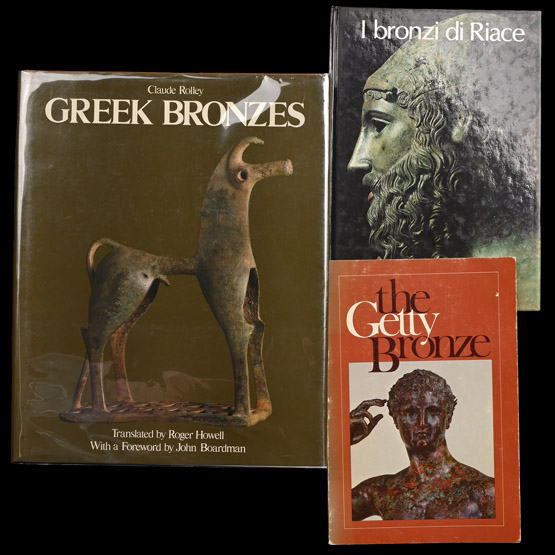
Books on Ancient Greek Bronze Antiquities, Ancient Art and Archaeology - 3 Titles
1980-1986 A.D.Sold for (Inc. bp): £20
C. Rolley - Greek Bronzes - Stevenage, 1986, hardback with dustwrapper, 267 pp, monochrome; G. Foti - I Bronzi di Riace - Novara, 1985, hardback, 48 pp, colour and monochrome; J. Frel - The Getty Bronze - Los Angeles, 1978, card covers, 51 pp, monochrome. 2.65 kg total, 23 x 15.5 - 31.3 x 25 cm
Property of a London, UK, gentleman. -
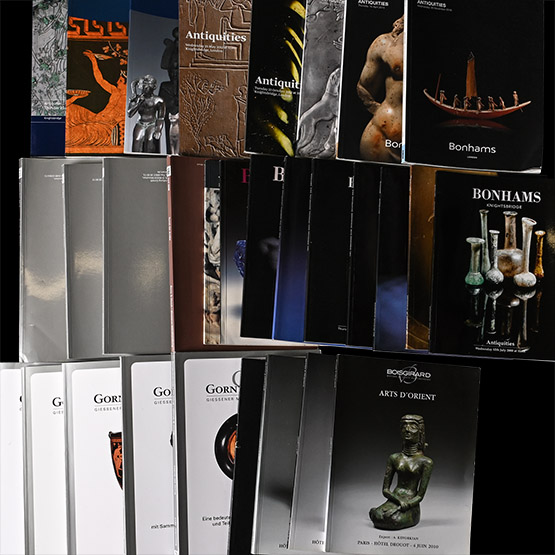
Bonhams, Boisgirard and Gorny & Mosch Antiquities and Ancient Art Auction Catalogue Group - 30 Titles
1993-2017 A.D.Sold for (Inc. bp): £143
BOISGIRARD: Arts D'Orient, 16-17 June 2005; Arts D'Orient, 22 May 2008; Arts D'Orient, 27 November 2009; Arts D'Orient, 4 June 2010; GORNY & MOSCH: Kunst der Antike, December 2017; Kunst der Antike, June 2017; Kunst der Antike, December 2016; Kunst der Antike, June 2015; Kunst der Antike, December 2014; Kunst der Antike, December 2013; Kunst der Antike, June 2013; Kunst der Antike, June 2007; Kunst der Antike, June 2005; BONHAMS: Fine Antiquities, London, 6 July 1993; Fine Antiquities, London, 4 July 1995; Fine Antiquities, London, 12 December 1995; Fine Antiquities, London, 4 July 1996; Fine Antiquities, London, 12 December 1996; Fine Antiquities, London, 26 November 1997; Antiquities, London, 24 June 1998; Antiquities, London, 1 December 1999; Antiquities, London, 12 July 2000; Antiquities, London, 26 April 2001; Antiquities, London, 17 May 2002; Antiquities, London, 7 November 2002; Antiquities, London, 23 May 2012; Antiquities, London, 23 October 2012; Antiquities, London, 2 October 2014; Antiquities, London, 16 April 2015; Antiquities, London, 30 November 2016. 20 kg total, 27 x 21 - 29.6 x 21 cm
Property of a London, UK, gentleman. -
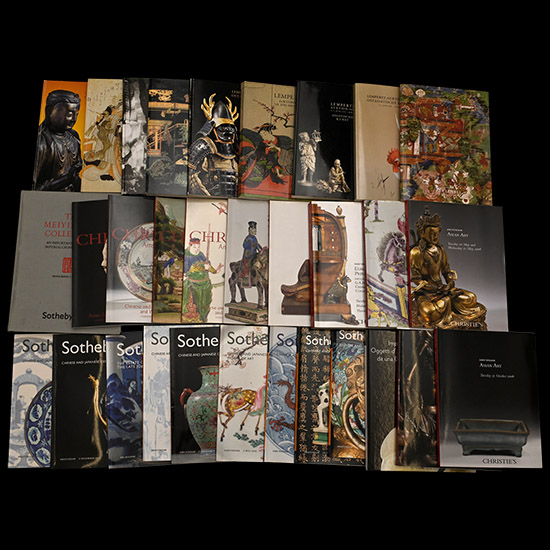
Lempertz, Christie's and Sotheby's Chinese, Japanese and Asian Art Auction Catalogue Group - 31 Titles
1996-2011 A.D.Sold for (Inc. bp): £91
SOTHEBY'S: Chinese and Japanese Ceramics & Works of Art, Amsterdam, 21 May 2003; Chinese and Japanese Ceramics & Works of Art, Amsterdam, 5 November 2003; The Estate of the Late John Kenny, Melbourne, 17-18 May 2004; Chinese and Japanese Ceramics and Works of Art, Amsterdam, 18 May 2004; Chinese and Japanese Ceramics and Works of Art, Amsterdam, 22 November 2004; Chinese and Japanese Ceramics & Works of Art, Amsterdam, 2 May 2005; Chinese and Japanese Ceramics & Works of Art, Amsterdam, 14 November 2005; Chinese and Japanese Ceramics & Works of Art, Amsterdam, 22 May 2006; Chinese and Japanese Ceramics & Works of Art, Amsterdam, 13 November 2006; Importanti Dipinti Antichi, Oggetti D'Arte Cinese, Arredi E Argenti da una Collezione Privata Milanese, Milano, 19 October 2010; The Meiyintang Collection, Hong Kong, 7 April 2011; CHRISTIE'S: Asian Ceramics and Works of Art, Amsterdam, 20-21 May 2003; Chinese and Japanese Ceramics and Works of Art, Amsterdam, 4 November 2003; Chinese and Japanese Ceramics and Works of Art, Amsterdam, 19 May 2004; Chinese & Japanese Ceramics & Works of Art, Amsterdam, 2 November 2004; Chinese Ceramics & Works of Art, Amsterdam, 3 May 2005; Chinese and Japanese Ceramics and Works of Art, Amsterdam, 27 September 2005; European Noble and Private Collections, Amsterdam, 14-16 February 2006; Asian Ceramics and Works of Art, Amsterdam, 23-24 May 2006; Asian Art, Amsterdam, 31 October 2006; Asian Art, Amsterdam, 20-21 November 2007; Asian Art, Amsterdam, 20-21 May 2008; LEMPERTZ: Ostasiatische Kunst, Köln, 29-30 November 1996; Ostasiatische Kunst, Köln, 28-29 November 1997; Sammlung Ignazio Vok Chinesische Keramik, Köln, 27 November 1998; Ostasiatische Kunst, Köln, 27-28 November 1998; Ostasiatische Kunst, Köln, 4-5 June 1999; Ostasiatische Kunst, Köln, 26-27 November 1999; Ostasiatische Kunst, Köln, 2-3 June 2000; Asiatische Kunst, Köln, 8-9 June 2001; Asiatische Kunst, Köln, 7-8 June 2002. 22.5 kg total, 25.9 x 20.5 - 30.2 x 23.5 cm
Property of a London, UK, gentleman.

