-
.jpg)
Greek Solid Gold Ring Idol
5th-4th millennium B.C.Sold for (Inc. bp): £2,730
Annular in form with pierced tab. 0.66 grams, 18 mm
Private collection, acquired in the late 1980s-early 1990s; thence by descent.
During the Greek Neolithic, certain types of ornaments share common morphological characteristics; one such example is the so-called ‘ring-idols’. The prototype of these ring-shaped pendants seems to have been made out of gold, which began to be used during these late phases of the Neolithic in Greece and the Balkans, in general. -
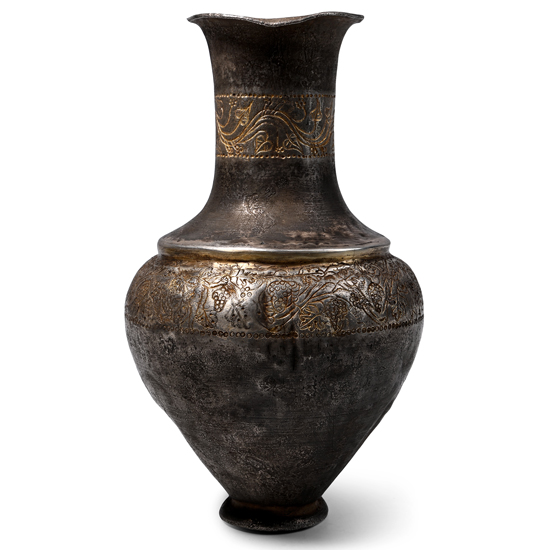
Greek Silver-Gilt Vase with Winged Putti Picking Grapes
Hellenistic, 2nd-1st century B.C.Sold for (Inc. bp): £2,340
Piriform in profile with flared foot and carinated ring at the shoulder, everted rim at the mouth; band of punched decoration on the neck with vinescrolls; similar band to the shoulder with bunches of grapes, tendrils and putti. 150 grams, 14.5 cm
Acquired on the US art market, early 1990s. Private collection, North America. Private collection, London, UK. This lot has been checked against the Interpol Database of stolen works of art and is accompanied by search certificate number no.13244-252968.
There is ample evidence that the princes of the Hellenistic world had a large appetite for expensive tableware. In a procession preceding games organised by the eccentric Antiochos IV Epiphanes (175-163 B.C.) in the Antiochene suburb of Daphne, 1000 silver vessels and 800 gold ones were carried. Kallixeinos of Rhodes reported the combined weight of gold and silver vessels displayed inside the pavilion of Ptolemy II Philadelphos as 10,000 talents, a weight of well over 200 tons. -
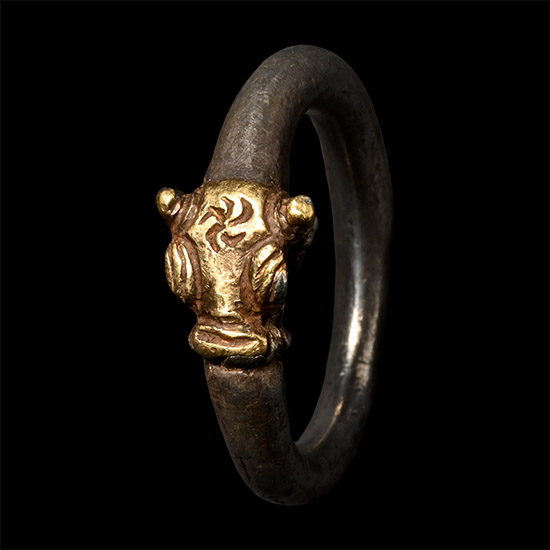
Greek Silver-Gilt Bull Ring
Circa 6th-4th century B.C.Sold for (Inc. bp): £715
Annular in form with plaque formed as a parcel-gilt bucranium with solar motif to the brow. 11.25 grams, 27.39 mm overall, 19.38 mm internal diameter (approximate size British P 1/2, USA 7 3/4, Europe 16.86, Japan 16)
From the private collection of a European gentleman (1942-2024), formed since the 1970s. -
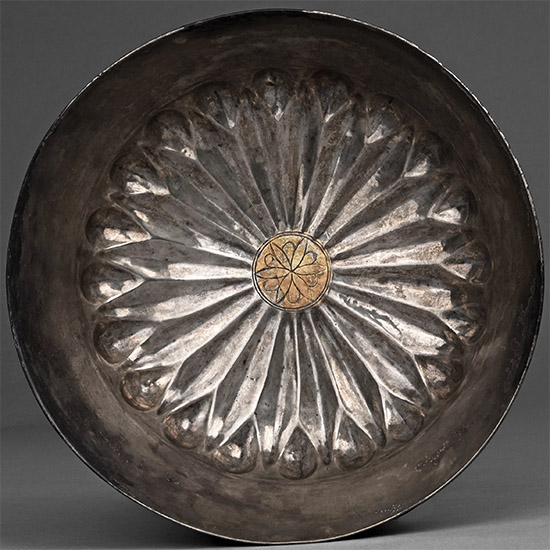
Greek Silver-Gilt Phiale with Petals and Lozenges
6th-4th century B.C.Sold for (Inc. bp): £4,680
Broad lotiform bowl with flared rim, flat mesomphalos with incised rosette and gilt finish. 412 grams, 18.5 cm
Private collection, London, UK. with Gorny and Mosch, 19 June 2013, no.34. Private collection, London, UK. This lot has been checked against the Interpol Database of stolen works of art and is accompanied by search certificate number no.13280-253528. -
.jpg)
Large Phoenician Terracotta Head of a Man
Levant, circa 4th century B.C.Sold for (Inc. bp): £4,680
Hollow-formed moulded head with conical cap, band above the brow with curls beneath, high-relief eyebrows and triangular nose, scaphoid protrusive eyes, tiny pursed mouth; collar to the neck with frontal pendant; ellipsoid vent to rear, flared rim to mouth; some loss to lateral edges at ear-level. 1.73 kg, 27.5 cm
with Phillips, London, 6 July 1993, no.127 (part). Private collection, London, UK. Acquired in London, UK, 2006. Accompanied by copies of the original Phillips and 2006 invoices. This lot has been checked against the Interpol Database of stolen works of art and is accompanied by search certificate number no.13281-254405. -
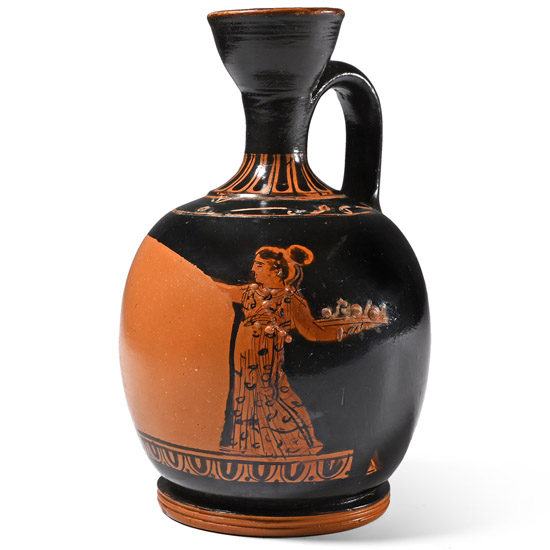
Greek Red-Figure Squat Lekythos Attributed to the Meidian Painter
Attic, circa 420-400 B.C.Sold for (Inc. bp): £715
Comprising a bulbous body with narrow neck and handle to the rear; radiating petals on the neck with a band of volute scrolls below, the body showing a female in a dynamic pose, dressed in an elaborate long dress and holding a plate of fruit with her left hand, a seated female before her; attributed to the Meidian Painter; some restoration. 95 grams, 10.9 cm
Ex Prof. Dr Hans (1918-1984) and Dr Ines (1922-2013) Jucker, classical archaeologists, Bern, Switzerland. with Galerie Rhéa, Zurich, Switzerland. This lot has been checked against the Interpol Database of stolen works of art and is accompanied by a search certificate number no.12645-236462.
Dancing women are a characteristic of the Meidian Painter. They are depicted as young women, wearing Doric costumes, earrings, pearls surmounting diadems, and golden bracelets, holding a patera and (probably originally here too) a thimiaterion. -
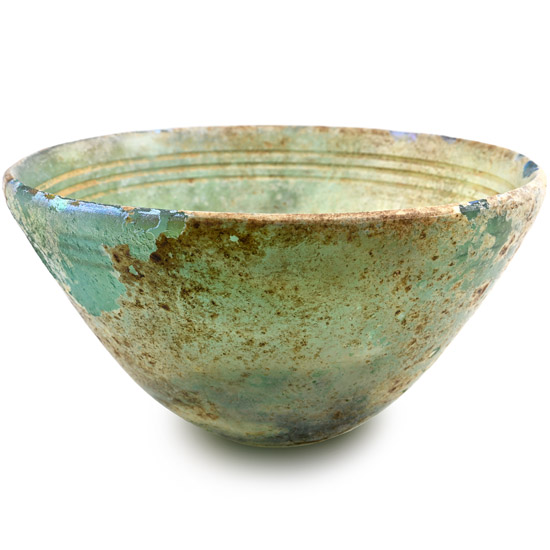
Greek Iridescent Pale Aqua Glass Bowl
Hellenistic, mid 2nd-early 1st century B.C.Sold for (Inc. bp): £2,080
Conical in profile with a rounded apex, aqua glass with three incised bands below the rim on the inner face. 380 grams, 16 cm wide
Dr Jutaro Kawabe, Nagoya, Japan, his collection formed in the 1960s-1970s. with Hoshigaoka Gallery until the late 1990s. Private collection, London, UK. This lot has been checked against the Interpol Database of stolen works of art and is accompanied by search certificate number no.12949-245243.
On ancient glass, iridescence is the soft play of colour that develops as the surface ages and becomes silica-rich. Minute layers form over time and break light into shifting blues, greens and golds. It is not a modern finish but something time has drawn out of the material itself, so the pattern and palette are unique to each piece. Collectors prize good, stable iridescence because it lifts the form: ribs read more crisply, profiles glow, and simple vessels take on depth and movement. Museums now tend to preserve these surfaces rather than polish them away, recognising both their beauty and what they tell us about an object’s long life (though it is not, by itself, a dating test). For display, iridescent glass performs brilliantly under gentle, directional light, where the colours “turn” as the vessel is moved. Well-preserved, even iridescence of this quality is not common and adds materially to the presence—and desirability—of the piece. -
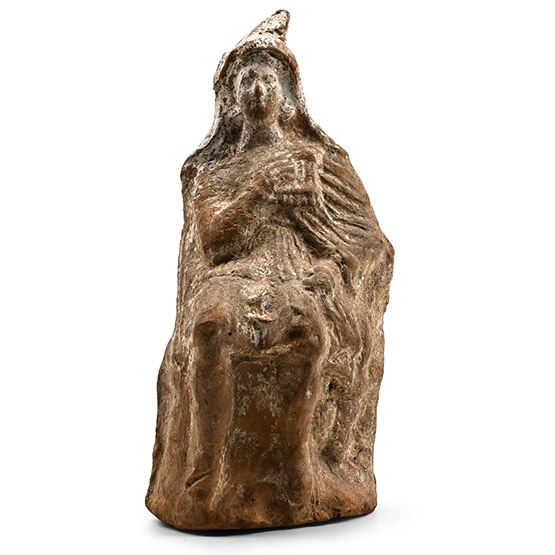
Greek Terracotta Seated Pan
Circa 400 B.C.Sold for (Inc. bp): £546
Hollow-formed statue showing a young pan wearing a short tunic and hooded cloak, holding pipes in his right hand; rectangular slot on the reverse. 205 grams, 15.8 cm
Private collection Mr T.B., Zürich, Switzerland, before 1970. with Galerie Rhéa, Zurich, Switzerland. -
.jpg)
Eastern Greek Marble Figure of Aphrodite, the Goddess of Love and Beauty
1st century B.C.-1st century A.D.Sold for (Inc. bp): £5,200
Carved in the round figure of the goddess standing nude with one hand raised and the other on her pudendum, her hair gathered into a chignon with lateral bunches on the crown and with voids to allow for the suspension of small gold earrings; putto at her left knee; left hand partly absent; remounted on a socle base. 1.2 kg, 32.7 cm
Acquired in the 1992. Private collection, Switzerland, thence by descent. Private collection, since the late 1990s. This lot has been checked against the Interpol Database of stolen works of art and is accompanied by a search certificate number no.12860-241669.
Aphrodite, the Greek goddess of love and beauty, was one of the most widely worshipped deities in the ancient world, particularly across the eastern Greek regions of Asia Minor. In these areas, her image often blended traditional Greek ideals with local influences, giving rise to distinctive regional styles. Marble figures such as this would have served not only as works of art but also as expressions of devotion, reflecting both personal piety and broader cultural values surrounding beauty, fertility, and desire. The enduring popularity of Aphrodite’s image speaks to her central role in daily life, where she was invoked not just in matters of love, but also in marriage, prosperity, and well-being. -
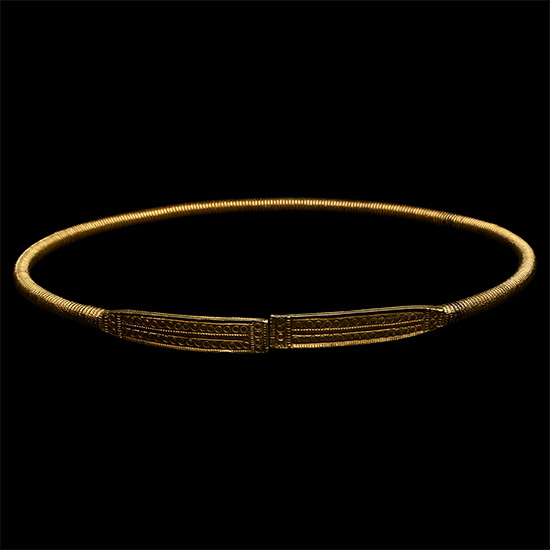
Scythian Gold-Clad Ribbed Torc with Decorated Terminals
4th-3rd century B.C.Sold for (Inc. bp): £9,360
Round in section with ribbing, rectangular finials with billeting to the borders and edges, and rows of impressed roundels. 481 grams, 28 cm
Private collection, Wagner family, Germany, 1955. Private collection, London. This lot has been checked against the Interpol Database of stolen works of art and is accompanied by a search certificate number no.12389-226870. -
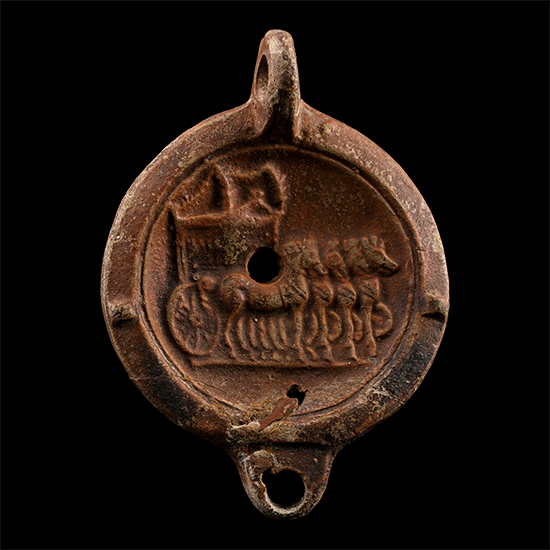
Roman Terracotta Oil Lamp with Victory Quadriga
1st-2nd century A.D.Sold for (Inc. bp): £715
Squat and shallow with broad base; pierced lug handle to rear and small stub nozzle; lateral spurs to shoulder; discus with low-relief quadriga; underside with 'CCLOD' maker's mark. 77 grams, 11.2 cm
From the private collection of Mr Brian Edwards, New Malden, Surrey, UK, formed from the late 1970s-early 1980s; thence by descent.
The mark 'CCLOD' appears in the Index of Signatures and Inscriptions for the J. Paul Getty Museum on a late 1st century lamp (Accession No. 83.AQ.377.96). -
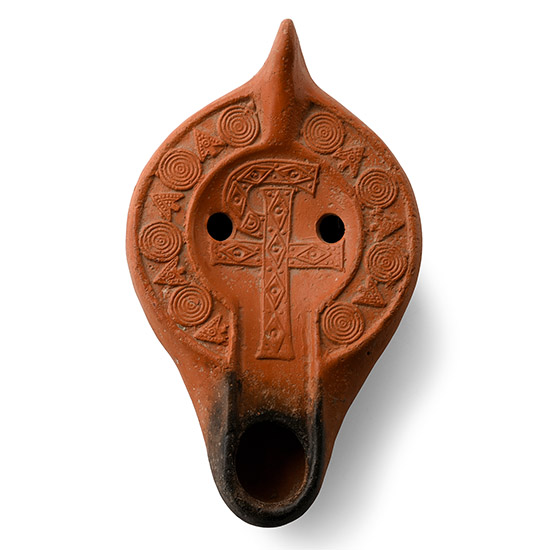
Late Roman Terracotta Lamp with Chi Rho
Late 5th-early 6th century A.D.Sold for (Inc. bp): £572
Recessed discus with two filler holes flanking a low-relief letter rho with cruciform stave, lozenge detailing; band of concentric circles and arrowheads on the rim, lug handle and a low basal ring. 173 grams, 13.9 cm
Private collection, acquired in 1994; thence by descent.
The so-called Christian lamps in Terra Sigillata Africana (TSA) have been classified by Hayes into two major types, I and II. Lamps of Hayes types I and II, initially produced in Tunisia only, were broadly exported, then imitated throughout the Roman Empire for three centuries; consequently, they are extremely numerous.

