-
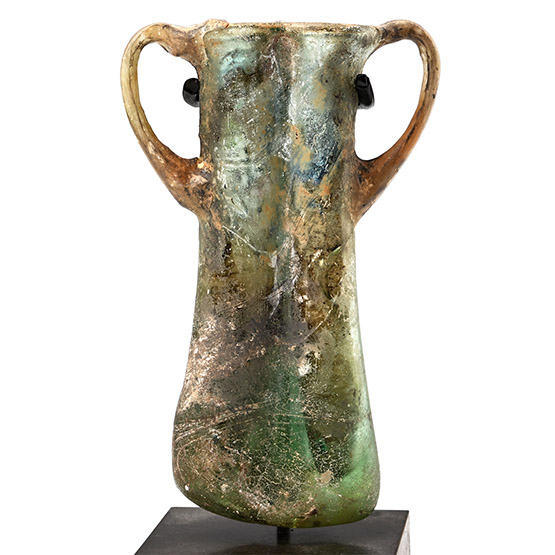
Roman Glass Double Balsamarium
Circa 4th century A.D.Sold for (Inc. bp): £312
Formed as a pair of conjoined tubes with slightly flared tops and thickened rims; applied handles at the shoulders joined to the rim; glass with areas of iridescence; mounted on a custom-made stand. 85 grams, 10.9 cm
From a London, UK, collection of glass, 1970-2000s. -
.jpg)
Roman Carnelian Gemstone with Bearded Mask
2nd-3rd century A.D.Sold for (Inc. bp): £91
With intaglio bearded facing mask forming the body of an insect; supplied with a museum-quality impression. 0.36 grams, 13.48 mm
From the private collection of a European gentleman (1942-2024), formed since the 1970s. -
.jpg)
Roman Glass Gem with Lion Attacking a Bull
2nd-3rd century A.D.Sold for (Inc. bp): £78
With intaglio scene of a lion attacking a bull; supplied with a museum-quality impression. 1.06 grams, 15.51 mm
From the private collection of a European gentleman (1942-2024), formed since the 1970s. -
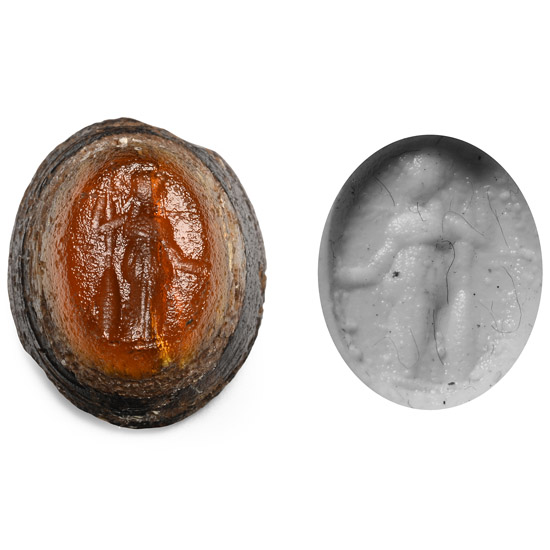
Roman Glass Gem with Minerva
2nd-3rd century A.D.Sold for (Inc. bp): £65
With intaglio Minerva holding spear and shield; supplied with a museum-quality impression. 1.56 grams, 14.75 mm
From the private collection of a European gentleman (1942-2024), formed since the 1970s. -
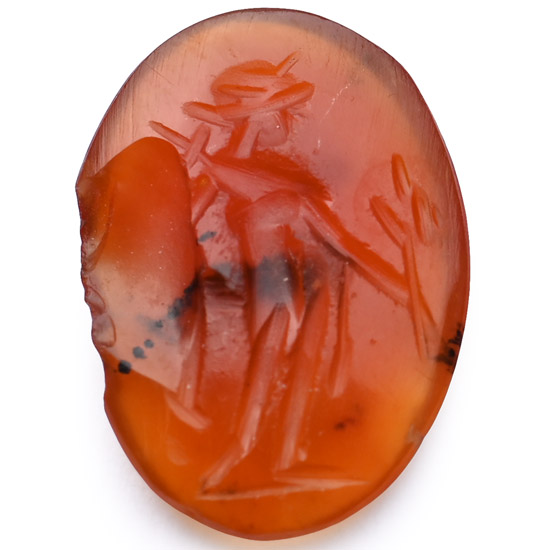
Roman Carnelian Gemstone with Mercury
2nd-3rd century A.D.Sold for (Inc. bp): £85
With intaglio standing figure of Mercury wearing a petasos, holding a flower; supplied with a museum-quality impression. 0.41 grams, 13.23 mm
From the private collection of a European gentleman (1942-2024), formed since the 1970s. -
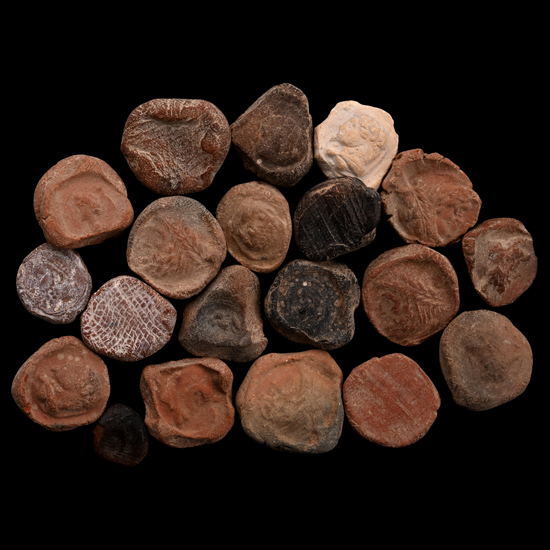
Roman Terracotta Bullae, Tesserae or Token Group
3rd century B.C.-1st century A.D.Sold for (Inc. bp): £98
A mixed group of ceramic bullae, tesserae or theatre tokens bearing low-relief motifs, mainly consisting of profile busts of deities. 37 grams total, 15-22 mm
From the private collection of a European gentleman (1942-2024), formed since the 1970s.
The term 'tessera' was used in Roman times to convey the Greek term σύμβολον (token). Small tiles are known as tokens, often shaped like coins, made of metal (copper, lead, iron), clay, bone, wood, or glass, stamped as well as engraved. The tokens, however, are not exclusively coin-shaped, as the Latin term 'tessera' suggests by etymologically referring to a square or at least a four-sided shape and confirmed in several cases by material remains of the past. Tokens and tesserae seem to have been used both in Athens and Rome for the distribution of goods. According to written sources, the term token is identified with credentials of the official authorities. They have also been interpreted as tokens of identity, as entrance tickets to theatre performances, tribunals or assemblies of citizens, archival material of seal engraving, as pawns in games, Charon’s obols and even as amulets. -
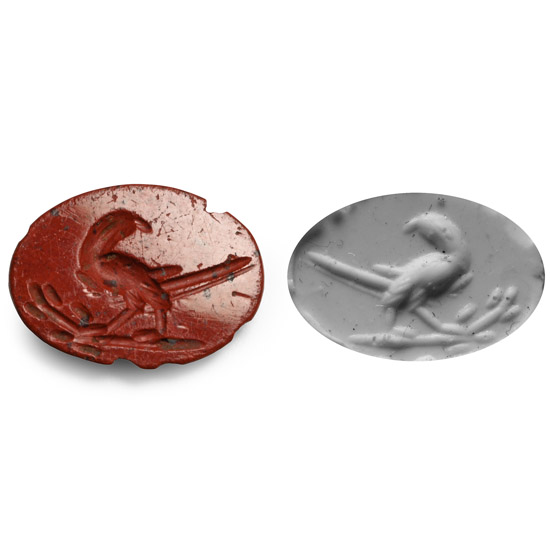
Roman Red Jasper Gemstone with Eagle
2nd-3rd century A.D.Sold for (Inc. bp): £130
With intaglio eagle perched on a branch, head reversed; supplied with a museum-quality impression. 0.23 grams, 10.81 mm
From the private collection of a European gentleman (1942-2024), formed since the 1970s. -
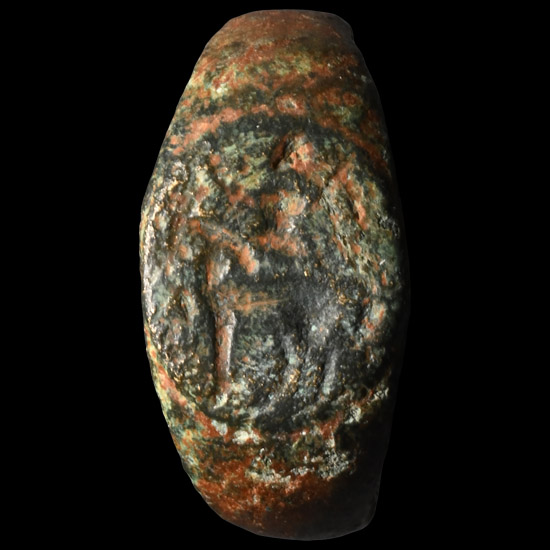
Roman Bronze Ring with Quadruped
1st-4th century A.D.Sold for (Inc. bp): £65
Wide hoop and an oval bezel with a standing quadruped, possibly an ibex. 4.42 grams, 21.63 mm overall, 16.34 mm internal diameter (approximate size British M 1/2, USA6 1/4, Europe 13.09, Japan 12)
From the private collection of a European gentleman (1942-2024), formed since the 1970s. -
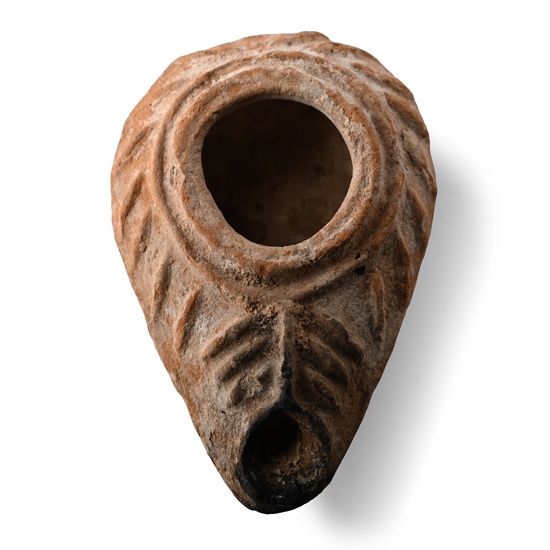
Late Roman Terracotta Slipper Oil Lamp
Circa 5th-6th century A.D.Sold for (Inc. bp): £72
Piriform body with raised rim around the filler hole and nozzle, raised linear decoration and low basal ring. 47.1 grams, 81 mm
Acquired from Ancient Art Shop, Berkshire, UK. From the collection of a Nottingham, UK, collector, established from the early 2000s. Accompanied by the original Ancient Art Shop certificate of authenticity. -
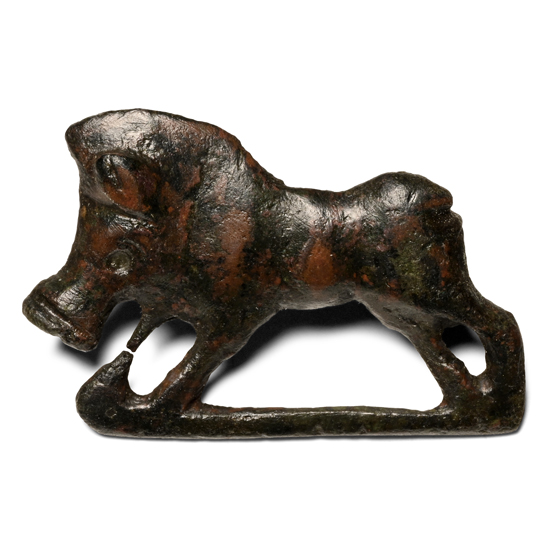
Roman Bronze Boar Plate Brooch
Circa 3rd-4th century A.D.Sold for (Inc. bp): £117
Modelled as a running boar on a baseline, catchplate and pinlugs on the reverse. 11.3 grams, 38 mm
Ex Wiltshire, UK, collection, 1990s. -
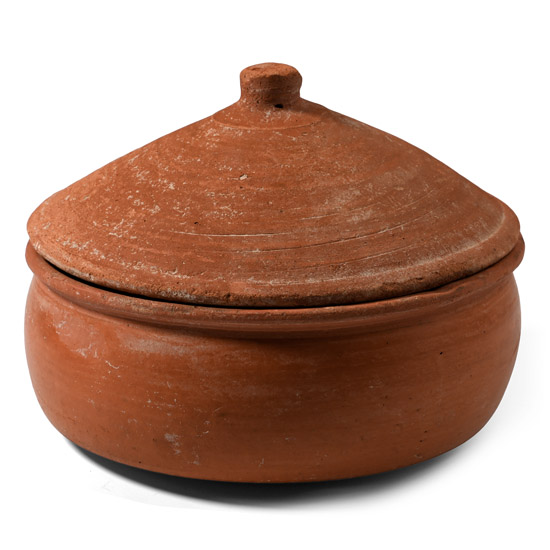
Roman Red Ware Lidded Bowl
Circa 3rd-4th century A.D.Sold for (Inc. bp): £208
Squat ceramic bowl with slightly domed base, rounded rim; domed lid with knop handle to apex. 845 grams total, lid: 17.3 cm wide
From the private collection of Mr Brian Edwards, New Malden, Surrey, UK, formed from the late 1970s-early 1980s; thence by descent, with collector's reference no.A34. -
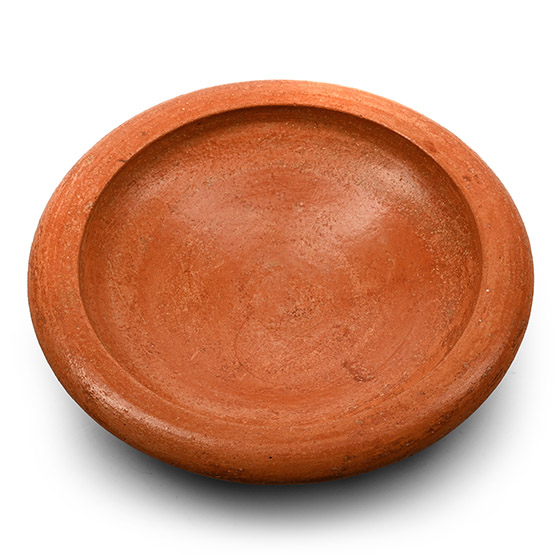
Roman Redware Plate
Circa 1st century A.D.Sold for (Inc. bp): £195
Shallow body with wide, rounded rim and a low basal ring. 243 grams, 16.6 cm wide
From the collection of a late Yorkshire, UK, gentleman.

