-
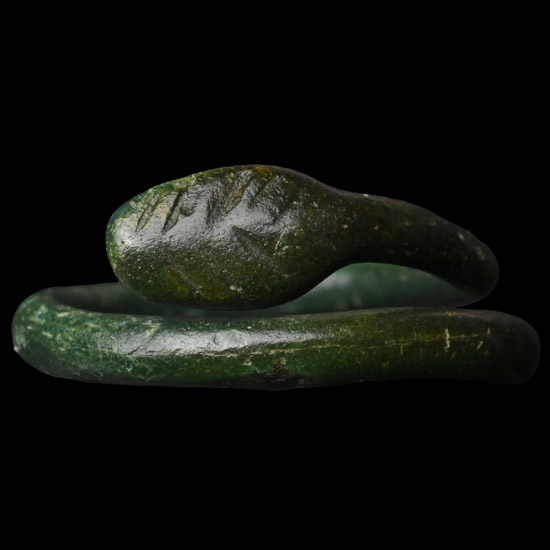
Romano-Egyptian Bronze Snake Ring
1st century B.C.-1st century A.D.Sold for (Inc. bp): £130
Formed as a coiled snake with chevron decoration on the head. 1.96 grams, 17.82 mm overall, 11.83 mm internal diameter
Ex German art market, 2000s. Acquired from an EU collector living in London. From the collection of a Surrey, UK, gentleman. -
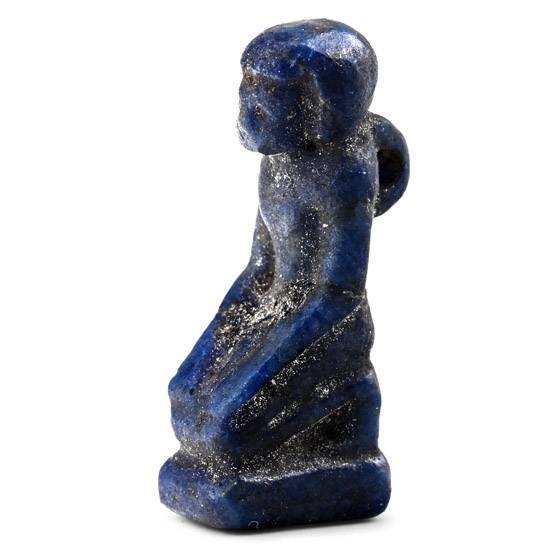
Egyptian Faience Kneeling Priest Amulet
New Kingdom, 1550-1070 B.C.Sold for (Inc. bp): £124
Modelled in the round figure of a priest kneeling on a base with hands on his thighs; loop behind the shoulders. 1.16 grams, 19 mm
From the collection of a gentleman, acquired on the London art market in the 1990s. -
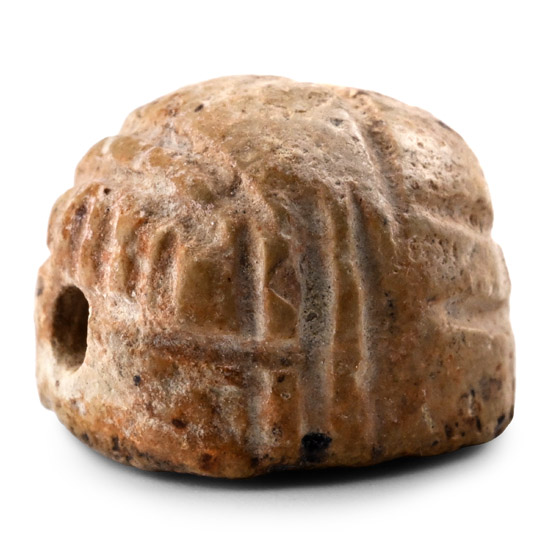
Phoenician Stone Scaraboid with Man Working in a Field
1st millennium B.C.Sold for (Inc. bp): £33
Domed body with incised detailing, underside showing a man tending his land. 3.21 grams, 15 mm
From a late Warwickshire numismatic collector, his collection formed from the early 1980s. -
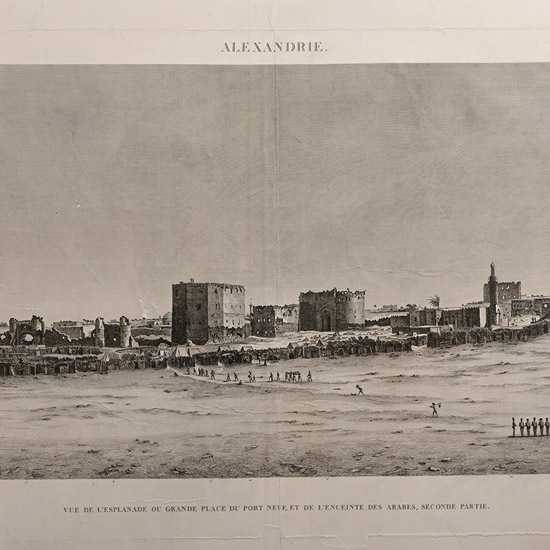
Very Large Egyptian Expedition Lithograph of a View of Alexandria
Early 19th century A.D.Sold for (Inc. bp): £91
Proof etching on laid paper of plate 98 from Description de l'Égypte : ou, Recueil des observations et des recherches qui ont été faites en Égypte pendant l'expédition de l'armée française. entitled Vue de l'Esplanade ou Grande Place du port neuf et de l'Enceinte des Arabes, Seconde partie. 233 grams, 105 x 66.5 cm
From the collection of a North American priest. Acquired between 1981-1996. Property of a North American collector.
Produced between February 1802 and 1830 on the orders of Napoleon Bonaparte; published between 1809 and 1828. Just 1,000 copies were distributed to various institutions, printed on laid paper with an 'Égypte ancienne et moderne' watermark. The book is subtitled Recueil des observations et des recherches qui ont été faites en Égypte pendant l’expédition de l’Armée française, publié par les ordres de Sa Majesté l’Empereur Napoléon le Grand (Gathering of observations and discoveries which were made in Egypt during the expedition of the French army, published on the orders of His Majesty the Emperor Napoleon the Great). It was the world's first encyclopedia devoted exclusively to the remains of ancient Egypt. The plates of this book are the first to present the archaeological sites of Thebes (Luxor). -
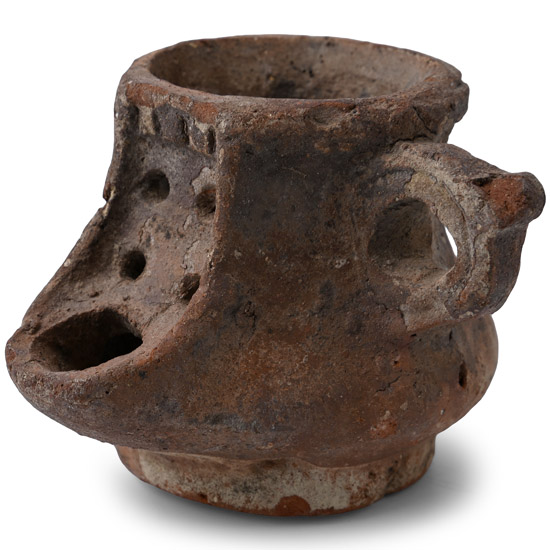
Egyptian Terracotta Handled Oil Lamp
Ptolemaic Period, circa 3rd-1st century B.C.Sold for (Inc. bp): £117
Biconical body with tubular neck and thickened rim, short spout with four piercings above, and handle to the side. 94 grams, 74.6 mm wide
From the private collection of Mr Brian Edwards, New Malden, Surrey, UK, formed from the late 1970s-early 1980s; thence by descent. Accompanied by the original collector's data sheet with reference no.A116. -
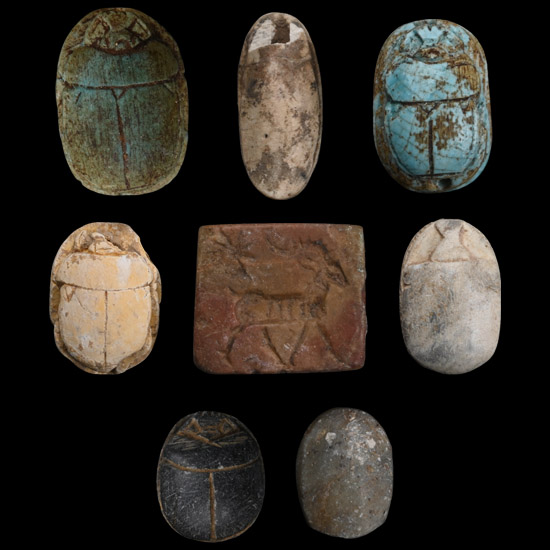
Egyptian Stone Scarab and Amulet Collection
Hyksos Period-Late Period, 1650-332 B.C.Sold for (Inc. bp): £585
Group consisting of scarabs, scaraboid and other types, some with hieroglyphs on the underside, including the cartouche of Amenhotep II (Akheperure) with the legend "Beloved of Amun". 15.71 grams total, 13-19 mm
From the collection of a gentleman, acquired on the London art market in the 1990s. -
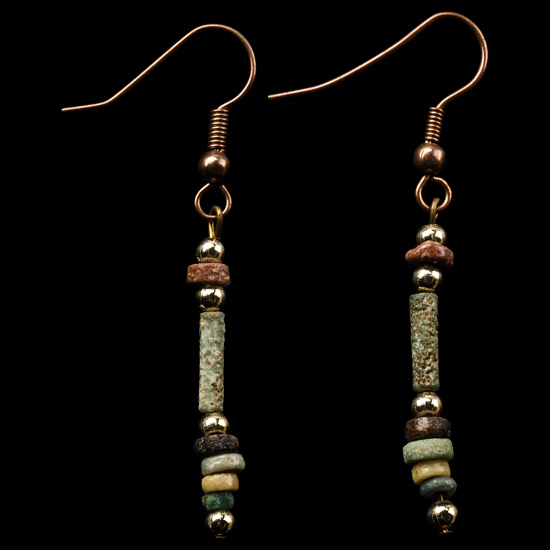
Egyptian Mummy Bead Earring Pair
Late Period, 664-332 B.C.Sold for (Inc. bp): £85
A matched pair formed of annular and cylindrical faience beads; modern hook and bar with gold-coloured beads. 1.27 grams total, 50-51 mm
Acquired Town Hall Antiques, Market Place, Woburn, Bedfordshire, UK, on 2nd March 2001. Property of a West Northamptonshire, UK, gentleman. Accompanied by a copy of the original Town Hall Antiques invoice. -
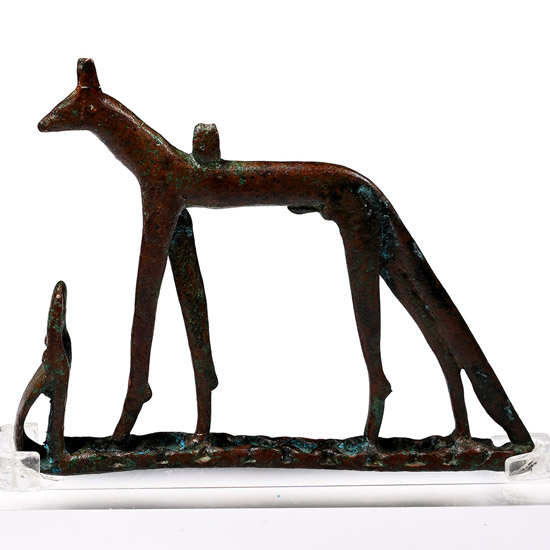
Large Egyptian Bronze Wepwawet Amulet
Third Intermediate-Late Period, 1069-332 B.C.Sold for (Inc. bp): £5,200
Showing the jackal deity Wepwawet standing with ears pricked on a sledge, the slender body modelled with long legs and a tail, suspension loop on the back; two rearing cobras before the jackal; mounted on a custom-made display stand. 54 grams, 91 mm (162 grams total, 11.7 cm including stand )
Ex Dr R. and Mrs L.B., Zumikon, Switzerland. with Galerie Rhéa, Zurich, Switzerland. This lot has been checked against the Interpol Database of stolen works of art and is accompanied by a search certificate number no.12627-236406.
This object may have been the decorative element of a ceremonial standard, examples of which have survived (cf. Petrie, W.M.F., Tanis: Part II / Nebesheh (Am) and Defenneh (Tahpanhes), London, 1886, pl. VII, no. 3). Wepwawet, meaning "Opener of the Ways," was an ancient Egyptian god associated primarily with warfare, protection, and funerary practices. Depicted as a jackal or a man with a jackal's head—often mistaken for Anubis—Wepwawet was believed to guide souls through the afterlife and open paths both in battle and in the spiritual realm. He originated in Asyut (ancient Lycopolis) in Upper Egypt and was one of the oldest deities in the Egyptian pantheon, with worship dating back to at least the First Dynasty (c. 3100–2900 BCE). Over time, Wepwawet became closely linked to Anubis, and the two were sometimes conflated, though Wepwawet retained his distinct identity as a god who preceded and cleared the way. In military contexts, Wepwawet was invoked to "open the way" for pharaohs and armies, ensuring victory and safe passage. In funerary texts, he was described as clearing the path to the afterlife, acting as a scout or guide for the deceased. -
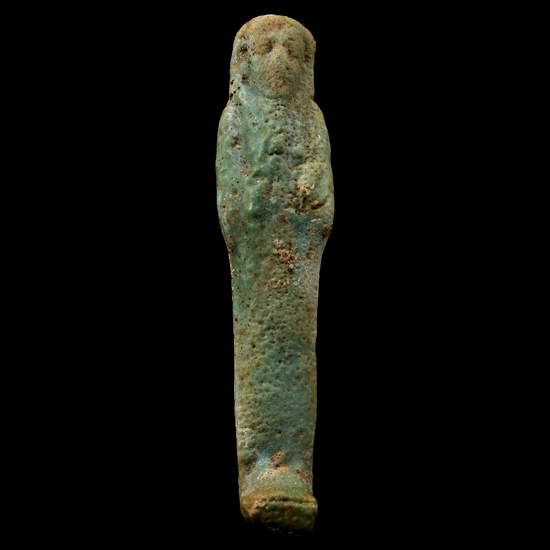
Egyptian Blue Glazed Faience Shabti Figure
Late Period-Ptolemaic Period, 664-30 B.C.Sold for (Inc. bp): £104
Mummiform figure with crossed arms, wearing a false beard and tripartite wig. 22.29 grams, 96 mm
Acquired from Ancient Art, London, UK. From the collection of a Nottingham, UK, collector, established from the early 2000s. Accompanied by the original Ancient Art certificate of authenticity. -
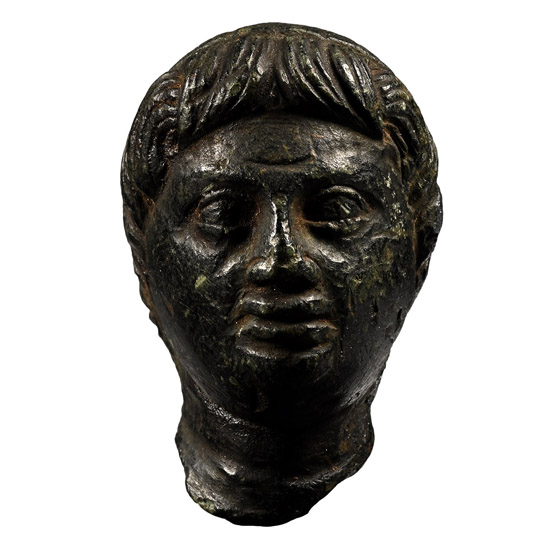
Egyptian Steatite Portrait of a Ptolemaic Prince
2nd-1st century B.C.Sold for (Inc. bp): £975
With a round face, large eyes, a narrow nose that broadens at the end, and full lips downturned at the corners; the forehead with a distinctive deep furrow above the brow; a narrow, twisted diadem encircling his wavy hair; mounted on a custom-made display stand. 84 grams total, 10 cm including stand
Private collection, Bern, Switzerland. with Galerie Rhéa, Zurich, Switzerland. This lot has been checked against the Interpol Database of stolen works of art and is accompanied by a search certificate number no.12631-236408.
The Greek hairstyle is a characteristic feature of Ptolemaic royal portraiture, as is the twisted diadem - a Greek interpretation of the Egyptian headband (the sšd) - which appears on several portrait heads of Ptolemaic boy-kings and princes. The distinctive furrow is intriguing, as it contrasts with the typically blemish-free physiognomy of most Ptolemaic royal sculpture. However, a similar furrow can be seen on the portrait head of a provincial governor from Dendera, dated to the 2nd century B.C. (Bothmer, B.V., Egyptian Sculpture of the Late Period 700 B.C. to A.D. 100, New York, 1960, pp. 144-143, pl. 112, nos. 301-302), which may indicate an artistic trend employed in high-status sculpture at that time. It has been suggested that small royal portrait heads, such as this example, may have served as votives. The lack of an Egyptian-style back pillar on this and similar pieces supports the possibility that they were inserted into statues made of different materials (Ashton, S.-A., Ptolemaic Royal Sculpture from Egypt, BAR International Series 923, Oxford, 2001, p.12). -
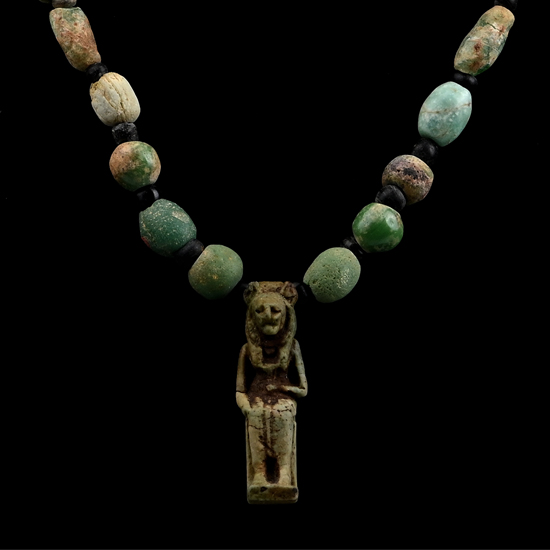
Egyptian Glass Bead Necklace with Large Sekhmet Faience Amulet
Late Period, 664-332 B.C.Sold for (Inc. bp): £546
Restrung group of mosaic glass tubular beads, spherical and other spacer beads, pendant amulet of Sekhmet seated on throne. 26 grams, 35 cm, amulet: 41 mm
From the collection of a gentleman, acquired on the London art market in the 1990s. -
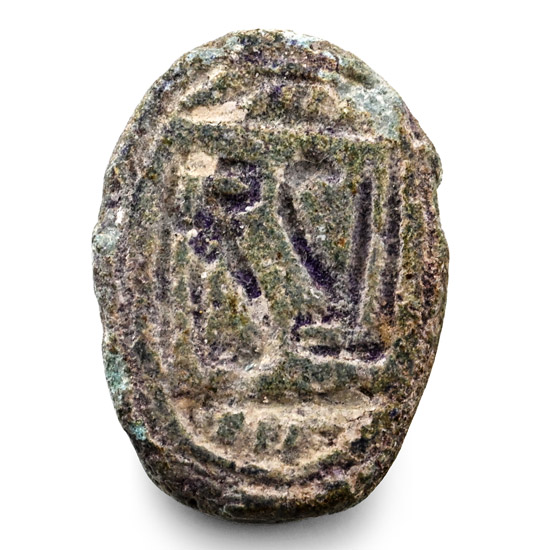
Phoenician Faience Scaraboid with Patterns
1st millennium B.C.Sold for (Inc. bp): £33
Anatomical detailing on the body and symbols on the underside. 0.9 grams, 15 mm
From a late Warwickshire numismatic collector, his collection formed from the early 1980s.

