-
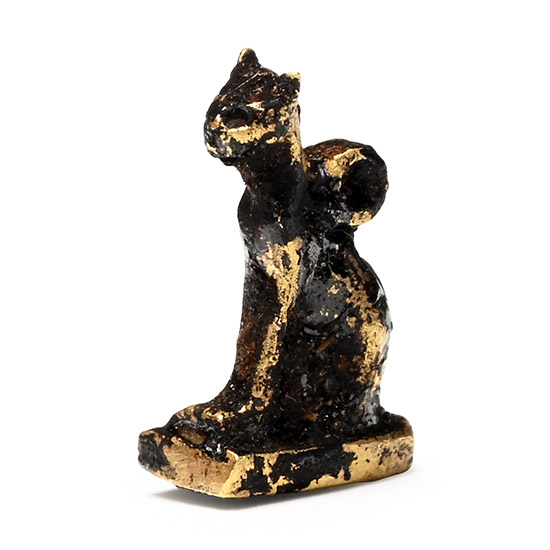
Egyptian Gold Bastet Seated Cat Amulet
Late New Kingdom-Third Intermediate Period, circa 1069-900 B.C.Sold for (Inc. bp): £468
Modelled seated on a tongue-shaped base, with simple facial detailing and suspension loop to the back. 0.51 grams, 8 mm
Ex French collection, early 20th century.
The goddess Bastet was believed to be the daughter of the sun god and was shown with the features of a lion up until about 1000 B.C. when she was first portrayed as a cat or human with a cat head. As the daughter of Ra she was associated with the rage inherent in the sun god's eye, which was considered to be his instrument of vengeance. Her development into a cat goddess occurred during the New Kingdom but did not fully develop until the Late Period. She was still associated with the destructive power of the sun and was shown on the prow of the solar boat, decapitating the evil serpent Apophis in the Book of the Dead. The maternal, protective and hunting characteristics of the cat are obvious in Bastet, and she was seen as a protector of pregnant women and young children. In the Pyramid Texts, she is invoked by the deceased king to act as his protector and to help him reach the sky to join the sun god; the king proclaims that Bastet is his mother and nurse. Like her counterpart, Sekhmet, Bastet has an aggressive side and, in a text from Karnak, Amenhotep II described his enemies being slaughtered like the victims of Bastet. The goddess had a shrine at Karnak, where she is known as the 'Lady of Asheru', which aligns her closely with the goddess Mut, the consort of Amun-Ra. Her most famous shrine was in the north-east Delta region, at Bubastis, and was known as Per-Bastet or 'the House of Bastet.' Herodotus describes the festival of Bastet as one of the most elaborate in all of Egypt and identifies her with the Greek Artemis. Cemeteries of cats have been excavated at Bubastis, and at Saqqara and Memphis. -
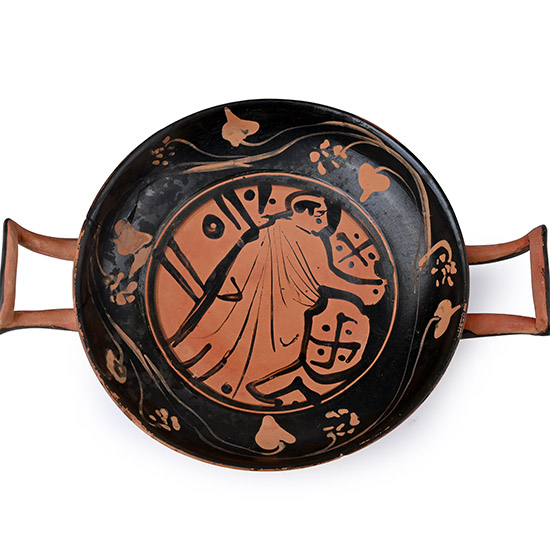
Greek Red-Figure Kylix with Youth in the Tondo from the Group of Vienna 116
Attic, circa 375-350 B.C.Sold for (Inc. bp): £1,300
Broad and shallow with two strap handles; ivy leaves and berries on the inside rim, tondo with cloaked figure surrounded by geometric motifs; outside with palmettes, scrolls and other motifs; repaired. 220 grams, 22 cm wide
Acquired on the art market between the late 1990s and mid-2000s. Estate of the late Barry Paul Buxton (1944-2024), Oakham, Rutland. Acquired on the UK art market, 2025. -
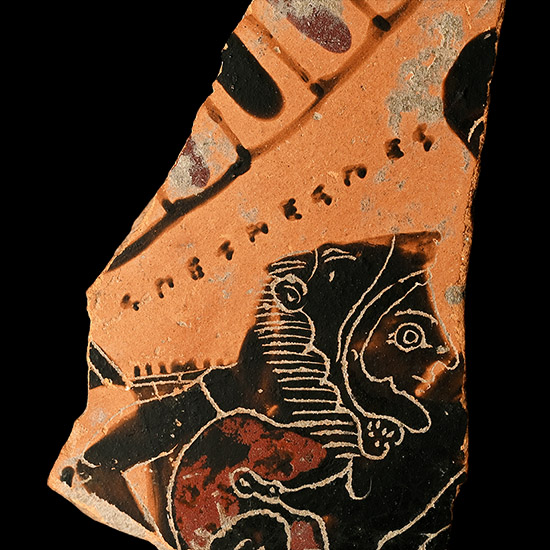
Greek Pottery Sherd with Inscription Above Hercules Wrestling a Warrior
Attic, circa 5th century B.C.Sold for (Inc. bp): £1,690
Fragment from a large vessel showing Hercules wearing the Nemean lion skin in close combat with a bearded warrior, Greek inscription above. 8.37 grams, 64 mm
From an old Belgian collection, circa 2000. -
.jpg)
Greek Terracotta Gnathian-Ware Alabastron
Apulian, circa 3rd century B.C.Sold for (Inc. bp): £1,235
Piriform in profile with a carinated rim to the mouth, a low basal ring; horizontal bands and a hatched panel, concentric rings. 255 grams, 14.5 cm
Louis-Gabriel Bellon (1819-1899) collection, France. European private collection, 2009.
Among the shapes of pottery that are also mostly represented in the Gnathian style are lekanides, bombilyoi and alabastra. They were containers for ointments and perfumes, used in funerary contexts during the first phase of the ritual, when the body needed to be treated and prepared for the burial. -
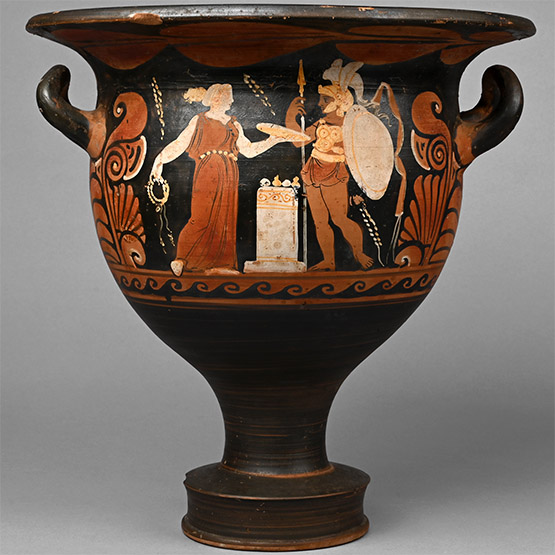
Greek Red-Figure Bell Krater with Warrior Funerary Offering Scene, Attributed to CA Painter
Campanian, 350-300 B.C.Sold for (Inc. bp): £5,980
Comprising a bell-shaped body with narrow stem and stepped pedestal foot, broad rim with square loop handles and palmettes beneath, frieze to sidewall: Side A: Oscan warrior with cuirass, helmet, shield and spear standing beside an altar with a female holding a patera in her extended hand, diadem in the other at her side; Side B: seated female with a patera and wreath facing a standing cloaked figure with thyrsus. 2.38 kg, 29.5 cm high
Private collection, Geneva, acquired in the late 1960s. Private collection, acquired in Geneva in 2000. Accompanied by collector's notes and old images. Accompanied by an original copy thermoluminescence analysis report no.QED1412/.SG-0602 from QED Laboratoire. Accompanied by an academic report by Dr Raffaele D'Amato. This lot has been checked against the Interpol Database of stolen works of art and is accompanied by search certificate number no.13219-249314.
The krater offers an interesting glimpse into the local life of Campania in the 4th century B.C. Particularly noteworthy is the depiction of the Oscan Samnite warrior, fully armed in the style of Campanian, Samnite, or Lucanian mercenaries, performing a funerary sacrifice. The depiction of the Chalcidian helmet, with its central crest and twin lateral plumes (geminae pinnae), dedicated to Mars, is extremely detailed. The style and the way in which the figures are realised, the conformation of the women, the details of the warrior, seem to point to the workshop of the CA Painter, a Campanian red-figure vase-painter whose name is unknown. Nevertheless, consistent individual characteristics of style suggest the existence of a unique artistic personality. Trendall called him the CA Painter because he was the chief painter in the first stage of Cumaean red-figure vase-painting, the initials standing for Cumaean (C), first stage (A). -
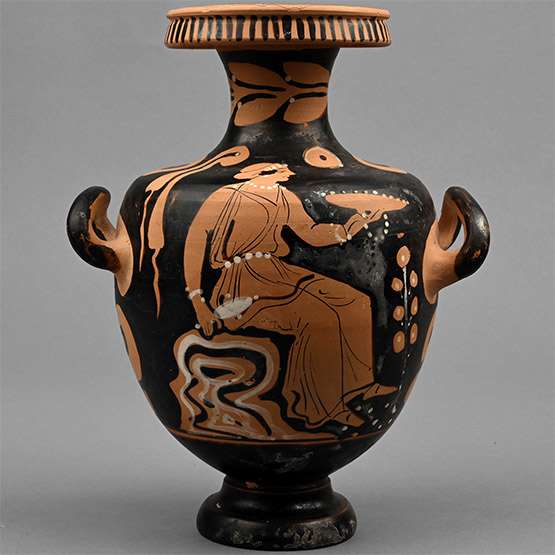
Greek Terracotta Red-Figure Hydria Depicting Offering Scene
Apulian, 3rd-2nd century B.C.Sold for (Inc. bp): £2,600
With cylindrical body and broad bevelled shoulder, stepped foot, lateral squared loop handles and strap handle to shoulder, broad mouth; Side A: seated female in himation holding an offering bowl in her extended left hand; white detailing to the diadem, necklace, earrings, mirror in her right hand, rim of the bowl and elsewhere; Side B: reserved palmette motif extending to the shoulder and neck; repainted. 771 grams, 23 cm high
Acquired on the art market between the late 1990s and mid-2000s. Estate of the late Barry Paul Buxton (1944–2024), Oakham, Rutland. Acquired on the UK art market, 2025. Accompanied by a thermoluminescence analysis report no.N126a16 from Oxford Authentication.
Apulian red-figure had a strong influence on other Italian ceramics of the late 5th century B.C. and an even greater effect from around the middle of the 4th century, with potters and painters apparently migrating to Italic centres throughout Apulia, as well as to Metaponto, Paestum and other parts of Campania. Although it is most probable that Taranto was the main centre of production for Apulian red-figure, the recent extensive finds at Canosa, Melfi and other sites suggest that there were numerous Apulian centres of manufacture. -
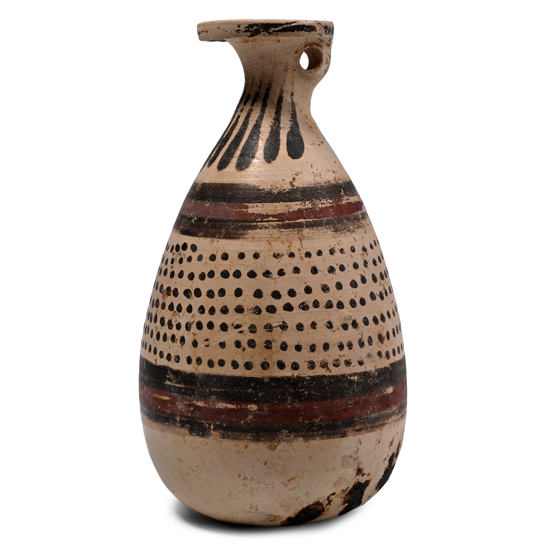
Greek Terracotta Alabastron
Etrusco-Corinthian, circa 6th century B.C.Sold for (Inc. bp): £468
Piriform body with narrow neck and flaring rim with a small loop handle below, decorated with radiating strokes below the neck, followed by eight rows of dot decoration flaked by red and black circumferential bands. 88 grams, 11.1 cm
From the collection of the late Sir Clinton Charles Donald Cory, 5th Baronet of Coryton. Ex Philip Auction House, 24 September 1985. Accompanied by two previous information cards. -
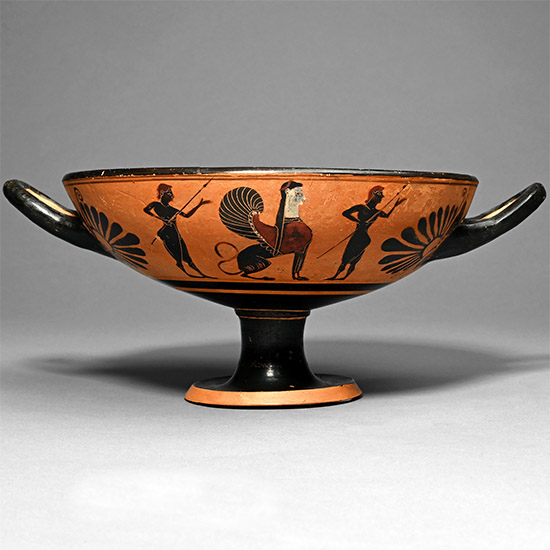
Greek Black-Figure Kylix with Warriors and Sphinxes
Attic, circa 530 B.C.Sold for (Inc. bp): £7,800
Comprising: a broad shallow bowl with two loop handles curving up towards the rim, short stem and broad foot with chamfered outer edge; the bowl with reserved central disc to inner face, palmette motifs at the junctions of the handles, frieze depicting two standing nude males flanking a crouching sphinx in profile; restored and with old dealer's labels beneath base. 414 grams, 27.3 cm wide
Ex Prof. F.S., Villingen-Schwenningen, Germany, 1991. with Gallery Drees Archeo S.P.R.L., Brussels. Acquired from the above, 16 December 2017. Accompanied by a copy of an Art Loss Register certificate, no.S00041086. Accompanied by a Gallery Drees Archeo certificate of authenticity. Accompanied by a thermoluminescence report no.0102 0910 from Laboratory Ralf Kotalla, 6 September 2010. This lot has been checked against the Interpol Database of stolen works of art and is accompanied by search certificate number no.12945-246388.
The present piece is a wide-bowled drinking cup known as a kylix - one of the most popular forms of pottery from the Achaean times (1600-1100 B.C.) through to the classical period (c.510-323 B.C.). It dates to an important moment in the development of Greek ceramics, just as the black-figure technique was being perfected by Athenian painters. Painted in black slip with details incised on top, kylikes usually had a frieze around the outside of the bowl as well as another scene on the tondo of the inside. The scene here represented can be linked with the well-known episode of Oedipus and the Sphinx. -
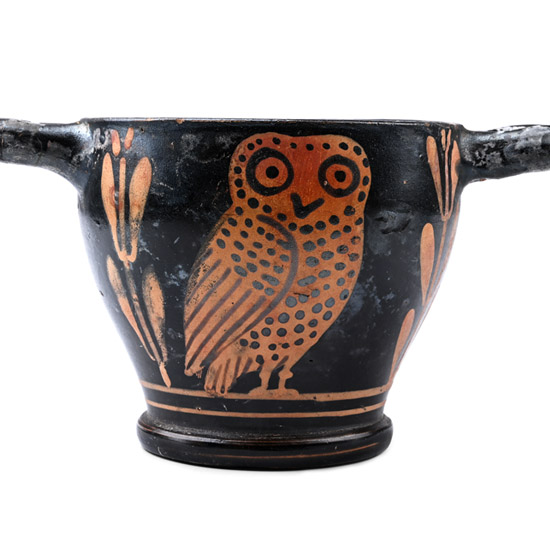
Large Greek Red-Figure Skyphos with Owl
South Italian, 5th-4th century B.C.Sold for (Inc. bp): £2,600
With mammiform body, pedestal base and two loop handles; each side with a facing image of an owl between laurel fronds. 239 grams, 17.5 cm
Swiss private collection, assembled in the 1960s-1970s. Private collection, acquired in 2013. Accompanied by a thermoluminescence analysis report no.N126a14 from Oxford Authentication. This lot has been checked against the Interpol Database of stolen works of art and is accompanied by a search certificate number no.12854-241751.
Bubo was the holy beloved magical owl of the goddess Athena, and it was a common subject on Greek painted ceramics. The owl-skyphos, originally produced in 5th century Athens, was extremely popular and was exported from Athens to other parts of the Greek world, including southern Italy and Etruria. Local imitations have been excavated at Corinth, and during the fourth century, or perhaps even slightly earlier, skyphoi similar to those from Athens were produced in Apulia and Etruria. -
.jpg)
Etruscan Votive Bronze Hand
Circa 7th-6th century B.C.Sold for (Inc. bp): £2,340
Modelled in the half-round with D-section fingers, portion of cuff behind the thumb; mounted on a custom-made display stand. 187 grams total, 11.8 cm high including stand
Acquired on the German art market, before 1992; thence by descent. This lot has been checked against the Interpol Database of stolen works of art and is accompanied by search certificate number no.13191-249245.
Votive offerings gained increasing popularity throughout Etruria, southern Latium and later northern Campania from the 7th century B.C. onwards. Most gods were thought to possess the power to heal, and the sick flocked to their sanctuaries for a cure or to pray for future health. Usually, these dedications depicted the parts of the human anatomy that needed healing. The area of Vulci offered many graves in which pairs of hands cut from a sheet of bronze, rolled up at the base to form the wrist, have been found. -
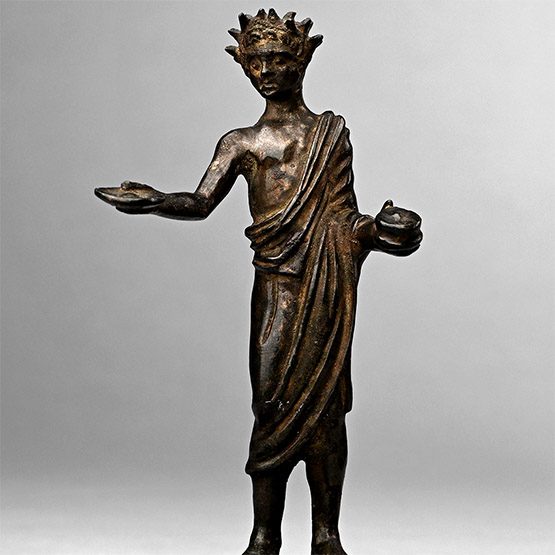
Etruscan Bronze Votive Figure of Genius Sacrificulus
6th-5th century B.C.Sold for (Inc. bp): £1,560
Depicting a ‘genius’ making a sacrifice, his head surrounded by a radiate crown or a wreath of laurel leaves arranged in rays; bare-chested with a cloak (tebenna) falling over his left shoulder, covering his back and resting on his left arm, enveloping his legs to below the knee; holding a patera in his right hand and an acerra in his left; accompanied by a display stand. 189 grams, 12.1 cm (367 grams total, 13.4 cm high including)
Anne Betgoner, Paris, by descent. French private collection, acquired in the early 20th century. Acquired from the above by the present owner. Private collection, UK. This lot has been checked against the Interpol Database of stolen works of art and is accompanied by a search certificate number no.13235-251199.
The figure represents a genius dressed as a priest according to the Etruscan tradition. He is celebrating a sacrifice by offering to the gods with a patera of precious liquids and perfumes, kept in the acerra or pyxis. Acerra was the name given to the casket in which the incense intended for sacrifices was placed (arcula turalis). A servant carried it to the altar, and the granules from the casket were scattered on the flames (acerra libare). -
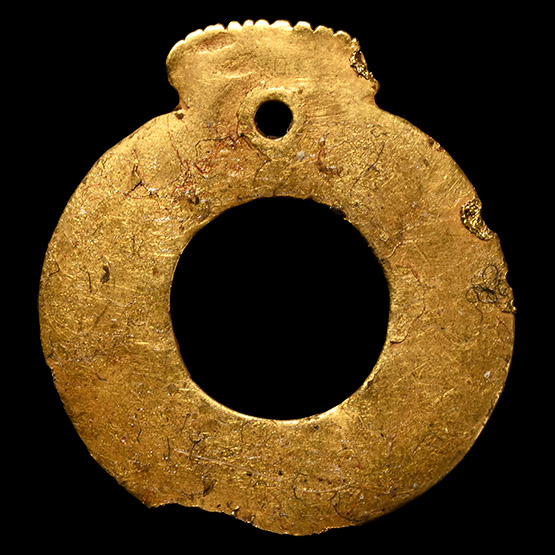
Greek Solid Gold Ring Idol
5th-4th millennium B.C.Sold for (Inc. bp): £2,860
Annular in form with pierced tab. 1.65 grams, 20 mm
Private collection, acquired in the late 1980s-early 1990s; thence by descent.
During the Greek Neolithic, certain types of ornaments share common morphological characteristics; one such example is the so-called ‘ring-idols’. The prototype of these ring-shaped pendants seems to have been made out of gold, which began to be used during these late phases of the Neolithic in Greece and the Balkans, in general.

