-
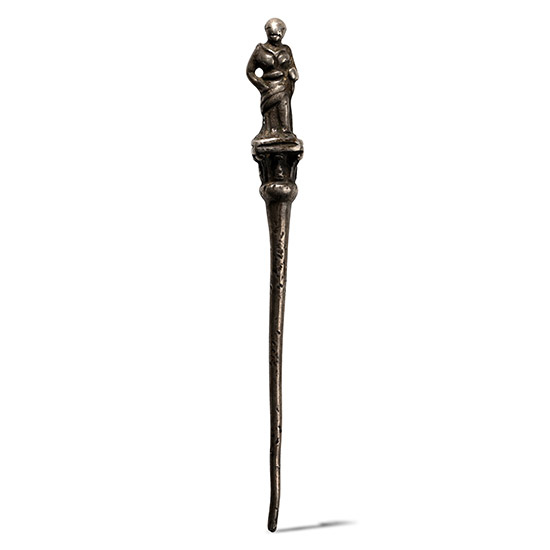
Roman Silver Pin with a Figure of a Standing Woman
2nd-3rd century A.D.Sold for (Inc. bp): £624
Comprising a tapering body with a Corinthian capital finial, a standing female figure atop the capital, dressed in long robes. 16 grams, 98 mm
Acquired in the 1980s. Private collection, Switzerland, thence by descent. Private collection, since the late 1990s.
The pin seems to belong to the group 18 of the Cool's classification. The treatment of the figures in these pins varies greatly, including both the very 'Celtic' looking face on a pin from Cirencester and a Graeco-Roman figure type of Venus standing on a Corinthian capital from London. This great diversity of treatments clearly suggests that these pins were the occasional products of a wide variety of workshops. -
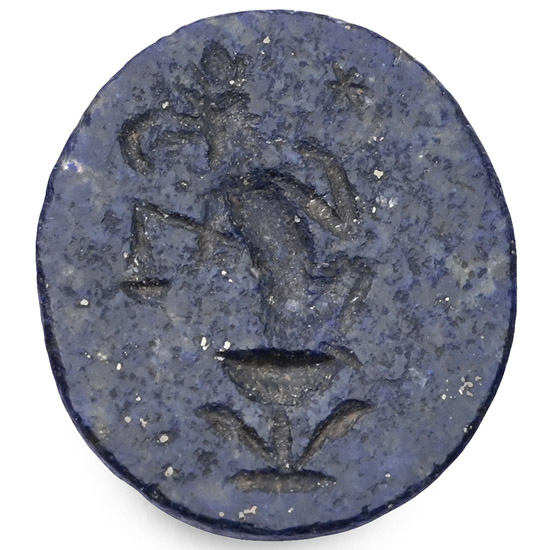
Roman Lapis Lazuli Gemstone with Putto
2nd-3rd century A.D.Sold for (Inc. bp): £52
With intaglio putto sitting on a chalice, objects in the field; supplied with a museum-quality impression. 1.07 grams. 14.07 mm
From the private collection of a European gentleman (1942-2024), formed since the 1970s. -
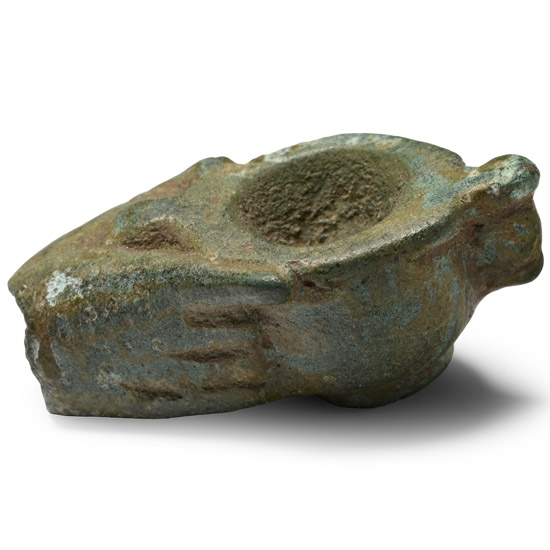
Roman Bronze Statuette Hand Holding Cup
1st-2nd century A.D.Sold for (Inc. bp): £26
Left hand holding one handle of a two-handled chalice. 18.71 grams, 31.16 mm
From the private collection of a European gentleman (1942-2024), formed since the 1970s. -
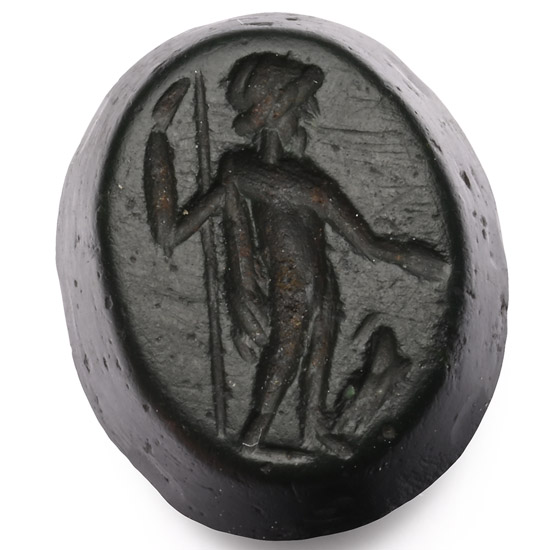
Roman Black Gemstone with Jupiter
2nd-3rd century A.D.Sold for (Inc. bp): £72
With intaglio Jupiter holding his sceptre, eagle by his feet; supplied with a museum-quality impression. 0.52 grams, 10.61 mm
From the private collection of a European gentleman (1942-2024), formed since the 1970s. -
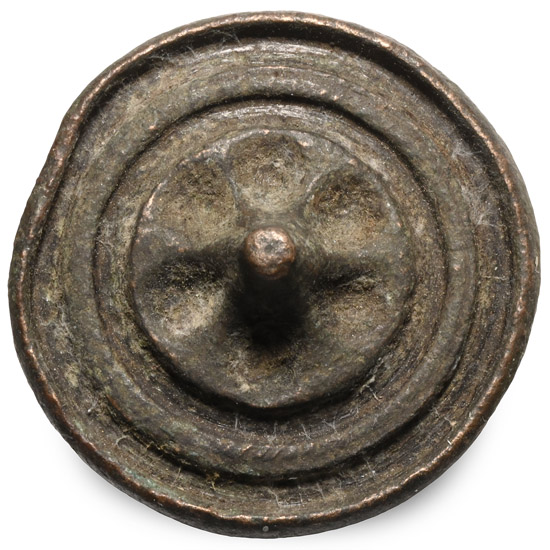
Roman Bronze Four-Way Bridle Strap Junction
3rd-4th century A.D.Sold for (Inc. bp): £65
Comprising a round disc with raised concentric circles and a central six-petalled flower motif with a pointed centre; underside with a four-way strap junction. 16.6 grams, 28.6 mm
From the private collection of a European gentleman (1942-2024), formed since the 1970s. -
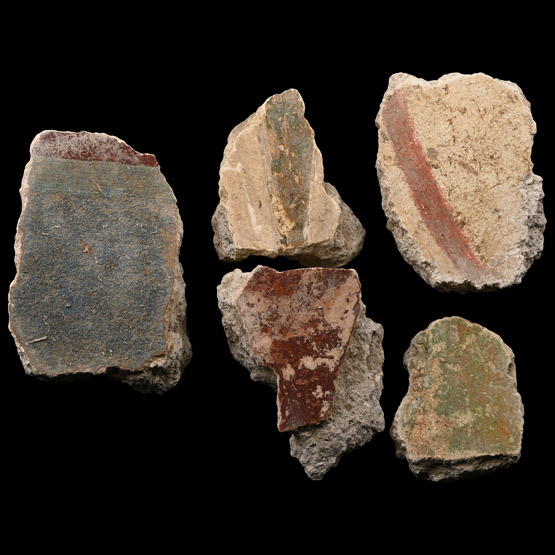
Roman Fresco Wall Plaster Collection
1st century A.D.Sold for (Inc. bp): £59
Fragments of wall plaster with rendered surface painted with mainly Pompeii red, pale blue and white detailing; some with impression of timber laths to the reverse. 713 grams total, 7-10 cm
Acquired in the 19th century. Ex Jeger collection, Switzerland. UK gallery, early 2000s.
These small fragments, for analogies with the fragments of Pompeii, seem to belong to the second style of Roman painting, red panels representing highlight and shadow, decorated with vegetal interlaces. Some panels were probably framed by a red grenade fillet. A fragment shows alternate blue and red colour over a cream background, maybe pertinent to a socle. -
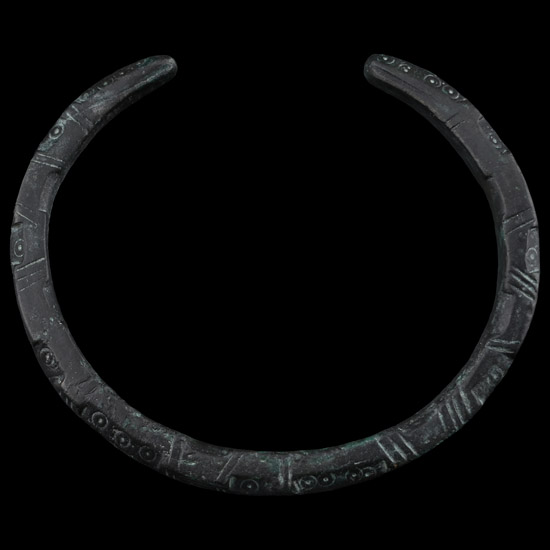
Roman Bronze Decorated Armilla Bracelet
1st-4th century A.D.Sold for (Inc. bp): £78
Penannular body divided into sections with linear and ring-and-dot decoration. 31.67 grams, 65 mm
Ex German art market, 2000s. Acquired from an EU collector living in London. From the collection of a Surrey, UK, gentleman. -
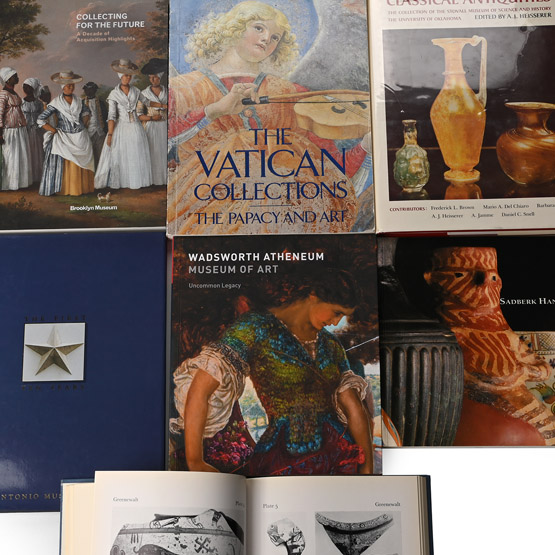
Books on Ancient and Classical Archaeology and Other Works of Art - 7 Titles
1970-2017 A.D.Sold for (Inc. bp): £20
California Studies in Classical Antiquity, Volume 3, 1970, hardcover, 227 pp, black and white images; Sadberk Hanim Museum, Istanbul, 1995, cardcovers, 162 pp, colour images; Wadsworth Atheneum, Museum of Art, Uncommon Legacy, 2017, cardcovers, 154 pp, colour images; The Vatican Collections, The Papacy and Art, 1982, cardcovers, 255 pp, black and white and colour images; A.J. Heisserer (ed.) - Classical Antiquities, the Collection of the Stovall Museum of Science and History, the University of Oklahoma, 1986, hardcover with dustjacket, 162 pp, black and white images; San Antonio Museum of Art, the First Ten Years, hardcover with dustjacket, 79 pp, colour images; Brooklyn Museum, Collecting for the Future, A Decade of Acquisition Highlights, 2012, cardcovers, 145 pp, colour images. 5.82 kg total, 26 x 18 - 28 x 22 cm
Property of a London, UK, gentleman. -
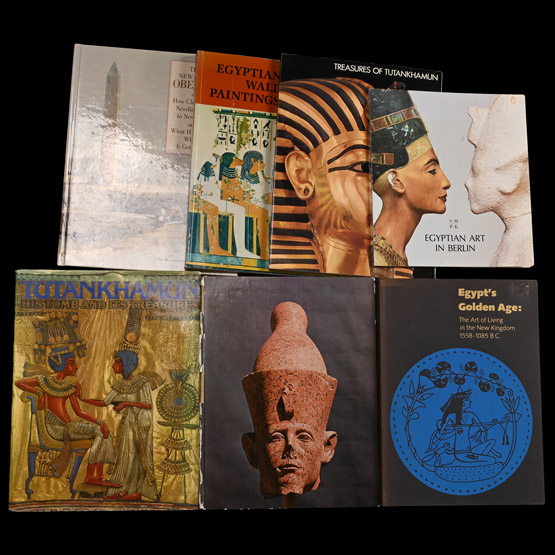
Books on Ancient Egypt, Egyptian Art and Egyptology - 7 Titles
1976-1993 A.D.Sold for (Inc. bp): £13
Luxor Museum of Ancient Egyptian Art - Catalogue - Cairo, 1979, hardback, 219 pp, monochrome; Museum of Fine Arts - Egypt's Golden Age: The Art of Living in the New Kingdom, 1558-1085 BC - Boston, 1982, card covers, 336 pp, monochrome; I.E.S. Edwards - Tutankhamum: His Tomb and its Treasures - New York, 1977, hardback with dustwrapper, 256 pp, colour and monochrome; M.d'Alton - The New York Obelisk - New York, 1993, hardback, 72 pp, monochrome; C.K. Wilkinson - Edyptian wall Paintings - New York, 1983, card covers, 163 pp, monochrome; Metropolitan Museum of Art - Treasues of Tutankhamun - New York, 1976, card covers, 174 pp, monochrome and colour; D. Wildung - Egyptian Art in Berlin - Berlin, 1994. card covers, 59 pp, colour. 5.94 kg total, 23 x 21 - 29 x 22.5 cm
Property of a London, UK, gentleman. -
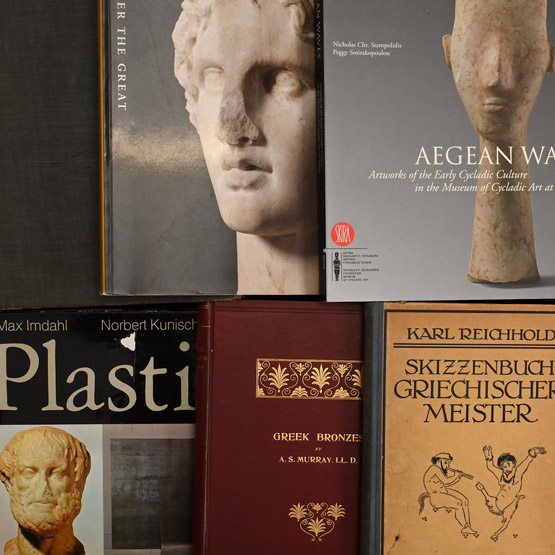
Books on Ancient Greek Antiquities, Ancient Art and Archaeology - 6 Titles
1898-2007 A.D.Sold for (Inc. bp): £52
Karl Reichhold - Skizzenbuch Griechischer Meister, 1919, in German, hardcover, 167 pp, black and white images; A.S. Murray, LL. D. - Greek Bronzes, London, 1898, hardcover, 104 pp, black and white images; Max Imdahl & Norbert Kunisch - Plastik, Antike und Moderne Kunst der Sammlung Dierichs in der Ruhr-Universität Bochum, 1979, hardcover with dustwrapper, 189 pp, colour and black and white images; Nicholas Chr. Stampolidis, Peggy Sotirakopoulou - Aegean Waves, Artworks of the Early Cycladic Culture in the Museum of Cycladic Arts at Athens, 2007, cardcovers, 213 pp, black and white and colour images; Dimitrios Pandermalis - Alexander the Great, Treasures from an epic Era of Hellenism, 2004, cardcovers, 151 pp, colour images; Margarete Bieber - The Sculpture of the Hellenistic Age, 1955, hardcover, 232 pp, 712 black and white figs. 6.9 kg total, 25.6 x 18.5 - 30.5 x 23.5 cm
Property of a London, UK, gentleman. -
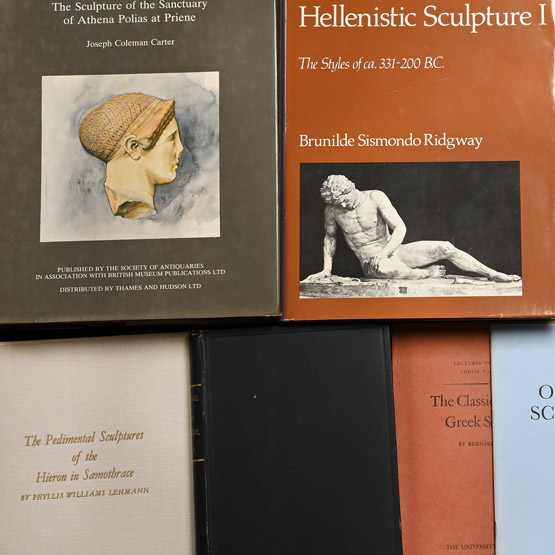
Books on Greek Sculpture, Ancient Art and Archaeology - 7 Titles
1900-1990 A.D.Sold for (Inc. bp): £52
Brunilde S. Ridgway- Hellenistic Sculpture I: The Styles of Ca. 331-200 B.C. - Madison, 1990 hardback with dustwrapper, 405 pp, 187 plates, monochrome; J.C. Carter - The Sculpture of the Sanctuary of Athena Polias at Priene - London, 1983, hardback with dustwrapper, 367 pp, 47 plates, monochrome; P.W. Lehamann - The Pedimental Sculptures of the Hieron in Samothrace - New York, n.d., hardback with cloth covers and library sleeve, 30 pp, 60 plates, momochrome; A.H. Smith - A Catalogue of the Sculpture in the Department of Greek and Roman Antiquities, British Museum Vol II - London, 1900, hardback with cloth covers, 264 pp, 27 plates, text figurres, monochrome; B. Asmole - The Classical Ideal in Greek Sculpture - Cincinnati, 1964, card covers, 47 pp, 69 monochrome illustrations; A. Stewart - Attika - London, 1979, card covers, 192 pp, monochrome; T. Burton-Brown - On early Sculpture - Wootton Woodstock, 1984, card covers, 42 pp. 5.35 kg total, 21 x 15 - 27.7 x 22.5 cm
Property of a London, UK, gentleman. -
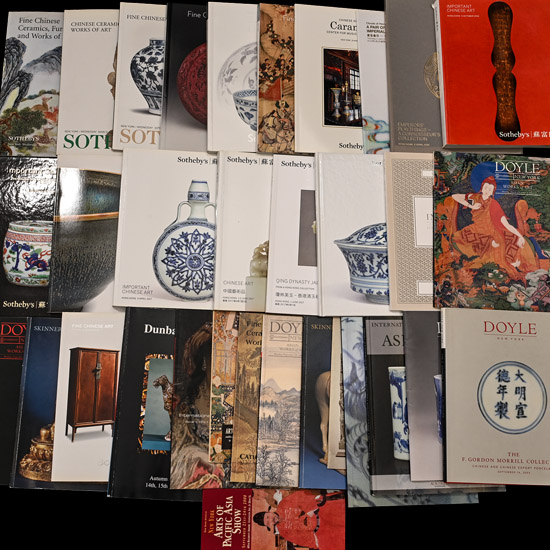
Sotheby's, Doyle and Other Chinese and Asian Art Auction Catalogue Group - 32 Titles
1972-2018 A.D.Sold for (Inc. bp): £195
SOTHEBY'S: Fine Chinese Works of Art, New York, 18 September 1996; Chinese Ceramics and Works of Art, New York, 22 March 2000; Fine Chinese Works of Art, New York, 20 September 2000; Fine Chinese Ceramics & Works of Art, New York, 15 September 2010; Informing the Eye of the Collector - Chinese Ceramics and Works of Art from J.T. Tai & Co., New York, 22 March 2011; Fine Chinese Ceramics & Works of Art, New York, 23 March 2011; Chinese Art from Caramoor, New York, 15 March 2016; Clouds of Heavenly Blessings: A Pair of Exceptionally Rare Imperial Doucai Waterpots, Hong Kong, 2 June 2016; Emperor's Playthings - A Connoisseur's Collection, Hong Kong, 6 April 2016; Important Chinese Art, Hong Kong, 5 October 2016; The Collection of a Parisian Connoisseur, Part III, Hong Kong, 5 October 2016; Important Chinese Art, London, 9 November 2016; Important Chinese Art, Hong Kong, 5 April 2017; Chinese Art, Hong Kong, 1-2 June 2017; Qing Dynasty Jades from a Hong Kong Collection, Hong Kong, 1 June 2017; The Edward T. Chow 'Bajixiang' Bowl, Hong Kong, 3 October 2017; Inspired: Chinese Art the Collection of Gerson and Judith Leiber, New York, 20 March 2018; DOYLE: Asian Works of Art, New York, 22 March 1999; Asian Works of Art, New York, 13 September 1999; Asian Works of Art, New York, 18 September 2000; The F. Gordon Morrill Collection, New York, 16 September 2003; Asian Works of Art, New York, 4 April 2006; UPPSALA AUKTIONSKAMMARE: Internationell Kvalitetsauktion, 3 December 2013; SPINK: Korean Ceramics of the Yi Dynasty, Masterpieces of the Choson Age, 6-17 December 1993; ETUDE Couturière NICOLAY: Arts d'Extrême-Orient, Art Africain et Précolombien, 2-3 June 1983; SKINNER: Asian Works of Art, 31 October 1998; Asian Works of Art, 5 June 1999; BONHAMS: Fine Chinese Art, 9 November 2017; Dunbar Sloane, Autumn Antique Auction, 14-16 June 2000; I.M. Chait, International Fine Arts, 19 October 2003; Arts de L'Islam, Collection d'un Amateur, 28 April 1972; Cathay's, Fine Chinese Paintings, Ceramics and Works of Art, Boston, 29 March 1997. 20 kg total, 23.6 x 18 - 29.3 x 23 cm
Property of a London, UK, gentleman.

